A bad idea. Why? Because if they wanted to make bus service better they should have just done it. There was an article in the Berkeley Daily Planet discussing why it's a bad idea. I've condensed the points below:
1. The EIR even says there will be a low change from automobile drivers to transit riders
2. It provides no energy consumption reduction
3. Will poach riders from BART
4. It keeps advertising BRT as "rail like" even though its not.
5. The EIR doesn't address the impact of 51 buses vs light rail on greenhouse gases
I don't agree with him that parking is such a big deal. It's not free folks. I also think that taking a lane for transit is good. Finally cars will play second best to transit.
This is enough to just be ridiculous. I don't know why folks like the Sierra Club or TALC are supporting this. There is no good reason to other than to give up on your environmental principles for transit mode that is hemorrhaging riders in the third world. Are we serious in this country about carbon? Are we serious about global warming? This is a huge waste of money. This is a reason why the East Bay will always be second rate. They will always play second fiddle to San Francisco. The poor shouldn't be relegated to second rate transit.
If they were smart about it they could do a rapid streetcar with passing lanes at stations that allow 1o minute headways. The streetcars would have their own lanes and attract way more riders and developement. The travel times would be better as well attracting even more riders on a smooth ride.
Friday, June 8, 2007

Transit Networks & Highwaymen
It seems these days that the folks from the Road cult are squealing pretty loud. I think they are afraid that they will be swept away by the transit space race. While that more than likely will never happen in my lifetime, one has to wonder what they are so worried about. They have after all most of the money for transportation going to roads. It seems to me like a little kid who just can't share his cookies. It's funny too when they cite choices, you can choose a car, or a car. It's your choice. Right?
Wrong.
The fundamental problem with this is that it's exactly what has caused congestion in the first place, letting everyone believe that they are free to have a piece of road at any time without any congestion. In fact some wish that it was in the constitution. Well where is the logic in that? If we look at nature and floods we see what happens when too much water wants to be all in one place. And so it should come as no surprise if everyone took geology or physical geography some time in high school that this would happen. Yet we keep building one mode of transportation. It's kind of like putting concrete at the bottom of a river to channel it. None of it seeps in to the ground just like cars magically get through traffic. And it seems to me that building all of these transitways for buses just encourages more cars. They might have 2 more people in the but its still a car. It's still VMT and pollution and sprawl.
But if you give people a choice they will take it. But it can't be a half cocked choice. Buses in freeway medians in Houston have shown that they only attract so many riders. I have a theory that it's because they travel in the middle of a freeway. Transit is a pedestrian oriented mode. Freeways are not pedestrian oriented. This is another reason why Houston's 5 transit ways garner about 43,000 riders a day while Portland's Max and Streetcar with 5 lines is over 100,000. Per day. It's why the San Diego Trolley is over 100,000 per day. Network and pedestrian orientation are what drives transit, and more freeways amplifies the inhumanities of single occupancy vehicles. 100,000 people in cars is no small amount of extra concrete for roads and parking spaces.
No one was meant to be that selfish every day of their lives. Yes you can be selfish sometimes. I know I am. I drive to my Gramma's house. She lives in the suburbs where the bus stops running at 3:30pm. It's 3 miles from the BART station and while sometimes I walk, some days i just don't have the extra 2 hours to spare (BART is lame in that they won't let bikes on rush hour trains). But everywhere else I walk or take transit whether it's a bus or a train. Tonight I went to concert by taking the J Church to the 45 Union Bus. Powered by alternative energy from Hydro, $1.50, no parking, no hassle. It's the power of networks and human scale quality transit which it seems some of the highway and HOV people miss.
I saw someone somewhere say that the Blue Line in Chicago which has 12 trains per hour could be replaced with an hov lane and 100 buses per hour and this would be revolutionary. I'm not sure what that person was smoking, but it must be bad stuff.
Wrong.
The fundamental problem with this is that it's exactly what has caused congestion in the first place, letting everyone believe that they are free to have a piece of road at any time without any congestion. In fact some wish that it was in the constitution. Well where is the logic in that? If we look at nature and floods we see what happens when too much water wants to be all in one place. And so it should come as no surprise if everyone took geology or physical geography some time in high school that this would happen. Yet we keep building one mode of transportation. It's kind of like putting concrete at the bottom of a river to channel it. None of it seeps in to the ground just like cars magically get through traffic. And it seems to me that building all of these transitways for buses just encourages more cars. They might have 2 more people in the but its still a car. It's still VMT and pollution and sprawl.
But if you give people a choice they will take it. But it can't be a half cocked choice. Buses in freeway medians in Houston have shown that they only attract so many riders. I have a theory that it's because they travel in the middle of a freeway. Transit is a pedestrian oriented mode. Freeways are not pedestrian oriented. This is another reason why Houston's 5 transit ways garner about 43,000 riders a day while Portland's Max and Streetcar with 5 lines is over 100,000. Per day. It's why the San Diego Trolley is over 100,000 per day. Network and pedestrian orientation are what drives transit, and more freeways amplifies the inhumanities of single occupancy vehicles. 100,000 people in cars is no small amount of extra concrete for roads and parking spaces.
No one was meant to be that selfish every day of their lives. Yes you can be selfish sometimes. I know I am. I drive to my Gramma's house. She lives in the suburbs where the bus stops running at 3:30pm. It's 3 miles from the BART station and while sometimes I walk, some days i just don't have the extra 2 hours to spare (BART is lame in that they won't let bikes on rush hour trains). But everywhere else I walk or take transit whether it's a bus or a train. Tonight I went to concert by taking the J Church to the 45 Union Bus. Powered by alternative energy from Hydro, $1.50, no parking, no hassle. It's the power of networks and human scale quality transit which it seems some of the highway and HOV people miss.
I saw someone somewhere say that the Blue Line in Chicago which has 12 trains per hour could be replaced with an hov lane and 100 buses per hour and this would be revolutionary. I'm not sure what that person was smoking, but it must be bad stuff.
Wednesday, June 6, 2007
Design, Shelters, & Riders
A recent competition was raised in San Francisco to design transit shelters. Apparently the idea is something that architects can get into, and by some of the shelters looks, can overdo. But its an interesting exercise in design. My questions would be, can good design keep away the vandals? Will the shelter actually keep the wind out? Will it put maps on many sides so you don't have to ask someone to leave their seat to look at them? Will the advertising be a tasteful size in order to not feel overwhelmed by a product at a bus stop? Those are a few of the questions I would have about these stops. Yes it's nice to worry about aesthetics, but hopefully they are heavy on function.
I would like to make a request to Muni as well. Please put a shelter at my stop on 24th and Church. And a map would be nice. You would think that a handicapped accessible stop on a Muni Metro line would at least have a map and perhaps nextbus. Now that would be great!
I would like to make a request to Muni as well. Please put a shelter at my stop on 24th and Church. And a map would be nice. You would think that a handicapped accessible stop on a Muni Metro line would at least have a map and perhaps nextbus. Now that would be great!
Tuesday, June 5, 2007
Hurricanes, Oil Spikes, and Transit
We might be headed for a major disruption in the coming days. The Oil Drum notes that it's a big deal in that a Hurricane has never entered the gulf. And the BBC notes that it's been about 60 years since this big of a storm event hit the region. From the Oil Drum...
This is an unprecedented event. NO CYCLONE has ever entered the Gulf of Oman. And there are no custom 'storm surge' models available for that area. This forecast is based on my experience and subjective analysis of the seabed slope and storm surge interaction with the sea floor. Considering the region has never experienced a hurricane, let alone a strong one it is highly unlikely the loading facilities or platforms were constructed to withstand the forces - both wave action and wind force - that they will experience. Significant, damage will occur. How much long term damage, and the volumes associated with it - can not be determined at this time.So what does this mean for Transit? Another good question is what does this mean for Dubai and the reclaimed urban projects like the palm islands. Given that we don't know what this will do to gas prices, it might be really bad or mild. If its really bad we'll see a spike in gas prices and transit ridership. If its mild there will most likely be a bullet dodged.
The Myth of Houston's No Zoning Part 1
There is a pervasive myth in the world of anti-planning and anti-transit fanatics that should be debunked. Specifically Randall O'Toole believes that Houston is the bastion of the free market. That would be nice and rosy if it were true, but it of course is not.
Parking Requirements
What is a good libertarian argument without a discussion about their preferred mode of transportation. If there was no such thing as zoning in Houston, then there would also not be any requirements on property. But instead we find that a one bedroom apartment has a 1.33 space parking requirement which of course lead to larger parking lots or garages costing developers lots of money. If it were a true free market issue, parking space construction would be left up to the market, yet its not. A report done by the EPA found that parking requirements were a big reason why TOD in Midtown has failed to take off. Another reason seems to stem from the fact that land owners think their land is worth much more than it really is and have been unwilling to part with it feeling like a high rise is their eventual destiny.
Parking Requirements
What is a good libertarian argument without a discussion about their preferred mode of transportation. If there was no such thing as zoning in Houston, then there would also not be any requirements on property. But instead we find that a one bedroom apartment has a 1.33 space parking requirement which of course lead to larger parking lots or garages costing developers lots of money. If it were a true free market issue, parking space construction would be left up to the market, yet its not. A report done by the EPA found that parking requirements were a big reason why TOD in Midtown has failed to take off. Another reason seems to stem from the fact that land owners think their land is worth much more than it really is and have been unwilling to part with it feeling like a high rise is their eventual destiny.
Monday, June 4, 2007
The Transit Space Race Explained
A Letter to the Herald in Seattle on the Space Race...
Let us consider the space race instead. Our best and brightest put men in space and on the moon using pencils, paper and slide rules. This was and continues to be a great engineering feat by our aerospace industry. We do not need commercial flights out of our little airport, we need a rail system to our big airport. A statewide rail system, a national system of bullet trains and light rail - let's get the big three automakers, aerospace, everyone involved. And like the trans-continental railroad, in some aspects, our government should pay for it and not expect to make a profit and not give it away to big business.
This may upset the oil magnates and the innovation of hydro-electric power will come off the back burner. Put Americans to work, put veterans to work, put documented immigrants to work. I want to ride the train to work, to play, to school, and to the airport.
Sunday, June 3, 2007
National Transit Planning
Seems like Canadian Mayors are taking matters into their own hands. If only Transit Agencies and Mayors in the United States were so proactive, maybe we would have a national plan by now.
Friday, June 1, 2007
The Truth About Roads
While folks like the Reason Foundation will ask for more roads, it seems to me that they are much more expensive than the transit solutions we are proposing and get to a worse end. Well here is the answer straight from the road kings at the Texas DOT...
Thanks to Andrew for the link.
Did you read that like I read that? $2.22 per gallon of subsidization for the road. And this isn't from some liberal think tank or a transit fanatic saying it, it's the organization that builds and collects taxes for them. And this is just the subsidy for the road, not the oil itself! So when simplistic folks from the Reason foundation propose building roads to relieve all congestion, you ask them who is going to be paying for that, or you shut them down with some good research on how much it will really cost versus your transit alternative. It seems to me that even more so now, rail looks even better than ever when it comes to cost effectiveness.
The decision to build a road is a permanent commitment to the traveling public. Not only will a road be built, but it must also be routinely maintained and reconstructed when necessary, meaning no road is ever truly “paid for.” Until recently, when TxDOT built or expanded a road, no methodology existed to determine the extent to which this work would be paid off through revenues.
The Asset Value Index, was developed to compare the full 40-year life-cycle costs to the revenues attributable to a given road corridor or section. The shorthand version calculates how much gasoline is consumed on a roadway and how much gas tax revenue that generates.
The Asset Value Index is the ratio of the total expected revenues divided by the total expected costs. If the ratio is 0.60, the road will produce revenues to meet 60 percent of its costs; it would be “paid for” only if the ratio were 1.00, when the revenues met 100 percent of costs. Another way of describing this is to do a “tax gap” analysis, which shows how much the state fuel tax would have to be on that given corridor for the ratio for revenues to match costs.
Applying this methodology, revealed that no road pays for itself in gas taxes and fees. For example, in Houston, the 15 miles of SH 99 from I-10 to US 290 will cost $1 billion to build and maintain over its lifetime, while only generating $162 million in gas taxes. That gives a tax gap ratio of .16, which means that the real gas tax rate people would need to pay on this segment of road to completely pay for it would be $2.22 per gallon.
Thanks to Andrew for the link.
Thursday, May 31, 2007
The Future E-Line to Fort Mason
I went on a little jaunt this afternoon along the future E-Line to see what i could see. What I found was most interesting. As I got on the streetcar, as usual it was a crush load at the Embarcadero station so I hopped in the back door and paid when I got to the Wharf.
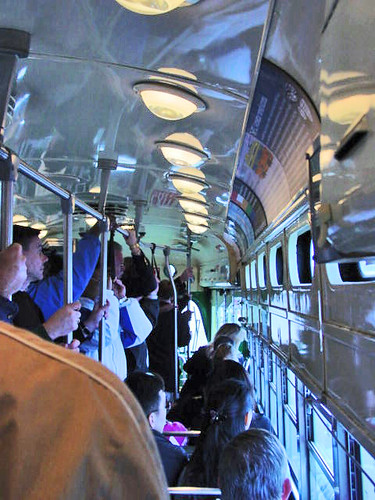
Several guys from New York City came on as well. They were to get off at Pier 39 so they gave me a fiver to pay with because they couldn't get to the front. I think they trusted me after I showed them that I had a pin on my bag that had the same MSR logo that was all over the inside of the car. After paying the five and my $1.50 the driver asked me where he could get the pin as I told him the story about the New Yorkers.
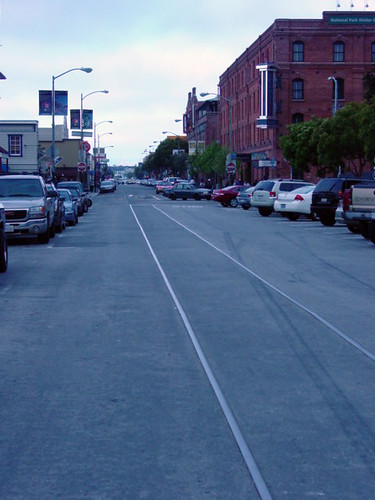
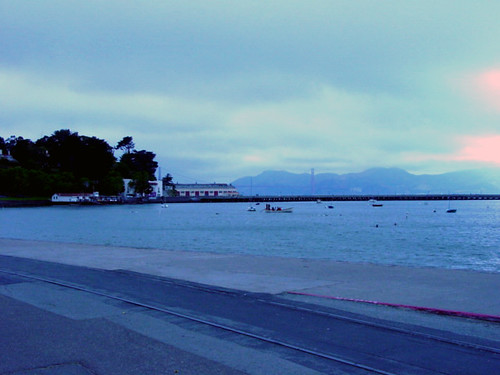
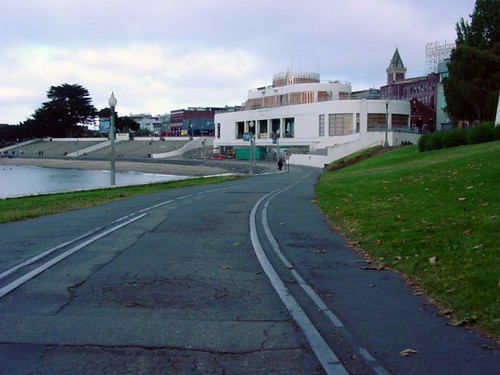
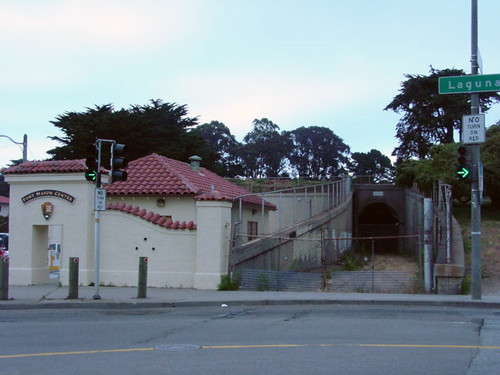
So I got off and walked down to where the new line would be extended to Fort Mason. I saw the tracks in the ground left from a bygone era and was wondering how slow the streetcar would have to go or how they would allow pedestrians and streetcars along the waterfront.
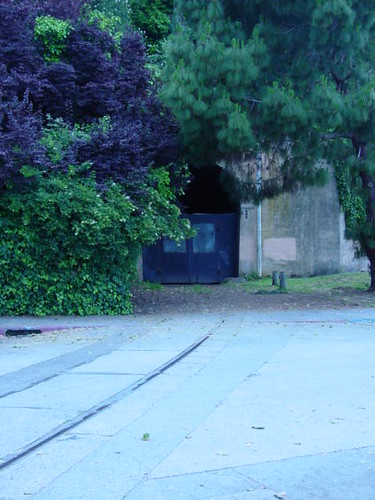
From the picture above, if you turn around and walk towards Fort Mason you can see the single track tunnel that was carved out for freight to the piers during the early years. Streetcar routes with tunnels or private ROW still operate, however this one was abandoned and never put into streetcar service.
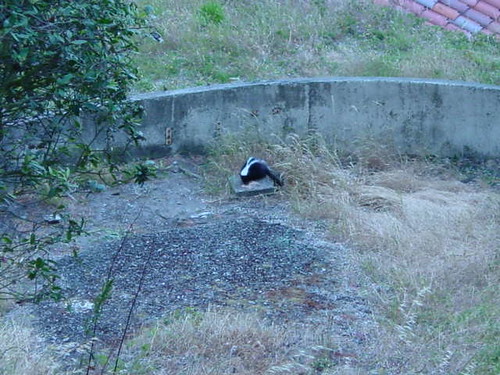
As I was walking around to the other side of the tunnel I also saw a skunk on the hill above the Fort Mason docks. It was pretty brave of this fellow to be out in broad daylight (or dark foggy evening) but nevertheless there he was. I wasn't going to mess with him but he was at a pretty good distance.
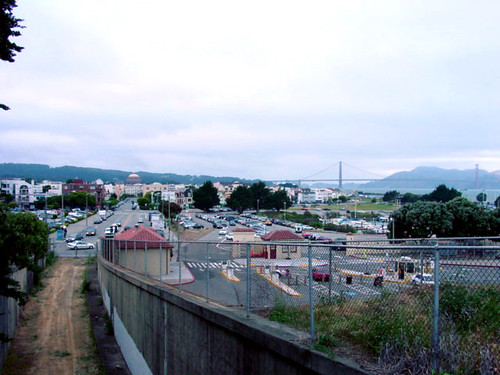
Finally as I got to the other side I could get a clear view of the Golden Gate Bridge behind the West Portal of the streetcar tunnel. This is where the streetcar will move out to the Marina giving its residents their first rail link in over 50 years. How exciting!
Several guys from New York City came on as well. They were to get off at Pier 39 so they gave me a fiver to pay with because they couldn't get to the front. I think they trusted me after I showed them that I had a pin on my bag that had the same MSR logo that was all over the inside of the car. After paying the five and my $1.50 the driver asked me where he could get the pin as I told him the story about the New Yorkers.
So I got off and walked down to where the new line would be extended to Fort Mason. I saw the tracks in the ground left from a bygone era and was wondering how slow the streetcar would have to go or how they would allow pedestrians and streetcars along the waterfront.
From the picture above, if you turn around and walk towards Fort Mason you can see the single track tunnel that was carved out for freight to the piers
As I was walking around to the other side of the tunnel I also saw a skunk on the hill above the Fort Mason docks. It was pretty brave of this fellow to be out in broad daylight (or dark foggy evening) but nevertheless there he was. I wasn't going to mess with him but he was at a pretty good distance.
Finally as I got to the other side I could get a clear view of the Golden Gate Bridge behind the West Portal of the streetcar tunnel. This is where the streetcar will move out to the Marina giving its residents their first rail link in over 50 years. How exciting!
Wednesday, May 30, 2007
Misleading Statistics & BRT Promotion
I went to a discussion today about BRT at Oakland City Hall where the former Mayor of Bogota Columbia spoke about his city and what they have done to promote living. He was a wonderful speaker and made a lot of great points about how a street should be safe for children and also how bike lanes should be a place where 8 year olds can ride and not have fears of getting hit by a car. I tend to agree that a white stripe in a road does not denote a bike lane. He didn't talk much about Bogota's famed Transmilenio BRT system and really I'm glad he didn't. BRT is still a bus and Columbia is a completely different country than the United States. I don't think we should be wasting money on a system where we underestimate the costs (replacing buses and pavement more often than projected etc) versus a tried and true system of getting people out of their cars with rail. In an earlier post i noted that the
However I was shocked by the blatant misrepresentations by AC Transit. In a slide show before the event they showed technology costs for Subways, Light Rail and BRT. Not surprisingly LRT was overestimated by a factor of two while BRT was underestimated by a factor of 3. I personally have never heard of a surface LRT system anywhere near the claimed $100 million. In fact, the most recent systems in Minneapolis and Los Angeles were around $60 million but only because of tunneling and viaduct construction. The most recently completed line, Denver's T-Rex was only $37 million a mile. As for BRT, it is completely underestimated. $10 million per mile is what they said but in Los Angeles it was completed for $22 million before extensive repaving because of damage from the buses and I'm not even sure if the right of way acquisition for the line was added into the costs since it was done with the pretense of light rail service eventually. Hartford's busway project is projected to cost $45 million per mile.
So I thought I might make a list of the things that BRT proponents don't tell you about that became apparent when listening to them speak:
1. They claim that its as good as a train but this is only if you add on all of the elements that come with light rail including level boarding, nextbus technology, their own right of ways, external fare recovery systems and signal pre-emption, you might as well build the system everyone wants anyway, not the one they are compromising on because such and such transit agency can't figure out how to make money off of capital investments. I feel no sorrow for agencies that don't get value capture.
2. With light rail projects, the whole street is generally reconstructed making pedestrian space more valuable with new sidewalks and amenities. BRT doesn't do this. In the renderings shown they do but when the project is completed do they do as promised. No. For example on San Pablo it's the same old bus with a red stripe on it. They did nothing to the ped space, didn't mess with the street and yet they still call it Rapid Bus. Clever marketing is bus repackaged transit.
3. They don't tell you that rail infrastructure lasts for over 50 years, perhaps more. Buses last 12 years if that but they don't add in the costs of buying new ones over and over while rail cars are used continuously. They don't tell you that buses are heavier than big rigs sometimes and crush the pavement even worse yet don't include that in costs. Taxpayers have to pay for that but it's a hidden tax that doesn't get reported.
4. They don't tell you that the bus ride is going to be the same jolting start stop bouncing even on the smoothest of roads. The guy reading the paper on the bus won't be able to because of the motion sickness. Anyone who's been on a bus, especially AC Transit 51, knows that you can't keep standing even if you're able bodied. It takes a two hand grip to stay vertical.
5. They also don't tell you that they expect gas prices to remain the same or come up with some whiz bang technology that is going to magically lower gas and diesel prices. I don't care how magically low the sulfer particulate escapage is on the bus, it's still emitting on the street where people are walking, and the internal combustion engine is still slower and less effective than an electric motor. This talk of hybrid's and fuel cells is a joke. Hydrogen of course is only as clean as the energy that is used to create the Hydrogen because it doesn't just grow on trees. Hybrid's are just fuel generators that feel electric engines. However electric overhead wires can be fueled by any number of alternative energy sources. Muni gets 30% of its power from alternative energy making it cleaner than most. Calgary uses 100% wind energy to fuel their light rail. I would be remiss to mention that most LRT lines are fueled by coal power plants but that fact that they can be converted in short order and don't give off local particulates which studies along freeways have shown affect kids the most is most appealing compared to a bus.
6. The people who advocate for BRT are people that generally don't ride the bus. In fact if you ask anyone whether they want to ride a bus or a train guess what the answer would be. Never mind that full BRT costs the same as LRT done right but at times when its more expensive people have been choosing Light Rail. More often than not they are anti transit like RandalL O'Toole or Wendell Cox. Government in bathtub drowning is their goal. But they like rules and regs that benefit them, just not you. The auto lobby in DC loves BRT, they can probably see it as another 20 years of profits and sprawl until people wake up. I get why the Mayor's of Bogota and Curitiba did it and I applaud them because they changed their cities in amazing ways. But why is it that the only thing we learn from them is about a cheap bus?
7. Light Rail operating costs per passenger mile are much less on light rail than on bus. Explained here, enough said.
8. BRT on freeways is just going to allow the cars in at some point. Creating a rail network says no cars ever in this space. In fact, the Harbor Freeway busway was supposed to be bus only, guess what? Now it's an HOV lane.
9. BRT advocates would have you think that low floor = accessible. On the contrary, buses do not pull up flush to the platform like rail does. Try as they might, it doesn't work out they way they promise and it wreaks havoc on accessibility.
10. I will continue this list at some point because i haven't really made half the points i'd like to but the bottom line is this. BRT is just bus repackaged transit pushed by folks that don't really like transit to begin with. They want it to stay for the poor so why not give the poor a third world system. Well we need to step up and invest like China, Japan, and Europe.
However I was shocked by the blatant misrepresentations by AC Transit. In a slide show before the event they showed technology costs for Subways, Light Rail and BRT. Not surprisingly LRT was overestimated by a factor of two while BRT was underestimated by a factor of 3. I personally have never heard of a surface LRT system anywhere near the claimed $100 million. In fact, the most recent systems in Minneapolis and Los Angeles were around $60 million but only because of tunneling and viaduct construction. The most recently completed line, Denver's T-Rex was only $37 million a mile. As for BRT, it is completely underestimated. $10 million per mile is what they said but in Los Angeles it was completed for $22 million before extensive repaving because of damage from the buses and I'm not even sure if the right of way acquisition for the line was added into the costs since it was done with the pretense of light rail service eventually. Hartford's busway project is projected to cost $45 million per mile.
So I thought I might make a list of the things that BRT proponents don't tell you about that became apparent when listening to them speak:
1. They claim that its as good as a train but this is only if you add on all of the elements that come with light rail including level boarding, nextbus technology, their own right of ways, external fare recovery systems and signal pre-emption, you might as well build the system everyone wants anyway, not the one they are compromising on because such and such transit agency can't figure out how to make money off of capital investments. I feel no sorrow for agencies that don't get value capture.
2. With light rail projects, the whole street is generally reconstructed making pedestrian space more valuable with new sidewalks and amenities. BRT doesn't do this. In the renderings shown they do but when the project is completed do they do as promised. No. For example on San Pablo it's the same old bus with a red stripe on it. They did nothing to the ped space, didn't mess with the street and yet they still call it Rapid Bus. Clever marketing is bus repackaged transit.
3. They don't tell you that rail infrastructure lasts for over 50 years, perhaps more. Buses last 12 years if that but they don't add in the costs of buying new ones over and over while rail cars are used continuously. They don't tell you that buses are heavier than big rigs sometimes and crush the pavement even worse yet don't include that in costs. Taxpayers have to pay for that but it's a hidden tax that doesn't get reported.
4. They don't tell you that the bus ride is going to be the same jolting start stop bouncing even on the smoothest of roads. The guy reading the paper on the bus won't be able to because of the motion sickness. Anyone who's been on a bus, especially AC Transit 51, knows that you can't keep standing even if you're able bodied. It takes a two hand grip to stay vertical.
5. They also don't tell you that they expect gas prices to remain the same or come up with some whiz bang technology that is going to magically lower gas and diesel prices. I don't care how magically low the sulfer particulate escapage is on the bus, it's still emitting on the street where people are walking, and the internal combustion engine is still slower and less effective than an electric motor. This talk of hybrid's and fuel cells is a joke. Hydrogen of course is only as clean as the energy that is used to create the Hydrogen because it doesn't just grow on trees. Hybrid's are just fuel generators that feel electric engines. However electric overhead wires can be fueled by any number of alternative energy sources. Muni gets 30% of its power from alternative energy making it cleaner than most. Calgary uses 100% wind energy to fuel their light rail. I would be remiss to mention that most LRT lines are fueled by coal power plants but that fact that they can be converted in short order and don't give off local particulates which studies along freeways have shown affect kids the most is most appealing compared to a bus.
6. The people who advocate for BRT are people that generally don't ride the bus. In fact if you ask anyone whether they want to ride a bus or a train guess what the answer would be. Never mind that full BRT costs the same as LRT done right but at times when its more expensive people have been choosing Light Rail. More often than not they are anti transit like RandalL O'Toole or Wendell Cox. Government in bathtub drowning is their goal. But they like rules and regs that benefit them, just not you. The auto lobby in DC loves BRT, they can probably see it as another 20 years of profits and sprawl until people wake up. I get why the Mayor's of Bogota and Curitiba did it and I applaud them because they changed their cities in amazing ways. But why is it that the only thing we learn from them is about a cheap bus?
7. Light Rail operating costs per passenger mile are much less on light rail than on bus. Explained here, enough said.
8. BRT on freeways is just going to allow the cars in at some point. Creating a rail network says no cars ever in this space. In fact, the Harbor Freeway busway was supposed to be bus only, guess what? Now it's an HOV lane.
9. BRT advocates would have you think that low floor = accessible. On the contrary, buses do not pull up flush to the platform like rail does. Try as they might, it doesn't work out they way they promise and it wreaks havoc on accessibility.
10. I will continue this list at some point because i haven't really made half the points i'd like to but the bottom line is this. BRT is just bus repackaged transit pushed by folks that don't really like transit to begin with. They want it to stay for the poor so why not give the poor a third world system. Well we need to step up and invest like China, Japan, and Europe.
Subscribe to:
Posts (Atom)