
Friday, June 22, 2007
Making the Case for Rail Transit
Over at Seattle Transit there is a post about a misinformed blog over at Crosscut. The part of the argument that rubbed me the wrong way and Diamajin gets right was that no one gets that you build transit then the densities will follow. We learn this the most from the Arlington Rosslyn-Ballston Corridor in DC. They put the subway in and limited the growth to the corridor to protect the surrounding neighborhoods. Now they get 32% of the county tax revenue from 7% of the land because of the transit and land use combination. This area densified (to 7,700 people per square mile) and would not have look anything like the famous picture below if it wasn't for the subway. The most interesting statistic is that 73% of riders walk to the station. I wish people would get real and understand that you don't need to already be like New York and Chicago, but you can grow corridors that have densities to support urbanism.

Thursday, June 21, 2007
Sprawlista Argues for...Well...Sprawl
The LATimes has had a dust up session much like one they held a few months ago over transit and smart growth. Basically they pit sprawl loving auto junkies versus transit or growth experts. It's a good read with lots of interesting points. I think the best part about it is that it allows us to hone our arguments against the knuckle draggers out there who just don't get it. I'm not a fan of Robert Bruegman, mostly because he distorts facts to get the desired outcome, but more so because his arguments sound like they are coming from a 1950's highway engineer who doesn't have to worry about VMT, Energy issues, or quality of life. I mean basically he's throwing all of today's issues. When you read these, keep in mind that he doesn't address any serious issues of the day. He skirts them.
Day 1. Density is LA's Undoing... Seriously...thats what Rob says. In fact he even makes the old basketball trash talk, you can't stop me, you can only hope to contain me.
Day 2. A Greener American Dream... let us hope this is what happens. Although Rob B. Makes a fool of himself when he argues that basically we should just let inertia take us where it will.
Day 3. Mass Transit... Rob argues for PRT while Gloria Ohland argues for housing choices. I'm glad she reframed the issue on him. The transit doesn't work because it doesn't address sprawl attitude is getting tired. If there were better, cheaper technologies out there, then wouldn't we be using them now? I mean just today we pushed the gas standards up to 35 mpg by 2020. While incredibly weak, we're been letting the auto industry get away with murder by babying them. Toyota isn't going under. I want moving sidewalks and those speed tubes from Futurama, but they aren't coming as long as the auto and concrete lobbies are in Washington. And right now the most efficient way to move people on a per passenger mile basis, and most fuel efficient is rail.
Day 4. It's Coming Soon...
I would do more commentary but really i'm just annoyed that people think like this. And really, if you don't know that sprawl is bad by now, then you might never get it. Is anyone else tired of the inertia and the same old arguments about the free market. Well if the free market worked the way the libertarians wanted it to, we would have transit and we wouldn't have ridiculous sprawling suburbs. If anyone gets a chance, they should check out Jonathan Levine's book, Zoned Out. It puts all that junk to rest, at least in my mind.
Day 1. Density is LA's Undoing... Seriously...thats what Rob says. In fact he even makes the old basketball trash talk, you can't stop me, you can only hope to contain me.
Day 2. A Greener American Dream... let us hope this is what happens. Although Rob B. Makes a fool of himself when he argues that basically we should just let inertia take us where it will.
Day 3. Mass Transit... Rob argues for PRT while Gloria Ohland argues for housing choices. I'm glad she reframed the issue on him. The transit doesn't work because it doesn't address sprawl attitude is getting tired. If there were better, cheaper technologies out there, then wouldn't we be using them now? I mean just today we pushed the gas standards up to 35 mpg by 2020. While incredibly weak, we're been letting the auto industry get away with murder by babying them. Toyota isn't going under. I want moving sidewalks and those speed tubes from Futurama, but they aren't coming as long as the auto and concrete lobbies are in Washington. And right now the most efficient way to move people on a per passenger mile basis, and most fuel efficient is rail.
Day 4. It's Coming Soon...
I would do more commentary but really i'm just annoyed that people think like this. And really, if you don't know that sprawl is bad by now, then you might never get it. Is anyone else tired of the inertia and the same old arguments about the free market. Well if the free market worked the way the libertarians wanted it to, we would have transit and we wouldn't have ridiculous sprawling suburbs. If anyone gets a chance, they should check out Jonathan Levine's book, Zoned Out. It puts all that junk to rest, at least in my mind.
Tuesday, June 19, 2007
Rail Ready BRT
Last week I had someone comment that I had not done my homework in respects to calling Oakland out for it's weak BRT program. And I should clarify that it isn't really Oakland rather AC Transit that is being weak. I'll give them some props for taking lanes away from auto traffic but at the same time I have to be skeptical of their claims that BRT will be a placeholder for LRT. Just because you build BRT doesn't mean its automatically a placeholder.
So when I got a comment about not doing my homework on San Francisco I was a bit incensed, especially because it was an anonymous troll and I feel like I pay pretty close attention to what is going on around the country. They were bound to get to my little corner of the blogosphere at some point but lets cut to the chase. Oakland will always think of itself as less than San Francisco, and this BRT plan shows it. The fact of the matter is that even though San Francisco is planning BRT too, that doesn't make Oakland or AC Transit cooler. In fact it makes AC Transit look even worse because San Francisco's BRT line on Geary is going to be rail ready. What do I mean when I say that? Well according to the SFMTA site, rail ready means the following...
On the other side of the bay, the local advocates at Rescue Muni are pushing for a rather speedy timeline for transformation including putting the rails in immediately.
So when I got a comment about not doing my homework on San Francisco I was a bit incensed, especially because it was an anonymous troll and I feel like I pay pretty close attention to what is going on around the country. They were bound to get to my little corner of the blogosphere at some point but lets cut to the chase. Oakland will always think of itself as less than San Francisco, and this BRT plan shows it. The fact of the matter is that even though San Francisco is planning BRT too, that doesn't make Oakland or AC Transit cooler. In fact it makes AC Transit look even worse because San Francisco's BRT line on Geary is going to be rail ready. What do I mean when I say that? Well according to the SFMTA site, rail ready means the following...
In the AC Transit EIS, it states that Light Rail is a long term goal in the corridor. Long term probably means next century.
The center-running bus rapid transit alternative will be designed to the physical dimensions required to accommodate a light rail vehicle. The Geary BRT Study will also determine the costs and feasibility of implementing a more extensive definition of rail-ready, which aims to minimize future construction impacts if resources become available to convert the bus rapid transit project to light rail. This definition would potentially include installing the rails and sub-surface electrical work, relocating utilities, and building longer platforms to accommodate light rail vehicles during the initial BRT construction.
It was chosen as the mode for the Locally Preferred Alternative (LPA), with the understanding that LRT service would be considered the long-term goal in the corridor.and
The BRT transitway and stations would be designed for future conversion to LRT service. Placement and configuration of BRT facilities would be consistent with requirements for upgrading the BRT transitway to an LRT guideway and extending the low-platform BRT stations to serve up to two lowfloor light rail vehicles. No timeline or program for such a conversion has been established.
On the other side of the bay, the local advocates at Rescue Muni are pushing for a rather speedy timeline for transformation including putting the rails in immediately.
Therefore, we support a BRT project that is "Rail-Ready" or ready for easy conversion to rail when funding for that project can be secured. We also support aggressively pursuing rail along the Geary Corridor...Put the rails in now! Another requirement of "Rail-Ready" BRT is to lay the rails now. It is our understanding that rails can sit for many years without harm to their functionality. And when it comes to rapid transit projects, the rails aren't the main cost of the project. Again, if we don't put rails in now, the bus lanes will have to be torn out and reconstructed, creating a mess.So if you think that AC Transit is a forward thinking organization that doesn't think of themselves as just a bus company you would be wrong. I believe their intent is to never improve to rail. A lot of people are getting suckered into this plan because its the best they can do at the moment and because its cheap. Since when did this country not want to do things right the first time? While I think that BRT in general is a sham, the guys at Rescue Muni and the SFMTA know that their constituents want rail and are going to get it to them as fast as possible, on the other hand AC Transit runs a bus system that believes they are operating for just the poor, so they are going to give them poor service. I predict super high operating costs for these corridors because lets face it, with all those drivers in all those buses, thats gonna cost a lot of money.
Monday, June 18, 2007
Toyota Prius vs. Muni Tunnel
Some people just aren't that smart, and here is a case where a car driver either was just having fun, or wasn't thinking at all. But to my knowledge, the lights in the Sunset Tunnel aren't that bright and I can't imagine them being very inviting.
Hat Tip N Judah Chronicles
Hat Tip N Judah Chronicles
Sunday, June 17, 2007
Mission Bay, Dogpatch and 3rd Street Light Rail
I took a little road trip today around the Dogpatch and Mission Bay Neighborhoods. The interesting thing about the Dogpatch is that it was one of the places that mostly survived the 1906 earthquake and includes some of the oldest working class housing in the city. But as usual I focused mostly on the Third Street Light Rail line and a lot of the redevelopment that is going on along it. It's rather amazing what is happening as the development is coming right out of the ground.
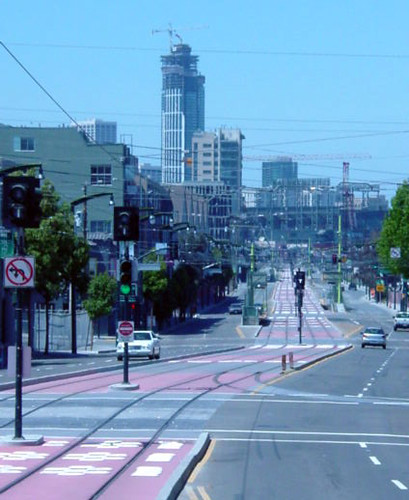
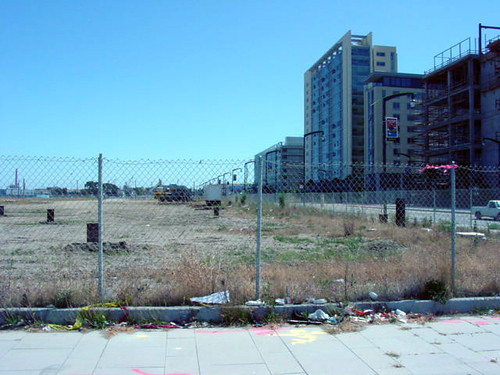
While the dogpatch survived the earthquake in 1906, I would be worried about this area in future earthquakes given its closeness to the bay and its susceptibility to liquefaction. Map of liquefaction susceptibility here. But what is interesting is what they do to deal with the issue. Below is a picture of some of the Mission Bay redevelopment along the Third Street Light Rail Line. On the other side of the fence you can see some of the pylons coming out of the ground. Well those where hammered down there by huge machines to the bedrock to stabilize the building so they would be less susceptible to the liquefaction.
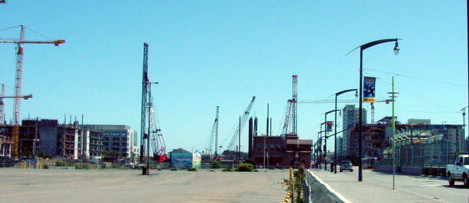
You can also see in the next picture the huge machines that hammer the pylons down into the subsoil and the many cranes which dot the skyline. I apologize for the blurriness of the picture.
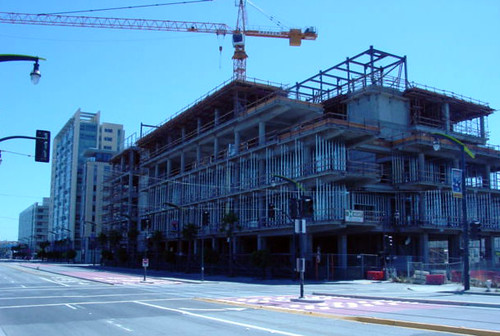
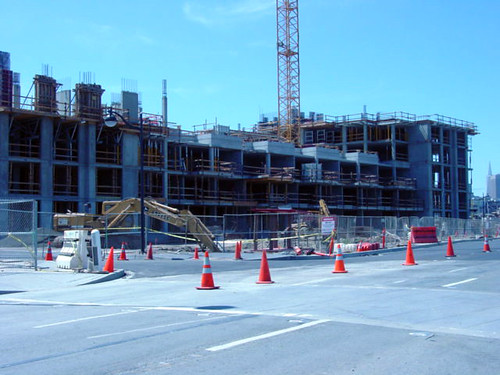
While the dogpatch survived the earthquake in 1906, I would be worried about this area in future earthquakes given its closeness to the bay and its susceptibility to liquefaction. Map of liquefaction susceptibility here. But what is interesting is what they do to deal with the issue. Below is a picture of some of the Mission Bay redevelopment along the Third Street Light Rail Line. On the other side of the fence you can see some of the pylons coming out of the ground. Well those where hammered down there by huge machines to the bedrock to stabilize the building so they would be less susceptible to the liquefaction.

You can also see in the next picture the huge machines that hammer the pylons down into the subsoil and the many cranes which dot the skyline. I apologize for the blurriness of the picture.
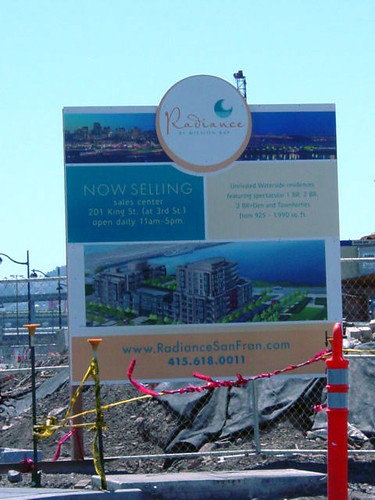
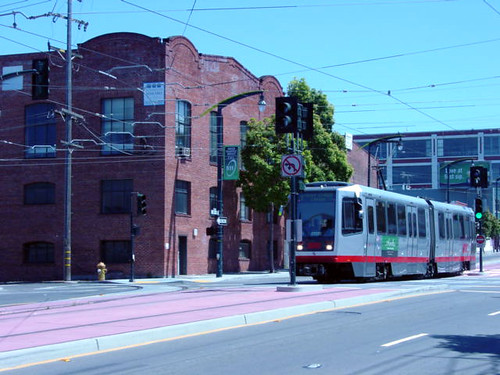
Much of the redevelopment is multi story buildings and lofts along the light rail line. With so many acres of land available, the area will add thousands of residents.
Further South along the light rail near the Dogpatch neighborhood other projects are going up and old wherehouses will more than likely be remodeled at some point. The photos below were taken near the Mariposa Third Street Station.
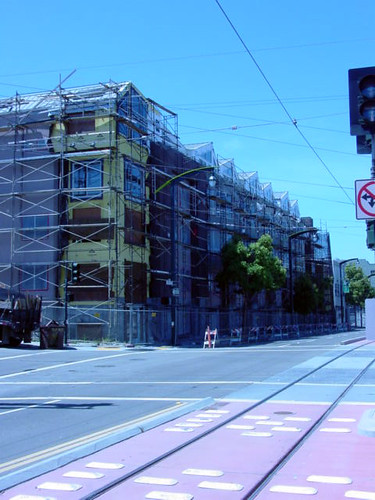
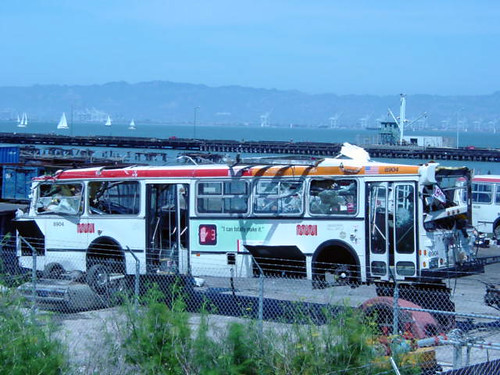
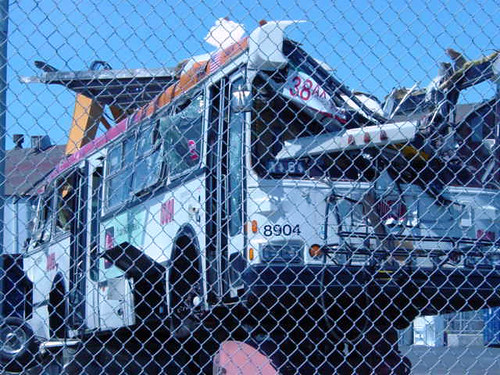
On another note, I drove by an old metal scrapyard where I found a few dead Muni buses. The 38 and 38x buses will be replaced with LRVs just like the streetcar was once replaced by the bus. All things are circular and I think these pictures are an indication of that, given that we saw many pictures of streetcars in the scrapyards after the transit holocaust of the 50s and 60s. Hopefully this is a scene that will be seen more often as we replace bus routes with more efficient rail lines.
Later this week I'll show some pictures of the new LRV repair and maintenance facility.
On another note, I drove by an old metal scrapyard where I found a few dead Muni buses. The 38 and 38x buses will be replaced with LRVs just like the streetcar was once replaced by the bus. All things are circular and I think these pictures are an indication of that, given that we saw many pictures of streetcars in the scrapyards after the transit holocaust of the 50s and 60s. Hopefully this is a scene that will be seen more often as we replace bus routes with more efficient rail lines.
Later this week I'll show some pictures of the new LRV repair and maintenance facility.
Friday, June 15, 2007
The Most Efficient Mode of All
Who would have thunk that the most efficient mode of all in terms of energy consumption is Amtrak. But it seems like folks are trying to hide it because I could only find one story to an Op-Ed in the Baltimore Sun about the energy department report.
With energy prices high and likely to go higher in the years ahead, it would make sense for the nation to embrace a transportation policy that puts a premium on energy efficiency. Transportation, along with electrical power generation, is the country's biggest consumer of fossil and renewable fuels. So what is the most fuel-efficient form of transportation available in the U.S. today?Now if only the government actually paid attention to its own research.Believe it or not, it's Amtrak. According to a recent study published by the U.S. Department of Energy's Oak Ridge National Laboratory, Amtrak uses less energy per passenger mile than cars, airlines or even subways and commuter rail systems. In fact, the relative disadvantage of commercial airlines and cars is particularly pronounced - both use more than one-fifth more energy per passenger mile than Amtrak's trains.
Thursday, June 14, 2007
Capping the Interstates
It seems like something out of the future but why hasn't the federal government or cities for that matter thought about capping all of the freeways with new buildings and streets to gain revenue? It seems to me that in areas which have urban freeways and high land prices, we should be able to not waste that land. Why not build steel tables on top of the freeway and just build up? There wouldn't be too much objection to it and perhaps there would also be room for transit on top.
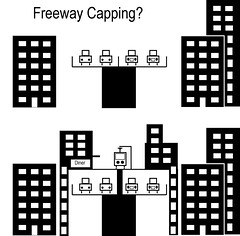
We already see ideas for either capping or submerging freeways and this might be a way to just leave them as they are while using the air above them as buildable space. And to make sure that the freeway isn't an eyesore from street level, there should be shops or housing wrapping the sides of it.
We already see ideas for either capping or submerging freeways and this might be a way to just leave them as they are while using the air above them as buildable space. And to make sure that the freeway isn't an eyesore from street level, there should be shops or housing wrapping the sides of it.
Wednesday, June 13, 2007
Is the DOT Lobbying for the Auto Industry?
Sources and Representative Henry Waxman say yes. Apparently one of the aids at the transportation department was calling representatives asking them to stop global warming initiatives because it would hurt the auto industry. The thing about this is that the auto industry has been babied for two long and now they are losing jobs and getting their butts kicked by the foreign auto makers. Even if they get off on some sort of technicality, someone needs to cut the umbilical cord on these guys.
H/T Think Progress and TPM
H/T Think Progress and TPM
Sunday, June 10, 2007
Ben Wear Can't Have It Both Ways
Ben Wear has no right to complain about gas prices when he continually harps on Capital Metro and promotes bigger toll roads. Given the state of the world, gas prices are only going to get higher. Something needs to be done about transportation and urban form in Austin if folks there are really going to address this issue. However constant Nimbyism by groups like ANC and rampant misinformation about the benefits of transit from road warriors like Wear's friend Jim Skaggs keep Austin in transportation limbo.
Its hard for me to take his 'poor me' shtick seriously when he rails against alternatives to his plight. In fact, it makes me wonder if he actually knows what the heck he is talking about. If not rail or transit, then how is he going to reduce the cost of transportation. Is it more wars? It certainly isn't with toll roads or hybrid technology. A recent publication by the Brookings Institute and the Center for Transit Oriented Development states that families who live in transit rich neighborhoods pay less than 10% of their incomes on transportation. This doesn't mean they stop driving, it just means they are less dependent on the car for every life movement. In sprawling areas, this cost escalates to 25%. For a family making $35,000 that is over $5000 back in their pockets each year. That's a real tax break for working families that could be created by investments in transportation alternatives. His Prius solution is only a savings of $1560, but that could be negated if toll roads continue to proliferate. Also not included is the cost of auto ownership in general.
So if Austin is going to have an honest discussion about issues facing the region including affordability, then there needs to be more information and action on alternatives to the automobile. Complaining about gas prices just doesn't tear at my heartstrings anymore, because Mr. Wear like many others, have dug their own hole.
Its hard for me to take his 'poor me' shtick seriously when he rails against alternatives to his plight. In fact, it makes me wonder if he actually knows what the heck he is talking about. If not rail or transit, then how is he going to reduce the cost of transportation. Is it more wars? It certainly isn't with toll roads or hybrid technology. A recent publication by the Brookings Institute and the Center for Transit Oriented Development states that families who live in transit rich neighborhoods pay less than 10% of their incomes on transportation. This doesn't mean they stop driving, it just means they are less dependent on the car for every life movement. In sprawling areas, this cost escalates to 25%. For a family making $35,000 that is over $5000 back in their pockets each year. That's a real tax break for working families that could be created by investments in transportation alternatives. His Prius solution is only a savings of $1560, but that could be negated if toll roads continue to proliferate. Also not included is the cost of auto ownership in general.
So if Austin is going to have an honest discussion about issues facing the region including affordability, then there needs to be more information and action on alternatives to the automobile. Complaining about gas prices just doesn't tear at my heartstrings anymore, because Mr. Wear like many others, have dug their own hole.
Saturday, June 9, 2007
IPod as the Great Transit Equalizer
It’s funny but I think the advertisements for Apple’s IPod are fairly accurate. Especially in
Now with the IPod, we can have thousands of songs in a device that is the same size of our wallet, allowing us to listen to whatever we want to, whenever we want to. But while the IPod can be hooked up to the car, it seems to be more useful from a transportation standpoint to walkable transit oriented neighborhoods. When you get out of a car the radio turns off or there is a tape transition, but when you leave a train or bus, the music continues on kind of like a soundtrack to your life.
In my opinion, it’s this soundtrack quality that can give transit a bonus versus the car. There are many songs that if I play them in my car they bring back memories. Specific places on a road from Austin to Houston when I would drive home for Christmas or Thanksgiving are imagined in my head when I listen to the particular song I like to play on that stretch of road. Since I had a CD changer in my trunk and not the front deck I would even pull the car over to switch CDs if the one I wanted for that certain section of road was not available in the changer.
Now I’m finding that I’m having similar experiences with transit and my Ipod. However instead of just in the car, I have it for walking around the city, places along bus routes and inside of department stores. It even allows me to drown out the awful music at say the Gap or other places where they try to match the brand with music types. Well what if I want to shop in the Gap or Target listening to some metal or opera? They wouldn’t play those over the speakers but with the great equalizer we can.
There might be some drawbacks including awareness of your surroundings that might lead to some unfortunate altercations with automobiles or with the less desirable and under discussed elements of city life. There is always an issue of being social as well; shutting people out by just having headphones on is easy. But if anything, the great equalizer is incredibly more social than say an automobile. People in their own pods of space cut off from having to deal with social situations has led to rises in the instances of road rage however I’ve never heard of anything called Pod Rage. It might exist but from what I’ve seen, people are generally passive when bumped into with their IPod versus people bumped into who don’t have one on.
There is a serious issue that should be discussed as well with regards to hearing though. I know I’m guilty of listening to my IPod much louder than I should if I’m in a subway to drown out the external noise. However this could lead to long term hearing damage and such is said your eardrums are like lobsters, once their cooked there is no going back. I’m thinking about whether I should get noise canceling headphones or just read with earplugs which might be a soundtrack setback.
But with all that being said, I see the Ipod and MP3 players in general as a great transportation equalizer. You can create a soundtrack of songs you like but now it won’t apply to just your car but rather memories and experiences of life in general.
Subscribe to:
Posts (Atom)