I haven't been posting as much due to a down internet at my house but check out Intermodality for some info on the MKT (Missouri Kansas & Texas)'Eureka' Corridor in Houston. It's interesting that these ROWs are still around.
UPDATE: There are plans for a bike trail on this ROW. Metro admits it jumped the gun, but personally I think they should figure out a way to share.

Friday, August 24, 2007

Wednesday, August 22, 2007
The Last PCCs of Mattapan
We know all about the PCC collections that reside in San Francisco and Philly but how about the last holdouts of a bygone era in Boston. The Ashmont-Mattapan Line is the last bastion of operating PCCs that never stopped. And hopefully it will continue past the repairs its undergoing at the moment. The following is a great article about the line from the Weekly Dig. (Links Added for emphasis)
The Mattapan Line is the only continuously operating system of PCCs left in the country, although Mattapan-Ashmont trolleys have been off-line for over a year. The T began jettisoning PCCs in the name of progress in the 1950s and 1960s; today, stretches of their track have been razed to make way for an enormous construction project at Ashmont, a gentrification-happy makeover that includes a new T station and a 116-unit condo development, the Carruth, abutting the Red Line tracks.It's an interesting article, check it out.While Ashmont is being rebuilt, the trolleys have been moldering at the Mattapan carhouse, which finds itself besieged by more construction at the Mattapan station. In their place, the T has been running a temporary "trolley shuttle" (an MBTA bus). Neighbors have become disgruntled; some worry that the "temporary shutdown" might become permanent. After all, the Arborway Line in Jamaica Plain met its fate that way.
Tuesday, August 21, 2007
Seattle's Shiftyness (A Good Thing)
Seattle Transit Blog has highlighted the shift from cars to transit while construction on I-5 is underway. A barrage of articles highlight the big scare that occurred before the construction started, which as should be known from previous experience including the Maze Meltdown would not materialize. The Stranger reports:
From the Times.
From the Post Intelliger.
And so on...
The News Tribune: Sounder is looking to keep the added ridership by adding trains.
So, you might have heard that a couple lanes of northbound Interstate 5 were closed last week. Hysterical media predictions of "nightmare" traffic failed to come true. Lists of "survival tips" for dealing with hellish commutes failed to be necessary. Even an entire blog (the Seattle Times' The Clog) devoted to "the Closure" couldn't make the predicted traffic clusterfuck materialize. For nearly two weeks, half of I-5 has been closed down—and traffic has, as if by a miracle, actually gotten better.
Last Monday – the first commuting day during construction on I-5 in Seattle – nearly 12,000 people boarded Sounder trains between Tacoma and Seattle. But while the number of passengers remained high throughout the week, it declined each day as I-5 gridlock didn’t materialize.From the Olympian.Sound Transit, the agency that operates the Sounder, knows it will take more than a construction project to persuade many people to leave their cars behind.
“A lot of people have made choices for this particular (construction) project that are probably not sustainable,” said agency spokeswoman Linda Robson.
From the Times.
From the Post Intelliger.
And so on...
Monday, August 20, 2007
Honeymoon & The Angry Monkey
Aaron Donovan over at Streetsblog decided to take his honeymoon with less carbon. A great story about traveling without a car ensued.
My wife and I were married last month in Brooklyn. For our honeymoon, we wanted to see as many great American cities as we could. In 19 days of travel, we visited Chicago, Seattle, Portland (Ore.), San Francisco, Los Angeles and New Orleans (and also stopped briefly in Cleveland, Milwaukee, Minneapolis, Houston, Atlanta, Washington, Baltimore and Philadelphia).On another news note today, a man and his monkey were angered when a MARTA bus ruined their day.How could two people as obsessed as we are with minimizing our transportation carbon footprints possibly justify taking so many flights for leisure travel? We didn't take any flights. We also didn't rent any cars or even set foot in a single taxi. We learned that thanks to the magic of transit-oriented hotel development (often inadvertent), it is entirely possible to travel this great country from sea to shining sea without any of those carbon-belching modes of travel -- and still have a fantastic time.
Here’s a reason an Atlanta-area monkey owner doesn’t like the Metropolitan Atlanta Rapid Transit Authority and it has to do with damage to his Porsche.A DeKalb County man says a MARTA bus caused damage to his car but MARTA refuses to accept blame. He was on I-20 earlier this month when he says his car was hit by flying rubber from a MARTA bus tire.Marketing man Bobby Manheim and his sidekick, a monkey named Dr. Irving, spend a lot of time on the road."If I wasn't in a car like I was I probably would've flipped just trying to avoid the chunks of rubber. Some of them were the size of baseballs," said Manheim.Manheim said while driving on the interstate August 1, a MARTA bus blew a tire spewing rubber all over his red Porsche.There is video with the news article. I suggest taking a look only if you have free time.
Sunday, August 19, 2007
Pawlenty Relents on Bridge
The Governor relented when the City of Minneapolis restated their belief that the bridge should be build with the ability to hold light rail at a future date and not necessarily for the Central Corridor. The Minneapolis Star Tribune reports:
Gov. Tim Pawlenty said Friday the state may be willing to pay the extra $20 million to $30 million it would cost to include light-rail transit on the Interstate 35W bridge.Pawlenty's comments came after nearly two weeks of debate and division among state, Minneapolis and federal officials over whether the replacement for the collapsed span should be built with the potential to carry light rail.
Before Pawlenty's comments, Minneapolis officials modified their stance, saying the bridge should have light-rail capacity but need not be built specifically for the Central Corridor line, which is to connect downtown Minneapolis and St. Paul. The city's role could be pivotal because, under state law, it will be asked to provide "municipal consent" for the bridge design.
A disagreement over light rail could stall the project for months, jeopardizing the state's plans to push for completion by the end of 2008.
This is a good sign that the Governor understands or at least is willing to consider the future needs and not just the present. The Star Tribune also reminds everyone that a transportation package needs to be passed as they reiterate what I had thought in the previous posts:
What is clear, however, is that routing the Central Corridor light-rail line across a new bridge doesn't work. Changing its route would eliminate a critical West Bank station at the University of Minnesota, attract fewer riders and add time and distance to the line. That, in turn, would lower the project's federal rating and risk its funding.
If a future rail line were projected for the Interstate Hwy. 35W corridor, a stronger bridge would make sense. But no such line is projected. Instead of obsessing on the replacement bridge, officials should focus on passing a comprehensive transportation bill that repairs bridges and actually pays for the new roads and transit lines that the state has needed for so long.
Friday, August 17, 2007
More Fantasy Maps
This time they are in LA, and done by the MTA. Check out some links at Metrorider LA.
Thursday, August 16, 2007
Bridge Design & The Central Corridor
Update: The Mayor has made it clear that he wants the bridge to handle light rail at a future date and doesn't necessarily have plans for a line now.
So the Mayor of Minneapolis and the Governor are having a bit of a spat over whether the I35W Bridge should include light rail. Initially the Gov and his lackeys said that there is no room, and emergency funds stipulate that the bridge must be built using the previous footprint. Ok, thats fine, so then why are you building a 10 lane bridge to replace an 8 lane bridge?? Personally I don't think that LRT should be on that bridge anyway but don't lie about what you can and can't do. Perhaps a provision that it could be built at a future date would suffice and priority transit lanes would be a good addition but it doesn't really make a lot of sense from a ridership standpoint for the Central Corridor unless you were going to build a line to the Northeast at some point.
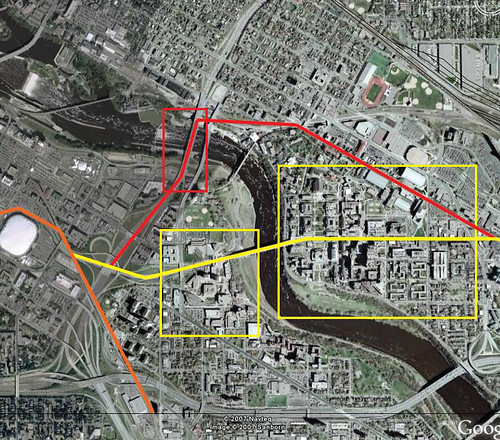
If you look at the picture, the red line is how the light rail would work over the bridge in a sorta kinda way. The orange line is the existing Hiawatha Line and the Yellow is the planned central corridor line. Look how the yellow line goes through the University (Yellow Boxes) rather than around it. (Hmmm, lesson for Austin?) Basically they got it right the first time so they shouldn't be trying to fix it wrong.
Now there are whole other issues at play with the retrofitting of the existing bridge to handle Light Rail and the possible tunneling under the University but really any cost savings that would have come by crossing the I-35W bridge would have lost a lot of ridership because people would have had to walk further. So Mayor Rybak, i love your spirit and willingness to fight for LRT, but save your chips for another day.
So the Mayor of Minneapolis and the Governor are having a bit of a spat over whether the I35W Bridge should include light rail. Initially the Gov and his lackeys said that there is no room, and emergency funds stipulate that the bridge must be built using the previous footprint. Ok, thats fine, so then why are you building a 10 lane bridge to replace an 8 lane bridge?? Personally I don't think that LRT should be on that bridge anyway but don't lie about what you can and can't do. Perhaps a provision that it could be built at a future date would suffice and priority transit lanes would be a good addition but it doesn't really make a lot of sense from a ridership standpoint for the Central Corridor unless you were going to build a line to the Northeast at some point.
If you look at the picture, the red line is how the light rail would work over the bridge in a sorta kinda way. The orange line is the existing Hiawatha Line and the Yellow is the planned central corridor line. Look how the yellow line goes through the University (Yellow Boxes) rather than around it. (Hmmm, lesson for Austin?) Basically they got it right the first time so they shouldn't be trying to fix it wrong.
Now there are whole other issues at play with the retrofitting of the existing bridge to handle Light Rail and the possible tunneling under the University but really any cost savings that would have come by crossing the I-35W bridge would have lost a lot of ridership because people would have had to walk further. So Mayor Rybak, i love your spirit and willingness to fight for LRT, but save your chips for another day.
Wednesday, August 15, 2007
Ridership Levels High in St. Louis, San Diego
From Adron at Transit Sleuth, Metrolink ridership in St. Louis hit an all time high. From the transit agency newswire:
Not to be outdone, San Diego rocked this months ridership as well. Average weekday boardings for July were just under 120,000 per day. This was likely helped by the huge Comic-Con convention and 4th of July celebrations.
“The new extension is certainly the reason why ridership is rising to these levels,” said Todd Plesko, Metro’s Director of Planning and System Development. “While we knew ridership would increase because of the additional eight miles and nine new stations that now offer more choices, no one really expected it to climb this high this fast.” Early predictions for the Cross County MetroLink Extension forecasted an average of 18,900 additional daily riders by the year 2025. However last month, after only eleven months of operation, MetroLink ridership totaled more than 88,000 boardings per average weekday, an increase of more than 27,000 additional daily riders—much higher than predicted.
Tuesday, August 14, 2007
Single Tracking to Save Cash
RTD in Denver while moving towards its goal of new rail lines is deciding to cut some of the budget on the west corridor by single tracking the western most section of the line. While this is making some folks in Golden a little worried about service levels, i'm sure that they will have the foresight to reserve the ROW for future expansion in order to facilitate expanded service should they decide to single track.
This is the way that Sacramento and San Diego went initially, later expanding to double track when the funding permitted. It should be considered in other settings as well for cost savings.
From the Rocky Mountain News:
This is the way that Sacramento and San Diego went initially, later expanding to double track when the funding permitted. It should be considered in other settings as well for cost savings.
From the Rocky Mountain News:
The project originally included two tracks on that final segment. But in 2005, faced with cost increases, RTD decided to cut service on the outer leg to trains every 15 minutes instead of every five minutes. That allowed RTD to reduce the number of train cars it had to buy, saving more than $12 million.
Then last year, with costs still escalating sharply, RTD realized it could run 15-minute service on a single track west of the federal center by including a short passing track near Red Rocks Community College. The move saved another $33 million.
Jefferson County planners and commissioners objected, saying if RTD's ridership estimates are wrong and more growth occurs than anticipated, RTD would be locked into having inadequate track capacity to handle it.
Jeffco had asked RTD to consider running 10-minute trains, which would have required a second passing track.
Monday, August 13, 2007
Madison Mayor Kills Streetcar Proposal
Mayor Dave was getting hammered on all sides for his streetcar proposal (mostly by people who don't like public transit anyways). I guess the lesson is to not make your idea the end all be all and educate everyone involved. There was no route picked and no one understood how they worked. A lot of folks stated "They aren't right for Madison". They don't really know that, they are just scared of change. Unfortunately the opponents of everything made the streetcar their glow point, hopefully other cities will learn from this. Some folks in Madison are outraged, and rightfully so. This is a mistake not just on Dave's part, but some of the blame could lie at the feet of Kathlene Falk. Perhaps someday County Executives who root for the suburbs and City Mayors (This means you too Milwaukee) can get along and build transit networks that help everyone, not just folks who were not smart enough to figure out that traffic to downtown is what happens when you sprawl. As Portland has shown, 9,000 riders a day , even with 12 minute headways, does a lot for circulation and city vitality.
Subscribe to:
Posts (Atom)