Tuesday, September 4, 2007

Which Way Does It Work?

Folks in Salt Lake City that live along 600 West are upset about a possible route alignment that will run by their houses. But JMD over at Transit in Utah is saying that its an important connection between the hotel/motel corridor and the airport.

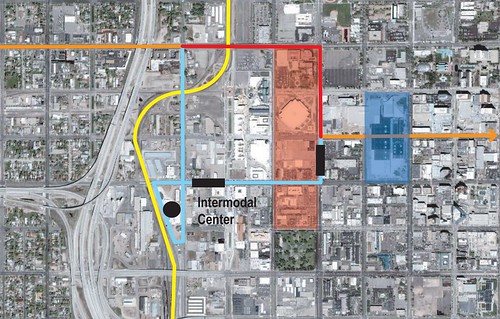
But wait, it gets better. There are complaints that UTA is bowing to a developer to swing the route away from a popular mall but really it looks like it might be the best way to go in order to connect the intermodal center that will connect the commuter rail line with the Airport and downtown and the mall. From the Google map it looks like there is a lot more opportunity for redevelopment along 600 as well. But see for yourself below. The Yellow line is commuter rail, the blue is the route folks are upset about and the red is the alternate route. The red box is the mall and the blue box is the basketball arena. Personally it looks like a no brainer.

Airport_Trax_Sm

Monday, September 3, 2007

A New Subway Station

Stephen Rees covers the opening of an amazing new subway station in Moscow. Check out his blog for pictures.

Sunday, September 2, 2007

New Transit Advocate Resource

Ok, I've started a new blog, City Transit Advocates. I'm not going to abandon this one but this is an addition that hopefully will be useful to everyone. Basically what I did is took the transit advocate blogs in my blogroll and aggregated their RSS feeds. There are 20 titles and one blog can only have two posts. This makes sure that blogs which post more often don't hog all the space.

Also, if anyone has any additions or knows of a good transit advocate blog to add to the aggregation that isn't there let me know. theoverheadwire at gmail dot com. There is a list of all the blogs in the aggregator at the right of the page.

I hope this is a positive addition to the transit blogosphere and allows people to get a look at what is happening in different cities.

Saturday, September 1, 2007

Environmental Elitists

John at RT Rider discusses the behavior of the faux enviros in the California Statehouse this last session.

Friday, August 31, 2007

Poor Funding Means Poor Support...

As Ezra Klein points out, you can't expect something to work very well if its poorly funded. The bootstrap argument doesn't really work in those situations.

As it turns out, when you don't fund crucial public services, they don't work very well. It's a fun cycle: The DC Metro has no dedicated source of funding nor particularly united constituency, so it gets shortchanged come funding time. Inevitably, the lack of funds degrade service and lead to failures. This makes the Metro less pleasant, driving people away, serving as an argument that government can't do anything right, and giving fuel to those who say that we should reinvest in more roads and private transportation infrastructure.
Now with the bridge collapse and a number of articles coming out about low funding for the FTA, people are starting to pay more attention as to why some things don't work as well as they possibly should and perhaps why sometimes transit gets a bad wrap.

As Ryan Avent pointed out, here's the result: This year, the government will allot $1.4 billion in federal spending for transit, and $42 billion in federal spending for highways. Sure is a mystery why our public transit systems don't work better....I think a bigger problem is that the sorts of public transportation that are beloved as an alternative to cars -- namely, systems that don't use roads, and thus evade traffic -- need to hit a critical mass of lines, stops, and, stations before they become a real useful alternative. Building that sort of infrastructure takes time, and our politics doesn't tend to like solutions that won't solve anything before the next few elections end.
Very true, we need to start thinking to the future. Or we might end up building these things under the light of a darkened sun. I'm glad bigger blogs are picking up on this.

Thursday, August 30, 2007

DART Expansion

Dallas has started construction on the Green Line. I'm really excited to see this line finally taking shape. The folks at DART are more educated now on TOD and might be able to make some decisions that will help this line be more transit oriented than the others. The Farmer's Branch Station apparently is first.

From the Dallas Morning News:


From Globe Street:
DALLAS-Dallas Area Rapid Transit is set to receive an $80-million grant for an expansion project. The first installment of a $700-million grant, approved last year by the Federal Transit Administration, will go toward construction of the Green Line, a 21-mile, two-segment extension of DART's light rail line, which will extend from the Pleasant Grove area of Dallas through Downtown Dallas and onto Farmers Branch and Carrollton.

The grant coincides with the Aug. 30 ground-breaking ceremony for the Farmers Branch light rail station. Carrollton will hold a similar ceremony Sept. 8 for the city's main Downtown station, one of three planned for the city. The Downtown Carrollton station will be the hub for three separate DART lines, making it one of the busiest in the system.

“Carrollton has the potential to become a major transit hub, joining Downtown Dallas, Downtown Fort Worth and Dallas-Fort Worth (DFW) Airport, in terms of importance to the region’s transportation network,” observes Carrollton Mayor Becky Miller. “We’re committed to leveraging public and private resources to maximize the development opportunities in this transit district.”

Tuesday, August 28, 2007

Will Streetcars Replace Buses on the 16th Street Mall?

Denver's 16th Street mall might undergo an extreme makeover. An article in the Denver Post via Denver Infill Blog states:

As Denver's 16th Street Mall approaches its 25th anniversary in October, local officials and business leaders are exploring upgrades that could include replacement of granite pavers in the bus lanes with concrete or even swapping out buses for streetcars.
That would be very cool and would allow the streetcars to be extended eventually to points all over the Denver first ring. Denver Infill even sees a web of streetcars (It would be cool to see a map of this)
Another solution discussed in the article is replacing the Mall shuttle busses with streetcars. This is ultimately the best solution for several reasons. Installing a streetcar line along Colfax has been gaining strong momentum over the past few years, and upgrading the Mall shuttle to a streetcar line would be the logical first step in that direction. With the 16th Street Mall ending right at Colfax, future streetcar extensions east and west along Colfax from Civic Center Station could easily follow. Next, the proposed Downtown Circulator along 18th, 19th, Broadway and Lincoln, could be implemented as a streetcar or, at least, upgraded to a streetcar line as soon as possible, as has been discussed.

RTD is also considering replacing the Welton Street light rail line with a streetcar line, running from the planned 40th & 40th Station down to the 20th & Welton Station, if not all the way to Civic Center Station. RTD also proposed (but dropped from the FasTracks program) a transit connection between the Broadway Station and Civic Center along Broadway/Lincoln. An extension of the Downtown Circulator streetcar line from 12th Avenue to the Broadway Station would be a no-brainer.
Very cool. It will give some of the closer in neighborhood some rail options and possibly connect some of the more vacant large parcels. I also heard something about a perpendicular bus mall to the 16th street mall this week when I was in Denver. Might be an interesting addition.

Also as a side, here are some photos from my few days in Denver.

Here is a sunset picture I took from the Bellview Light Rail Station.

Sunset

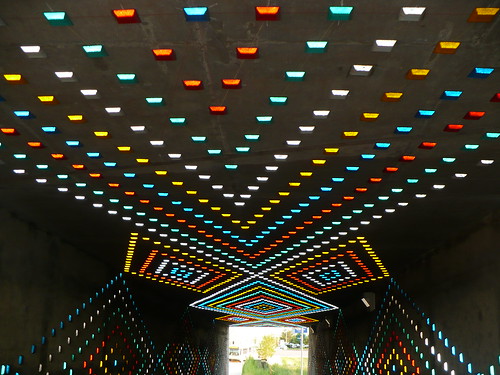
Another At Bellview in the tunnel that goes under the road to the elevators. This was really fun with a flash camera.

Transit Art @ Belview

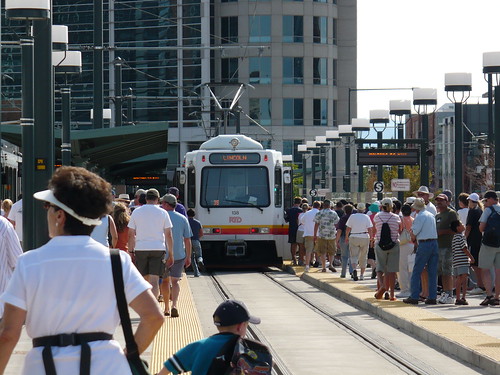
A lot of people use the C Line to get to special events. These folks were coming from a Rockies Game.

Rockies Game Outlet 2

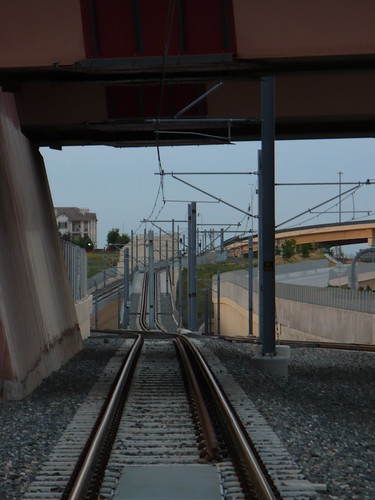
Man I wish the Bellview Station was on the other side of the road. There would have been some great Transit Orientation. You can see the freeway at right. In the photo after, it shows the view from the station (with a cool cloud formation) to the development the transit might have served better.

Southeast Corridor at Bellview

Clouds Over Bellview

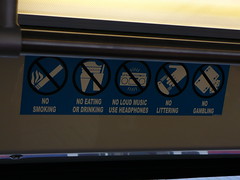
There is also no gambling on Light Rail, suprisingly

No Gambling on LRT

Monday, August 27, 2007

Are You The Gatekeeper? Are You the Keymaster?


Recently the FTA has been playing more of a gatekeeper to transit projects. Beyond DC posted that the FTA just works in DC, and Congress should be to blame. Well thats not really a good excuse. Sure Congress should provide more funding and being a penny pincher is great if you're cutting fat, but not if you're leaning up already lean transit projects. Personally the Tyson's tunnel rejection is the worst transit decision in this century. And making Minneapolis cut the Central Corridor project until its in pieces is ridiculous considering the DOT would fund any road project for the sake of congestion relief. And now the FTA is transferring all the Small Starts money to New York City for their BRT projects, to a place that has a lot of transit and is about to generate a lot of money with congestion pricing.

An article in the Washington Post lays it out:

The concessions show just how focused planners are on pleasing officials at the federal agency. The Purple Line is estimated to cost as much as $1.6 billion, an amount state officials say they can't afford without federal help.

Unlike federal highway funds, which states receive based on a formula and may spend as they wish, money for new transit projects is awarded at the discretion of the FTA. The agency doesn't have much to dole out. The FTA has proposed spending about $1.4 billion on new transit projects next fiscal year, compared with $42 billion that states will receive for highway maintenance and construction, according to federal figures. More than 100 transit projects across the country are expected to compete for federal money in coming years, according to a federal report.

Translation: States don't have to go through a cost effectiveness measure to justify spending on highway projects and should bend over backwards to make the FTA happy. Never bite the hand that feeds you right? In fact, a lot of this competition is what is causing problems for transit agencies around the county. In Charlotte, it took 10 years to build the line, a lot of which was the FTA process. Does no one think that there will be cost overruns? Money doesn't cost the same over a decade! If Charlotte loses its half cent tax, some of the blame lies at the feet of the FTA process.

FTA evaluations can take years, because it rates a project -- and grants permission for it to move forward -- at several different points, controlling it from preliminary engineering through construction. The process has grown so complicated and time-consuming that, across the country, many local officials have begun to forgo federal money if they can secure enough local or private funds to build a project, according to a recent U.S. Government Accountability Office report.
The article then goes into something I haven't talked about in a while, the Transit Space Race.

Meanwhile, competition for that money is increasing rapidly. Many booming areas -- including such traditional highway-loving cities as Phoenix, Denver and Houston -- are turning to transit to curb air pollution and control their car-dependent sprawl.

"The demand for transit has never been higher," Puentes said. "At the same time, the federal government substantially underfunds transit, so it's very competitive to get those funds."

Very competitive? Try knock down drag out fight. Cities such as Columbus Ohio can't even build a BRT line to the FTA cost standards, and they are the 15th largest city in the United States. This alone means there is something very wrong with fixed guideway transit funding, yes give Congress hell, but don't give the FTA a pass for being the Gatekeeper. That's like saying, that Rove guy just lives in DC, George Bush is the only one to blame.

Update: Looking deeper into the Beyond DC blog, they make a lot of good points. But this brings about my point that we still have to take the FTA rules to task. Congress can fix it, but it would help if these projects weren't looked at through the cost-effective TSUB lens as advocated by the FTA.
Sunday, August 26, 2007

China's Subway Boom

An article in the LA Times discusses the subway boom that is going on in China. Realizing that they can't fit their population into cars without choking on the result, they decide to expand rapidly like Robert Moses. While its fast and it gets it done, I'm not sure I would want the government to come and just kick whole neighborhoods up to build lines. On the other hand, it sure beats having to wait ten years for the New Starts program. Ridiculous. We could build a system like that with all the public involvement we enjoy, it just needs to be funded. Subways for America. How about starting out with massive expansions of Subways in Los Angeles, San Francisco, Miami, Baltimore etc. Perhaps even lines in places like Minneapolis and Tampa. Being a little selfish, could we put one on Geary and Van Ness? It would really help me get to the In N Out Burger and the local gatherings on Saturday's for Texas football without spending an hour on transit to go 5 miles.

Brian Taylor, a professor of urban planning at UCLA, noted that the United States used to be much more heavy-handed in its planning policies. Consider, for instance, the way whole swaths of central Los Angeles were razed to make way for the Santa Monica Freeway. Perhaps, he said, China is simply at a different stage in its evolution, both in terms of economic development and political participation.

From about 1890 to the late 1970s, he said, Los Angeles expanded its transportation system at an astonishing rate, first building the world's most extensive streetcar system and then tearing it down and building the world's first and largest freeway network.

"So it's not as if we haven't had these enormous investment eras in transportation infrastructure," Taylor said.

Cities "go through these various epochs of growth," he said, and at the moment, Los Angeles is in a very different stage than Shanghai.

Saturday, August 25, 2007

Charlotte's Transit Web

Neil Pierce has a column in the Hartford Courant about Charlotte's trials and tribulations in their fight for transit. It's a fabulous article and tells a lot about the trouble we have in this country explaining the benefits of good transit and alternatives to driving. One part of the interview is telling,

But why should an elected official take all the grief for pushing a new concept? Public transportation and land-use planning were nowhere on the agenda, McCrory acknowledges, when he ran in 1995. But a few weeks into office, he read a previous mayor's neglected "Committee of 100" report on public transportation. The report's thrust: The fast-growing Sunbelt city would choke on its expansion without effective bus and rail transit lines.

Then McCrory noticed for himself: "When I took my nephews out on strollers, we couldn't get to the street because there were no damned sidewalks. We had no connectivity or pedestrian access - just total reliance on the car." He began to see alternative futures: Charlotte could have tree-lined streets with bikeways and sidewalks, or "traffic lights every 15 feet, strip malls and unlimited pavement."

No sidewalks. That is the mark of a city with its priorities in the wrong places. And Charlotte has many people who want that burgeoning banking center to go back to a southern hole in the wall. But kudos to McCrory for having a vision and doing something to change that.

So why did McCrory become his region's lead advocate for public transit at all? One reason was purely pragmatic. While the exciting idea of rail service got the most attention in the 1998 sales tax referendum, McCrory had another, bigger worry. The city had a dilapidated, poorly run bus system, supported by the city property tax.

McCrory explains: "I thought a regionwide sales tax would be better - people driving in from outside sharing the burden." In fact, 65 percent of the proceeds from the expanded sales tax that opponents are attacking actually finances an expanded, successful new bus system. If the sales tax gets repealed, McCrory says, "the entire bus system cost gets transferred back to Charlotte property taxpayers. I'm a conservative; I want to protect them."
This is a side I hadn't heard before but its true. Why should the residents of Charlotte take the burden of the region? Similar to Minneapolis and Portland, Charlotte is somewhat of a regional government given that their county and city are under one government. It makes it easier to establish a vision and build on it. Also suburbanites have been sucking on the subsidies from cities for the last half century and not paying for it. Tax base created by downtowns often gets exported to the burbs in the form of utility outlays and freeways. Now they are being asked to ante up a bit and they cry not fair. But what about the people who pay most of the taxes?

Many of the opponents have it very wrong. Sure there are things to learn from the inflation and bidding on the original line and service doesn't go to every part of the city yet, but Rome wasn't built in a day and there are solid plans for expansion. Charlotte is one of those cities where the cost of living will benefit from an extensive rail network. There is no doubt in my mind that Charlotte would be a new flash of gold in a southern region choking on its own congestion and autocentricity. And when gas goes to $10 a gallon, you know who is going to win? Cities that thought ahead, like Charlotte.

On a side note, this letter to the editor hits the nail on the head.

Transit critics outed: Just follow the money

Ever since I read in the Observer about the Chamber's involvement in the transit study conducted by UNC Charlotte, I've been waiting to read more about the backgrounds of transit opponents.For example, David Hartgen's work has been funded by the Reason Foundation, known for its connections to the auto and oil industries. Do you think it might have a vested interest in less light rail?

Many opponents' funding can be traced back to the conservative John Locke Foundation, based in Raleigh. Why might they be interested in defeating light rail in Charlotte?

Bea Quirk