
Monday, May 26, 2008
Toll Road Conundrum

Sunday, May 25, 2008
Taking Light Rail to the Speedway
But the point of my post is that people in the county in which Lowe's is located want to extend light rail to the track (blue line extension map here). It would be an interesting juxtaposition and show a lot of people who probably don't take transit what rail can do. If the track pays for a spur from another route to the mall it would be helpful for pre and post race traffic. That is if there are races and with oil cheap enough to race.
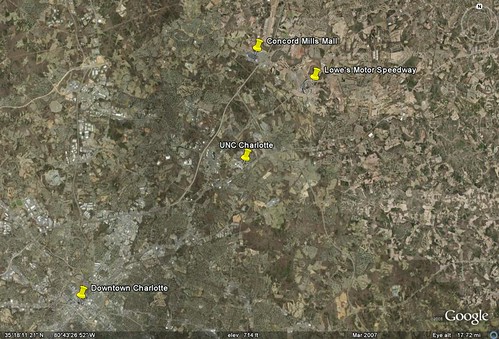
The one thing however I find discouraging is that they are saying if it does happen, it wouldn't be till 2020. Give me a break. We need to move much faster than that on all of this stuff. I'm finding that this country moves way too slow. Think about the time between 1950 and 1970 and how much of the interstate system was built. We're going to have to get at it if we're going to keep up with the demand, especially when gas is $10 a gallon.
Saturday, May 24, 2008
Holy Conversation Change Batman: Walkscore
Atrios
Yglesias
Kos
Oh, and my score is 92. I'm not sure what else I need to get 100, but there is no bonus for transit. Since BART is a half mile walk and the J-Church streetcar is half a block away I think I might have a higher score.
Giving Transit Expansion to Those Who Plan For It
One day after the city's transit committee agreed to support the much-discussed Transit Option Four, they added a special note for any suburban constituents or councillors hoping for expansion of the light rail tracks outside the Greenbelt: you'll have to prove that it's a worthy investment by demonstrating greater demand and higher population density.The only place in the United States I can think of that has this type of rule is the Bay Area and the Metropolitan Transportation Commission. The MTC is the local MPO and they have set up a system that mandates certain densities for cities to get funding for new transit expansion. And cities take it seriously. A Contra Costa Times article yesterday discusses transit officials in Antioch that are worried they won't make their intensity benchmark if they leave the station in the place for which its planned.
The median location near Hillcrest Avenue would constrain transit-oriented development because of the existing PG&E property, thus making it difficult to reach a Metropolitan Transportation Commission mandate for residential units within a half mile radius of a station, city planning officials said.I wish more MPOs were as progressive as the MTC. Most of them are just highway money distributors. Here is their policy summed up:
Each transit extension project funded in Resolution 3434 must plan for a minimum number of housing units along the corridor. These corridor-level thresholds vary by mode of transit, with more capital-intensive modes requiring higher numbers of housing units.Now that residential units are down, there needs to be a jobs policy, because as we noted in a post on jobs, its great to have residential density, but unless it connects to where you want to go, it doesn't really help much.
Betting on the Wrong Horse
Personally I think building a subway for buses is insane especially when you have to destroy two perfectly good light rail tunnels to do it. You can't go as fast with drivers in the tunnels and you still get that awful bouncy jerkey bus ride and low capacity vehicles. Boston will increase its budget deficit operating these schemes. Perhaps the rise in oil will change some minds. It's not too late.The city bet on the wrong horse, or rather, bet on the wrong bus. Within the past ten years the T has sacrificed the A line tracks and half of the E, while pushing for a “bus rapid transit” system where residents demanded light rail. A light rail network that would ultimately cost less in infrastructure than the BRT network. All of this has been prompted by a fierce anti-rail ideology at work in both the MBTA and mayor’s office.
The anti-rail, pro-bus, pro-car agenda ignores basic logic and economics. Trains hold more people, run at faster speeds through tunnels, and offer comfortable, single-seat rides to anywhere in the urban core of Boston. They do this in vehicles which can operate for forty years as opposed to the ten to twelve of their rubber-wheeled counterparts. And they’re cheaper to run.
Friday, May 23, 2008
GDP and Transit
The article he quoted discusses spending on GDP:
...in 1960, the U.S. spent 12 percent of its gross domestic product on infrastructure and now spends 2.4 percent. Japan spends 10 percent, China 9 percent and India 4.6 percent...I keep wanting to put the GDP thing into perspective. So lets say we spend 10% of GDP on Transportation. Let's say 20% of that goes to transit. Where would that leave us? $262 Billion based on $13.13 Trillion GDP(2006). Now APTA says that we spent $42 Billion in 2005 on capital and operations. That is a big difference! 523% increase.
Which when held against the $3.4 billion per year that will be promised in the climate bill for transit spending makes it look sad and small. I'm glad we're starting to turn the ship around when it comes to the transportation conversation in this country. But right now it feels like we're trying to reverse earth's orbital rotation.
Thursday, May 22, 2008
Chicks Dig Low Carbon Footprints
Two Peas in a University Pod
Here is the U of M alternate route from the Pioneer Press.

Now here are the alternate Austin routes I drew up where the yellow is the better route, however the University continues to push the red route.

I believe what this shows is that Universities for one are scared of things they don't understand, and that they know nothing about transportation planning and so are trying to solve a problem that only exists 8 times a year. Football game and special event congestion. With Austin, they're running the line right past the performing arts center, the football stadium and the track and swim stadiums instead of by the main campus and the dense residential neighborhood to the west.
Another perceived problem is that light rail is dangerous to pedestrians. Unlike those extremely safe cars careening through and around campus driven by students. But it just goes to show that Universities shouldn't control regional decisions by throwing fits. If there were a real issue, regional planners would understand and back off, but planning so that cars can keep driving through campus and less trips on transit can be taken is unacceptable.
Wednesday, May 21, 2008
Bill Language Translation
Grants for Additional Public Transportation Service
65% of the funds will be put into the formula funding program for transit already set up under section 5307. 60% of these funds can go to capital and operations funds and will be appropriated according to the urbanized area population. 40% of these funds can be allocated based on growth in the state based on the census. Also, any capital project that receives federal funding will be eligible for the funding if it provides 20% of its own funding (See section e). Operating costs will only allow 50%
I worry that some of these funds might be eligible for transfer to freeways and roads. I can't tell for sure though if this is possible, but the rules set out below from the code make it possible.
In a Transportation Management Area (TMA), the MPO may elect to transfer portions of its FTA Section 5307 funds that cannot be used for operating assistance to FHWA for highway projects subject to the requirements of 49 U.S.C. §5307(b)(2).
(3) In a transportation management area designated under section 5305 (a) of this title,[1] amounts that cannot be used to pay operating expenses under this section also are available for a highway project if—
Grants for New Public Transit Projects
This is a really cool part. 30% of the $171 Billion expected would go to fixed guideway construction (Heavy Rail, Light Rail, Streetcar, Commuter Rail, and True BRT). It's subject to the same criteria as the new starts program. Now we have a little bit to worry about here if John McCain and Mary Peters stick around because they are going to water down fixed guideway as much as they can. Earlier this year they tried to make hot lanes eligible for new starts funding as "fixed guideway". This is also pennies. $1.026 Billion per year for fixed guideway projects is the basic idea.
Grants for Efficiency at Public Transit Agencies
5% of the funds will be allocated for reducing VMT, Bike and Ped infrastructure, carpool and telecommuting programs that don't include new road capacity. Funding will be distributed based on the total GHG reductions of the project applying for funding. This could include any of the following:
(A) improvements to lighting, heating, cooling, or ventilation systems in stations and other facilities that reduce direct or indirect greenhouse‐gas emissions;
(B) adjustments to signal timing or other vehicle controlling systems that reduce direct or indirect greenhouse‐gas emissions;
(C) purchasing or retrofitting rolling stock to improve efficiency or reduce greenhouse‐gas emissions; or
(D) improvements to energy distribution systems.
Like Ryan says, we can do better. But its a small start that could and should be expanded.