Tuesday, August 26, 2008
Proof of Payment Around the Country
Does anyone know of a light rail system that is not in a subway tunnel that doesn't use proof of payment? I can't seem to think of any.

Monday, August 25, 2008
Monday Night Can't Watch the DNC Because I Don't Have Cable Linkage
Augusta is looking at streetcars. One of the points that Streetcar Salesman Charlie Hales talks about in this article that I don't see in too many of them is the difference in pedestrian traffic before and after the streetcar. This is one of the things I think Jan Gehl talks about that I just love, prove things with data. Data data data. Jan is all about doing ped counts to tell shop keepers that their shop isn't suffering because they don't have parking if they have 1,000 people walking by per hour.
The Albany Times Union has an article stressing something that should be adopted as one of our memes. Public transit is an investment, not an expense. Ed Tennyson says this all the time and it certainly makes a lot of sense. Since it is an investment, we need to amortize over the life of the transit to get its true benefits and operational costs.
Finally, Dave Reid at Urban Milwaukee has an awesome post on drinking and not driving.
The Albany Times Union has an article stressing something that should be adopted as one of our memes. Public transit is an investment, not an expense. Ed Tennyson says this all the time and it certainly makes a lot of sense. Since it is an investment, we need to amortize over the life of the transit to get its true benefits and operational costs.
Finally, Dave Reid at Urban Milwaukee has an awesome post on drinking and not driving.
As a society we say “don’t drink and drive” but in this case actions speak louder than words. Zoning and land use policies have an impact on the built environment that often promotes driving and limits other transportation options. These regulations to some extent mandate how we get home from work and unfortunately how we get from the tavern, home. Many regulations are involved in this problem but with adjustments to the three below a real reduction in drunk driving can be promoted.
Sunday, August 24, 2008
Space Race Update: Denver's Whiners
I like the Fastracks program. What it has done is lead the way for other regions to start thinking about how transit is being built in this country, usually one line at a time over many years. But now that the budget has gone up a few times, a lot of people are freaking out, mostly the people that didn't want the project in the first place, like the Rocky Mountain News. Part of the problem is that they never saw the importance of the project, but another part is that they are stuck in the car oriented world of roads are the greatest thing since sliced bread.
An editorial at the Rocky Mountain News this weekend states that Fastracks should be pared down in order to deal with the cost, which sounds reasonable when you think about it, until you read what they feel like should be the priority instead.
I do think RTD is doing the best it can with a bad situation created by the people that love roads anyways. It's not their fault that costs have skyrocketed because of issues outside of their immediate control, but to say that because of the cost, this type of project shouldn't be completed is wrong headed and short sighted. In fact, if the money for expanding (not fixing) freeways in the state was shifted to transit to complete the project, they would get done faster and help direct growth more intelligently sooner. The funds used on expansion would have just allowed people to sent more of their money to foreign oil companies and increase VMT.
There was a poster who replied to the editorial saying he was tired of North Denver getting the shaft when it came to funding allocations. The favored quarter of the Southeast is getting a lot of the investment and the northern end is paying for a lot of it, yet there is a lot going on in the Northwest as well.
I can see where the corridor gets even more congested between Boulder and Denver as population fills in the gap between the two cities. The need for an alternative development strategy is great and its not going to happen with BRT going down the center of a huge freeway, contrary to what people think. I have a lot of problems with the southeast corridor light rail because it was run down the side of the freeway. Many of the stations including those in the area of the tech center are not able to help the district turn into a more walkable pattern because the stations are on the other side of the freeway. The line should have shot through the center of the building density, not around it.
 But I digress. We should be measuring mobility projects on whether they can get us out of the hole we have dug. The Denver projects move the region in that direction and the locals will have to step up and push against the road building interests of newspapers and the status quo.
An editorial at the Rocky Mountain News this weekend states that Fastracks should be pared down in order to deal with the cost, which sounds reasonable when you think about it, until you read what they feel like should be the priority instead.
Some of those new revenues could come from whatever tax plan for transportation emerges from the legislature in the coming years. But transit should be far behind highway and bridge construction as a priority for state transportation planners. There simply isn't enough new revenue likely to materialize.Because new highway construction to make the problem Fastracks is trying to help solve worse is a great idea. Look, for over 60 years in Denver, hundreds of billions of dollars have been spent on road infrastructure just like everywhere else. I don't see why making even a $10 billion investment in transit is such a big deal.
I do think RTD is doing the best it can with a bad situation created by the people that love roads anyways. It's not their fault that costs have skyrocketed because of issues outside of their immediate control, but to say that because of the cost, this type of project shouldn't be completed is wrong headed and short sighted. In fact, if the money for expanding (not fixing) freeways in the state was shifted to transit to complete the project, they would get done faster and help direct growth more intelligently sooner. The funds used on expansion would have just allowed people to sent more of their money to foreign oil companies and increase VMT.
There was a poster who replied to the editorial saying he was tired of North Denver getting the shaft when it came to funding allocations. The favored quarter of the Southeast is getting a lot of the investment and the northern end is paying for a lot of it, yet there is a lot going on in the Northwest as well.
I can see where the corridor gets even more congested between Boulder and Denver as population fills in the gap between the two cities. The need for an alternative development strategy is great and its not going to happen with BRT going down the center of a huge freeway, contrary to what people think. I have a lot of problems with the southeast corridor light rail because it was run down the side of the freeway. Many of the stations including those in the area of the tech center are not able to help the district turn into a more walkable pattern because the stations are on the other side of the freeway. The line should have shot through the center of the building density, not around it.
 But I digress. We should be measuring mobility projects on whether they can get us out of the hole we have dug. The Denver projects move the region in that direction and the locals will have to step up and push against the road building interests of newspapers and the status quo.
Saturday, August 23, 2008
Obama Biden 08 - Amtrak Ticket
I'd like to add to the comment on MyDD on economics and Joe Biden, who is now the VP pick for Obama.
While he embodies a lot of things about Washington -- he's been there for a long time, of course -- he has commuted to and from his home in Deleware ever since being elected rather than maintaining primary residence inside the Beltway like so many others on Capitol Hill. Even the city he was born in -- Scranton, Pennsylvania -- kind of embodies this connection to working Americans.He not only commuted, he commuted with the people, on Amtrak.
"As an almost daily commuter on Amtrak, I've seen first-hand the need to prioritize the increased security and efficiency of our railroads.This is a good pick for increased transit. I'm not sure what they'll do, but I imagine Mary Peters is not on the long list of possible DOT Secretaries.
Friday, August 22, 2008
Here We Go Again
Wow, this is a kick in the teeth to the Tyson's Tunnel folks and good TOD. It sounds like good news, but its really just a way to get the elevated portion started so that no one can fight it later. Good work FTA. Way to be teh suck.
Thursday, August 21, 2008
Killing the Opposition's Density Meme
Chicken and Egg again. I'm not saying that the move not to go into Scott County isn' t the right one in the Twin Cities Region. Being fairly far outside of the core, it's not likely to get a rail link to downtown any time soon.
But for Peter Bell, the head of the Metropolitan Council to claim that there will only be two more light rail lines in the region because of population density shows that people still don't get it, the people that are supposed to. They still don't understand that transportation is an investment made in part to decide later land use. I can think of three light rail corridors in the Twin Cities that are in planning. Does this mean that only two get rail because the other one has no chance to regenerate?
This meme needs to stop, and you know who has been aiding and abetting? From Peter Bell's quote, it's our favorite Mary Peters and her FTA. They don't believe in land use or transit changing land use patterns. In fact, they encourage under investment in transit by telling cities they can't build light rail lines unless they have a cost-effectiveness measure that matches current conditions, not future. Again, transit investment is about shaping future growth patterns. We know this because we have seen what transportation investment has done to our growth over the last 60 years.
But for Peter Bell, the head of the Metropolitan Council to claim that there will only be two more light rail lines in the region because of population density shows that people still don't get it, the people that are supposed to. They still don't understand that transportation is an investment made in part to decide later land use. I can think of three light rail corridors in the Twin Cities that are in planning. Does this mean that only two get rail because the other one has no chance to regenerate?
"There will only be one or two additional light rail lines in this region," council chair Peter Bell warned. "We just simply don't have the population density, and we won't get the federal matching dollars.These are unfortunate comments from someone who should know better than to reinforce the auto-centric density meme. This is one of these things that everyone should be on message about. We really need to hammer our leaders on this issue because we'll never get anything done if people are repeating what the opposition wants the message to be, especially when false. Was Arlington County dense enough to get a Metro Subway? Was the Pearl District dense enough to get a streetcar?
This meme needs to stop, and you know who has been aiding and abetting? From Peter Bell's quote, it's our favorite Mary Peters and her FTA. They don't believe in land use or transit changing land use patterns. In fact, they encourage under investment in transit by telling cities they can't build light rail lines unless they have a cost-effectiveness measure that matches current conditions, not future. Again, transit investment is about shaping future growth patterns. We know this because we have seen what transportation investment has done to our growth over the last 60 years.
Wednesday, August 20, 2008
Space Race Update: St. Louis
It's possible, that this is the year of the sales tax. Increases are being discussed all over the country and the most recent I've heard of that we'll be following on election night is proposition M in St. Louis. Half of the sales tax would go to transit operations in the region while the other half would go to expansion. If passed, this means that St. Louis will now be looking to expand its network to the plan below.

You can find studies for the six corridors here.
North Corridor is the top green line to the furthest right
South Corridor is the bottom green line to the furthest right
Daniel Boone is the furthest left
Those are the three likely to be funded first and would really improve the ridership of this system drastically. At some points they are getting to 88,000 riders a day. That's pretty good for such a small system.
You can find studies for the six corridors here.
North Corridor is the top green line to the furthest right
South Corridor is the bottom green line to the furthest right
Daniel Boone is the furthest left
Those are the three likely to be funded first and would really improve the ridership of this system drastically. At some points they are getting to 88,000 riders a day. That's pretty good for such a small system.
Olympics Update: The Hurdles are Tough
I've seen a lot of people hit hurdles. It's tough every time. Probably the worst was Steve Slattery at the Big 12 Championships in 2002. He did a windmill flip over a steeple hurdle after hitting his shin. Looked like it hurt, but he got up and kept running.
My heart goes out to Lolo Jones. She was ahead and on her way to gold when she hit a hurdle. We all hit hurdles, usually of a different type. But I always hope that when we do, we come out stronger, tougher, just as she has shown she will. A true champion. (Video here)
My heart goes out to Lolo Jones. She was ahead and on her way to gold when she hit a hurdle. We all hit hurdles, usually of a different type. But I always hope that when we do, we come out stronger, tougher, just as she has shown she will. A true champion. (Video here)
Tuesday, August 19, 2008
Subways Could Have Been
Eric at Transbay Blog has an interesting post on the subways of San Francisco's past, built and still unbuilt.
Share the Tracks
An interesting proposal in Portland that would be pretty inexpensive introduction of Commuter Rail:
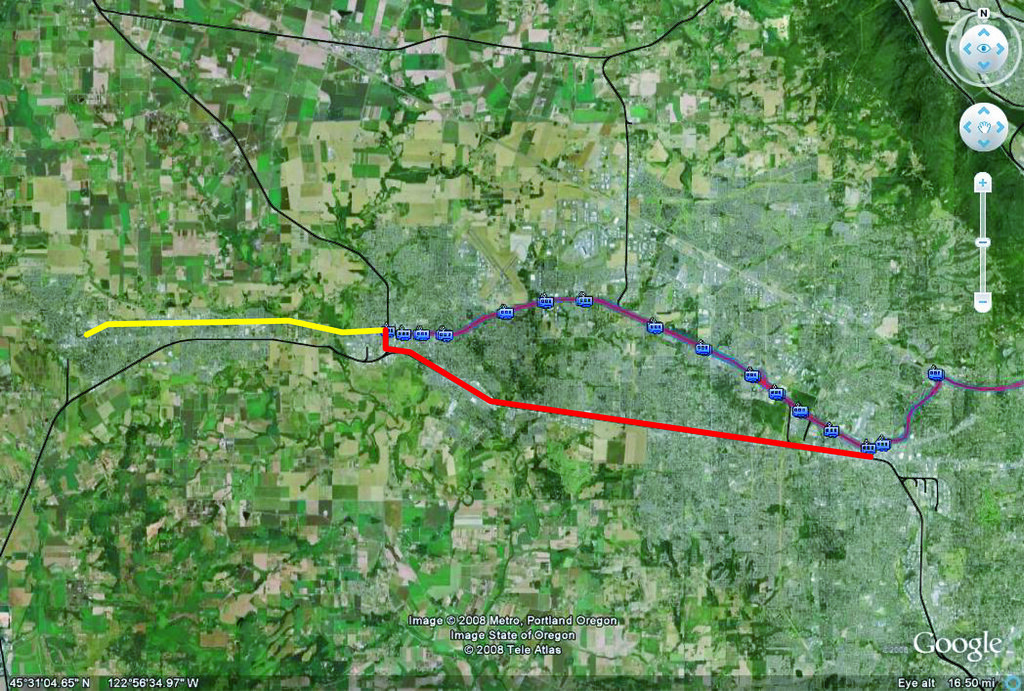
A representative for Portland & Western Railroad approached local leaders about the idea this summer. Larry Harvey, a senior consultant with PacWest Communications, said the railroad's line just north of Oregon 8 is deteriorating.
Without an upgrade, it will no longer be able serve the five or so companies now using it for freight, he said, forcing them to relocate or start contracting with truck companies.
"Portland and Western said, 'Gee, if we committed to only running freight on that line between midnight and 4 a.m., then passenger cars could run between 6 a.m. and 7 p.m.," Harvey said.
The railroad has approached local governments about cooperating to find funding for what Portland & Western estimates would be a $30 million project, in 2008 dollars.
They will have to deal with the FRA which means they wouldn't be able to use lightweight vehicles. It is a rather short route and I wonder if they should just run the line all the way to Beaverton catching a lot of the commercial corridor left unserved by the light rail line (represented by the red extension to the yellow).
Subscribe to:
Posts (Atom)