Tuesday, October 14, 2008
Transit Not Stadium
Richard is right. We should be building transit, not sports stadiums. Even if stadiums did help districts, the investment in one place for games eight times a year is a waste compared to daily linear transit lines that can have the affect of changing the city, instead of one district. Not to mention in 20 years, stadiums are obsolete according to team owners.

UTA Ridership Up
JMD covers the surge in ridership at UTA. The new commuter rail line and light rail lines have been good investments. The expansion of five more lines will give the region an even better access and mobility.
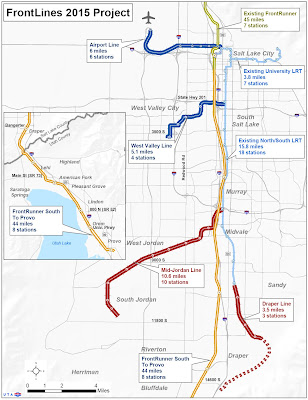
It is clear that the investment in TRAX and Front Runner is paying off. Despite there being only two TRAX lines it carries 34% of UTA's ENTIRE ridership. Add Front Runners numbers into the equation and it is at 40%. When you consider the bus system covers six counties and a couple of hundred routes, it truly shows how well TRAX and Front Runner is doing.Here's the official map they have recently put up on their website for the expansion:
Trax - 51,849
Front Runner - 8,250

I Hate It When He Does This
I'm annoyed. When Obama talks about transportation he talks about cars and roads. There have been a few times like in Portland where he talked about bikes or in PA when he talked to the GE train makers. Those are site specific and everywhere else it's usually about cars. I don't want to hear about cars. And I certainly don't want us giving money to companies who can't seem to get it right in the first place.
"We'll create 5 million new, high-wage jobs by investing in the renewable sources of energy that will eliminate the oil we currently import from the Middle East in 10 years, and we'll create 2 million jobs by rebuilding our crumbling roads, schools, and bridges," he said.
He revisited the subject again later in the speech: "It is time to protect the jobs we have and to create the jobs of tomorrow by unlocking the drive, and ingenuity, and innovation of the American people. And we should fast-track the loan guarantees we passed for our auto industry and provide more as needed so that they can build the energy-efficient cars America needs to end our dependence on foreign oil."
Why is it that Toyota and Honda consistently get the market here in America right but Detroit can't seem to figure it out? Obama talks alot about changing the way things are done in Washington. I think he needs to go a step further and talk about changeing the way we do things in State DOTs, MPOs, and Detroit.
Monday, October 13, 2008
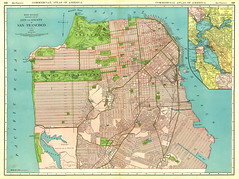
1925 San Francisco Street Map
I wish this streetcar network were still around...
1925 San Francisco Street Map
Originally uploaded by Dollar Bin
1925 San Francisco Street Map
Originally uploaded by Dollar Bin
Living in Exurbia Getting Expensive
In case you missed it, this PBS show NOW talks about the tough times people are having living far from their jobs. My coworker Gloria is in the film too. I will say, one thing that bothered me is the interviews almost seemed like caricatures of people who live in urban places and in the exurbs. But at least we're starting to cover the issues as they continue to hit people hard.
Some Things Never Change: Part 3,000
In a Metropolis, Everybody benefits from Public Transportation...
H/T RS
H/T RS
Congrats to Krugman
Seems he won some Nobel Prize. From Nobel:
Economies of scale combined with reduced transport costs also help to explain why an increasingly larger share of the world population lives in cities and why similar economic activities are concentrated in the same locations. Lower transport costs can trigger a self-reinforcing process whereby a growing metropolitan population gives rise to increased large-scale production, higher real wages and a more diversified supply of goods. This, in turn, stimulates further migration to cities. Krugman's theories have shown that the outcome of these processes can well be that regions become divided into a high-technology urbanized core and a less developed "periphery".Let's look back to what he's said on transit...
But none of it amounts to much. For example, some major public transit systems are excited about ridership gains of 5 or 10 percent. But fewer than 5 percent of Americans take public transit to work, so this surge of riders takes only a relative handful of drivers off the road.Any serious reduction in American driving will require more than this — it will mean changing how and where many of us live. To see what I’m talking about, consider where I am at the moment: in a pleasant, middle-class neighborhood consisting mainly of four- or five-story apartment buildings, with easy access to public transit and plenty of local shopping.
It’s the kind of neighborhood in which people don’t have to drive a lot, but it’s also a kind of neighborhood that barely exists in America, even in big metropolitan areas. Greater Atlanta has roughly the same population as Greater Berlin — but Berlin is a city of trains, buses and bikes, while Atlanta is a city of cars, cars and cars.
Sunday, October 12, 2008
Would Berkeley be "Destroyed"?
Regressive progressives are at it again in Berkeley. The November vote will determine if buses can have dedicated lanes in the City Limits and whether denser development can occur on transit corridors. The response by the opposition is fear:
"This election is huge," said Laurie Bright, president of the Council of Neighborhood Associations. If voters reject Measure KK and approve LL, she said, the combined effect could "destroy Berkeley as we know it."This is a perfect example of the idea that things should always stay as they have been. People are really afraid of change and expect others to take the brunt of what is coming anyway (growth). This was highlighted by opposition at a recent meeting that claimed they should build dedicated lanes in places that "needed it" like Walnut Creek. It's always exporting things to somewhere else rather than taking initiative and controlling it yourself. It's also a direct contradiction of Wendell Cox and others who believe that Smart Growth policies are the bain of housings costs. It actually seems as if its general NIMBYness.
Traffic Costs Transit
This article in WTOP is a little old but it discusses the importance of clearing paths for public transit and people. While a lot of people will say that congestion just means we should build more roads, places like downtowns just can't add roads, so you need to add capacity. If we don't wake up and realize this, the cost will be huge.
The Metro transit agency adds an average of 10 buses a year just to maintain the same rush-hour service. Fairfax County public schools adds 20 to 30 buses a year - even when enrollment is flat - because of increased travel times. Officials say routes that used to take 30 minutes now take 50 minutes.
The additional vehicles on the road only make congestion and pollution worse. They also cost businesses and taxpayers money. "This is the perfect illustration of the cost of congestion," said Ronald F. Kirby, transportation director for the Metropolitan Washington Council of Governments. "And those costs are passed on to customers and taxpayers."
Saturday, October 11, 2008
Fleet Week Awesome. Muni FAIL
Today was an awesome day on the North end of the city that started with Texas(5) beating Oklahoma(1). I watched from a bar on Union Street with about 200 Texas exes and friends. Then I went with some friends to watch the Blue Angels fly over San Francisco at varying angles. All of this was great and made me pretty tired but glad I got out today. It was an amazingly beautiful day.
On the other hand. It was an epic epic Muni FAIL. In my first year here. I made the mistake of driving the 3 miles North to watch the football game during fleet week. Bad idea. No parking (when is there ever?) and traffic you wouldn't believe. The last few years, I've decided to take Muni which I try to do as much as possible. This morning I would take my usual J to 22 connection. But it started out badly. When I left my house, the NextMUNI webpage said 3 and 15 minutes for the J at 24th and Church. I got to the stop and the 3 min J was just leaving. I felt that was ok. 10 minutes wasn't bad and I would be a little late to the game but no problem right?
Not right. I waited 25 minutes for the J and the driver was chatting away with what seemed like a supervisor with a yellow MUNI vest. I was already annoyed that they were 15 minutes late and the talking really wasn't doing much harm, but because they were late more people had gathered meaning more people had to pay as they entered which always slows the whole process down. And why they have so many stop signs on Church I'll never know.
So i get to Duboce and Church where I would hop on the 22 and the next one comes in 12 minutes. It's already 9am and the game starts at 9am. I wait 12 minutes and off we go. The 22 gets there and I'm responding to texts from my friends telling them I'll be a little late but not too bad. Then some crazy stuff happens. The driver decides that at stop lights he'll read the SF Chronicle. And at one point he hops out of the bus at a stop and walks into a store to pick up a sandwich. What?!
Obviously I was annoyed. I was already late because of Muni. But this was ridiculous. So what would have taken me about 15 minutes in a subway or a car took me an hour on Muni. I know this is the reason people drive. It annoys the heck out of me that we can't get it right. Between the late train and the crazy bus driver...it was enough to make me almost declare war on Muni.
The way home pretty much sucked as well. So much traffic on Van Ness (I walked that way to see the ships from Fort Mason) I decided to go back to the 22. Well I got passed by three full buses and ended up just walking the 2 miles to the J. It was ok though. I got to take some pictures on Union Street. But for the once in a while rider, that day would probably kill your riding for about a year. Cabs it is!
In any event. This needs to be improved. And the TEP would really do almost nothing to change that trip. BRT on Van Ness could possibly help that trip but honestly there needs to be an east west and north south subway. I should be able to get anywhere in a 7 mile by 7 mile city in 30 minutes. That should be the goal. That would be quite impressive mobility for here and guess what, more people would take transit!!!
Here are some pictures and movies. The first one shows the final seconds of the game at the Blue Light bar. Pretty exciting.
The following pictures are of the Fleet Week traffic...
Van Ness
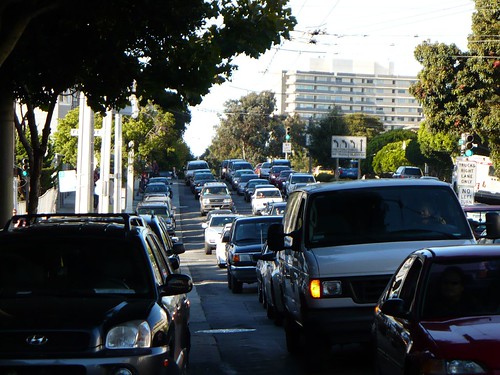
Lombard
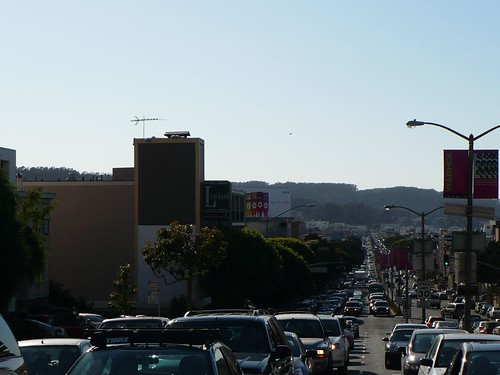
North Point Street

People Traffic and Ships!
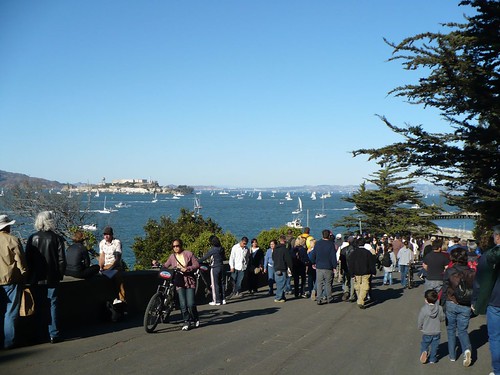
Marina Street - They would be dumb not to put the future F Line extension to the presidio in its own lane when you see this:
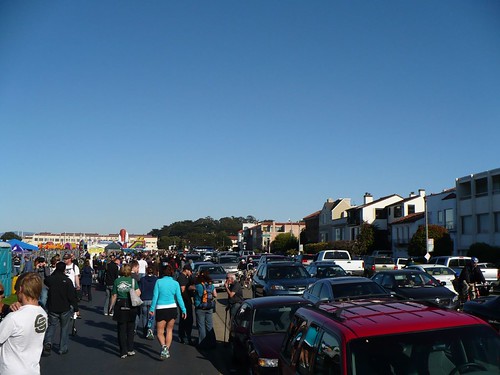
Union Street Life
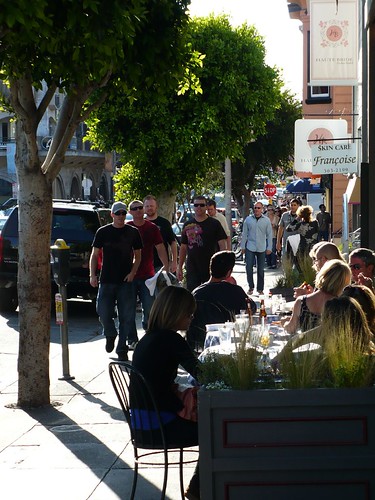
On the other hand. It was an epic epic Muni FAIL. In my first year here. I made the mistake of driving the 3 miles North to watch the football game during fleet week. Bad idea. No parking (when is there ever?) and traffic you wouldn't believe. The last few years, I've decided to take Muni which I try to do as much as possible. This morning I would take my usual J to 22 connection. But it started out badly. When I left my house, the NextMUNI webpage said 3 and 15 minutes for the J at 24th and Church. I got to the stop and the 3 min J was just leaving. I felt that was ok. 10 minutes wasn't bad and I would be a little late to the game but no problem right?
Not right. I waited 25 minutes for the J and the driver was chatting away with what seemed like a supervisor with a yellow MUNI vest. I was already annoyed that they were 15 minutes late and the talking really wasn't doing much harm, but because they were late more people had gathered meaning more people had to pay as they entered which always slows the whole process down. And why they have so many stop signs on Church I'll never know.
So i get to Duboce and Church where I would hop on the 22 and the next one comes in 12 minutes. It's already 9am and the game starts at 9am. I wait 12 minutes and off we go. The 22 gets there and I'm responding to texts from my friends telling them I'll be a little late but not too bad. Then some crazy stuff happens. The driver decides that at stop lights he'll read the SF Chronicle. And at one point he hops out of the bus at a stop and walks into a store to pick up a sandwich. What?!
Obviously I was annoyed. I was already late because of Muni. But this was ridiculous. So what would have taken me about 15 minutes in a subway or a car took me an hour on Muni. I know this is the reason people drive. It annoys the heck out of me that we can't get it right. Between the late train and the crazy bus driver...it was enough to make me almost declare war on Muni.
The way home pretty much sucked as well. So much traffic on Van Ness (I walked that way to see the ships from Fort Mason) I decided to go back to the 22. Well I got passed by three full buses and ended up just walking the 2 miles to the J. It was ok though. I got to take some pictures on Union Street. But for the once in a while rider, that day would probably kill your riding for about a year. Cabs it is!
In any event. This needs to be improved. And the TEP would really do almost nothing to change that trip. BRT on Van Ness could possibly help that trip but honestly there needs to be an east west and north south subway. I should be able to get anywhere in a 7 mile by 7 mile city in 30 minutes. That should be the goal. That would be quite impressive mobility for here and guess what, more people would take transit!!!
Here are some pictures and movies. The first one shows the final seconds of the game at the Blue Light bar. Pretty exciting.
The following pictures are of the Fleet Week traffic...
Van Ness
Lombard
North Point Street
People Traffic and Ships!
Marina Street - They would be dumb not to put the future F Line extension to the presidio in its own lane when you see this:
Union Street Life
Subscribe to:
Posts (Atom)