Data alone doesn't always tell the whole story, such as the before and after ridership chart the FTA put together which shows Memphis ridership on its most recent extension (Medical Center) is awful. But why is it awful compared to the projections? Because the Medical Center shut down and moved right after the line opened.
But the numbers always tell you all you need to know right? So says our favorite Libertarian scholar. Mr. Setty does the fun work of comparing apples to apples. He tosses in a talk on self selection fallacies to boot.
Thursday, November 13, 2008

Wednesday, November 12, 2008
Electric Grids, Gas Taxes and Transit Expansion
David Roberts has a post up on how a gas tax isn't enough. He's right. There is no way we can ever raise enough money for anything we really want with just a gas tax. Especially if we really want to reduce VMT and increase walking, biking and transit. Well as usual, I'm going to do some thinking out loud and let you all shout me down or make the thought better.
What if we got rid of all those laws that pushed apart electric companies and transit companies? Some comments have been made about just getting people on transit instead of changing the vehicles. But honestly, I feel like San Francisco is a better urban place because bus exhaust is not flowing in my face when I'm walking down the street. One thing I noticed this weekend in Charlotte was that the bus terminal is going to lead someone to cancer. The downtown bus center has buses idling under a canopy at all hours creating a smell that means particulate concentration can't be very good.
In any event, with the electric grid needing a serious upgrade, how much more would it really cost to bring overhead wires to the most traveled routes and tie them into the new grid? Some of these could be light rail, some could be trolley buses, and other could be streetcars. But all could be easily adapted to alternative energy if they were using electricity to start with. But also, how could this be a mutually beneficial relationship?
Some thoughts I came up with:
What if we got rid of all those laws that pushed apart electric companies and transit companies? Some comments have been made about just getting people on transit instead of changing the vehicles. But honestly, I feel like San Francisco is a better urban place because bus exhaust is not flowing in my face when I'm walking down the street. One thing I noticed this weekend in Charlotte was that the bus terminal is going to lead someone to cancer. The downtown bus center has buses idling under a canopy at all hours creating a smell that means particulate concentration can't be very good.
In any event, with the electric grid needing a serious upgrade, how much more would it really cost to bring overhead wires to the most traveled routes and tie them into the new grid? Some of these could be light rail, some could be trolley buses, and other could be streetcars. But all could be easily adapted to alternative energy if they were using electricity to start with. But also, how could this be a mutually beneficial relationship?
Some thoughts I came up with:
- Use power rates as sort of a business carbon fee. Businesses paying the tax would directly benefit because infrastructure is used to get to work and retail spaces. Bikes, transit, even roadways would benefit from such funding mechanism.
- Transit could get a lower power rate as part of the power company. This means operations could be less expensive meaning more service and if enough transit vehicles are running, perhaps cheaper energy because of power equalization during greater off peak power consumption.
- If we improve the grid and transit is a part of it, charging your plug in hybrid or scooter would pay into the transportation fund as well generating funding for the transport agency as well.
- If we have a business power fee, could it allow us to get away from the sales tax?
- This type of fee would reward more efficient building practices.
Blogger Solidarity
I don't wear PJ's, but perhaps I should start. Either that or ride the train in slippers.
Via Yglesias
Via Yglesias
Tuesday, November 11, 2008
Inernational Rail Updates
Wow lots going on in the world. We have updates from China, Nigeria, and Saudi Arabia.
Lagos is one of the world's densest cities. They plan to float a bond to pay for two new rail lines. I'm not sure where this relates to the BRT lines they have been planning, but part of this project concerns value capture schemes for the land around the transit stations. I wonder if they'll have to change their Euclidian zoning. Sure.
Mecca plans on building a light rail line as well. Seems silly in a place where oil is king no?
~~~~~~~
And we've seen the numbers before, but here is an article in another format on China. Business Week:
H/T Orphan Road
Lagos is one of the world's densest cities. They plan to float a bond to pay for two new rail lines. I'm not sure where this relates to the BRT lines they have been planning, but part of this project concerns value capture schemes for the land around the transit stations. I wonder if they'll have to change their Euclidian zoning. Sure.
~~~~~~~“The Lagos State Government intends to finance the infrastructure for both rail lines through the capital market by floating an estimated N275bn worth of rail infrastructure bonds.”
He also gave the details of the capital cost of project as Okokomaiko-Iddo ($582m), Iddo-Marina ($215m), and Agbado-Iddo ($402m). He stressed that the project would assist in traffic decongestion and landmark public/private partnership and opportunities for real estate development near the rail stations.
Mecca plans on building a light rail line as well. Seems silly in a place where oil is king no?
~~~~~~~
And we've seen the numbers before, but here is an article in another format on China. Business Week:
China is now undertaking the world's biggest railway expansion since the U.S. laid its transcontinental line in the 1860s. Beijing plans to spend $248 billion through 2020 on 75,000 miles of new track, for both freight and high-speed passenger lines. At that point, China's high-speed passenger network will likely be the biggest on earth.
H/T Orphan Road
Streetcar & LRV Poll
Seems as if the international streetcar article has garnered some interest. Let's see where folks stand on Tram and Light Rail design from around the world. At the right under the pantograph photo the there is a poll. I was going to put pictures up but it was hard to control sizes, so you'll have to click through. Here are your contestants with their country of origin:
Ansaldo Breda Italy: MUNI, MBTA, LACMTA, Sirio Series
Kinky Sharyo Japan: Seattle, Phoenix, Hudson Bergen
Siemens Germany: San Diego, Charlotte, Houston, Combino Series
CAF Spain: Pittsburgh, Sacramento
Bombardier Canada: Minneapolis, Flexity Series
Skoda Czech Republic: T14, T10, Portland, Seattle
Alstom France: Paris, Bordeaux, Citadis Series
Ansaldo Breda Italy: MUNI, MBTA, LACMTA, Sirio Series

Kinky Sharyo Japan: Seattle, Phoenix, Hudson Bergen
Siemens Germany: San Diego, Charlotte, Houston, Combino Series
CAF Spain: Pittsburgh, Sacramento
Bombardier Canada: Minneapolis, Flexity Series
Skoda Czech Republic: T14, T10, Portland, Seattle
Alstom France: Paris, Bordeaux, Citadis Series
Monday, November 10, 2008
Charlotte Photo Dump
Charlotte is turning into a great place (Not that it wasn't good before). Here's a small tour of what is going on.
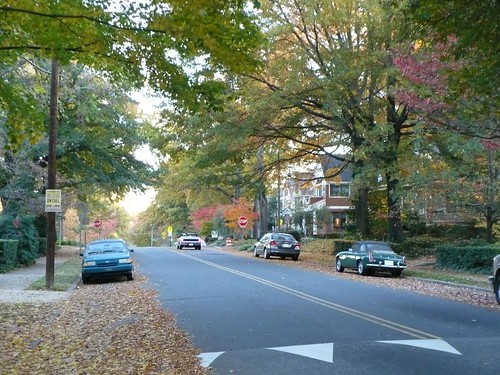
The Dilworth Streetcar Suburb. Look familiar?
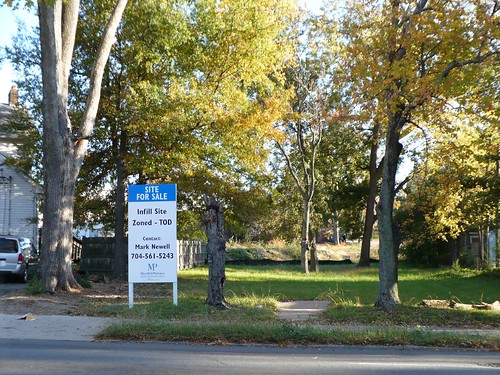
Because there was no comprehensive plan for the South End, everything is Zoned TOD.

It's going to be a sad that they will have to cut down some of these trees.
New development in the south end.
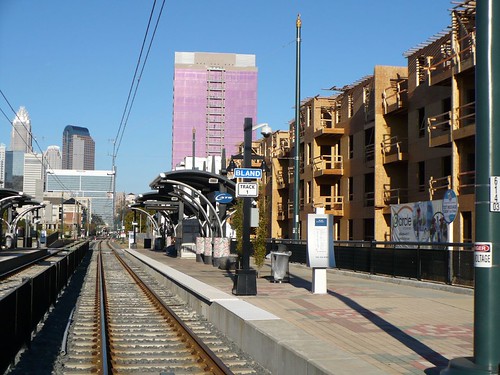
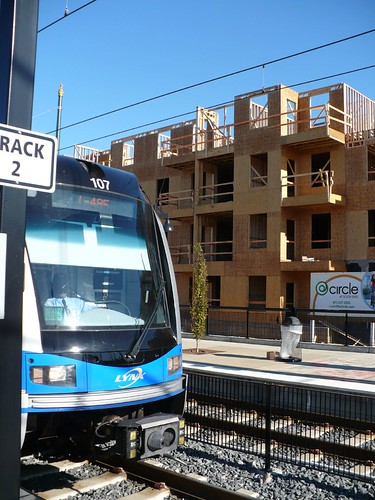
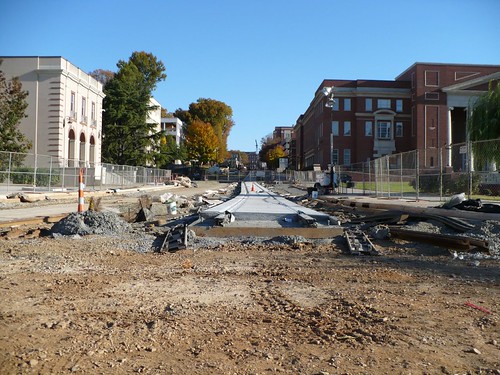
New Streetcar Tracks on Elizabeth Ave.
The Surveyer

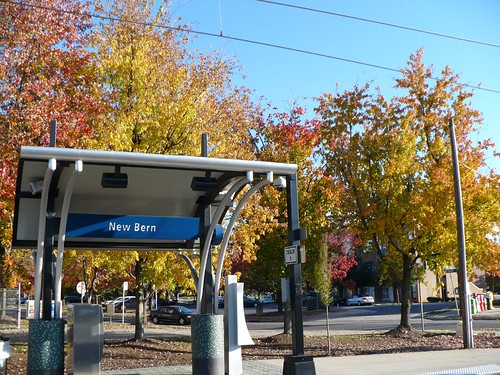
Fall Foliage

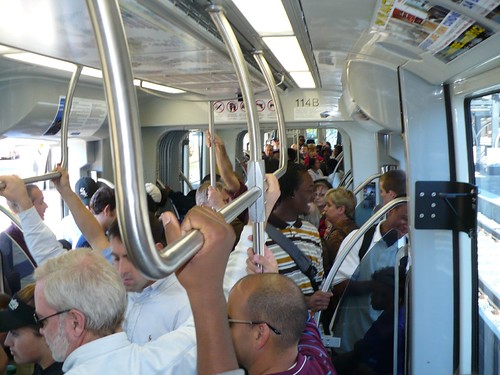
Mid-Day Thursday ridership
The Dilworth Streetcar Suburb. Look familiar?
Because there was no comprehensive plan for the South End, everything is Zoned TOD.
It's going to be a sad that they will have to cut down some of these trees.
New development in the south end.
New Streetcar Tracks on Elizabeth Ave.
The Surveyer
Fall Foliage
Mid-Day Thursday ridership
Bikes & Streetcars Coexist
Mike over at Transit Miami sent me over a link to a planning study on Bikes and Streetcars. Lots of really cool pictures of how life should be.
Building Up the Industry
So it seems that while we're looking to bail out our auto industry at the same time the European tram manufacturers are drooling over the expansion of rail in this country. While there is a buy America component, the profits go back to Europe and Asia. It seems about time to start to think seriously about building up a transit industry here?
But that is not stopping European companies like Siemens of Germany, AnsaldoBreda of Italy, CAF of Spain and Skoda of the Czech Republic from jockeying for position at the head of the line, eager to supply sleek new streetcars, now tagged light rail vehicles, for one of the few fast-growing markets for trams. Competition from elsewhere comes primarily from Bombardier of Canada and Kinki Sharyo of Japan.
Sunday, November 9, 2008
People of the Green Book

The audio above is Andres Duany at this last weeks CNU Transportation Networks Summit. Now I don't agree with everything Andres says. A lot of times he drives me nuts when it comes to transit modes like streetcars because he'll go into a city and say something completely crazy like limiting streetcar distance or density before transit which are things I haven't agreed with. But in this instance he makes a lot of sense.
I often wonder if we're over engineering our light rail and streetcar lines as to render them so expensive that the BRT folks swoop in and say cheaper is better. The first lines we built in this country were on shoestring budgets with off the shelf vehicles and know how from folks that operated streetcars that were discontinued. As we get further away from that knowledge base, we continue to gold plate systems using super heavy catenary that is aesthetically displeasing and have been perhaps over lawyer-ed. But the technology remains basically the same, just as the automobile and we've lost a lot of that knowledge.
What Andres talks about in losing knowledge of how to build roads is seen in our cities where cars go too fast and road diets are often the new buzz word. What the engineer knows comes from the engineering manuals. Yet there is years of knowledge out there and best examples in our cities and existing rail lines that we can learn from. The clip is about 4 minutes. I cut out the part I thought was interesting from the 30 minute talk. So enjoy. I hope to do more of these audio things now that I have a recorder.
I often wonder if we're over engineering our light rail and streetcar lines as to render them so expensive that the BRT folks swoop in and say cheaper is better. The first lines we built in this country were on shoestring budgets with off the shelf vehicles and know how from folks that operated streetcars that were discontinued. As we get further away from that knowledge base, we continue to gold plate systems using super heavy catenary that is aesthetically displeasing and have been perhaps over lawyer-ed. But the technology remains basically the same, just as the automobile and we've lost a lot of that knowledge.
What Andres talks about in losing knowledge of how to build roads is seen in our cities where cars go too fast and road diets are often the new buzz word. What the engineer knows comes from the engineering manuals. Yet there is years of knowledge out there and best examples in our cities and existing rail lines that we can learn from. The clip is about 4 minutes. I cut out the part I thought was interesting from the 30 minute talk. So enjoy. I hope to do more of these audio things now that I have a recorder.
10% Off Your Next Stay
Update: Good Luck getting there on LRT. Jon and Anon have pointed out that its nowhere near the station. I thought it was the downtown station, but its one out by the new WES line.
If you take Max to your hotel.
If you take Max to your hotel.
"Our hotel has recently undergone renovation, which means we're able to offer top-of-the-line accommodations with the 10% discount that we offer to guests who use the Light Rail," said director of sales Melissa DelBalzo. "During these tough economic times, we wanted to help our guests get the best deals possible while still feeling like they're getting pampered on the road. The savings of staying at an Embassy Suites really add up when you consider the cost of a cooked-to-order breakfast, light snacks, and free drinks of your choice - all of which we provide as a standard amenity to our guests."
Subscribe to:
Posts (Atom)