In a speech to the New York Public Transit Association, Clinton urged "bigger and bolder" transportation programs, including high-speed rail, and said modernizing the nation's transportation infrastructure and expanding transit will be a key issue for the next Congress and President-elect Barack Obama's incoming administration.
..."It takes too long and it costs too much to deliver transit projects," despite high and growing demand for more public transportation across the country, she said.
Noting that when President Dwight Eisenhower signed legislation authorizing the federal interstate highway system in 1956, the act launched the largest American public works program in history, Clinton said developing transit is a similar opportunity to leave a tangible legacy.
"Just as we built a 19th century transportation system with canals and railroads and we built a 20th century transportation system with highways, we now can build a 21st century transportation system with mass transit," she said.
Saturday, November 15, 2008
Senator Clinton Calls for Transit Investment
I've seen Hillary talk about transit before, but I think that this is probably the most direct language I've seen out of her on the subject. This is change I can believe in.

More Stim
Some high level officials gathered in Evanston to talk about transportation's future.
"Our transportation network has been the envy of the world, but we're starting to fall behind," warned Minnesota Rep. James Oberstar during the William O. Lipinski Symposium on Transportation Policy at Northwestern University in Evanston. The gloomy financial forecast is "all the more reason to invest in transportation infrastructure," said Oberstar, a Democrat who chairs the U.S. House Transportation and Infrastructure Committee. "Every billion invested in infrastructure means 34,000 jobs."
Rep. Jerry Costello, a downstate Democrat who heads up the House Subcommittee on Aviation, said the House will likely take up an economic stimulus package after Thanksgiving and added, "I've been assured that a large part of that will be for infrastructure."
Friday, November 14, 2008
Watch Out for Big Rail
Mr. Setty referenced the article earlier but this quote is hilarious:
H/T ASD
And then you’ve got the rail transit lobby. The transit lobby is about 4 or 5 times bigger than the highway lobby. People always think there’s this huge highway lobby, but the highway lobby is very small compared to the transit lobby. And there’s enormous profit to be made. The average urban freeway in America costs about 5 to 10 million dollars per lane mile, and the average light rail line is cost up to 80 million dollars a route mile. So obviously there’s a lot more profit to be made building rail than there is building highway and so naturally the companies like Parsons-Brinkerhoff and so forth – Bechtel –that build transit are going to be lobbying for it.Of course this is all bs, but if we (I'd be all about being a part of big rail if it existed) had as much power over the road folks as Randal says, I think we'd see a different landscape in congress and in our communities. Perhaps big rail is bigger than we think or perhaps it has a different name, the livable communities movement.
H/T ASD
Friday Night Linkfest
I saw this post from Streetsblog about the transportation transition team leads. This isn't the whole team, just people leading specific sections. We should wait to see who is on the teams under these folks before we get too riled up.
~~~~~~~~~~
Looks like the FTA finally got around to saying they would fund the University Link.
~~~~~~~~~~
Stimulus for California HSR?
~~~~~~~~~~
The Capricious Commuter is back. It's not Erik, but its good to have another newspaper blogging local transportation.
~~~~~~~~~~
It looks as if Washington Metro is off the hook... for now.
~~~~~~~~~~
David Goldberg argues that the old economy of autocentricty could be over. According to a recent study in Australia written in part by the super awesome Peter Newman, $85 million dollars in up front infrastructure costs are being wasted per every 1000 housing units built on the fringe. With the $250 million in transport costs that could be saved as well, thats a lot of money thrown away.
~~~~~~~~~~
Looks like the FTA finally got around to saying they would fund the University Link.
~~~~~~~~~~
Stimulus for California HSR?
~~~~~~~~~~
The Capricious Commuter is back. It's not Erik, but its good to have another newspaper blogging local transportation.
~~~~~~~~~~
It looks as if Washington Metro is off the hook... for now.
~~~~~~~~~~
David Goldberg argues that the old economy of autocentricty could be over. According to a recent study in Australia written in part by the super awesome Peter Newman, $85 million dollars in up front infrastructure costs are being wasted per every 1000 housing units built on the fringe. With the $250 million in transport costs that could be saved as well, thats a lot of money thrown away.
A Green Deal
Time Magazine has some commentary I can believe in. A New New Deal:
But not all government spending is created equal. Obama needs to pump serious cash into the economy in a way that promotes his long-term priorities. That means billions for energy-efficient and climate-friendly infrastructure like wind turbines, solar panels and mass transit, but nothing for new sprawl roads that ravage nature and promote gas-guzzling.He's right, water and other basic infrastructure is complicit in the growth as well as roads. Doing things that can focus future growth in sustainable ways should be on the top of the list. Arnold and others would do well to pay attention to this.
A Blank Canvas
So many people are expecting that their agendas will be possible in an Obama administration. Even folks looking to expand roadway capacity and bring tolling schemes to bear. Now tolling is not all bad, but it's not as some feel, the solution to everything. And bus rapid transit is not the solution to everything just like rail isn't the solution to everything.
Michael Replogle, transportation director for the Environmental Defense Fund, told the group that with revenue from gasoline taxes in constant flux, leaders need to start thinking about adding tolls to existing roads and opening rapid bus transit lines.
The transportation expert also suggested that technology will lead to GPS-based pay-by-the-mile taxes, or an all-toll-road system that changes fees based on real-time traffic volume.
"We're at the cusp of a new era," Replogle said, adding that President-elect Barack Obama's administration will likely embrace such changes.
Do we have any evidence that Obama or his administration would be behind these types of measures? I feel like this is something he hasn't signed on to, at least not that I have seen. But as people had said before the election season even started, folks see him as a blank canvas to project their hopes and dreams. I heard he's going to give everyone a star wars lego set. Can I expect to see that soon?
As an aside, can we stop calling freeway buses in HOV lanes bus rapid transit? We need to define what BRT really is so people understand what others mean when they say BRT.
Thursday, November 13, 2008
A Thousand Words
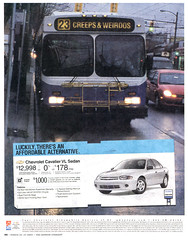
Creeps & weirdos GM ad against transit
Originally uploaded by rllayman
And we wonder why we have to work so hard to get people to take transit. h/t Richard Layman
Insurance By the Mile
What a novel concept! I wonder if it would lower my costs. I already get a discount for driving low miles but it would give an even greater incentive to stay out of the car.
Auto - Centricity
I really don't like transit stations in the center of freeways. It takes away the best land for TOD, and exposes riders to the elements not to mention caters to cars and work trips rather than non-work trips. If we didn't build another freeway centered rail line I would be pretty happy. But alas that won't happen. We'll see another one soon in Antioch.
The Green Facade Falls Hard
We knew he was faking after all of those cuts to transit funding, but give me a freakin break. The Governor plans to circumvent the new California Sprawl law to build highways. This is not green. This is not any color close to green. It's the new black death.
Now, according to sources in the state legislature, the Schwarzenegger administration is proposing to waive all greenhouse gas and pollution restrictions for large transportation and flood projects as part of the "economic stimulus" package proposed for the legislature's special session, convened last week.
Under the administration's proposal, any transportation project funded "in whole or in part" with bond funds would be exempt from comprehensive environmental reviews. That would include most new roads and freeway expansions, which will facilitate millions of new car and truck trips, adding tens of thousands of tons of planet-warming carbon dioxide and other pollutants to the atmosphere.
Subscribe to:
Posts (Atom)