Redevelopment, as it turns out, is actually bad because it prompts higher property values (and taxes) and might gentrify the district, forcing some people to move. In other words, light rail should be prevented from doing what it does best: add value to urban neighborhoods. More stations might be OK, according to the suit, but only if nearby residents and businesses are insulated from the ravages of prosperity. At least that's the drift of the argument.So do we just not improve anything? I'm sure that's not the answer. But these things are tough to balance.

Sunday, January 24, 2010
The Ravages of Prosperity
It's interesting how any transit investment can be seen as good or bad based on how the increase in values affects the community. Some want better property values but others don't for fear of being displaced. So you're damned if you don't, damned if you do.

Public Input in Ogden
I was really shocked by this quote in Standard Net, the newspaper for Ogden Utah:
It shows a disconnect between the citizen process and leaders such as the Mayor of Ogden who haven't wanted to see the 25th street alignment considered at all because 36th was his idea. There was also thefear of the state DOT who people have always believe would not want the streetcar running on their road, whether in a dedicated ROW or not. Perhaps the upstart group should look to some of the Urbanophile's suggestions for beating state DOTs and apply them to both UDOT and UTA.
UTA spokesman Gerry Carpenter said he is impressed with the amount of homework and energy the Trolley District group put in and believes the group has worthy goals, but it may be coming to the table too late.That last part about coming to the table too late is outrageous considering the group has been looking at the 25th street alignment over the 36th street alignment for over a year and has been very vocal about it as well. They were never allowed at the table, so to say they were late is a bit disingenuous. I know this only because I went to speak about streetcars in Ogden about a year ago, though not to advocate for a specific route. The activists were pounding the pavement in support then and are still on the path now.
It shows a disconnect between the citizen process and leaders such as the Mayor of Ogden who haven't wanted to see the 25th street alignment considered at all because 36th was his idea. There was also thefear of the state DOT who people have always believe would not want the streetcar running on their road, whether in a dedicated ROW or not. Perhaps the upstart group should look to some of the Urbanophile's suggestions for beating state DOTs and apply them to both UDOT and UTA.
Friday, January 22, 2010
TOD Will Pay Someday
Unfortunately it feels like there is a bit too much optimism that TOD will pay for infrastructure such as rail. Really though, the increase in value brought by new transit lines has too many people fighting over it, from the basic infrastructure to affordable housing to the lines themselves. We can't expect to put all of that weight on the back of a few projects. However we keep making TOD out to be the savior of all. I feel like it can do a lot of things, just not everything.
Thursday, January 21, 2010
Assume the Risk
There have been a lot of issues recently over cost estimates that are starting to rub me the wrong way. I had never mentioned it before but in my head I kept thinking to myself that the cost for LRT in Norfolk seemed awfully low. The most recent estimate was $232 million for 7.2 miles. Compared to most LRT lines that would have been a steal. Phoenix was upwards of $80 million per mile while Norfolk was hovering around $32 million. Now it's $340 million which is still ok at $47 million a mile, but everyone is going crazy.
But today I saw something interesting out of Houston. The city is going to pay up front an extra $100 million for their contract and the bid winner will assume liability for any cost overruns during the project (assuming it doesn't cause them to go out of business). My question then becomes, how come we don't make all contractors stick to their cost estimates?
While I understand that things change and work orders change, shouldn't the company which came in with the chosen bid be responsible for seeing through with their magic eight balls? Perhaps that is asking too much or asking in some instances for disaster. Cutting corners leads to bad things and I certainly wouldn't want a contractor to go cheap on materials because they were trying to make money. In any event, with all these cost overruns on projects that are making LRT look bad, I don't see why more isn't being done to make the bidders more responsible for their bids.
But today I saw something interesting out of Houston. The city is going to pay up front an extra $100 million for their contract and the bid winner will assume liability for any cost overruns during the project (assuming it doesn't cause them to go out of business). My question then becomes, how come we don't make all contractors stick to their cost estimates?
While I understand that things change and work orders change, shouldn't the company which came in with the chosen bid be responsible for seeing through with their magic eight balls? Perhaps that is asking too much or asking in some instances for disaster. Cutting corners leads to bad things and I certainly wouldn't want a contractor to go cheap on materials because they were trying to make money. In any event, with all these cost overruns on projects that are making LRT look bad, I don't see why more isn't being done to make the bidders more responsible for their bids.
Wednesday, January 13, 2010
Ding Dong the Witch is Dead
Well sort of. Today the 2005 dear colleague letter that then FTA Administrator Jennifer Dorn released on the world requiring that all New Starts projects have a medium rating on their cost effectiveness has been rescinded. Many have hailed this as a huge step forward for livability advocates but honestly its only half of the picture. One of the reasons I believe that the medium rating was imposed was to build more cheap BRT projects and cut out subway and lrt projects. But another reason was to cut all the junk projects out of the funding loop. With only about $8 billion dollars available for new starts projects in the last transportation bill, it leaves the need for regions to pick up the hundreds of billions more needed to build out transit networks. One estimate pegged the total at approximately $250 billion dollars. That is a huge gap.
So while some newspapers including the New York Times believe that this is opening up the funding floodgates, they are sorely mistaken. It does however change a few dynamics that have been holding projects back. The Central Corridor in Minneapolis is a curious case. They have been wanting to add a station in St. Paul to serve lower income community however it slowed down the travel time just enough to push the line over the index. This is just one example of how suburban to downtown speedy travel is emphasized over shorter trips in denser communities by the existing cost effectiveness index. Yonah has specifically mentioned another Minneapolis project that I also believe is headed in the wrong direction.
Dropping the medium requirement also takes a step towards making us think harder about what we're really building transit for. Is it for existing population or the future population or both? A common comment about the current cost effectiveness rating is that it would have never funded the DC or New York Subways. But DC and New York would not have gotten to where they are now in terms of density without the investments in the subway. Really this is a chance to start thinking about how to make transformative investments in transit around the country. It's an opportunity we've been waiting for, but as with all big ideas, it needs money.
So while some newspapers including the New York Times believe that this is opening up the funding floodgates, they are sorely mistaken. It does however change a few dynamics that have been holding projects back. The Central Corridor in Minneapolis is a curious case. They have been wanting to add a station in St. Paul to serve lower income community however it slowed down the travel time just enough to push the line over the index. This is just one example of how suburban to downtown speedy travel is emphasized over shorter trips in denser communities by the existing cost effectiveness index. Yonah has specifically mentioned another Minneapolis project that I also believe is headed in the wrong direction.
Dropping the medium requirement also takes a step towards making us think harder about what we're really building transit for. Is it for existing population or the future population or both? A common comment about the current cost effectiveness rating is that it would have never funded the DC or New York Subways. But DC and New York would not have gotten to where they are now in terms of density without the investments in the subway. Really this is a chance to start thinking about how to make transformative investments in transit around the country. It's an opportunity we've been waiting for, but as with all big ideas, it needs money.
Sunday, January 10, 2010
Sunday Night Notes
I realize there has been much less posting here, but if you still want links you can follow me on twitter which seems to be more regular. @theoverheadwire
There are some interesting links today however:
I don't really think cities should compete to land new jobs. Especially for government funded jobs such as Northrup Grumman.
~~~
Wal Mart doesn't create new jobs. Tell us something we don't know.
~~~
So does this mean Smart Cars are PRT?
What does urban authenticity mean?
There are some interesting links today however:
I don't really think cities should compete to land new jobs. Especially for government funded jobs such as Northrup Grumman.
~~~
Wal Mart doesn't create new jobs. Tell us something we don't know.
~~~
So does this mean Smart Cars are PRT?
“Smart’s not a car in the traditional sense, it’s a high- style alternative to public transportation,”~~~
What does urban authenticity mean?
Wednesday, January 6, 2010
Is It a Wonder How Housing Prices Are So High?
I appreciate environmental regulations and the like, but it seems like a lot of folks in California just take it too far:
Talk of any development along the rail line has raised concern in the environmental community, some of whom believe the system will act as a catalyst for growth, as developers try to build for those who want to live near a train station.and this:
Under proposed air-quality guidelines, for the first time in the U.S., if extra cancer risk meets a specific threshold, the developer would be told to study the potential health effects of the freeway pollution on the people who would live in the homes. That would be in addition to what the developer is already required to do: study the effects of the housing on freeway traffic and the surrounding environment. If the health risk is too great, the developer might need to modify or scrap his development plan, or spend extra time persuading the city or county to approve it.If we can't develop near transit stations or near freeways in existing urban areas, where the heck are people supposed to develop new homes that won't affect the environment? Am I missing something here?
Tuesday, January 5, 2010
Can One Development Catalyze a District?
And is it right to be developing once vital industrial land? It's a question that often comes up that I don't quite know the answer to. Here in Oakland many properties in West Oakland have been deemed off limits to commercial or residential development. Many council members want to preserve the industries that provide much needed jobs and an economic boost.
In Denver, there are developers who are looking to revitalize the South Broadway area around the Evans station that is primarily industrial. Much of the project is a mixed use redevelopment on six acres that was once a superfund site. The developer is a single developer which also begs the question of how a market gets started. Once he proves that the area is changed and continues to build more and more projects, other folks will follow suit. But ultimately the developer is the one who will boom or go bust.
I find this interesting because everyone is always looking for the next big neighborhood or district. In the past improvements have been predicated on good bones. The gridded street network already exists and a light rail station is already near by. But at the moment the market isn't there. Could it be a single developer who creates a market? Or are markets organic and ultimately unpredictable. I guess we'll find out.
In Denver, there are developers who are looking to revitalize the South Broadway area around the Evans station that is primarily industrial. Much of the project is a mixed use redevelopment on six acres that was once a superfund site. The developer is a single developer which also begs the question of how a market gets started. Once he proves that the area is changed and continues to build more and more projects, other folks will follow suit. But ultimately the developer is the one who will boom or go bust.
I find this interesting because everyone is always looking for the next big neighborhood or district. In the past improvements have been predicated on good bones. The gridded street network already exists and a light rail station is already near by. But at the moment the market isn't there. Could it be a single developer who creates a market? Or are markets organic and ultimately unpredictable. I guess we'll find out.
Monday, December 28, 2009
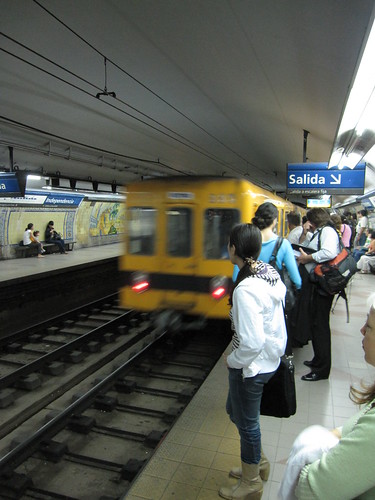
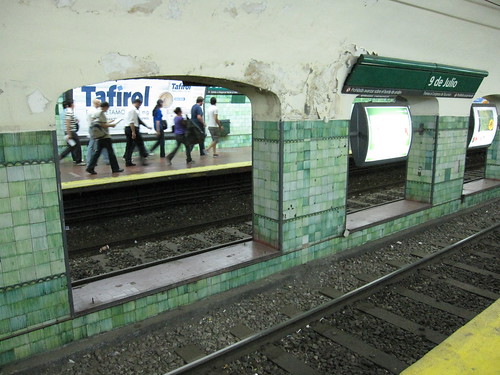
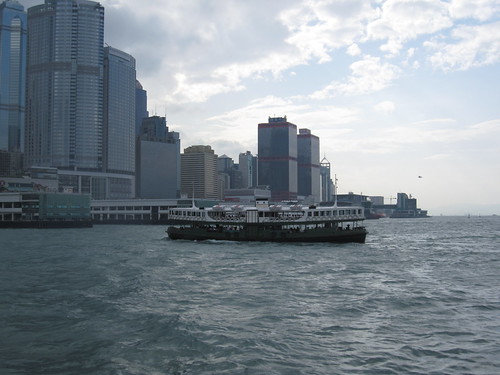
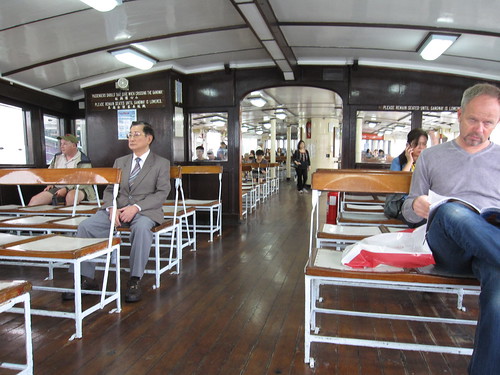
Around the World: Argentina & Hong Kong
Fearless Overhead Wire correspondent and world traveler @nspicer just got back from his honeymoon in Argentina with @autgoff and took a few transit shots because he knows that I'm a nerd and I appreciate these things. He's also recently been to Hong Kong and rode the Star Ferry. Here are a few shots from his travels. Thanks Spicer and Anna!


Subscribe to:
Posts (Atom)