Wednesday, June 16, 2010

New Siemens S70 LRV Debut in Salt Lake

We discussed these bad boys when the order was put in back in 2008. The thing I find interesting about this version of the S70 is that they are snout nosed and less archy on the ends than the new Portland and San Diego vehicles. This apparently was so that they could continue to run four car trains.

Here's a photo of Portland's new LRVs (with some older)


via Thomas Le Ngo on Flickr

Then the new Salt Lake City version

via Transit in Utah

I think I actually like them better. If anyone in Utah gets some photos shoot em over and we'll post them.

Thursday, June 10, 2010

Oakland Streetcars

The last few years have seen many ideas tossed around for a streetcar line up Broadway in Oakland. I like the idea personally because it would allow me to take the streetcar to Kaiser Hospital if I have Doctor's appointments during the work day and potentially revitalize a corridor with a huge economic upside. I've seen lots of floated ideas but none are as well thought out as Daniel Jacobson's plan. He really did his homework and has a great result. Hopefully some folks in Oakland take a good look at this work.

Saturday, June 5, 2010

Temporary Switch

I'm a fan of Veke on facebook but most of the time I have no idea what they are talking about because Hungarian to English translation leaves much to be desired. But I enjoy their work covering trams in Budapest and other Hungarian cities. So it was kind of cool to see how an emergency tram switch would be employed when a section of track was closed due to what I believe is some sort of flooding. While they fix it, this ramp allows trains to move forward without having to dig into the track surface. Check out the blog through google translate here. Also check out the youtube video below.

Friday, June 4, 2010

Midnight Notes

So sad to see that Elana Schor is moving on from Streetsblog. You can still follow her work but it's not likely to be all transportation all the time.
~~~
I can appreciate the want to allow people to walk and bike to the store and perhaps consume less in general. But saying that people can't buy a lot of groceries seems like a bit of overkill to me.
The plan intends to discourage large purchases, which will help ensure that people walk or bike home.
I really only have time to go to the store once a week and I walk and use a single reusable bag. But if you have a large family that can be a bit tougher. What do you all think?
~~~
If you haven't seen the dramatic photos that show the change of the Vancouver skyline, i suggest taking a look at Price Tags.
~~~
I think Megan McArdle completely underestimates the value of buses and bikes in congestion pricing schemes. She doesn't make a single mention of them. While the subways in New York are crushed, if you limited traffic and gave buses and bikes some lanes, you might find that transit service could improve and people could get around the city just fine without their cars. While I love the subways and think many cities should have better subway systems (ie San Francisco) I think we discount the roll of buses and bikes at our own peril.

Tuesday, May 18, 2010

Kids These Days

The day that I went somewhere and said "dang kids" was the day I knew that I had grown old. Not that I am that old, but it just means I'd started desiring different things in my older life than that of my childhood. Kid me would probably be off buying packs of baseball cards and candy corn. Today though I can't even muster up the courage to throw down for an xbox 360 to finally play Halo 3.

But I'm not the point where I'm telling kids to get off my lawn like New Urbanist Andres Duany. In an article in the Atlantic in their very cool city section, Andres goes on to do just that:
There's this generation who grew up in the suburbs, for whom the suburbs have no magic. The mall has no magic. They're the ones that have discovered the city. Problem is, they're also destroying the city. The teenagers and young people in Miami come in from the suburbs to the few town centers we have, and they come in like locusts. They make traffic congestion all night; they come in and take up the parking. They ruin the retail and they ruin the restaurants, because they have different habits then older folks. I have seen it. They're basically eating up the first-rate urbanism. They have this techno music, and the food cheapens, and they run in packs, great social packs, and they take over a place and ruin it and go somewhere else.
I'm not quite sure where this came from. It's pretty low to bash on the people who are moving to cities in droves because they want the urban experience. Do we all become angry at younger folks like this at some point? I sure hope not.

Monday, May 17, 2010

The Discussion is Lacking

Audio Wire Logo

This exchange on Real Time with Bill Maher between Chris Matthews and Ross Douthat is the perfect example of why this country is so misinformed. While Chris goes on extolling the virtues of High Speed Rail, all you can hear Ross say is that Amtrak is heavily subsidized. No mention of highway subsidies or other market distortions, just the fact that Amtrak is government run. And no one really fights back. Never mind that most of the time it has to borrow tracks or has a higher operating recovery ratio than any other mode in this country.

Anyway, listen to the exchange and see how the country can be mislead so easily by people that don't discuss things with the facts. I always say this when I listen to people I think might be smart talk about a subject I know something about, but I need to remind myself that if they are this unintelligent about a subject I know about, how much do they know about things I don't know about, and what kind of misinformation am I getting on other subjects?

You can listen here before the flash uploads.

For some reason the embed feature wasn't working. The audio is still at the link above...

Thursday, May 13, 2010

On Gentrification, Supply, and Expansion

Living in the bay area can be particularly maddening. Even if you're working hard and making a good living, you are likely to still not be able to afford a house in the neighborhood of your choice. The reason being its so hard to build anywhere without coming up against NIMBYs and people that already have theirs. Take the BRT disaster where Berkeley rejected even doing the study for dedicated lanes in the city limits. It seems like progress is just a step away but defeat is often snatched from the jaws of victory.

I sometimes wonder why we can't just build more dense housing in employment districts or places where NIMBYs don't exist. There's a huge supply of land in these areas of San Jose with parking lots that could use serious transit infrastructure expansion. But the fact of the matter is that areas that are really desirable and dense are for the most part built out, and since they are built out their cost continues to increase dramatically because people really want to live there and there is a limited supply.

Take for example the Mission in San Francisco. For many years it was a lower income neighborhood known for its culture but over time transitioned. There are still vestiges of this in the compact and livable urban environment, but now the hipsters have come. I'm not sure that's a bad thing per say but we've seen this story before. Certain parties populate an urban neighborhood and then others follow until it becomes upper class, it gentrifies/yuppifies (a good read here on this subject). This end state of neighborhoods is seen as awful for the folks that were pushed out, but it is also seen as progress for the city as buildings get painted and the garden flowers are potted. This very end state of the process or "Starbucks Urbanism" is what becomes the mark of progress for those seeking it.

The problem however I see with this is not the end state per say, but the fact that the process has to happen at all. The biggest issue I have with the gentrification claim is that it can be rendered useless if we actually supplied housing for the actual market for housing. I know this is a claim long pushed by the planners and CNU set, but there's actually something behind the idea that we've overproduced single family housing and under produced urban types. What we've seen in urban neighborhoods with good bones over the last decade or so is a transformation based on lack of opportunity to improve without pushing out the middle.

But I do see a possible opportunity in the massive expansion plans that exist due to the transit space race to improve without pushing away. With multi-line expansion plans in places like Los Angeles, Denver, and Seattle, so many stations will be brought on line, the market won't be able to get to them all at once. One of the major benefits and worries of these new transit lines is that they will bring increased property values and push out existing communities. While this will provide better mobility to many of these areas, it's not likely to bring wholesale change to each of them. But it does start to provide opportunities for building housing that starts to change the urban vs. suburban market, without focusing it all on one close in neighborhood such as what has been happening in smaller regions that build transit over the last boom. We'll see what happens, but this is the theory I have.

Tuesday, May 4, 2010

Bad Design and Money Disconnects

Hey everyone, I realize that the posts on here have slowed to a crawl. I don't meant to neglect them but sometimes life gets in the way. You can find links from me on twitter everyday @theoverheadwire. They are also on the bottom right of the blog. But on to biz:

I've had some tabs open that I really wanted to comment on but hadn't gotten a chance. So if this is old news I apologize:

First off, Kemper Freeman stands to gain a lot of development money from light rail. It's unfortunate that his head is so far up his ass that he can't see the dollar signs and is instead wasting them on lawsuits. No matter, give all those earnings to the lawyers and watch him lose anyway.

~~~

Second, I'm really annoyed at Yahoo's campus design. This is just more suburban crap and instead of creating buildings and a street network that actually form a true urban grid, such that other buildings could form some sort of urban neighborhood around them. This is what is wrong with our employment centers and why they aren't walkable, making it harder to take transit. Sure its better than what was there before, but it could have been used to set off a new way of developing office parks that was sustainable. Great you're next to a light rail line and it looks like a school campus. I still think Adobe is the champ for going downtown.


~~~

Finally. If you haven't seen it yet, the 1906 SF streetcar video is pretty cool. You can find more explanation at Market Street Railway.

Monday, April 19, 2010

Perhaps a New Game

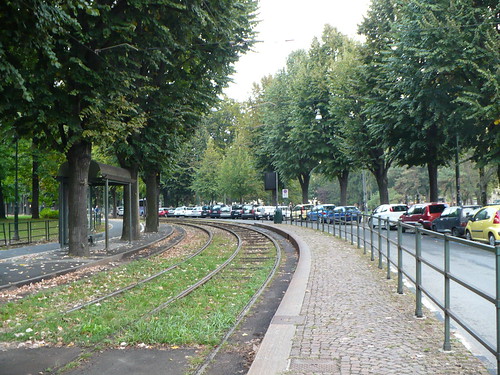
It's called, spot the wires. Sure are ruining this nature scene for everyone! This is Turin, Italy.

Italy Transport

Thursday, April 15, 2010

Bigger Thinking on Texas Stadium Site

In my post below I talked about how hard it would be to connect the two parcels over the freeway. Looks like they have thought about that.

In an article in Fast Company, the developers and city of Irving are looking to make the freeway choked property where the stadium once was into "the densest, most walkable neighborhood in the Dallas-Ft. Worth Metroplex outside of downtown Dallas." That's a pretty bold statement. But the renderings show they have some ideas about how its gonna be, and I must say, they do have a grand imagination.


Via the Irving Chamber

If they can get this done more power to them. I especially appreciate them doing it on the transit line. Now how about that transit connectivity? This type of density needs more than just one rail line.