A little light hearted Oakland post.
Friday, January 9, 2009

Rail Opponent Cliche Fest
Ryan points out the dumb comments the Post starts its article out with:
"Despite its substantially higher cost"He goes on to comment:
Despite its substantially higher cost, I ordered the delicious steak the other night, instead of the potted meat. Despite its substantially higher cost, I bought a nice bottle of wine instead of a plastic jug of horse spit. Despite its substantially higher cost, I opted to burn a pile of money, rather than shell out for a copy of the worthless Washington Post.I'll do you one better! How about all these wonderful anti rail cliches from US News and World Report:
Democratic bleeding heartsWho thinks US News should stick to college rankings?
social engineering program
nice thing to have. But
at a fraction of the cost, buy swank new buses
half the cost of light rail, build a dedicated "bus rapid transit" system
riders of the proposed Purple Line already take mass transit to work
proponents are actually hurting the cause
Walk & Train
Ryan says:
It's easier to support a carbon tax if you have a grocery store within walking distance and can take the train to work.Absolutely. I would likely be skeptical if I were living in Austin still and knew that I had to drive to get most places. Now that BART and the Grocery store are a half mile in each direction, I don't worry about it anymore. I fill up my car maybe once every month and a half, sometimes even longer. Think about if everyone was able to move from once a week to once every two months. More money for local business, more money for alternative energy and more money for housing near transit. Winners all around.
Reframing a "Highway" Bill
We need to stop calling it the "Highway Bill". It should never fund mostly highways ever again. It's just like the needed reframing of the "Farm Bill." Michael Pollan has called for it to be called the food bill.
Doing so starts with the recognition that the "farm bill" is a misnomer; in truth, it is a food bill and so needs to be rewritten with the interests of eaters placed first. Yes, there are eaters who think it in their interest that food just be as cheap as possible, no matter how poor the quality. But there are many more who recognize the real cost of artificially cheap food--to their health, to the land, to the animals, to the public purse. At a minimum, these eaters want a bill that aligns agricultural policy with our public-health and environmental values, one with incentives to produce food cleanly, sustainably and humanely.If we follow this logic to its transportation end, we should be calling the transportation bill something else entirely. Livable mobility bill? This means that the bill should be written with livability placed first. Is that so hard a goal? Let's try Michael's paragraph replacing the food words with transportation words.
Doing so starts with the recognition that the "highway bill" is a misnomer; in truth, it is a livable mobility bill and so needs to be rewritten with the interests of people placed first. Yes, there are people who think it in their interest that driving just be as cheap as possible, no matter how poor the quality. But there are many more who recognize the real cost of artificially cheap driving--to their health, to the land, to themselves, to the public purse. At a minimum, these people want a bill that aligns transportation policy with our public-health and environmental values, one with incentives to move us cleanly, sustainably and humanely.Sounds pretty good huh? If you have something better than the livable mobility bill, let's hear it.
Thursday, January 8, 2009
Smashing
People are mad. I'm not happy about it either. But why smash stuff that has nothing to do with what happened on that BART platform? Becks has posted another person's story about how things got out of hand, and hotter heads prevailed. It's unfortunate that a few need to be hooligans and vent anger that exists in this way. Here's a commentary I agree with to a certain extent.
Working downtown has given me some perspective, but I don't understand most of the dynamics. The underlying issues need attention. And I don't think anyone in the leadership of the city is paying enough attention to what is going on deep down to actually fix it. I don't know the answer, but hopefully someone will think outside the box on this. The shooting was just one event, but so was the killing of Franz Joseph. It's a powder keg in Oakland and we need a solution. Where's the leadership summit? Where are the bright minds and big hearts? This is a cycle that must be broken.
No question that Oakland is a full-on bonfire, soaked in gasoline and just waiting for a match or two. Chronicle columnist Chip Johnson and reporter Henry Lee have provided readers a long running and deep image of a city off its moorings, from hapless (or absent or corrupt) government leaders to rampant homicide.This has been boiling for a while. Oakland seemed a bit sleepy for a while but Dellums being the absent professor isn't helping and no one has really taken a leadership role in the city of late. I'm not afraid but rather sad. The city has such great potential but seems to have a bit of a complex. Always overshadowed by San Francisco, Oakland developed an identity related to the bad things that have happened. But it has great qualities. It has great bones.
Working downtown has given me some perspective, but I don't understand most of the dynamics. The underlying issues need attention. And I don't think anyone in the leadership of the city is paying enough attention to what is going on deep down to actually fix it. I don't know the answer, but hopefully someone will think outside the box on this. The shooting was just one event, but so was the killing of Franz Joseph. It's a powder keg in Oakland and we need a solution. Where's the leadership summit? Where are the bright minds and big hearts? This is a cycle that must be broken.
Wednesday, January 7, 2009
Restructuring Property Tax to Land Alone
I don't remember posting this when it popped up, but its something I remember a classmate discussing in grad school and I just found it again after the break. At the ULI blog:
I think this is a very interesting idea. This would keep large swaths of downtown land from continuing on in life as parking lots. But it might also have the effect of having something built, but not quite to the density that it really should be over the long term.How about restructuring the property tax across America to install a two-tiered system? More tax on those horizontal pieces of empty land and asphalt, less on the buildings. That is, reduce the tax rate on homes and other improvements, and substantially increase the rate on the site value. I think such a system would induce more compact development and more infill work.
Pittsburgh has used the system for years until problems arose with the way assessments worked out, as my colleague and former Pittsburgh Mayor Tom Murphy has told me. Nonetheless, if assessments are fair, the higher land tax would bring vacant or woefully under-used central sites into use, giving new life to inner cities and reducing sprawl. It would also stem land speculation, which is the big engine behind house price escalation, thus stabilizing neighborhoods and keeping sale prices and rents more affordable. The land tax returns to government--the values it creates with bridges, roads, and other infrastructure--helping to pay for maintenance and necessary improvements.
Did Anything Really Change?
Apparently Dulles is a go. But Ma Peters made a comment:
"We wanted to find a way to make this a good project. It's a better project than it was a year ago."Peters said the most significant improvement made by project managers was to strengthen the proposal's finances and contingency budget. The rail line's costs have spiraled in recent years, and the project was at risk of failing federal transit cost-efficiency standards. That risk is now gone, Peters said.
Did anyone think to ask them if the reason that costs were spiraling out of control was because they kept delaying the project? Then the hurl inducing comment of the week:
"God bless Mary Peters," said U.S. Rep. Frank R. Wolf (R-Va.), who, along with Kaine and recently retired U.S. senator John W. Warner (R) led state efforts to revive Dulles rail.You mean the lady that almost single handedly killed the project. Thank you sir may I have another?

Greedy DOTs Just Following Orders?
Wow, this is a lot of nerve and if true, would be really really disgusting.

Transportation leaders missed an opportunity to jump-start mass transit in Florida and to repair existing roads and bridges, he said. "The problem is our transportation leaders do not have vision," said Ashwell. The department defended the request. DOT spokesman Dick Kane said Congress requested the stimulus funds be tied not to mass transit but highway and bridge projects that can start within 90 to 120 days. "The whole idea of the stimulus package was to have projects ready to go," he said.Looks like Florida has about $13 billion in transit projects at some stage. You can't tell me that some of these can't be ready to go. Sounds like excuses to me.
Singles Use Energy
Anyone seen this? Says singles use more energy. I wonder if they controlled for city living vs. suburban living.
Tuesday, January 6, 2009
Let Them Eat Cake
...and drive on dedicated bus transitways. Yet another reason why the pavement without rails means cars. Maybe not today, maybe not tomorrow, but someday.
The Ottawa Sun added that at today's council meeting, councillors "also voted in favour of directing staff to review opening the bus Transitway to vehicular traffic."Who's next?
When Chickens and Eggs = Omelettes
Some want reversible carpool lanes, City Council members want light rail. This discussion ensues:
But transportation decisions drive development policy as well. If there is no light rail, there is no reason to get away from business as usual in development. The organizing principle and parking reduction impetus is gone. Express buses and buses in general are land use serving. That is, they will follow the development instead of shaping it. I'm not sure if there is enough of a ridership base to support light rail in this corridor so don't count me committed to one opinion yet and I really don't like light rail in freeway medians, but if they design intelligently with the future in mind, or figure out a way to get what they want, they'll smartly come out of it with something better than business as usual, scrambled eggs and chicken soup.
Regional transportation planners want to remake Foothill Drive to help carpools and express buses speed students and workers to and from the University of Utah. It's not enough for some Salt Lake City Council members, who heard the plan Tuesday but said they want light rail -- and not just up Foothill, but all the way to Park City. "Anything that encourages more cars is short-sighted and yesterday's planning," Councilman J.T. Martin said.I don't know if I would say yesterday's planning, more like Highway Era. If we go back a little further, we did do it right. But semantics aside, he's got the right idea. But then here comes the study.
...
Martin and others said the plan focuses too much on moving cars through. Switching to light rail could help reshape land uses, leading to denser housing and new development east of the road, they said."What a wasted opportunity," Councilman Luke Garrott said of the Wasatch Front study. He agreed that the plan would cement the current landscape and promote cars instead of using light rail to reshape a major gateway to the city.
But in its study, the regional council dismissed light rail for the foreseeable future, partly because current land uses wouldn't support it, said Wasatch Front Deputy Director Doug Hattery.So which is it? Will light rail shape the gateway or is the land use insufficient for light rail? In my experience it's both. If they put light rail there and hope for growth without any other interventions in land use or development policy, the train will end up being a worthless park and ride route to the city and university (Congrats Utes BTW).
But transportation decisions drive development policy as well. If there is no light rail, there is no reason to get away from business as usual in development. The organizing principle and parking reduction impetus is gone. Express buses and buses in general are land use serving. That is, they will follow the development instead of shaping it. I'm not sure if there is enough of a ridership base to support light rail in this corridor so don't count me committed to one opinion yet and I really don't like light rail in freeway medians, but if they design intelligently with the future in mind, or figure out a way to get what they want, they'll smartly come out of it with something better than business as usual, scrambled eggs and chicken soup.
Where's the Housing Action?
On the blue line in Charlotte.
This along with similar reports in Phoenix and Denver has been telling us what everyone needs to hear. If you want a strong region, there needs to be a range of opportunities for people to live. I feel like part of the reason for this continued construction on housing near transit is not only that its strong in a storm, but rather there is a lot of catching up to do in order to provide the actual product that people want. The market is so saturated with the same dreck, the pendulum swing is going to be long and hard. I hope it goes far to the other side, but I'm not holding my breath.Development in the Charlotte region has slowed for sure, but real estate analysts say persistent developers are still making things happen.
Look no farther than the Lynx Blue Line, where the Charlotte Apartment Report says 10 communities totaling nearly 3,000 apartments are in various stages of development along the tracks paralleling South Boulevard.
Monday, January 5, 2009
Round Rock Rail?
Hmm. Doesn't anyone else think they should pay their fair share before they start thinking they can use Capital Metro's tracks. And when is Central Austin going to actually get rail?
Sunday, January 4, 2009
Vacation is Over Links
Well vacation will be over in the morning. I was enjoying my time off but can't be a bum forever. Here are some links for the day.
~~~
The New York Times has an editorial asking for more funding for transit and an end to the cost-effectiveness index. Never thought I would see that!
~~~
Folks in Tampa are hoping to expand their transit types to include a rail system.
~~~
The debate over light rail vibration continues in the Twin Cities. A study says that it can be minimized by technology.
~~~
The New York Times has an editorial asking for more funding for transit and an end to the cost-effectiveness index. Never thought I would see that!
~~~
Folks in Tampa are hoping to expand their transit types to include a rail system.
~~~
The debate over light rail vibration continues in the Twin Cities. A study says that it can be minimized by technology.
Price Signals
The Vine writers over at the New Republic discusses the end of unlimited driving insurance. They discuss how it could have a greater impact on driving than even the climate bill or energy taxes. I tend to think that the more we can get people to pay the true cost of driving, the more it will change policies that encourage walkable land uses and alternative modes of transport such as biking, walking and transit.
Who Knew...
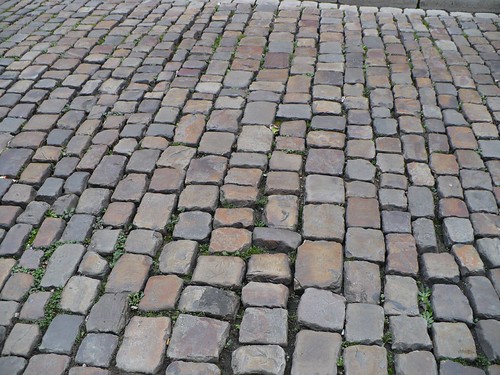
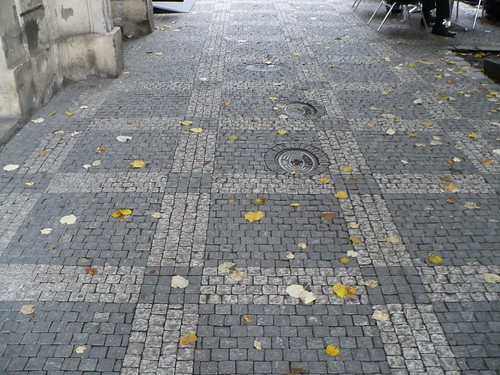
bricks were so much trouble? A lot of what I have seen in this area is concrete that is pressed to look like bricks. Is it also possible that there is a spray that could keep the friction coefficient higher on these bricks while also allowing them to look the same? Here are a few of my own pictures of good looking but perhaps troublesome brick streets.
Prague:

Vienna Woonerf
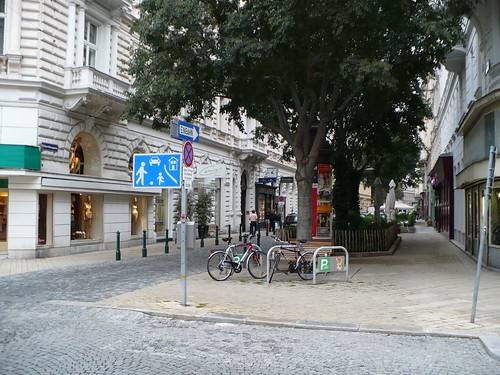
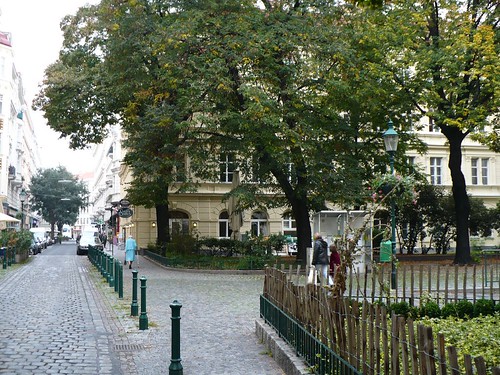
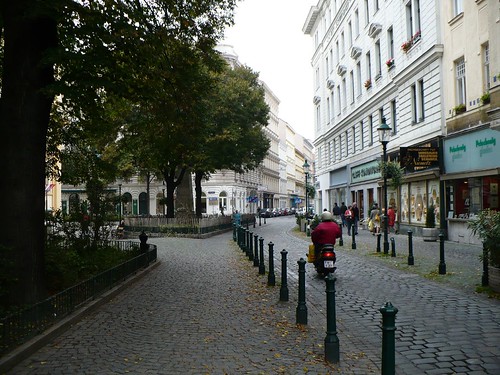
Budapest Pavers
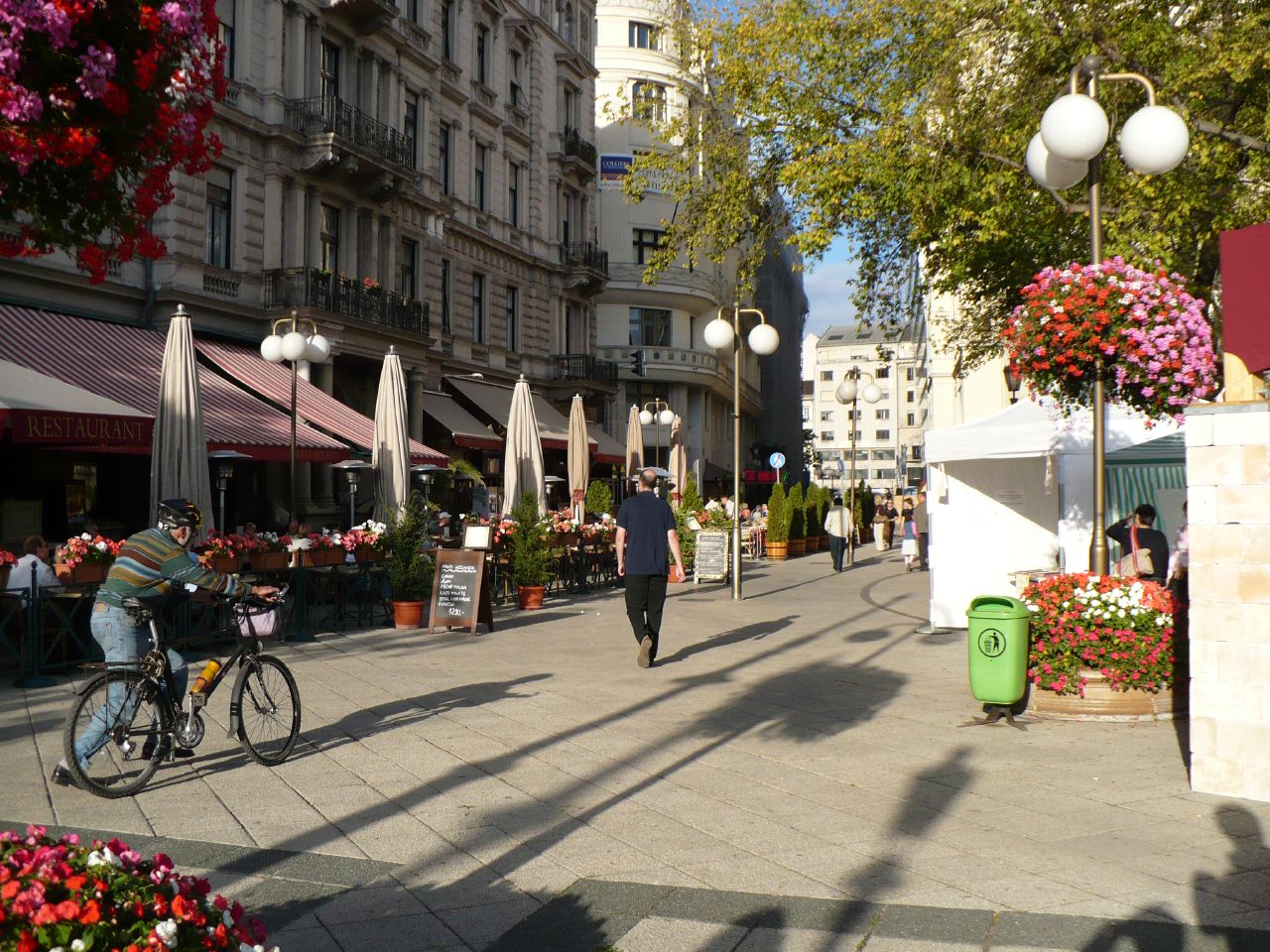

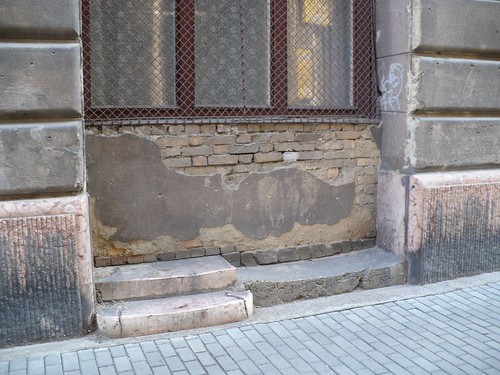
Why does this matter for transit? Well transit users are pedestrians before and after they use the train. It's important to focus on the complete movement from place to place.
Prague:
Vienna Woonerf
Budapest Pavers
Why does this matter for transit? Well transit users are pedestrians before and after they use the train. It's important to focus on the complete movement from place to place.
Subscribe to:
Posts (Atom)