It's a little early to claim victory here because of all the special events that have been going on since this line opened as well as the "new" factor, but it looks promising. Current weekday ridership numbers are at 30,000 while the projections for opening day were at 26,000. Long term 2030 numbers are expected to be around 50,000. And hey, look! A low-medium cost-effectiveness rating! Again, today it takes a medium because of a 2005 Bush administration edict. This could turn into yet another ridership projection FAIL if the ridership stays at it's current level during a severe downturn.
Ridership projection FAIL = Cost Effectiveness Index FAIL.
Wednesday, February 18, 2009

Just One More Thing From Charlotte...
David Hartgen is just looking for a backdoor way to bring down Charlotte's transit expansion. Even after getting beat down by 70% in the last election, the other side just won't give up trying to kill rapid transit expansion in Charlotte.
Hartgen said he thinks ridership will drop further because uptown layoffs are only starting, and that the drop in ridership should spur CATS to consider halting its ambitious plans to build more rapid transit. “We should be saving for our operating budget,” Hartgen said.
If anything, we should be building more transit to create jobs and shape the next housing boom. If we wait till the next housing upswing to build these types of lines around the country, we'll miss a huge opportunity to shape development. We can't afford it.
Not Dense Enough
Even in the downturn the Charlotte light rail line beat its projections. Currently ridership is down from its highs, but it makes me think that there needs to be a working over of the transportation models at the FTA. Under the current process that requires a medium rating for cost effectiveness, Charlotte would not have made the cut with its ridership projection as it was. It had a low medium rating in 2003, yet was recommended because of its land use planning. Which brings me to a second point.
An excuse for Kansas City not going back after light rail is the usual complaint. We're not dense enough. Via the Urbanophile from the KC Star:
The point of building a rail line today, whether it's light rail, a subway line, or a streetcar is the shape the future development of a corridor but this is something that isn't measured in the current process, at least with any meaning. This is something Congressman Oberstar is looking to fix, but we need to help.
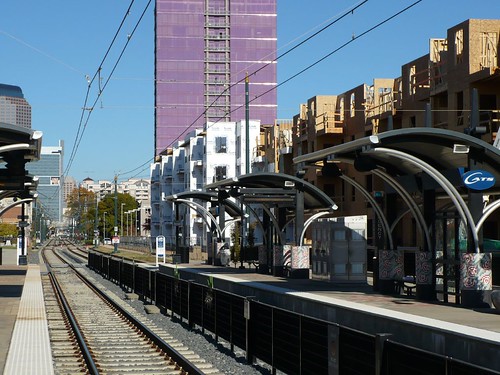
Charlotte South Corridor:
An excuse for Kansas City not going back after light rail is the usual complaint. We're not dense enough. Via the Urbanophile from the KC Star:
The city is set up for cars. As a result, most of the metropolitan area is not densely populated...Generally, an average of 6,600 to 10,000 people per square mile is needed to score federal funds. But Kansas City isn’t close to that number along the 14-mile route that voters rejected in November.So now, since they aren't dense enough currently(even in AC's weighted density) and use that as an excuse to not move forward, there will be no change and they'll continue to drift in autodom. But the problem here is not just the lack of imagination and foresight, but also that the current FTA gives no hope of change. People will continue as long as we let them to refer to the cost-effectiveness index as god's law. It's all about the now when in reality we should be planning for the future.
The point of building a rail line today, whether it's light rail, a subway line, or a streetcar is the shape the future development of a corridor but this is something that isn't measured in the current process, at least with any meaning. This is something Congressman Oberstar is looking to fix, but we need to help.
So Charlotte gives us some clues as to what we can look forward to in terms of changing neighborhood dynamics and creating a demand for future density in transit corridors. It also shows that the cost effectiveness index does not determine the success of a project, no matter how much weight seem to put on a single metric based in auto engineering. That doesn't mean we shouldn't look at the costs and weight it against the benefits. It just means the way we're doing it now is weighted towards killing meaningful projects. Places that need subways are forced by cost shock and the CEI to look at light rail and places that should have light rail are forced to BRT and so on down the heirarchy. I hope this changes, and that the "not dense enough" canard can't be used against a city looking to change its ways ever again.At this point, however, the Federal Transit Administration has declared the cost effectiveness index number and not transit oriented development as the critical factor in giving a thumbs up or down to a project. It's time for the CEI not just to be amended, but eliminated, says Rep. Jim Oberstar, chair of the House Transportation and Infrastructure Committee says.
"As soon as there is a Federal Transit Administrator I will encourage that person to, by executive order, erase it from the books. And if they don't we'll do that in legislation."The cost effectiveness index became the deciding factor for transit projects in April, 2005. That's when the FTA received a letter from the Bush administration's Office of Management and Budget proclaiming the CEI's primacy.
Charlotte South Corridor:
Tuesday, February 17, 2009
"Virgin" Rail's No Kissing Zones
Virgin rail is urging people to move along after they are dropped off at the train station. This has prompted a no kissing zone. I can understand if its crowded but don't stick too close to the name...
 Photo via Independent UK
Virgin Rail says that if passengers want to share an embrace before they part company, they should pay to park their cars nearby where they can kiss all they want.
Photo via Independent UK
In Case You Missed Them...
Two articles were bouncing around more than others today. Politico has an article about how HSR got into the stimulus bill and David Brooks talks about a really poorly defined pew poll on urban preferences for living. What if I don't want to live next to a McDonald's or Starbucks?
Practice What You Preach
Does anyone know if one of these transportation officials that doesn't take transit is Nat Ford? (CBK notes he takes the bus) It kind of makes me angry when people don't practice what they preach, especially in transit. If I didn't believe in what I was talking about, I wouldn't be living it, and I think that if you're going to be working for a transportation agency and saying people should be living a certain way there's really no excuse for living the opposite.
Would Have Gotten Away With It...
If it weren't for those locals. These are the types of things I like to see. More local control over local decisions. Federal and State funding is good and should be available, but it's the local folks that know what they need.
The local-state show of support was far different from the 2007 lawmaking session. Some lawmakers then gave only grudging lip-service to the rail plan; others were hostile or resentful that local officials had pushed them to support the ambitious project.Obviously there is still a vote needed, but this is a good step for local option transportation funding, hopefully more transit funding than roads.
Monday, February 16, 2009
Build In California Alone
So says Ed Glaeser. He states that because of the temperate climate, more people should live in density in California cities to increase environmental savings. Though this doesn't really work if the people moving here don't have water, the climate changes, and we can't grow food in the central valley.
If this is along the same lines as Randal O'Toole and Wendel Cox are pushing, build in the preserved open spaces at existing densities with limited regulation, then no thank you. However, if its building more density in greyfields and on transit corridors with better transit then sure. But people shouldn't mix the two, that would be a disaster.
If this is along the same lines as Randal O'Toole and Wendel Cox are pushing, build in the preserved open spaces at existing densities with limited regulation, then no thank you. However, if its building more density in greyfields and on transit corridors with better transit then sure. But people shouldn't mix the two, that would be a disaster.
Taking or Easement?
Bernie at Orphan Road found an interesting article from Spokane. Seems as if the local government is looking to preserve right of way through zoning. Is there a way to preserve ROW that isn't a taking but doesn't cost the city money? I would have thought this qualified as an easement where the city can push for the land owners to allow the city to use the property for a specific use such as ROW, but the city has to get permission from the land owner.
In Portland, the Lake Oswego rapid streetcar would run on an existing easement that allows the rail line to run. If the current shoreline trolley stops operating, the easement reverts to the original landowners. This was discussed in recent comments at Portland Transport.
In Portland, the Lake Oswego rapid streetcar would run on an existing easement that allows the rail line to run. If the current shoreline trolley stops operating, the easement reverts to the original landowners. This was discussed in recent comments at Portland Transport.
Big Cities That Are Going Bust
We've seen numerous stories about Dubai, a city that is rapidly losing people as they jump ship or man made sand island but what about American cities? It looks like we have the usual suspects with a few new friends. Cities that have been known as thriving metropolis' but also allowed real estate to run wild. The two big ones that would have probably been on my own list are Las Vegas, Atlanta, and Orlando. Other cities in the rust belt such as Detroit and Dayton are not a surpirse but what about Richmond Va? The best cities are Boston, New York, and Honolulu, areas with hefty real estate and living costs.
I'd love to see other statistics on these cities such as the types of growth patterns over the last 15 years and see if the disconnected nature has something to do with it. I'm not sure if that would show anything, but it would be something to think about. I also wonder about the soul of these cities. What are they known for. Obviously we know Vegas is entertainment but what are Atlanta and Orlando known for? Would having more of an identity make them more like a New York or Boston? Would it have precluded the real estate mess? I don't know the answers, but its always interesting to ask them.
I'd love to see other statistics on these cities such as the types of growth patterns over the last 15 years and see if the disconnected nature has something to do with it. I'm not sure if that would show anything, but it would be something to think about. I also wonder about the soul of these cities. What are they known for. Obviously we know Vegas is entertainment but what are Atlanta and Orlando known for? Would having more of an identity make them more like a New York or Boston? Would it have precluded the real estate mess? I don't know the answers, but its always interesting to ask them.
Expanding Highways Bad for Environment
Duh. NPR has a story on the stimulus and how spending on highways is not really green. Next up, they tell you that eating things with high fat content is bad for your health.
Sunday, February 15, 2009
Oh the Logic
O'Toole writes his rules of the stimulus, wherein I immediately start dying of laughter at his rules and claims...
User fees must cover all operating and most capital costs...Many, if not most, wish-list projects fail this test. House Transportation Committee Chairman James Oberstar, Minnesota Democrat, wants to increase transit's share of federal surface transportation funding from 15 to nearly 30 percent. But transit riders pay only a third of the operating costs and none of the capital costs of transit, while highway users pay 80 to 90 percent of highway costs. This suggests transit will not have anywhere near the stimulative effect of highway spending.It's official, my mind is officially blown. He's basically saying that since we spend a whole lot of money on driving cars, freeways are the only way to stimulate the economy. I should just give up now because transit is wasteful and doesn't make me spend a lot of my money on cars. In fact, I save so much money from taking transit, it doesn't count when I spend it on something else, like say a nice dinner locally. Let's send our money to the Saudis instead.
Ooh Look, Something Shiny
Maybe keeping Larry Summers busy with cars will keep him from messing with transit.
Bounce on the Bus Goes Up and Down
While riding the 704 Rapid on Santa Monica Blvd in LA two weeks ago, I took a video. There were a number of times where I almost fell down and many more times where I became unbalanced trying to keep my suitcase upright and my body off the floor. I tried to keep the camera level. But here's the result of a 40 second stretch.
Destroying What You're Trying to Protect
The divide in understanding transportation's value to working families is rather disheartening. At one time, automobiles were seen as the great equalizer, allowing upward mobility for the masses. Sometime along the way, they went from being a benefit to being a burden. Costs of ownership increased as land use patterns led Americans to drive even further away from their workplaces in search of an inexpensive place to raise a family that had a yard for the dog. But that house was in a place where the family had to buy two or even three cars to keep mobile.
But that push through subsidy towards the suburban ideal, has left us with lopsided policy that spends more money than we need to on urban development and mobility. It also leads people to believe that transit is a tool of the poor alone, not seeing the possible benefits to them personally. A recent New York Review of Books (via T4A) article notes that the poor are a large part of the transit constituency and that the regressive effects of a carbon tax should be offset by building more buses.
But others don't see it that way. Some conservatives and especially libertarians would have you think that freedom is the automobile and that everyone wants to live in a big house with three cars. They believe so much so in this that anything else is forced upon those who we know are actually self selecting. Here is Milwaukee uber conservative Patrick McIlheran:
Sure people could choose to live a transit oriented lifestyle on the existing bus system, but last time I heard, Milwaukee conservatives have been starving it to death, creating a situation where its not really an option. They don't just have a thing against trains, they have a thing against quality transit. And that is too bad because they are punishing those who they think they are trying to help. Since when did the idea of pooling money for an outcome that is a common good become a bad idea? The savings would be incredible and its unfortunate that the disconnect is even there.
The thing that Patrick is railing against is actually what he's advocating on the other end. It's hypocrisy at its greatest, pushing away from what the market is actually working towards and artificially going the other way. One would hope that if he really wanted to save taxpayer money, he would advocate for the most efficient land use patterns and push for less tax revenue going to large road projects and into projects that could save a lot of people money. In essence, he's pushing for people to spend thousands more so they can save hundreds. This never made sense to me.
But that push through subsidy towards the suburban ideal, has left us with lopsided policy that spends more money than we need to on urban development and mobility. It also leads people to believe that transit is a tool of the poor alone, not seeing the possible benefits to them personally. A recent New York Review of Books (via T4A) article notes that the poor are a large part of the transit constituency and that the regressive effects of a carbon tax should be offset by building more buses.
Investment in the infrastructure of a post-auto-industrial society would provide some compensation for the regressive effects of a carbon tax (or of the increase in prices that would result from a "cap and trade" scheme, as industries passed on the costs of compliance to consumers). It would be an investment in the technologies that are used by poor people, including buses, bus stops, and information about the departures of buses and transit vans.But what about the middle class? They are squeezed as well with rising costs of automobiling and rising home costs in cities. An answer that has become more palatable is increasing transit funding and moving towards better land use patterns and policies that would increase housing in the core. This change would allow people to save money, and allow them to live within their means by saving money on transportation costs.
But others don't see it that way. Some conservatives and especially libertarians would have you think that freedom is the automobile and that everyone wants to live in a big house with three cars. They believe so much so in this that anything else is forced upon those who we know are actually self selecting. Here is Milwaukee uber conservative Patrick McIlheran:
Yeah, TOD isn't going to be everyone's choice, rational thinkers know that, but the problem here is that we're spending lots of tax money to make automobiling happen and not investing in the other pieces of the transportation spectrum or sustainable development. But the mistake he makes here is the idea that buses are for the poor or people who want that lifestyle, but they don't deserve better service that might increase the demand.What's more, people can and do live transit-oriented lives along these Milwaukee streets and others. While Bernstein argued that people here are made poorer by having to drive a lot, the fact is that there's a lot of reasonable real estate next to scheduled transit, should you want it.
...
Dense, transit-oriented living is good and useful for those who seek it. Where its enthusiasts err is in feeling that many more people, maybe all, should be seeking it and that spending lots of tax money will make that happen.
Sure people could choose to live a transit oriented lifestyle on the existing bus system, but last time I heard, Milwaukee conservatives have been starving it to death, creating a situation where its not really an option. They don't just have a thing against trains, they have a thing against quality transit. And that is too bad because they are punishing those who they think they are trying to help. Since when did the idea of pooling money for an outcome that is a common good become a bad idea? The savings would be incredible and its unfortunate that the disconnect is even there.
The thing that Patrick is railing against is actually what he's advocating on the other end. It's hypocrisy at its greatest, pushing away from what the market is actually working towards and artificially going the other way. One would hope that if he really wanted to save taxpayer money, he would advocate for the most efficient land use patterns and push for less tax revenue going to large road projects and into projects that could save a lot of people money. In essence, he's pushing for people to spend thousands more so they can save hundreds. This never made sense to me.
Digging Up the Past
I always like reading these articles. It's cool that you can find history right under the streets. Usually it's just utilities and such, but sometimes you find more...
When the site for MacArthur Center was excavated in 1997, discoveries included a Hessian gold coin, 4,000-year-old spear points, Colonial-era pottery shards and a 19th-century medicine bottle.In other places around the world such as Rome, it can get a bit crazy digging for subways.
...
Streetcar tracks are not uncommon, he said, and often "ugly to remove. There's usually a large concrete footer beneath the tracks to work around." Streetcars ran in Norfolk from about 1870 to 1948. He's also come across old retaining walls and bulkheads since parts of Norfolk were underwater."We just punch our way right through them," Swan said. When improving Boush Street several years ago, he said, the most unexpected obstacle was a live Western Union telegraph line.
Saturday, February 14, 2009
Rainy Saturday Links
Looks like planning for the streetcar and future fixed guideway transit is in the works for Portland. You can find more info here at Metro's site.
~~~
More proof that the Republicans are morons and have devolved to a party that just tries to win the news cycle. The cries that Harry Reid wants HSR to Vegas to get all the money is just ridiculous and is unfounded. Give me a break guys. Grasping at straws. And the fact that the media is reporting this dreck is disgusting. Yonah has more info, and it shows what kind of junk we'll have to fight back against. Good thing we've had some good training against the likes of O'Toole, Cox and the lot. Quote of the day from the LA Times...
Bills are expected to go through the Texas legislature soon that would allow Dallas - Ft. Worth to have a vote to build a regional rail network.
~~~
Salt Lake City is looking to use redevelopment districts to help pay for the streetcar. I think consultants and locals are not thinking outside the box on funding. This seems to be the first answer they come up with, as we saw in Charlotte recently. Consultants, stop being so boring!!!
~~~
An interesting story about streetcars that once ran in Jamaica.
~~~
More proof that the Republicans are morons and have devolved to a party that just tries to win the news cycle. The cries that Harry Reid wants HSR to Vegas to get all the money is just ridiculous and is unfounded. Give me a break guys. Grasping at straws. And the fact that the media is reporting this dreck is disgusting. Yonah has more info, and it shows what kind of junk we'll have to fight back against. Good thing we've had some good training against the likes of O'Toole, Cox and the lot. Quote of the day from the LA Times...
(Dem Rep. David) Obey also took issue with Republicans' efforts to portray the rail funding as an earmark. "The worst thing that people can do in this town is to believe their own baloney," he said. Noting that funding decisions will be made by the Department of Transportation, he added, "The last time I looked, the new Cabinet secretary was a Republican."~~~
Bills are expected to go through the Texas legislature soon that would allow Dallas - Ft. Worth to have a vote to build a regional rail network.
~~~
Salt Lake City is looking to use redevelopment districts to help pay for the streetcar. I think consultants and locals are not thinking outside the box on funding. This seems to be the first answer they come up with, as we saw in Charlotte recently. Consultants, stop being so boring!!!
~~~
An interesting story about streetcars that once ran in Jamaica.
Friday, February 13, 2009
PBS Program NOW Talks Transit
I've been watching the PBS Now program live on transit and it's great. I highly suggest it. Check your local listings for this program over the weekend or watch it below.
Norfolk Officially Enters Transit Space Race
Sure they don't have funding but they are building their first line and have big plans for a regional transit network chock full of commuter rail, light rail, express buses and more. That's right Norfolk Virginia, the 34th largest metropolitan area by population just ahead of Charlotte, Providence, Milwaukee and Austin.
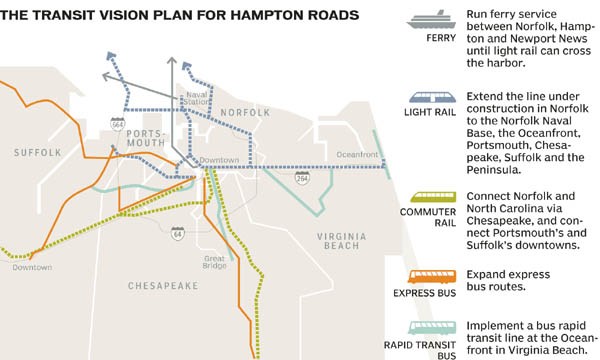 It looks like about 4 light rail extensions would be planned and commuter rail that would stretch to Richmond. The thought that they would shift monies to transit away from highway projects would be huge as well. It looks as if regions are starting to figure it out.
It looks like about 4 light rail extensions would be planned and commuter rail that would stretch to Richmond. The thought that they would shift monies to transit away from highway projects would be huge as well. It looks as if regions are starting to figure it out. Robert Case, a transportation engineer who manages the study for the Hampton Roads Metropolitan Planning Organization, said there is growing political interest in shifting resources from highway projects to transit. He said such a shift would be a "sea change" and would require changes in land use and funding priorities.
The plan calls for creating higher-density and mixed-use development patterns in some areas to support an expanded transit network.
Subscribe to:
Posts (Atom)