I wanted to try something a little different, so I'm just going to link a quote from the articles I'm posting today.
~~~
DC: "Some residents of the District cling to a suburban mentality."
~~~
National: "Americans travel by car twice as much per year as Germans and use transit only a sixth as much."
~~~
Texas: "This isn’t a transportation funding crisis," said Keener, whose Austin group promotes low taxes and small government. "It’s a funding priority crisis."
~~~
Las Vegas: "The zoning provides incentives, such as bonus density, for developers who build projects that combine residential, professional and commercial space and encourage residents to use the mass transit line."
Saturday, April 18, 2009

Thursday, April 16, 2009
Industrial Tipping Points
Richard calls for a separate tax classification for industrial land because its too easy to change when the demand is high for other uses. It's interesting because I've been thinking a lot about the near downtown industrial districts ripe for redevelopment with streetcars and light rail. While industrial land is usually easiest for redevelopment, it can also be tricky when some or all of that land is viable for industrial uses. Areas like the Pearl in Portland, South Lake Union in Seattle, Channelside in Tampa, and the South End in Charlotte were once industrial districts that have since been redeveloped because of increased transit accessibility and proximity to downtown.
However other areas such as parts of West Oakland have been deemed off limits to developers even when the proximity to downtown is just enough that a streetcar or light rail line would explode the potential in the area. This is because the industrial land is still viable as such and city council saw value in keeping the jobs and land available in the area. I can't say that I disagree with this assessment but what is the point where industrial properties anywhere are too valuable to tax base?
For the most part, many of the easy pickings in downtowns around America have been taken back in the form of downtown adjacent former brick industrial buildings that have formed a base for a loft district fairly close to downtowns. But there are still spots waiting for a rail line that have good bones and would be great spots for the new streetcar suburbs. Is there an area in your cities that have dwindling industrial uses and is within a two mile radius of downtown?
However other areas such as parts of West Oakland have been deemed off limits to developers even when the proximity to downtown is just enough that a streetcar or light rail line would explode the potential in the area. This is because the industrial land is still viable as such and city council saw value in keeping the jobs and land available in the area. I can't say that I disagree with this assessment but what is the point where industrial properties anywhere are too valuable to tax base?
For the most part, many of the easy pickings in downtowns around America have been taken back in the form of downtown adjacent former brick industrial buildings that have formed a base for a loft district fairly close to downtowns. But there are still spots waiting for a rail line that have good bones and would be great spots for the new streetcar suburbs. Is there an area in your cities that have dwindling industrial uses and is within a two mile radius of downtown?
Transit Lobby Strong Like Ox
I almost spit out my drink when I saw this comment from our favorite O'Toole.
Second, Congress could increase the share of funds dedicated to transit. The transit lobby is powerful and the highway lobby is weak, but the latter probably still has enough power to stop that idea.Bwahahaha. I wonder if Randall was out teabagging today.
Combino Cracks
Looks like the Combino is having more problems. In 2004, there were issues with car bodies slightly cracking.
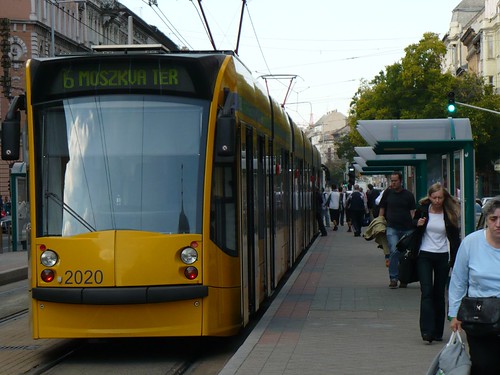
On March 12, 2004, Siemens admitted to problems concerning the stability of the car bodies and, as a precautionary measure, instructed all public transportation services to take all Combinos with a service distance of more than 120,000 kilometres (74,565 mi) out of service. Torsion forces generated in S-curves were much higher than anticipated, leading to cracks around the articulations between the car modules. Subsequently, hairline cracks were found in the joints of the aluminium bodies, which could cause the roof to collapse in the case of an accident.The Caterpillars of Budapest had issues and were delayed due to door issues in 06. While not as bad as the issues the European versions had, Melbourne is going to make fixes due to the fractures that have occurred on their trainsets. I've heard that subsequent redesigns have fixed the problem on the current model.
Wednesday, April 15, 2009
Quick Sprawling Plug
My buddy Tim at Planetizen co-wrote the kid's book on planning. I think it's doing pretty well except for that demon looking picture in the New York Times. Sorry bud, had to call it out. :)
Now they have put together a DVD on sprawl that features some famous names talking about how it all went wrong. Check out the lineup and watch some previews at Planetizen.
Now they have put together a DVD on sprawl that features some famous names talking about how it all went wrong. Check out the lineup and watch some previews at Planetizen.
Tuesday, April 14, 2009
Locating Stations is Hard
Where does the station go? Novato has chosen to tell SMART not to put a station in their downtown. After looking at the map, it seems a bit silly to me.
The top is a close up of the two stations under consideration. The downtown station was ruled out which with the experience of Caltrain seems a bit silly. The yellow box shows the jobs they are talking about which have a huge parking lot outside of the building. Why not develop the downtown more and create a reason for people to live in downtown Novato and take the train to other cities?


But Eklund and other council members were concerned about the lack of parking for those who would take the train and the relatively small job centers. Councilwoman Jeanne MacLeamy said she expected as many as 1,500 new jobs to come to the Atherton area in the coming years on top of the 1,500 already there. There are about 500 jobs near the proposed downtown station.Why not have a policy to push more jobs onto the urban grid that exists downtown. It's also the most connected to the residential neighborhoods meaning it will be easier for people to get to the station without cars. Stop designing for cars!!!
The top is a close up of the two stations under consideration. The downtown station was ruled out which with the experience of Caltrain seems a bit silly. The yellow box shows the jobs they are talking about which have a huge parking lot outside of the building. Why not develop the downtown more and create a reason for people to live in downtown Novato and take the train to other cities?


Guest Post: Remove the Wire Noose
George Barsky is a frequent commenter on one of my transit listserves. In a recent email, he asked that Washington D.C. be freed from its wire noose, ie the prohibition of wires in the federal city. Here are his comments he gave me permission to post and some photos of what he believes wires would look like in the district:
Conduit at Union Station
 With Overhead Wires
 George Barsky
Germantown, MD
It's high time Congress allowed the District of Columbia to operate clean, green, efficient, electric surface mass transit on any of its streets.
Streetcars and light rail are making a strong comeback in cities all across the USA. Obviously, that form of mass transit is being recognized more and more as a worthwhile public investment to move lots of people. And there is a new transportation infrastructure recognition by the Obama Administration.
Until more reliable forms of power become available, the best system for more than 100 years to power streetcars is from a simple almost invisible overhead wire. This is how more than 400 other electric surface transit systems operate around the world and within other US cities. However, Congress banned overhead wires in parts of D.C. more than 100 years ago stifling electric surface transit progress and ultimately killing it almost 50 years ago.
It's time for Congress to take a leadership role and change that law to allow streetcars to use single simple, non-polluting almost invisible wire above their tracks and return to all of D.C. When the law was passed more than 100 years ago it was well intended to remove masses of utility wire from city streets. Utilities can bury their wires but transit cannot. The old underground conduit system used by the now abandoned D.C. streetcar network is too expensive and difficult to maintain or reinstall and not at all desirable.
I am not recommending a sky full of wires. A small single simple nearly invisible overhead wire supported by decorative lampposts or nearby buildings can be extremely architecturally effective and easy to maintain without destroying the visual landscape of D.C. There are thousands of examples worldwide in cities just as beautiful or more so than D.C. They are not harmed or defaced by them and their beauty is enhanced by modern healthful environmentally friendly electric surface transit.
Discussions abound about clean energy, CO2 reductions and global warming, but Congress has turned a blind eye in their own backyard by continuing to impose the antiquarian overhead wire ban for surface transit. Everyday Al Gore and other officials call for change and reform in terms of energy and environment but Congress does nothing to encourage D.C. to modernize its surface transport making it green and more inviting to use. The beauty of D.C. will not be marred by this minute change and will enable it to eliminate many noxious and polluting buses from its streets. It's time to CHANGE how D.C. does surface transit.
Congress has to get this message and take reasonable action by eliminating the overhead wire ban for surface transit within all of D.C and let D.C. decide where and how to institute its transit needs.
By comparison to other recent problems this may seem trivial. Basically it is, except that a change in the law requires an act of Congress. I doubt that many Congressmen and staffs today are even aware that giving D.C. this benefit lies within their jurisdiction. Many of them now have modern light rail in their own districts. It's one of those niche items buried in ancient D.C. history but is quite important to the District of Columbia and all who use or want to benefit from good surface transit therein. Allowing D.C. to resurrect electric streetcar service in all parts of D.C. by means of a simple almost invisible overhead wire will showcase an example to the nation and the world that Congress gets it. All that is required is a single simple nearly invisible overhead wire.
Best of all, no funds are required for this enabling act.
It is time for new outside the box thinking regarding green electric surface transit within all of D.C. and remove the ancient wire noose from around the District's neck. If an overhead wire is OK for the new Anacostia streetcar line than it should be OK in all parts of D.C. The residents will applaud such new vital action.
Conduit at Union Station
With Overhead Wires George Barsky
Germantown, MD
Houston Light Rail Sims
I always find these simulations interesting. Watch the development that changes in the last few frames from a large industrial property to a large big box development. It's somewhat obvious from the simulation that urbanism was left out of consideration.
Houston METRO Light Rail from NC3D.com on Vimeo.
H/T George B.
Houston METRO Light Rail from NC3D.com on Vimeo.
H/T George B.
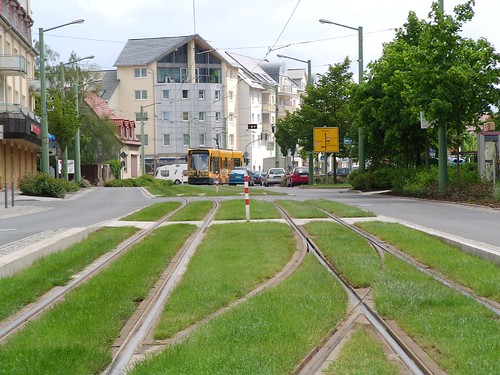
Grass Track on the T Willie?
This post got me thinking, what if they would have put in a grass track on the T-Willie? Could we do it on Geary?
 Flickr Photo by SFCityscape
Vs.

Photo from Mellow Monk.
Some of my favorites from Tram photog Neitech in Nordbrand Germany.


Via CNU
Flickr Photo by SFCityscapeVs.
Photo from Mellow Monk.
Some of my favorites from Tram photog Neitech in Nordbrand Germany.
Via CNU
Monday, April 13, 2009
A Different View
It's generally known that places like San Francisco, New York City, and Europe draw the ire of conservatives for their "liberal" tendencies. But do they really hate those places? Or is it a reflexive action based on the views projected from a southern base?
It would seem to me that this views of these places also translates to modes of transportation that are seen as "european" or basically foreign as well such as light rail. Which to me makes it all the more amazing that Charlotte has been able to move itself towards transit expansion that is seen as the cutting edge in cities around the south, even those that have existing systems such as Atlanta. The amazing thing there is the changing political will towards a more transit centered, urbanism. I would argue that Charlotte in particular is a function of outsiders from the Northeast. The Urbanophile has laid out why outsiders have a way of making changes to a community because they can see something different.
I remember visiting my parents from college when they lived in Rotterdam for a year and being amazed at the different transportation types, streets for people instead of just cars, and the fact that my dad could just walk to work. I was amazed and I believe it was one part of how my views changed towards the ones that I have now. Before that, I just hadn't been exposed to anything like it and didn't know it existed.
It's not that they aren't open to the experience, they just haven't had it. Not sure how that could be fixed, but it might explain some of the reasons for the San Francisco and New York bashing from the South. We're generally afraid of what we don't know. What do you all think?
It would seem to me that this views of these places also translates to modes of transportation that are seen as "european" or basically foreign as well such as light rail. Which to me makes it all the more amazing that Charlotte has been able to move itself towards transit expansion that is seen as the cutting edge in cities around the south, even those that have existing systems such as Atlanta. The amazing thing there is the changing political will towards a more transit centered, urbanism. I would argue that Charlotte in particular is a function of outsiders from the Northeast. The Urbanophile has laid out why outsiders have a way of making changes to a community because they can see something different.
Outsiders are willing to imagine things being different in the first place since they already experienced and indeed grew up in an environment that is different. It's sort of like visiting a foreign country for the first time. We notice how all sorts of little things are different, prompting four reactions. The first is, "Hey, things are different here." That can be a revelation itself. When we grow up and experience only one way of doing things, we tend to think everybody must do it that way or that there is only one way to do it.A possible function of the Southern feeling towards San Francisco or Europe is that they haven't been there before and their impressions are based on what they are told rather than what they experience. How many people do you know have changed their view of their own places after seeing a foreign country? I also have to wonder how much of the south is bigger cities as well and how much the lack of cities might lead to a similar feeling.
I remember visiting my parents from college when they lived in Rotterdam for a year and being amazed at the different transportation types, streets for people instead of just cars, and the fact that my dad could just walk to work. I was amazed and I believe it was one part of how my views changed towards the ones that I have now. Before that, I just hadn't been exposed to anything like it and didn't know it existed.
It's not that they aren't open to the experience, they just haven't had it. Not sure how that could be fixed, but it might explain some of the reasons for the San Francisco and New York bashing from the South. We're generally afraid of what we don't know. What do you all think?
Clean Air Adds Life
Imagine how much more life we could have without all the carbon. Another reason why the wires around San Francisco are music to my lungs.
The project tracked the change of air quality in 51 American cities since the 1980s. During that time general life expectancy increased by more than two and half years, much due to improved lifestyles, diet and healthcare. But the researchers calculated more than 15% of that extra time was due to cleaner air.
Sunday, April 12, 2009
A Suburban Double Standard
An interesting quote from the folks in Massachusetts.
Now on the issue of bus and rail and the quote above. It seems like a bit of a double standard. Why would you say something like that to the suburbs about rail when you are doing exactly the opposite in the core with the Silver Line BRT tunnel. Can't have it both ways guys.
Egan said that Governor Deval Patrick and Aloisi remain committed to bringing rail to the region because "we will not get the same economic bang for the buck" with bus service.This is in response to the South Coast commuter rail alternatives analysis in which they were examining express buses as an alternative. I never understood this need to study the alternatives to a commuter rail line like express bus when for the most part the reason to build the line would be to take advantage of the rail ROW. It's either cost effective and useful or its not.
Now on the issue of bus and rail and the quote above. It seems like a bit of a double standard. Why would you say something like that to the suburbs about rail when you are doing exactly the opposite in the core with the Silver Line BRT tunnel. Can't have it both ways guys.
Saturday, April 11, 2009
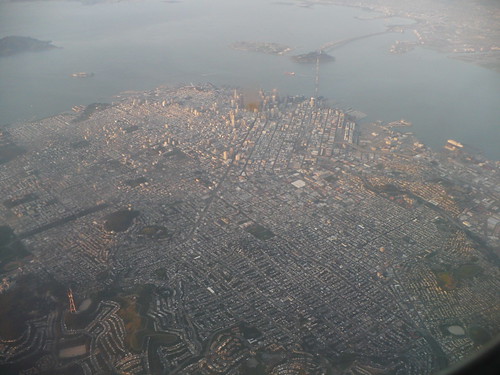
San Francisco from the Sky
I'll try and do a Photo Dump at some point this weekend but here's a good one I took from the plane. The big brown dot downtown is on the plane window. Too bad it couldn't be clearer.
Eliminate Public Transportation
John Hodgman (aka PC) is brilliant.
"Eliminate Public Transportation. The industry is ready to commit to this relationship, but not until fickle Americans stop catting around with Amtrak and light rail"
H/T Hub and Spokes
"Eliminate Public Transportation. The industry is ready to commit to this relationship, but not until fickle Americans stop catting around with Amtrak and light rail"
| The Daily Show With Jon Stewart | M - Th 11p / 10c | |||
| You're Welcome - Auto Industry | ||||
| ||||
H/T Hub and Spokes
Pre Easter Linkfest
Here's a few links from the wide world of transit:
In Denver, the Daily Camera posed a question about the possible Fastrax expansion tax hike to fill the funding gap for all the lines. There were a few interesting nuggets in some ranting. Most of all though, they aren't really seeing the one possible solution to this mess, shifting money from roads to transit. Here's one from an anti growth guy who doesn't quite get that growth happens whether you like it or not, but he makes an interesting point about paying for your impact.
~~~
Could inadequate transit cost Tampa?
~~~
California State cuts to transit are killing local agencies. It makes them look for more funding and look like the bad guys in all of this. Adequate blame should be announced in some way or another.
~~~
No more stepping into the street for a streetcar in Toronto.
~~~
Trains jammed for Arizona Diamondback games. Also, it seems to me that because sports fans are going to be perpetually confused about transit TVMs, why not just allow tickets to be POP.
A two station solution for the transbay terminal CAHSR issue?
~~~
More cuts, Boston.
~~~
Hippocrite, thy name is Tim Pawlenty. Remember when he vetoed funding for expanding Twin Cities transit? Now it's all cool when Joe Biden sez.
In Denver, the Daily Camera posed a question about the possible Fastrax expansion tax hike to fill the funding gap for all the lines. There were a few interesting nuggets in some ranting. Most of all though, they aren't really seeing the one possible solution to this mess, shifting money from roads to transit. Here's one from an anti growth guy who doesn't quite get that growth happens whether you like it or not, but he makes an interesting point about paying for your impact.
The fundamental reason we need more transit and more roads is growth. And the fundamental reason that taxes keep going up and service levels keep going down is the failure of the majority of the Legislature to impose impact fees on new development to pay for growth-related infrastructure. Why don't they impose such fees? It's simple - these fees cut into the profits of developers and land speculators, and they are big contributors. In this pro-development political environment, transit doesn't solve problems; it just encourages more development but in different places.The commenters also leave much to be desired. This is one reason why we need to stand up to the likes of O'Toole, because his crap gets distributed through article comments like this.
~~~
Could inadequate transit cost Tampa?
~~~
California State cuts to transit are killing local agencies. It makes them look for more funding and look like the bad guys in all of this. Adequate blame should be announced in some way or another.
~~~
No more stepping into the street for a streetcar in Toronto.
~~~
Trains jammed for Arizona Diamondback games. Also, it seems to me that because sports fans are going to be perpetually confused about transit TVMs, why not just allow tickets to be POP.
Metro estimated that 5,000 to 6,000 fans used the trains for their trip to and from Chase Field on Monday. The process repeated itself, but in smaller numbers, Tuesday and Wednesday.~~~
A two station solution for the transbay terminal CAHSR issue?
~~~
More cuts, Boston.
~~~
Hippocrite, thy name is Tim Pawlenty. Remember when he vetoed funding for expanding Twin Cities transit? Now it's all cool when Joe Biden sez.
Upgrades, No New Transit for Chicago Olympics
So says the bid book for the 2016 Olympics bid:
But the plan lacks imagination for my taste. Especially considering what could happen if they spent $10 billion dollars on dedicated rapid streetcar lanes. That would be 333 miles of new fixed rail infrastructure that would serve the city long after the Olympics. Think about the reduced energy usage, the reduced operations costs per passenger and the increase in value that would be generated by such an ambitious expansion plan. Alas nothing like this is planned and no new transit infrastructure would be built.
So if Chicago is really getting nothing new out of this in terms of transit but the idea of pedestrian ways is something I'm willing to think about. Is there specific bike infrastructure for the city in these ped ways? Will there be consideration to keeping these ped ways after the Olympics are over? The big question is though, is an Olympic bid worth it?
I'm still fuming at Gavin for screwing this up for San Francisco. It would be amazing to have the games here and it surely would have pushed for serious upgrades to infrastructure and a speeding up of long term projects that need to be sped up. That said, its expensive and you have to weight the pros and cons. But being able to live in the city and go see the track events would have been amazing for this former aspiring olympian. I'll get to the Olympics eventually. Hopefully here in San Francisco.
H/T Payton C via FB Status
Chicago’s consolidated and compact venue plan places 21 sports, the Olympic Village and the IBC/MPC along Lake Shore Drive, a magnificent thoroughfare on the shores of Lake Michigan. An additional 4 sports will take place within the Olympic Ring. Venues have been proposed near existing public-transit lines and high capacity roadways, maximizing the use of existing infrastructure and eliminating the need for any new lines or roads. Thorough pedestrian and vehicle flow modeling will ensure the safe, efficient movement of all constituent groups.In addition, the plan is to have a two tiered dedicated road lane system for moving people around and increase headways of existing transit.
Olympic Lanes will connect venues and provide freeflowing, safe transport for Olympic Family vehicles and spectator shuttles on a network of more than 590 km of dedicated roadways.Now that's not to that using funds to upgrade existing systems in need of serious funding is bad. That is an extreme need Chicago and other legacy systems have needed for a while. The book states that over $1.5 billion would be budgeted for track, signal and terminal facility upgrades of CTA Heavy rail lines, $2.8 billion for Metra Commuter rail upgrades. This is half of what is planned for O'Hare at $8.2 billion dollars. (Update: Payton says that these are already budgeted in regular formula funding, meaning there would be no new expenditures for the Olympics) I would like to see this coincide with a plan and start of high speed rail lines into Chicago from other regions. It would be amazing if a plan was set in place to upgrade infrastructure like this so that it could be in place for the Olympics. Talk about stimulus.
...
To meet the heightened demand for rail transport, Chicago will increase the frequency of train cars during the Games period.
But the plan lacks imagination for my taste. Especially considering what could happen if they spent $10 billion dollars on dedicated rapid streetcar lanes. That would be 333 miles of new fixed rail infrastructure that would serve the city long after the Olympics. Think about the reduced energy usage, the reduced operations costs per passenger and the increase in value that would be generated by such an ambitious expansion plan. Alas nothing like this is planned and no new transit infrastructure would be built.
So if Chicago is really getting nothing new out of this in terms of transit but the idea of pedestrian ways is something I'm willing to think about. Is there specific bike infrastructure for the city in these ped ways? Will there be consideration to keeping these ped ways after the Olympics are over? The big question is though, is an Olympic bid worth it?
I'm still fuming at Gavin for screwing this up for San Francisco. It would be amazing to have the games here and it surely would have pushed for serious upgrades to infrastructure and a speeding up of long term projects that need to be sped up. That said, its expensive and you have to weight the pros and cons. But being able to live in the city and go see the track events would have been amazing for this former aspiring olympian. I'll get to the Olympics eventually. Hopefully here in San Francisco.
H/T Payton C via FB Status
Friday, April 10, 2009
BRT >> HOV >> HOT >> Lane
If you pave a road, anything with a rubber tire can go on it. Meaning at some point, someone will want to co-opt that street for a personal vehicle. Is it a process. Don't get tricked. How long till BRT becomes HOV becomes HOT becomes a regular lane? The pressure is on.
Thursday, April 9, 2009
Don't Lecture If You Can't Change Yourself
In an article on the new Indian auto sensation, Projjal Dutta calls for the United States to and other countries around the world to invest more in transit to change the future land use patterns that we know will result from all the automobiling that is in front of the Tata Nano. But he calls out the government for just doing the same as it always has in the stimulus package at 80/20.
As with many other issues, the world will expect America's "talk"--say, urging China and India not to become auto-centric--to be accompanied by "walk," at home. That, unfortunately, despite early glimmers of hope, is not happening. The stimulus bill has allocated about 8 billion dollars to transit, compared with 30 billion to highways. This is roughly in keeping with the traditional 80/20 split of federal transportation funds that have been enshrined since the Eisenhower days.I agree. We can't just lecture other countries about what they should do when we continue to fund the same levels we always have. How are we supposed to solve the problems in the world if we can't lead by example.
The president's stimulus package has put dollar commitments behind promises about promoting green-jobs and increasing renewable energy generation capacity of the U.S. Yet, despite the concern and awareness within the administration, American lifestyles are inextricably linked to very high automobile usage. Until that bull is taken by the horns, climate change cannot be properly confronted.This is why I keep harping on the folks at SF city hall in the Emerald Aristocracy. Fake green and gizmo green is not leading by example, its just delaying the inevitable. Check out the Forbes article, it's a good read.
Government Work
I always find it a tad funny when photos show up of other countries in official government publications (web or paper). Take for example the web site of the United States Senate Banking Committee. Senator's Shelby and Dodd look quite content on each side of a line of foreign LRVs. Now I still can't tell where they are from, but I know it's not within the United States. Anyone know where this is? The best guess from some knowledgable folks so far is Helsinki. Perhaps we're going socialist afterall.


Via wikipedia

Via wikipedia
Wednesday, April 8, 2009
Calling Shennanigans on The Emerald Aristocracy
Looks like the Muni budget crisis isn't just a function of the economy, but a reshuffling of the deck in order to keep other budgets running without as many cuts. In fact, according to Beyond Chron, $80 million dollars is work orders from other agencies within the city.
What are we going to find tomorrow from the emerald aristocracy and thier gizmo green? You know, the ones that think electric cars are the answer in a city that couldn't park them anyways.
H/T Transbay & NJC
Muni’s $129 million deficit means the MTA Board is exploring painful choices that would cripple service, but $80 million of the problem is “work orders” from other City Departments. Newsom directed every agency to trim its budget, and some unloaded it on Muni by charging for services done for free.Some of these include millions for 311, which apparently charges $1.96 every time you call and ask them to look up next muni for you. That is almost 50 cents more than a muni fare meaning that when those people who called step on the bus, they are actually adding $2 to the trip. Another issue that annoys me is that I have never seen a police officer on the bus, yet SFPD is looking for $12 million out of the budget.
What are we going to find tomorrow from the emerald aristocracy and thier gizmo green? You know, the ones that think electric cars are the answer in a city that couldn't park them anyways.
H/T Transbay & NJC
Subscribe to:
Posts (Atom)