Thursday, July 23, 2009

$eeking A Green Funding Scheme

Congress is looking hard for a funding source for all things transportation. With the gas tax woefully inadequate, they are looking for other sources. One that continues to come up is the VMT tax. While this is a promising idea, no one likes to think further or beyond the box. I was actually surprised when people immediately let an idea like DeFazio's oil futures tax even sit for a while. But for the most part, congress is boring. It's like people are stuck going in circles.

But in the Streetsblog article there are some ideas that have floated before, in other forms that might be a bit innovative. For example the tax break idea has been floated before and discussed here, albeit for a somewhat different cause. Alan Drake has been proposing for a long time that we use property tax breaks to electrify the main freight lines across the country. This is just an addition.
Rep. Kendrick Meek (D-FL) touted his bill to provide tax credits for companies that build new freight tracks or terminals. Rep. Ken Calvert (R-CA) suggested levying a freight fee of 0.075 percent per shipment, with a maximum of $500, on goods that arrive at the nation's ports.
But what about other ways to find funding for transport. Are there any other innovative mechanisms for a national scale? The Transport Politic says we should take it from the general fund. How about if we can carve out some of the income tax for transportation. Perhaps you can see how much you're paying into it on your weekly statement, kind of like FICA. Especially since everyone uses transportation to get to work where they get income. And if they don't, they are living at home and should get a break for that.

Or one of my favorite ideas is an electric bill surcharge, perhaps one for commercial electricity and one for residential. This might accomplish two goals, one being a reduction in energy usage from higher price points and another being when more electric automobiles and other vehicles start coming, they will be paying into the transportation fund. Obviously not completely thought out, but there's something in there somewhere.

I really wish we could throw all kinds of crazy ideas on the table and see what might stick. Any other ideas out there we should know about?

72% New

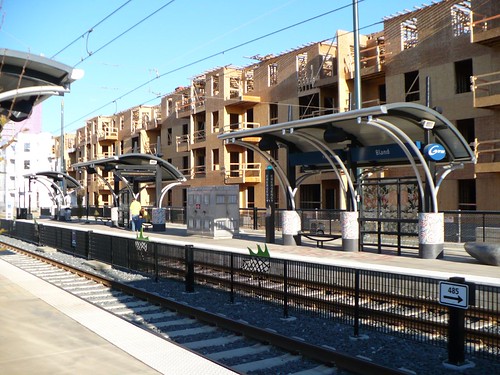
72% of riders on Charlotte's light rail system hadn't used transit before. That is a HUGE number and somewhat surprising to me given that these are all people who have access to a car. Though I have to take issue with the last sentence in the article:
The study didn't ask riders what route they would have taken to work, so it's impossible to determine where the Lynx has provided any congestion relief.
If 72% weren't taking transit before, it seems to me they aren't blocking the road. The big thing still though is the development that has taken place along the corridor. While much of it has occurred in the South End, it just shows the power of transit push the downtown development market a bit further out with easier transportation access.

P1010599

Wednesday, July 22, 2009

Streetcar Post

There's an interesting post at Steve Munro's site on some things that have happened in Toronto over the years. Also, Mayor Becker in Salt Lake City talks about getting funding for the Sugar House Streetcar and a downtown network on a local NPR station.

Tuesday, July 21, 2009

Could BRT Carry 7 Million New Yorkers?

Streetsblog is at it again with BRT. When do we get a streetfilm on Berlin or London's or Tokyo's or Hong Kong's or Moscow's or Paris' or Helsinki's or (name amazing world city with a subway here) Underground? Probably never because we only take good ideas from third world countries. (insert joke about becoming one here)
On the east side of Manhattan, the right BRT configuration would carry almost as many commuters as the Second Avenue Subway, for a fraction of the cost.
For a fraction of the cost you get a fraction of the ridership and a fraction of the service. How many buses and how many Union wages would it take to get that level of service? Let's all imagine how much it would cost operationally to carry ~7 million daily subway riders on buses every day in addition to the 2.3 million people that already ride buses in New York. Let's see what kind of a city New York would be without the Subway. There is a specific crowding issue that needs to be addressed on the east side and if you amortize that $5 billion over the lifetime of the tunnels it is well worth the investment over centuries of use.

Instead of taking everything Walter Hook and the BRT/rubber tire/World Bank lobby say as gospel, how about talking to other people who have written a few books on the subject. Say a certain professor at UPenn who has written three tomes on transportation operations and planning.

Then how about talking about these issues:

Paying union wages for 30 second headways
Fumes that come from the buses because they won't electrify
Using more oil for IC engines
Roadway damage that will occur along the way
Replacing those buses every 12 years or sooner
Crowding that is acceptable in Curitba and Bogota
Speeding buses and pedestrians
Bus traffic sewers on the streets
Actually taking lanes from drivers when you can't even get road pricing

You want less people to ride transit? Then build inferior transit. In all actuality though, this country needs more Metro Subways. You know, the kinds of things they have in first world countries on the European continent. Washington DC is an example of a place that has developed more recently around the subway. Regions that build BRT will always be car cities. If you want to truely transform regions, we're going to have to think bigger.

I think a lot of people talk about Arlington County because of the great success it has had in development. Yet no one talks about what Atlanta was like on Peachtree just north of downtown or in the Buckhead area just north of there before MARTA. Not a lot of people seem to realize that San Francisco is much more dense now because of BART and Caltrain connections as well as the Muni Metro than it ever would have been without. In fact, certain companies have pushed the MTA in San Francisco to make Muni better or they will leave. They wouldn't be saying that if we had a system that actually worked.

The problem with places like San Francisco and Atlanta is that they didn't go far enough. They built a couple of lines and then stopped. If we truely want to see our cities transform, we need to go further and without BRT as THE substitute idea for Heavy Rail or Semi Metro Light Rail. It's an outrage to think that people actually think this is a real alternative to transform our cities and turn the population to transit. It's just us being cheap. We're already cheap with transit, and look where that gets us. To more people riding cars and more sprawl.

That's Expensive Signage

How hard is it to just make a sign? $2.2 million? Or better yet, just take the Hiawatha Line?

Monday, July 20, 2009

Cost Effectiveness Strikes Again

Is it worth it to single track a major section of transit investment that isn't towards the end of the line? This seems really insane but it's also what the cost-effectiveness measure has done to transit projects. It's stuffed them in this current box instead of thinking about complete life-cycle of the corridor. Baltimore single tracked its first light rail line only to spend much much more later on as well as give a lot of commuters headaches. It also depressed ridership greatly sucking the wind out of an existing line while the upgrade was made.

I'm not against single tracking in all situations as Denver's West Corridor single tracking at the end of the line seems like a good cost cutting measure that can easily be remedied later. But single tracking a tunnel for a mile in a more central section only seems like asking for train delays if the schedule gets bumped even a little bit. Let's get rid of this cost-effectiveness measure. This would just push costs down the line, instead of truly being effective.

Taking the Lead

I like the business leader approach of Virginia Beach. The city council is elected to make decisions.

Top business leaders have come out against the city holding a referendum on a light-rail project, arguing it's a decision the City Council should make.

"It's a complex subject, but it's not above your pay grade," Jim Flinchum, board president of the Virginia Beach division of the Hampton Roads Chamber of Commerce, told the City Council last week. "This is your job."

Roadkill

The Dillos in Austin will go extinct. I think I rode a Dillo one time when I lived in Austin. They were too infrequent and the interiors were uncomfortable. When discussing streetcars, people often say the Dillos don't work so the streetcars won't either. But here is a case where the routes changed and then the whole service will be cut. The permanence argument for the streetcar gets stronger in this respect.

It's good though in one sense, no one can call them trolleys anymore.

Flickr photo by Cackhanded

Sunday, July 19, 2009

It's the Priority, Not the Perception

Carol Coletta who has her own NPR show called Smart City muses on buses and their image issue:
As I travel U.S. cities, it is unusual for public transit not to come up as a priority. But buses are rarely mentioned. Cities want the sexy stuff -- light rail, trolleys and trams. I was reminded of this as I was reading again about Bogota's Bus Rapid Transit (BRT) and London's newly redesigned buses.
Aside from mass implementation, there is not much that can be done to improve the feel of riding the bus. Oakland tried this with buying the Van Hools (a whole other discussion) and many other agencies have tried or are trying small fixes such as San Francisco's stop spacing redo. It's still a bus and it has it's function in the transit spectrum. The problem is that it runs in traffic with cars and stops every other block. And all United States systems are woefully underfunded, bus or otherwise, such that better diversity in service is not provided.

But then there is this:
And the TransMilenio carries none of the negative stereotypes associated with buses.
Say what? Just because Enrique Penalosa says that doesn't mean it is so. I've obviously never been to Bogota nor plan on going, but the BRT there has many freeway centered sections and still runs on rubber tires and still operates using a third world pay scale for its drivers. This means no pedestrian friendly TOD opportunities around the station and you're still on the bouncy bus when the concrete shifts. Not to mention the crowding and operating costs.

Flickr photo by Pattoncito

I understand the allure of BRT, and I honestly think that more bus routes should get a lane such that BRT is more the norm in dense urban areas. This only comes with a change in our own perceptions of what is a priority, not so much the current perception of what buses are. This means building more metro systems, more light rail, and dedicating more lanes to transit and bikes. That is a fundamental shift that needs to happen, not just focusing on making buses a tiny bit better by renaming them.

An Interesting Funding Source

This is quite fascinating. I always notice the blue highway signs with the gas stations and fast food but I never knew they paid for the privilege. But using that funding to pay for Amtrak is pretty innovative it seems. Any other interesting funding mechanisms out there?

Saturday, July 18, 2009

Link Light Rail

Seattle opened it's first regional light rail line today! Very exciting. I know some of you have been hoping for a post on this, but really, I have to leave it to the Seattle Transit Blog folks who have done an excellent job push hard up in Washington for great transit. Today they are tweeting and blogging and posting video from the first ride. Check em out.

Friday, July 17, 2009

OT: Hook 'Em Walter

I am not old enough to be in the era of Walter Cronkite reading news. But I did experience him through a connection with my University, one that runs very deep. His voice is masterful and I can only imagine what it was like to hear him nightly. But if you're a Longhorn this hits you pretty hard, especially when the memories of your school are tied so well together by the imagery of Austin and his voice.


You can see all the spots he voiced for the University of Texas here. May you enjoy a Shiner in the sky good sir. Tell Arthur and J Fred I said hi. Hook 'em.

Some Notes

USA Today has an article about intensifying suburbs in the Hong Kong style. Interesting they mention the tall buildings but not the massive transit infrastructure needed to move these people to where they want to go.
~~~
Jarrett at Human transit was wondering early on what would get comments and a discussion going. I don't think he has to look anymore. In fact he's even got the ears of major newspaper reporters. Now if only they actually understood what he was saying or if newspaper reporters actually gave the public credit for knowing more than they do. This Dallas Morning News post is exactly why print media is dying. Calling your readers stupid works every time.
Further, would the public understand the dual systems? Is there a city today that has a combination of light rail and streetcars in a downtown area where there is demonstrated demand for both?
I'm tired of Texas (or from any state) transportation reporters who don't know transportation.
~~~
The Evergreen Line gone?
~~~
Swimo pops its head out of the water again. It's like a cute little penguin, an electric penguin that runs on rails without wires. When we all have Zed PMs we'll be golden.
~~~
Fort Worth is hoping for Streetcars sooner than planned.

A Letter Against a $4 Billion Freeway

Cavan from Greater Greater Washington sent a link to a form letter urging leaders in Montgomery County to stop the nonsense of ever expanding the freeway there. It's really quite insane that they can't see what happened last time they did this. I urge any locals send letters and push back against this 1950's expansion pack.

Thursday, July 16, 2009

Unhinged

Wow. Can you say jump the shark?
"The problem with Los Angeles is not that it's the epitome of sprawl," he says. "The problem with Los Angeles is that it's the epitome of smart growth."
The whole article is a big whopping expose on the arguments he's been making lately. He goes on to say that Smart Growth advocates are mad that middle class people are moving into their neighborhoods and they resent that. It basically shows how unhinged and out of touch with reality this guy is. The problem though, is that people actually listen and he still gets into papers like the New York Times. I guess its fair and balanced or something. But I guess the best we can hope for right now is an article that features the qualifier "tries".

The House Does NOT Like Larry Summers

Here are some Transpo folks quotes from the Hill Article:
“These theoretical economists don’t understand how the program works,” Oberstar told The Hill....“Who’s managed a construction firm? Who’s met a payroll?”
...

Rep. Peter DeFazio (D-Ore.) said Obama’s top economic advisers see only two ways to boost the economy: through tax cuts or by bailing out Wall Street firms like Goldman Sachs.

“It wasn’t productive activity, it didn’t put any Americans back to work, it didn’t rebuild our infrastructure, it didn’t even fill in a single pothole,” DeFazio told The Hill on Tuesday when asked about Obama’s approach. “But that’s their orientation.”

Freezing Over

First a Metro and now streetcar in Curitiba? Granted, it's just a tourist project but it's a start right?

Wednesday, July 15, 2009

Setting Up the Switch Hit

Supervisor Alioto Pier who represents Northern San Francisco asked in the July 14th Finance Committee meeting for TA staff to start thinking about an extension of the Central Subway to the Presidio under Lombard Street. (You can watch the video where she makes her request at 54:45 here).

It's an interesting proposal to say the least but how much of this is really driven by a want to kill the Market Street Railway extension for Fort Mason and beyond with its "visually polluting" overhead wires?
The second phase of the extension will take the streetcar down Beach Street, Cervantes and Marina Boulevard. That will involve erecting overhead power lines, putting rail tracks in the street and removing a lane of traffic. Putting overhead power lines down Marina Boulevard is contrary to Section 101.1 (b) (8) of the City Master Plan, City Urban Design Plan Element Policy 1.1, , and is contrary to the City Transportation Plan. Yet the City Planning Department states that it does not have to be involved with these plans!

The Marina Community Association is working with Supervisor Alioto-Pier and taking other steps to require the City Planning Department to accept its responsibility.
The neighborhood suggestion? Bring back the water taxi idea! If she really wanted better commute service to her district, an inexpensive option would be supporting the extension to the Presidio via the MSR extension. However in discussions with folks who live in the area, they want nothing to do with it. "It'll just bring all the tourists and riff raff and the wires are ugly" I've heard before. Again, my lungs don't care about your aesthetic. So what makes the subway expansion different? Well for one thing it's easier to kill than more inexpensive incremental MSR extensions.

Before this goes any further, I'd really like to know where she stands on the MSR extension already planned for her district and if the idea of a subway extension to the Presidio via Lombard is an honest one. Personally, I like the idea in the long term (Geary subway first ALWAYS) but I question her motives based on previous votes and a lack of understanding from her and her constituents to what transit-first really means. Alioto Pier has been pro commuter transit but not big on the transit "lifestyle".
While she supports the Transit Effectiveness Project (TEP), and wants more people to ride Muni, she doesn't necessarily feel the City should be encouraging people to get rid of their cars.
No one I know wants people to get rid of their cars, we just want the option of getting around without them. It would be nice to have a subway to the Presidio. I imagine a lot of people would use it, especialy people who come from Marin and want to skip the city drive to downtown. But Geary is first, and the MSR extension is an easy way to expand that direction with dedicated lanes. Let's see where this goes shall we?

Tuesday, July 14, 2009

Nine Million Bicycles

Thought I would share some tunes. Not quite Music Monday, but this will work.

Sunday, July 12, 2009

Sunday News Dump

So these news dumps are just a way for me to make small comments when something doesn't warrant a whole post or I just have a bunch of things to share at once. Anyway, here's the dump for Sunday night.

Curitiba is naming its Metro. I can't wait for this to open up for us to have real vs. numbers on the modes.
~~~
Why are more regions not doing transfer of development rights (TDR) schemes? It seems to me that this would show tangibly how you trade land for development.
~~~
Something caught me in this Urbanophile article I forgot to mention before. I don't think it really matters how far jobs are from the center if most of them are clustered into centers. Many of the jobs in Minneapolis are not in the Central City but 60% of them are in distinct clusters. I think we need to look more closely at what job dispersal means and especially what it means for high capacity transit.
~~~
I understand its a commuter rail station, but please do more than 4! units per acre. That's just wrong. Why not build these on the periphery and come back when the market is stronger around the station. You'll be kicking yourself when the market comes back morons. Not that it really matters with only 10 trips a day. Another reason not to go back to Austin.
~~~
Very cool map of Detroit with SF, Manhattan and Boston drawn inside. Puts things in perspective.

via Urbanophile
~~~
Silver Lie BRT concrete crumbles. Pattern with these BRT projects?
~~~
A plan to streetcarize Oakland. I dig it.