
Others argue that Denver has a bus connection, so why should it be that big a deal that the employment center is connected to the train station by a bus? For one thing, Denver's bus mall is dedicated to transit alone and has buses coming so often that you can always see the next one approaching. I seriously doubt that a place which has fought against light rail so hard would put dedicated bus lanes downtown and run such a service. But really what is the point of rapid transit if it doesn't go into the center of activity? The more apt comparison is Bellview station in Denver (funny how the names are the same) right next to the tech center, which we have discussed in previous posts. That should be used as an example of what to avoid when locating a station near a major employment center.
Apparently there is a lot of research that discusses the issue as well. Robert Cervero has looked at this issue in a paper called Office Development, Rail Transit, and Commuting Choices. Ultimately the findings show that the further the station is away from office buildings are, the less likely workers are going to use transit. If the station is near the office, workers are three times more likely to take transit to work.
Also employment density matters as well. The greater the employment density, the more people will take transit. In the Bay Area, the Cervero paper cites statistics that for every 100 workers per acre more, 2.2 increase in commuting by transit. In the Twin Cities, Professor Gary Barnes of the University of Minnesota found that the central city and CBD were greater attractors of transit ridership than suburban offices. So for every increase in 1000 people per square mile in residential density, CBD ridership increased by 2.43%, central city destinations increased by 1.15% and suburban job locations increased by .63%. Ultimately where you are going matters just as much if not more than where you are coming from.
For light rail lines, transit ridership increases the more jobs are within a half mile of the station. Using LEHD data, if you look at recently constructed light rail lines and employment within a half mile of the station, the number of jobs is related to the number of riders that a line gets. Here are a number of recently constructed lines charted against workers.
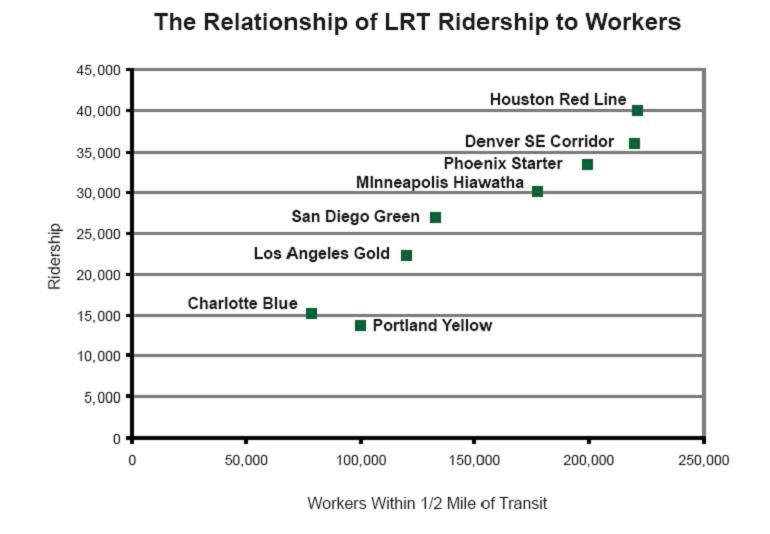 So with all this evidence why would anyone ever think about running a line outside of an employment district instead of right through it to capture more riders? The goal should be to boost and improve accessibility for workers, who make up 60% of transit ridership, not make it harder for them to use transit.
Previous posts on this subject:
Importance of Employment Centers
When Road Engineers Do LRT

