It's so busy, nobody ever goes there anymore...
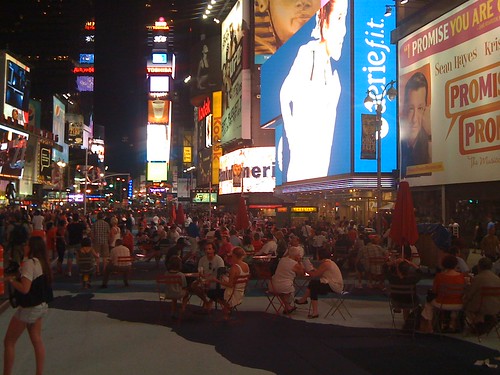
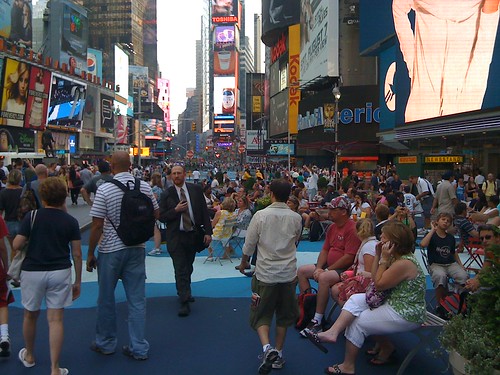
Don't forget in the daytime
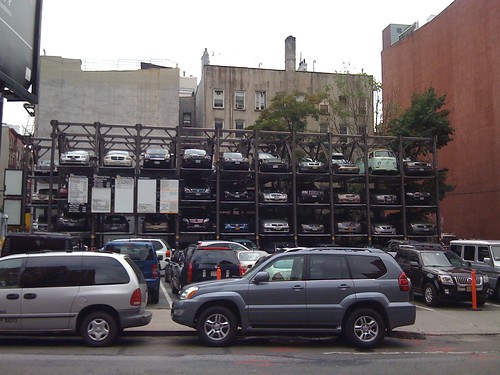
Apartments for cars near the Streetsblog offices
Your friendly bike lane taker uppers
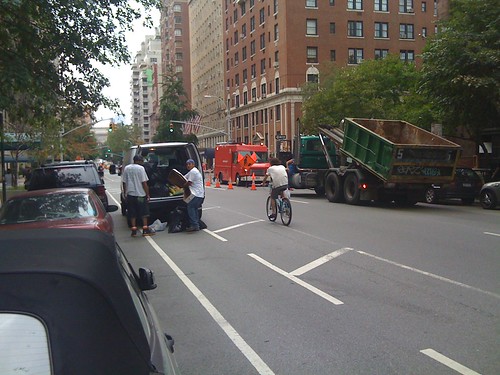
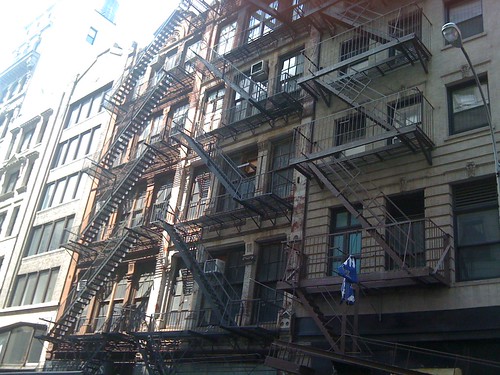
Reminds me of the Netherlands. Needs less fire escape

Some other urban routes--for example between Houston's relatively buoyant downtown and the massive, ever expanding Texas Medical Center--could potentially prove suitable for trains.But we can have more fun with those guys. I am now a card carrying member of the density lobby. In light of the madness, I decided to go over the edge. Anyone who wants to be a card carrying member of the density lobby, shoot me an email and I'll make you one to display proudly on your site. Of course its a big joke, but so are people that say there is a big UN bike conspiracy or actually believe there is an organized lobby for "big density". If you meet anyone that wants to fund our cabal let us know. I'm sure there is someone out there who is rich and nefarious enough to take over the world with affordable TOD!
 Email me at theoverheadwire at gmail | Send your name (real or fake), specific office (ie density integration), and location of choice. I will assign a member number and join date. Also if you just want the illustrator file I can send that along as well.
1. Clustering or dispersing nonresidential space. Suppose 10 million square feet are to be added to a growing urban area. One option is to put the floorspace into two highway oriented non residential clusters, each 5 million square feet in size. Another is to create a new downtown of 10 million sq ft. In the second case, per capita trips by transit within a 3 to 5 mile radius will be 50 to 70 percent higher than in the first case, keeping residential density the same.All of this says that increasing your downtown size, and putting dense housing near downtown is likely to increase transit ridership. Now this goes so far when we're talking about polycentric regions and employment clusters that we see today such as Tyson's corner etc. But ultimately I think this work has lessons for those places as well. It will be interesting to see where the next decade of TOD research heads because ultimately I think this is a part of the research that needs to be explored in greater detail.
2. Enlarging downtown size or raising nearby residential density. Suppose the options are to double the size of a downtown from 10 to 20 million square feet, or to double the residential density within a few miles of it from 15 to 30 du/acre. The former will increase per capita trips by transit three to four times more than the latter.
3. Increasing residential density near downtown or farther away. Suppose the options are to double non-residential density from 5 to 10 dwelling units per acre either within one mile of a downtown of 10 million square feet or at a distance of 10 miles from it. In the first case, public transit trips per capacity in the affected area will increase seventeen times as much as the second case.
4. Scattering apartments or concentrating them near transit. Suppose a rapid transit station is located 5 miles from a downtown of 50 million square feet of nonresidential floorspace (the 1976 size of Newark). At a density of 15 du/acre, the square mile surrounding the station will send about 620 trips a day downtown by transit. Suppose speculative development scatters apartments throughout the square mile, raising its density by 20%. This will increase transit ridership at the station by about 24 percent. Yet if the apartments are clustered within 2000 feet of the station, preserving the rest of the neighborhood intact, transit ridership will increase by 34% or more; at least a car load of 62 people a day will be added not from any increase in average density within the square mile, but only from a new arrangement of the new development within it.
"Thus land use policies which will do most for public transportation are those which will help cluster nonresidential floorspace in downtowns and other compact development patterns. Downtowns of 10 million square feet of gross non residential floorspace, if confined within less than one square mile, begin to make moderately frequent bus service possible and to attract an appreciable proportion of trips by transit. By contrast, downtowns of 5 million square feet can support only meager bus service. Spread suburban clusters of nonresidential use can only occasionally support meager bus service, if they contain shopping centers, or if they are surrounded by residential densities in excess of about 7 du/acre.
Residential density is less important for transit use than residential location, ie proximity to a downtown of substantial size or proximity to a rail transit line. If greater transit use is the goal, it is more important to put housing close to a downtown than make it high density. In fact, moderate residential densities in the range of 7-15 du/acre can support moderately convenient transit service by any of the transit modes reviewed in this book. Of course, densities higher than this will support better service, as well as more trips on foot. Thus, a strongly transit-oriented city such as Montreal has an average density of 35 dwellings per acre; attached two-family houses form an important part of its newly developed neighborhoods. Evidence from New York suggests that the shift from auto to transit diminishes, and reductions in total travel per capita cease, at densities above 100 du/acre. This density can be represented by 13 story apartment houses covering 20% of their site; on transportation grounds, there appears to be no need to exceed this density. It is important to emphasize, though, that a 13 story building located amid open fields will make no contribution to transit; it will only make a contribution if embedded in existing urban fabric, close to downtown or a rail station.”

[Sarasota County Director of Smart Growth Peter] Katz showed the results from retail properties. Here comes surprise No. 1.: Big box stores such as WalMart and Sam’s Club, when analyzed for county property tax revenue per acre, produce barely more than a single family house; maybe $150 to $200 more a year, Katz said. (Think of all those acres of parking lots.) “That hardly seems worth all the heat that elected officials take when they approve such development,” he noted in a related, written presentation.[...]But here’s the shocker: On a horizontal bar chart Katz showed, you see that zooming to the far right side, outpacing all the retail offerings, even the regional shopping mall, is the revenue from a high-rise mixed-use project in downtown Sarasota. It sits on less than an acre and contributes a hefty $800,000 in tax per acre. (Add in city property taxes and it’s $1.2 million.) “It takes a lot of WalMarts to equal the contribution of that one mixed-use building,” Katz noted.
It's funny. The links to this article from Kotkin (which also made it into the Wall Street Journal) suggested that it was about demographic trends and would include lots of evidence to show that people aren't moving to central cities anymore. But then I read the article, and the whole thing is really just a cautionary tale to the commercial real estate industry. Kotkin asserts that alleged trend of folks moving back into cities seems to be reversing itself. Now, maybe this is true. Maybe that's what the population data show. And this is an important conversation to have – it's not at all clear to me that cities are thinking rigorously enough about how best to grow, and who is likely to show up. We won't find any useful answers from Kotkin, though, who bizarrely bases the bulk his argument on price movements:
Housing prices in and around the nation's urban cores is (sic) clear evidence that the back-to-the-city movement is wishful thinking. … Condos in particular are a bellwether: Downtown areas, stuffed with new condos, have suffered some of the worst housing busts in the nation.
He then engages in some brazen cherry picking, discussing house-price declines in Miami, Vegas, and Los Angeles, and only focusing on new condo construction as opposed to the market at large. Beyond the fact that these aren’t exactly beacons of walkable urbanism, using these cities in particular to make a point is just misleading when you look at how their markets have been behaving:

These lines in the chart are the Case-Shiller Home Price Indices for the metros that Kotkin cites, along with the 20-city composite in purple (which isn’t exactly the same as a national average, but is a reasonable proxy). As you can see, LA, Vegas, and Miami all had much bigger bubbles and much bigger crashes than the nation as a whole. This means two things: 1. these are terrible examples to use for the nation, since they are where much of the bust has been concentrated, and 2. of course the market activity in these places looks terrible, and of course it looks really bad in their downtowns, which is where much of the growth had been taking place. You could make the exact opposite argument by choosing the Bay Area as your focus, and comparing price moves in exurbs like Stockton and Tracy to those in San Francisco. The truth is that this is just a nonsensical way to analyze a national trend since different metro areas have had very different experiences during the housing bust. The numbers he cites aren’t necessarily wrong, but they prove absolutely nothing, other than that people were making some crazy moves in Miami and Vegas during the housing boom.
Visit msnbc.com for breaking news, world news, and news about the economy
 Courtesy of UTA


 via Transit in Utah

The plan intends to discourage large purchases, which will help ensure that people walk or bike home.I really only have time to go to the store once a week and I walk and use a single reusable bag. But if you have a large family that can be a bit tougher. What do you all think?
There's this generation who grew up in the suburbs, for whom the suburbs have no magic. The mall has no magic. They're the ones that have discovered the city. Problem is, they're also destroying the city. The teenagers and young people in Miami come in from the suburbs to the few town centers we have, and they come in like locusts. They make traffic congestion all night; they come in and take up the parking. They ruin the retail and they ruin the restaurants, because they have different habits then older folks. I have seen it. They're basically eating up the first-rate urbanism. They have this techno music, and the food cheapens, and they run in packs, great social packs, and they take over a place and ruin it and go somewhere else.I'm not quite sure where this came from. It's pretty low to bash on the people who are moving to cities in droves because they want the urban experience. Do we all become angry at younger folks like this at some point? I sure hope not.


