Sunday, January 4, 2009
IBM Congestion Pricing Commercial
Has anyone seen this? I saw it this morning during the Miami/Baltimore game but wasn't able to find anything on youtube yet. Here's a link to the IBM ad campaign. There's even a podcast about the Stockholm pricing scheme that IBM implemented, which I haven't been able to watch yet. But if anyone finds the commercial let me know and I'll post it.

Friday, January 2, 2009
Likely Unlikely Ally
Folks in the steel industry are getting behind the idea of transit for the stimulus. Seems to me like there are other unlikely allies out there. Anyone have an unlikely ally that should be in the mix?
Before Transit
In my previous life I was a runner. Many people that didn't know me before I moved to California ask what I was like before transit took over as my thing, since I spend so much time blogging about it and thinking about it. Well, there are a few descriptions I could use to explain, but to the non-runner its hard to understand or perhaps even believe. I often get confused looks.
The word "Monk" comes to mind, with a secluded life and permanently focused mental state. The best way that I could explain to people what it was like was to send them to read Once a Runner. It's a fictional tale of how one runner lived and is used as the basic template for telling the story of one's running life. Though I tried to write down what it was like to run and live the life of a runner, it never quite filled everything in the way this book does. According to Slate, it's getting a reprint. Good. Because like so many other runners, I lent my copy to a girl (or friend) at one point to explain my lifestyle.
I don't miss waking up at 6am to run 10 miles for an easy day. I don't really miss being 25 pounds under weight, or having to watch exactly what i eat. And I certainly don't miss having to go to bed when everyone else is out having a beer. But I do miss Sundays. 18 mile runs through the woods with no destination and no sound but the pitter patter of feet and your own breath for an hour and 45 minutes. If we could stay at the fitness level we achieved forever, that's where I would be. But at some point running 90 miles a week wears on your body and mind. But like life there is no secret to running. Some might think they have the answer, but the answer like the article states, is just patience and a lot of hard work.

The word "Monk" comes to mind, with a secluded life and permanently focused mental state. The best way that I could explain to people what it was like was to send them to read Once a Runner. It's a fictional tale of how one runner lived and is used as the basic template for telling the story of one's running life. Though I tried to write down what it was like to run and live the life of a runner, it never quite filled everything in the way this book does. According to Slate, it's getting a reprint. Good. Because like so many other runners, I lent my copy to a girl (or friend) at one point to explain my lifestyle.
...but a part of me wishes the novel had stayed out-of-print. Not everyone is up for the running life, and not everyone should be able to get their hands on this book. It should take effort, whether that means borrowing (or stealing) it from someone or saving up $77.98. Once a Runner's portrait of running may smack of elitism, but it is a democratic elitism: Not everyone can be a runner, but a runner can come from anywhere.Though I will warn you as the article explains:
It aggrandizes the insular world of running in a way that, with due respect to its new publisher, no nonrunner could possibly relate to. It is written for runners—and to keep nonrunners out. But it also nails the running life like no other novel ever has.Perhaps that is the point of the book, it allowed running to be kind of a fight club. You were a member or you weren't. You showed up to class Monday with spike marks in your shin or calf and mud washed away from the race last weekend that tore up a University Golf Course in such a manner that you weren't allowed back again in the near future.
I don't miss waking up at 6am to run 10 miles for an easy day. I don't really miss being 25 pounds under weight, or having to watch exactly what i eat. And I certainly don't miss having to go to bed when everyone else is out having a beer. But I do miss Sundays. 18 mile runs through the woods with no destination and no sound but the pitter patter of feet and your own breath for an hour and 45 minutes. If we could stay at the fitness level we achieved forever, that's where I would be. But at some point running 90 miles a week wears on your body and mind. But like life there is no secret to running. Some might think they have the answer, but the answer like the article states, is just patience and a lot of hard work.
I'm tied deeply to my past as a runner. It taught so many lessons that no school or teacher could ever go through. Patience, Integrity, Hard Work. As a poster that once hung in my room says:Like many cults, distance running has its mysteries, and The Secret—how you become a real runner—is Once a Runner's chief concern. ("As Denton's reputation grew," Parker writes, "a number of undergraduate runners decided they would train with him, thinking to pick up on The Secret.") But it turns out that The Secret is that there is no secret. The runner must pound the mileage, as we say. It's a grueling, tedious, insane lifestyle. So why do we keep doing it?
To understand the answer, you have to understand a bit about distance running. For one thing, it helps to know that only nonrunners talk about a "runner's high." It's not that it doesn't exist, that weird feeling of euphoria you sometimes get briefly after a tough day at the track or a superlong run. But no one could possibly be a runner just for the highs, whether brought on by natural chemicals or by winning a race. The running life is mostly just lots and lots and lots of miles. Only a few competitions punctuate the grind of thankless workouts on anonymous tracks, and you literally need a very loud gun to snap you out of the training existence and tell you it's time to save nothing for later. There simply isn't enough in the way of traditional rewards as compared with hard labor to make it worthwhile—that is, if you're only after the traditional rewards.
There are clubs you can’t belong to, neighborhoods you can’t live in, schools you can’t get into, but the roads are always open.So when someone asks me if I'm going to join the gym. I kind of laugh. The roads are free, at least for now.
Thursday, January 1, 2009
Things We Could Have Told You
Sometimes studies are funny things.
However, very few road projects are 100 percent “toll viable” — meaning, profitable and thus enticing to the private sector...So much for PPPs for all!
Mental Block
I took a some heat a few days ago for saying that Atlanta is falling behind. Even though they have more transit and have a big plan, other cities seem to actually be "doing" rather than just talking. But its also an issue of regional mentality. I've seen a lot of these articles over the last few years and the feeling that nothing is getting done while other cities are building makes the fact that they are already ahead not so much of a consolation. And this doesn't help either:
Olens said plum employers with skilled jobs are slipping away. “In the last two years, I’ve had two major corporations tell me they would not move their headquarters to the Cobb Galleria area because all we had are buses,” Olens said this week.The fact that there is little movement is well known to leaders that want to move forward in Atlanta, and there are many. But it seems as if no one with the political will wants to push.
“I continue to be frustrated that we can’t seem to move in that direction,” said Sam Olens, chairman of the Atlanta Regional Commission and the Cobb County commission. “We’re losing our competitive advantage.”
Two years ago, the Metro Atlanta Chamber of Commerce invited reporters to hear officials from Phoenix and other cities talk about their new transportation initiatives. The message was clear: Atlanta and Georgia could be left in the dust.
On Wednesday, Sam Williams, president of the chamber, said in a statement that “cities that have made transportation a priority, like Phoenix, Dallas and Charlotte, continue to leapfrog Atlanta with respect to regional mobility. … While these areas make progress, we seem choked in congestion with little leadership to get us out.”
Monday, December 29, 2008
Monday Linkage
I haven't had a lot of time to write, but wanted to share with you all what has come through the ole reader.
~~~
Arnold wants to waive CEQA to pass the budget. I like that for transit, not so much for roads.
~~~
Tom Friedman writes gas tax and Oberstar talks about it on NPR.
~~~
A Portland Architect talks about how GM should be the catalyst for a nationwide streetcar revival.
~~~
Four subway lines opened this year. Just not in this country.
~~~
Arnold wants to waive CEQA to pass the budget. I like that for transit, not so much for roads.
~~~
Tom Friedman writes gas tax and Oberstar talks about it on NPR.
~~~
A Portland Architect talks about how GM should be the catalyst for a nationwide streetcar revival.
~~~
Four subway lines opened this year. Just not in this country.
Sunday, December 28, 2008
Inertia
For energy. And for development patterns. How do you stop a moving freight train with your bare hands?
Saturday, December 27, 2008
Prop 13 Hangover
I feel like this makes our mobility issues worse when people are unwilling to move closer to work for fear of losing their existing low taxes.
H/T YglesiasThis leads to all sorts of idiotic consequences. Back when I lived in California, one of the few ways of raising taxes available to cities and towns was to increase the sales tax by some fraction of a percent. Result? Cities and towns did this, and then tried desperately to induce people to set up car dealerships and other places where people sell big, expensive things. Did it make sense to have so many car dealerships? Who cares! It's revenue!
Likewise, people in California don't always sell their houses when it would normally make sense to do so, because as long as they stay in their existing house, the assessment will not rise much and their taxes will stay low, whereas if they buy a new house, it will be assessed at its purchase price, and their taxes will go up.
"Free markets", indeed.
Opening a Line Always Popular
Post Christmas Day Linkage
I limited my internet access over the past few days in Bakersfield (would have been nice to take HSR down there) and am now catching up completely with my reader. Posting will be light over the next week as I just kind of zone out for a bit. One thing I miss about college is that month long sleep break we got around Christmas time. I'm gonna take some time with sparse posting. In any event, here is some linky goodness.
~~~
The Tram that serves OHSU in Portland did an amazing job keeping people working there linked to the city during the snow storm.
Light Rail is now open in Phoenix!
~~~
California HSR could get $20B from the stimulus. That would be a great contribution to the future of California, just like the aqueduct was many years previous. Personally, I'd like to see us hire Dutch engineers for New Orleans and California's Levee problems. I know its off topic, but its something that needs serious attention too and will benefit for many years to come.
~~~
More on the big push from Congressman Oberstar.
~~~
This seems a bit much to me. $668 million for a crossover track between Walnut Creek and Concord on BART?? Isn't there a better use for that money? Anyone know anything about this?
~~~
And finally, Dan shows us how to man up in the snow.
~~~
The Tram that serves OHSU in Portland did an amazing job keeping people working there linked to the city during the snow storm.
The tram, which extends from a streetcar stop in South Waterfront up to OHSU, helped the hospital keep running through the worst of the snow. With buses unable to make the trip up to Marquam Hill, OHSU kept the tram running until midnight so that patients and staff could get up to the hospital and back down the hill again.~~~
Light Rail is now open in Phoenix!
~~~
California HSR could get $20B from the stimulus. That would be a great contribution to the future of California, just like the aqueduct was many years previous. Personally, I'd like to see us hire Dutch engineers for New Orleans and California's Levee problems. I know its off topic, but its something that needs serious attention too and will benefit for many years to come.
~~~
More on the big push from Congressman Oberstar.
Oberstar said, "We're going to rewrite the whole book on this thing." The stimulus package is the prologue to a broader effort to show that mass transit is not just a good idea; it's a vehicle America can ride into the future.This makes me think there needs to be a name for our movement. Something simple. The Big Push? Any suggestions?
~~~
This seems a bit much to me. $668 million for a crossover track between Walnut Creek and Concord on BART?? Isn't there a better use for that money? Anyone know anything about this?
~~~
And finally, Dan shows us how to man up in the snow.
Thursday, December 25, 2008
Good for Chu
Caught this over at Planetizen:
"Somehow we have to figure out how to boost the price of gasoline to the levels in Europe," Steven Chu, the director of the Lawrence Berkeley National Laboratory, told the Wall Street Journal in September.From the Wall Street Journal Article:
In a sign of one major internal difference, Mr. Chu has called for gradually ramping up gasoline taxes over 15 years to coax consumers into buying more-efficient cars and living in neighborhoods closer to work.At least someone in the administration gets it. Apparently Obama does not, at least publicly.
But Mr. Obama has dismissed the idea of boosting the federal gasoline tax, a move energy experts say could be the single most effective step to promote alternative energies and temper demand. Mr. Obama said Sunday that a heightened gas tax would be a "mistake" because it would put "additional burdens on American families right now."
Replay 10.16.07: Vienna's Ringstrasse
In addition to the ring system in Budapest, Vienna has the Ringstrasse. Interestingly enough, there isn’t a single line that completes the loop however many lines come into town and turn around next to the loop leaving the downtown walking city to be accessed only by the Metro system. There are several lines which use the Ringstrasse but all lines link to specific metro stations on the Ringstrasse with the Strassenbahn (Tram) filling in the accessibility gaps between Metro stations and regional rail. The central city is completely walkable, mostly cobbled and in some instances closed off to cars.
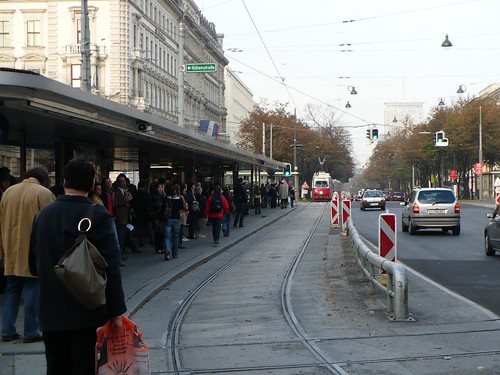
What is the history of this tram ring that allows the circulation of this signature street? Initially the ring was the city fortifications. However Franz Joseph, the King of the Austrio-Hungarian Empire decided that it wasn’t needed anymore and wanted to create a signature street. And create a meaningful place he did. The street is very wide and accommodates automobiles, streetcars, as well as a wide tree lined pedestrian and bike space.
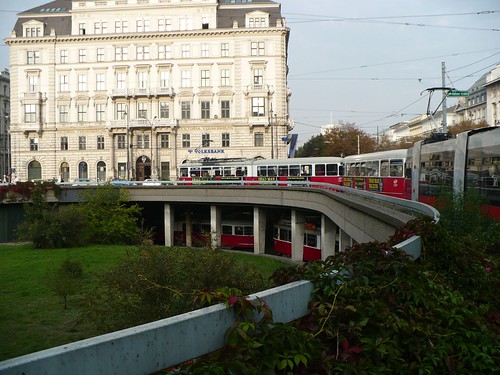
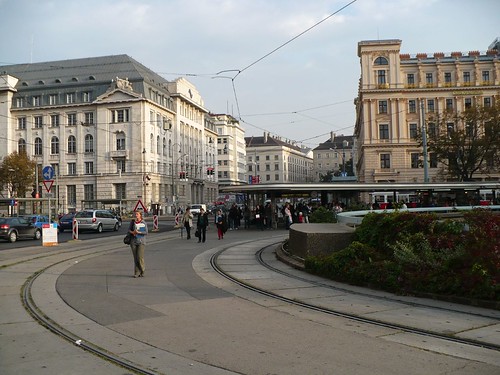
The most interesting piece related to transit is not really the loop itself, although its an important part of both Vienna and Budapest transport, but rather the multimodal connections that are made at certain nodes along the Ringstrasse. At one node, there are four tram stops on the surface, a tram turnaround just beneath the surface and a connection to the M2 Metro which follows its own ring around half of the downtown. In the photos below you can kind of see how this works.

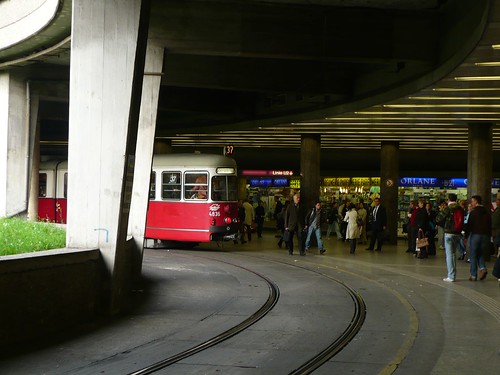
In another node, there are loops for trams, buses and the Metro connected by tunnels which allow citizens to not cross the Ringstrasse on the surface. Underneath the surface its like a mini-mall with eateries and the infamous Tabak shops where you can buy cigarettes and your metro pass.
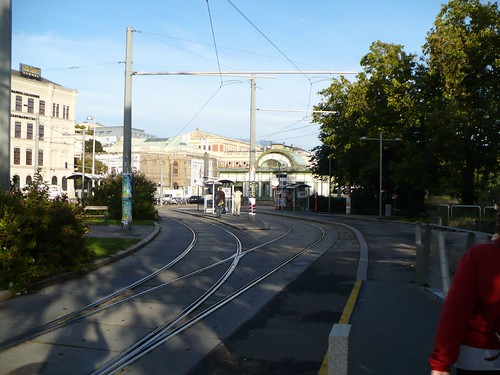
So why do these systems work? Well first off they are the circulators for all modal connections with in the central city. Their operation is dependent on the interface of faster Metro lines and slower tram and bus connections (the photo below is a tram and bus stop). In Vienna specifically the buses sometimes are even using the tram right of way and stops of the trams. They also all connect to the intercity trains on the edges of town allowing anyone living in town to get around effortlessly without a car.
This means that its incredible affordable to live in the old parts of Vienna. I was told that inside the ring is expensive, but just outside of the ring you can get a nice flat for $600 per month. I will warn folks that there are lots of good restaurants there so food could get expensive.
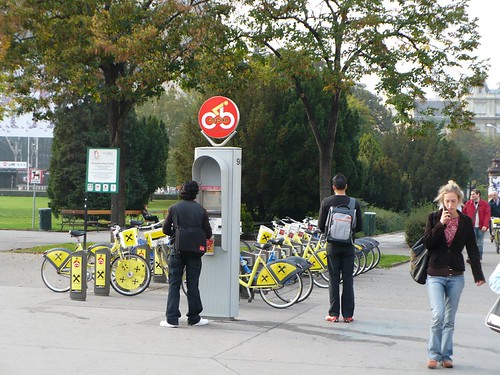
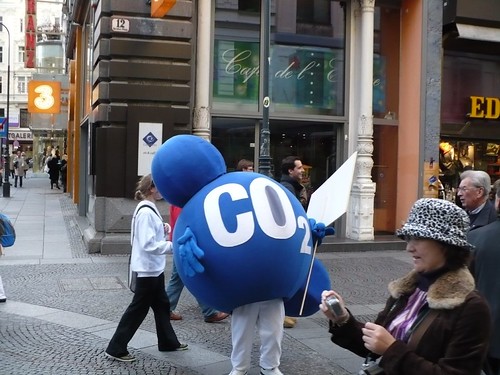
And if you're worried about the environment, there are people there to remind you.
What is the history of this tram ring that allows the circulation of this signature street? Initially the ring was the city fortifications. However Franz Joseph, the King of the Austrio-Hungarian Empire decided that it wasn’t needed anymore and wanted to create a signature street. And create a meaningful place he did. The street is very wide and accommodates automobiles, streetcars, as well as a wide tree lined pedestrian and bike space.
The most interesting piece related to transit is not really the loop itself, although its an important part of both Vienna and Budapest transport, but rather the multimodal connections that are made at certain nodes along the Ringstrasse. At one node, there are four tram stops on the surface, a tram turnaround just beneath the surface and a connection to the M2 Metro which follows its own ring around half of the downtown. In the photos below you can kind of see how this works.
In another node, there are loops for trams, buses and the Metro connected by tunnels which allow citizens to not cross the Ringstrasse on the surface. Underneath the surface its like a mini-mall with eateries and the infamous Tabak shops where you can buy cigarettes and your metro pass.
So why do these systems work? Well first off they are the circulators for all modal connections with in the central city. Their operation is dependent on the interface of faster Metro lines and slower tram and bus connections (the photo below is a tram and bus stop). In Vienna specifically the buses sometimes are even using the tram right of way and stops of the trams. They also all connect to the intercity trains on the edges of town allowing anyone living in town to get around effortlessly without a car.
This means that its incredible affordable to live in the old parts of Vienna. I was told that inside the ring is expensive, but just outside of the ring you can get a nice flat for $600 per month. I will warn folks that there are lots of good restaurants there so food could get expensive.
And if you're worried about the environment, there are people there to remind you.
Tuesday, December 23, 2008
Anti-Rail Activist Out of Office
When I heard from friends that Gerald was gone, I was a bit shocked. He was one of the major architects behind killing Austin light rail in 2000 and I don't think anyone should ever forgive him for that. He got pulled out by the Obama undertow. Kinda feel bad for Ben Wear, he lost one of his three sources.
Transit Not Roads
Lots of editorials coming out discussing the issue of roads and transit in the stimulus package. Take a look at a few on each side. It doesn't surprise me Atlanta is so far behind, and falling faster. They have editorial page people like this guy. But there are folks that get it. Such as local writers from PIRG and at the *Toronto Star* (updated: err Globe and Mail).
Monday, December 22, 2008
Design Matters
Interior design of buses matters as we found out with the Van Hool debacle in Oakland. But let's not forget that the exterior matters as well. I'll be interested to see how the Roadmaster double deckers will be replaced in London with a sleeker Aston Martin version. James Bond on the bus? Maybe. If people see buses as dirty old carbon spewers they won't even think to take them. It's hard now to get people to take the bus in places where the culture of bus riding is absent, but design can help change the image, and things like this are a step in the right direction.
Transit Can't Do All the Work
Just because a place has transit doesn't automatically mean it's going to turn into TOD. Case in point in Dallas at the Parker Road Station. Transit can shape growth if all of the players and policies are setting the scene for the market to drive growth, but if that isn't there, we can't expect transit to do all the work.
Signs of the Apocolypse
Well kinda. Click and Clack are pretty smart guys, but having the Car Talk guys advocate a 50 cent gas tax has to count for something right?
"I'm sick of people whining about a lousy 50-cent-a-gallon tax on gasoline! I think its time has come, and I call on all non-wussy politicians to stand with me, because our country needs us."Amen.
Final Administration Push on HSR
Seems kind of strange that the DOT would be looking at HSR, though I think its a plot to do it more privately than publicly. It's kind of the last gasp of the Bush administration. Perhaps it will go somewhere, but with the economy, It's seems kind of like an empty gesture.
H/T NJH
H/T NJH
Subscribe to:
Posts (Atom)