I thought this was an interesting video from 1908. I think people knew the camera was on the streetcar, and just like today were trying to ham it up.
Tuesday, March 31, 2009

Monday, March 30, 2009
Calculating Social Justice
I love how the blogosphere works. Someone posts on an older story and makes it relevant again and it screams across the blogs like a meteor. Today STB posted on an older Intermodality post that got to Ryan which I imagine is where it got picked up by Markos of teh big Orange.
Kos' post also brought me to this post at A Future Oakland that put forward some fun stats that drive me crazy every time the social justice folks bring them up, which they do often. The issue I have is with the use of the National Transit database to compare subsidy across different mode types for the sole purpose of saying that one mode is better for poor or minority folks than others. Why they always want to pick this fight is beyond me and its a symptom of thier not being able to connect the different types of modes and thier function to regional job opportunty expansion for lower income job seekers. Check out this chart from Public Advocates dot org, a law firm devoted to social justice.
 You can see that the chart doesn't discuss income levels but rather race, I imagine as a proxy for income levels? I'm also not sure what they mean by subsidy but I'm guessing its Capital funding+operating per rider? And as an issue, these lines all perform different services at different distances which affects the costs. No mention that BART and Caltrain riders pay higher fares than AC Transit riders. No mention that per passenger mile (a standard measure across modes), Caltrain and BART are far more efficient than AC Transit. There are a couple of reasons for this and AC's would be better compared to itself if it didn't include the less productive routes or $40 a trip paratransit but those are necessary services.
I want to believe in the social justice movement but they shoot themselves in the foot with dumb charts like this that don't tell me anything except that they don't understand transit operations or regional connectivity to jobs for lower income workers. If I were arguing on the social justice angle, I would start by saying that funding for road expansions is being wasted on suburbs that are leaching tax base and making people spend more of thier hard earned money on transportation. We also shouldn't be saying that AC is more efficient because thats false based on per passenger mile comparison and its operating type. Comparing AC to Caltrain per rider based on 20 mile trip versus a mile or two mile trip is rediculous and doesn't get us anywhere. Based on the 2007 NTD here are the comparisons for operating costs:
Caltrain is 27 cents per passenger mile.
BART is 34 cents per passenger mile
AC is $1.32 per passenger mile.
If we're going to look at capital and operating per passenger mile, it comes out to this in 2007:
BART: 50.9 cents per passenger mile
Caltrain: 60.3 cents per passenger mile
AC Tranist: $1.57 per passenger mile
Versus a Per Trip operations calculation:
AC Transit is $4.02
BART is $4.21
Caltrain is $7.28
What the argument should be is that expansion funding should stop going to stuff like ebart and expansion freeways and should start going to core expansion of AC Transit, Muni, BART, Caltrain Metro East etc. Put the transit where the riders are and it will be helpful for everyone to connect with job opportunities.
This culture war against rail that takes people to job centers in places like Concord and Walnut Creek needs to stop. Would it be more efficient to run buses? No. First that means more cars on the freeway because less people would be taking transit. It also means that more of downtown Oakland and San Franciso would be parking lots inducing less walking trips overall. But if we didn't look at regional transit systems, we would be allowing the bay area fiefdoms of transit to limit the job opportunities for low income workers. In Portland, the Max lines actually allow workers to reach a greater number of opportunities. This 2006 paper on economic development for the FTA by Strategic Economics shows an interesting chart below. But basically regional connectivity provides more opportunities for jobs that make it possible for upward mobility.
 If anything, the issue of expansion should point to the fact that suburban jurisdictions have too much power in how transportation funds are allocated. If it were equitable towards the core, services such as AC Transit would get more funding for more service, but it wouldn't make them more efficient in moving people. They are still a bus company.
This should tell you that MTC is shafting Oakland and San Francisco by not spending more on more efficient rail and metro type service for trunk lines that would serve hundreds of thousands of people. Compare the expansion of BART to San Jose versus a Geary Subway. A Geary Subway would cost around $3 billion and carry 100,000 riders easy the first day. The BART to San Jose line will not get anywhere close to that ridership number and cost a lot more money. These are the decisions that are being made based on regional politics rather than real expansion needs. The up front costs are more but the efficiency of operations leads to less cuts and better travel times for all riders in the core and connections beyond.
Just because people are poor or of a different race doesn't mean they deserve inferior or just one type of service. A network of service that serves different travel sheds is the best way to get people to thier jobs and open up the region for opportunity for all. The fight against the modes that take people further needs to be better thought out as a regional strategy for improving core service rather than pitting modes against each other, especially operations as efficient as BART or Caltrain. It's not very productive and the way the social justice movement is going now can only fail if they are going to bring data such as the chart above to the game.
Flame on...
Kos' post also brought me to this post at A Future Oakland that put forward some fun stats that drive me crazy every time the social justice folks bring them up, which they do often. The issue I have is with the use of the National Transit database to compare subsidy across different mode types for the sole purpose of saying that one mode is better for poor or minority folks than others. Why they always want to pick this fight is beyond me and its a symptom of thier not being able to connect the different types of modes and thier function to regional job opportunty expansion for lower income job seekers. Check out this chart from Public Advocates dot org, a law firm devoted to social justice.
 You can see that the chart doesn't discuss income levels but rather race, I imagine as a proxy for income levels? I'm also not sure what they mean by subsidy but I'm guessing its Capital funding+operating per rider? And as an issue, these lines all perform different services at different distances which affects the costs. No mention that BART and Caltrain riders pay higher fares than AC Transit riders. No mention that per passenger mile (a standard measure across modes), Caltrain and BART are far more efficient than AC Transit. There are a couple of reasons for this and AC's would be better compared to itself if it didn't include the less productive routes or $40 a trip paratransit but those are necessary services.
I want to believe in the social justice movement but they shoot themselves in the foot with dumb charts like this that don't tell me anything except that they don't understand transit operations or regional connectivity to jobs for lower income workers. If I were arguing on the social justice angle, I would start by saying that funding for road expansions is being wasted on suburbs that are leaching tax base and making people spend more of thier hard earned money on transportation. We also shouldn't be saying that AC is more efficient because thats false based on per passenger mile comparison and its operating type. Comparing AC to Caltrain per rider based on 20 mile trip versus a mile or two mile trip is rediculous and doesn't get us anywhere. Based on the 2007 NTD here are the comparisons for operating costs:
Caltrain is 27 cents per passenger mile.
BART is 34 cents per passenger mile
AC is $1.32 per passenger mile.
If we're going to look at capital and operating per passenger mile, it comes out to this in 2007:
BART: 50.9 cents per passenger mile
Caltrain: 60.3 cents per passenger mile
AC Tranist: $1.57 per passenger mile
Versus a Per Trip operations calculation:
AC Transit is $4.02
BART is $4.21
Caltrain is $7.28
What the argument should be is that expansion funding should stop going to stuff like ebart and expansion freeways and should start going to core expansion of AC Transit, Muni, BART, Caltrain Metro East etc. Put the transit where the riders are and it will be helpful for everyone to connect with job opportunities.
This culture war against rail that takes people to job centers in places like Concord and Walnut Creek needs to stop. Would it be more efficient to run buses? No. First that means more cars on the freeway because less people would be taking transit. It also means that more of downtown Oakland and San Franciso would be parking lots inducing less walking trips overall. But if we didn't look at regional transit systems, we would be allowing the bay area fiefdoms of transit to limit the job opportunities for low income workers. In Portland, the Max lines actually allow workers to reach a greater number of opportunities. This 2006 paper on economic development for the FTA by Strategic Economics shows an interesting chart below. But basically regional connectivity provides more opportunities for jobs that make it possible for upward mobility.
A preliminary analysis of transit ridership by industry and occupation in Portland, Oregon indicates that fixed guideway transit connects to more diverse employment opportunities than local bus. An Entropy Index was used to measure the diversity of incomes for occupations in industries with the highest percentage of transit ridership in the region. Entropy index scores are stated as a decimal and the lower the number, the more concentrated the occupational and income mix within that industry.
As Table 1 shows, industries with high percentages of bus ridership also tend to have low Entropy Index scores for an overall average of 0.54. For the most part, these were industries with a high percentage of low wage jobs. However, industries where workers use fixed guideway transit and/or bus and fixed guideway transit to get to work had a much greater diversity income diversity with an average index score of 0.89. This analysis demonstrates that fixed-guideway transit provides connectivity to jobs with different income opportunities, and possibly greater opportunities for advancement, while bus provides the best connectivity for workers in predominantly low-income industries with little opportunity for advancement.
 If anything, the issue of expansion should point to the fact that suburban jurisdictions have too much power in how transportation funds are allocated. If it were equitable towards the core, services such as AC Transit would get more funding for more service, but it wouldn't make them more efficient in moving people. They are still a bus company.
This should tell you that MTC is shafting Oakland and San Francisco by not spending more on more efficient rail and metro type service for trunk lines that would serve hundreds of thousands of people. Compare the expansion of BART to San Jose versus a Geary Subway. A Geary Subway would cost around $3 billion and carry 100,000 riders easy the first day. The BART to San Jose line will not get anywhere close to that ridership number and cost a lot more money. These are the decisions that are being made based on regional politics rather than real expansion needs. The up front costs are more but the efficiency of operations leads to less cuts and better travel times for all riders in the core and connections beyond.
Just because people are poor or of a different race doesn't mean they deserve inferior or just one type of service. A network of service that serves different travel sheds is the best way to get people to thier jobs and open up the region for opportunity for all. The fight against the modes that take people further needs to be better thought out as a regional strategy for improving core service rather than pitting modes against each other, especially operations as efficient as BART or Caltrain. It's not very productive and the way the social justice movement is going now can only fail if they are going to bring data such as the chart above to the game.
Flame on...
Sunday, March 29, 2009
The Indigo Line
The Fairmount Line is the only T Commuter rail line that stays within the Boston city limits. It's also been neglected over the years with poor maintenance and limited stations through one of the more challenged neighborhoods in Boston. However there have been recent plans by the CDCs to add five or so stations and make this line a part of the rapid transit network and use the new station construction to get better service on the line as well as more opportunities for affordable housing. Because of the patterns of parcelization and built out nature of the corridor, it would be hard to expect a major renaissance but small progress is to be expected.
Better service would definitely improve the corridor too. It will be interesting to see how it works out. Recent planning and funding put forward by the Patrick administration suggests that this will be done soon but rejoicing should wait until its actually complete. For more information on this corridor, check out the report chapter by Reconnecting America that discusses tools and policies for revitalization. (Warning, 38MB)
Better service would definitely improve the corridor too. It will be interesting to see how it works out. Recent planning and funding put forward by the Patrick administration suggests that this will be done soon but rejoicing should wait until its actually complete. For more information on this corridor, check out the report chapter by Reconnecting America that discusses tools and policies for revitalization. (Warning, 38MB)
Waco Streetcar?
If this gets built before Austin builds its light rail/streetcar line, I'm not sure what I'll do.
Saturday, March 28, 2009
The Foot Bus to School
I remember walking to school as a kid and then riding my bike in middle school. Aside from being a public health benefit, I also think that kids learn direction and wayfinding this way. It's an important lesson that I think is overlooked much of the time.
I find it interesting that a small town in Italy is looking to cut greenhouse gases by creating foot buses, groups of kids walking to school together. Seems like a great idea to me. From the New York Times:
I find it interesting that a small town in Italy is looking to cut greenhouse gases by creating foot buses, groups of kids walking to school together. Seems like a great idea to me. From the New York Times:
They set up a piedibus (literally foot-bus in Italian) — a bus route with a driver but no vehicle. Each morning a mix of paid staff members and parental volunteers in fluorescent yellow vests lead lines of walking students along Lecco’s twisting streets to the schools’ gates, Pied Piper-style, stopping here and there as their flock expands.
McCrory Gets on the Streetcar Wagon
It's interesting that the Charlotte Mayor is pushing for a streetcar over the maintenance bay that Keith Parker has lined up for stimulus money. Some of the tracks for the line are already in the ground and it would connect an east side destination with downtown. I walked the route when I was there but it's certainly a case where the streetcar would make a more physical connection between the two places. However I tend to agree that fixing the bus barn is of greater importance though I would like to see them do both.

But here's another idea. CATS laid tracks on Elizabeth Avenue that aren't being used. Why couldn't CATS install more streetcar track in phases but not operate it until it has a line long enough to span across uptown?There's another thing I don't think McCrory gets. He says there was not enough stimulus money for roads. I think there was too much for roads. If more money was allocated for transit, they could have done both of these projects.
Public Transit Keeps You Fit
I would tend to agree with this. Especially considering my own experience that I walk much more than when I lived in Austin because I'm not just walking to my car and driving somewhere but walking to the store and taking transit to work.
The researchers say that the fact that transit trips by bus and train often involve walking to and from stops increases the likelihood that people will meet the recommended 30 minutes of moderate physical activity a day, five days a week.
According to them, people who drove the most were the least likely to meet the recommended level of physical activity.
Thursday, March 26, 2009
The Noe Google Buses
These shuttle buses from Google (and other companies) come into the neighborhood in the evenings and mornings picking up tech workers and bringing them down to their respective south bay campuses. Many times I'll see the buses zooming up 24th street from the direction of the BART station on my way home and see them also almost bottom out at Dolores and 24th on the hill ridge. At times I myself will curse the Google kidz under my breath because of thier company heads' inability to locate near public transit so that these riders would patronize the system set up for everyone. How many of those workers would rather have a 15 minute ride on the J instead of a 40 minute ride to the campus.
I'm kind of torn on these shuttles. On one hand, it's a really huge freakin bus running up a residential street. But it is getting people that would likely be driving down 101 into more fuel efficienct ways. I don't have the same problem as others seem to have, complaining that affluent people have come to live in the neighborhood.
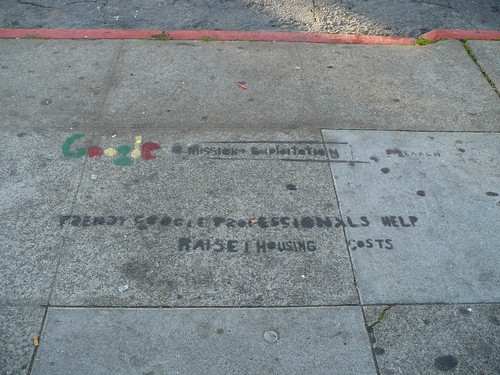
On the other hand, it's very stupid and un-environmental for these companies to locate such large office clusters away from conventional transit hubs. For all this talk of being green and forward thinking, companies like Google prove with their locational decisions that they don't understand how much transportation and land use plays into greenhouse gas emissions. But most of silicon valley is like that. Worst. Employment. Sprawl. Evah.
Because so many people want to live in a place that is walkable like San Francisco, you would think that businesses in the South Bay would look harder at trying to make more places like that instead of allowing even more junk down there. Facebook has actually caused a price spike in Palo Alto for helping thier workers live closer to work. I think this is a better solution than the shuttle buses but these companies are also skewing the local housing markets.
For "campuses" like Google, it seems that they could have built an office building downtown (they do have some offices in San Francisco) and saved more of thier employees money by allowing them to easily take transit to work. Instead they get more free parking which I would say if there is free parking at work, it is even more incentive to not live a location efficient lifestyle. Especially if you think you're special because you have solar panels over the parking. I wonder how much more Greenhouse Gases each of their employees emits because they drive a lot versus the amount of greenhouse gases those solar panels save.

I'm kind of torn on these shuttles. On one hand, it's a really huge freakin bus running up a residential street. But it is getting people that would likely be driving down 101 into more fuel efficienct ways. I don't have the same problem as others seem to have, complaining that affluent people have come to live in the neighborhood.
On the other hand, it's very stupid and un-environmental for these companies to locate such large office clusters away from conventional transit hubs. For all this talk of being green and forward thinking, companies like Google prove with their locational decisions that they don't understand how much transportation and land use plays into greenhouse gas emissions. But most of silicon valley is like that. Worst. Employment. Sprawl. Evah.
Because so many people want to live in a place that is walkable like San Francisco, you would think that businesses in the South Bay would look harder at trying to make more places like that instead of allowing even more junk down there. Facebook has actually caused a price spike in Palo Alto for helping thier workers live closer to work. I think this is a better solution than the shuttle buses but these companies are also skewing the local housing markets.
For "campuses" like Google, it seems that they could have built an office building downtown (they do have some offices in San Francisco) and saved more of thier employees money by allowing them to easily take transit to work. Instead they get more free parking which I would say if there is free parking at work, it is even more incentive to not live a location efficient lifestyle. Especially if you think you're special because you have solar panels over the parking. I wonder how much more Greenhouse Gases each of their employees emits because they drive a lot versus the amount of greenhouse gases those solar panels save.

Why People Are Going to Hate You
Because you're floating a bill that would make transit planning a state function instead of a more local one. That is dumb on so many levels.
The main reason the measure is so politically fraught is that it seeks to take metro-area transit authority away from the powerful and long-entrenched Metropolitan Council. Hausman says the present concentration of transit dollars and planning power in the Met Council and the Counties Transit Improved Board (CTIB) creates inefficiencies and unwisely forces the whole state to hew to a long-range rail transit policy dictated by a handful of metro entities--particularly Hennepin County and the city of Minneapolis.Why would you take the transit authority away from the regional planning agency? This makes absolutely no sense unless you want to steal funding for "other" transportation priorities. One of the problems in the Twin Cities is that the current righty Governor appoints members of the Metro Council which controls regional policy. Somehow fix that first.
Wednesday, March 25, 2009
Oh for the Love of...
You can't make this up:
H/T BATN
It would mean that the Millbrae-to-San Francisco route would have three separate electrified options for riders. Isn't that more than a bit redundant? Rail planners don't seem to be bothered one whit by the concept at this point. They are forging ahead.How many roads go to San Francisco?
H/T BATN
Hadn't Thought of That
Some officials in the UK are saying that it would be cheaper to build new rail lines instead of renovating existing lines because they took into account people's time cost during the reconstruction that would disrupt service.
I hadn't thought of it that way but it seems like an interesting proposition to me. Reconstruction always seems to cause problems, and if they built new lines, that would open up the capacity on the old ones for later rehabilitation.Building from scratch, he said, would not carry this cost, and it was "by no means clear that ostensibly lower-priced upgrades are always better value than new lines including new high-speed lines".
Additionally, he said the government had to take account of "the true cost of the disruption to passengers in services cancelled or diverted year after year".
He continued: "For the future, we need to assess the relative merits, including disruption saved, of building new lines rather than highly disruptive and expensive major upgrades of existing lines."
Monday, March 23, 2009
On the Hiawatha Today
So if you follow my twitter account you'd have seen my tweet noting that I was on the Hiawatha Light Rail line in Minneapolis. What you didn't see is what I was thinking on my way to downtown Minneapolis. It was strange now that I think back on it. A colleague and I were on the train and just chatting away with our bags in our laps but I didn't feel like it was out of the ordinary. I felt perhaps like some do when they dream in a foreign language after learning it for a long time. I've learned to take transit and expect it to be there yet this isn't a serious option in many of our regions and cities and that makes me a bit sad.
It should always be so easy to just hop on the train. In the last few weeks I've been able to not drive a car since I left Chicago. I took the Orange line to the airport, flew to San Francisco, took BART home. Today I walked down to BART, flew to Minneapolis and rode light rail to downtown. It's second nature now I guess, looking for the easy accessible transit. During those rides I was able to chill and not worry about whether I was going to be late. I was able to check email or listen to a podcast. I didn't need to worry about parking my car. I just needed to be. Is that so hard to understand for folks so opposed?
It should always be so easy to just hop on the train. In the last few weeks I've been able to not drive a car since I left Chicago. I took the Orange line to the airport, flew to San Francisco, took BART home. Today I walked down to BART, flew to Minneapolis and rode light rail to downtown. It's second nature now I guess, looking for the easy accessible transit. During those rides I was able to chill and not worry about whether I was going to be late. I was able to check email or listen to a podcast. I didn't need to worry about parking my car. I just needed to be. Is that so hard to understand for folks so opposed?
HOT Lanes, Sprawl, Not Transit
So says the FTA about stimulus cash. What a joke. I sure hope things change soon because I'm getting tired of this type of BS. Is anyone else encouraged by the DOT Secretary's blog? I am.
This comes at the same time when Texas wants to use other stimulus funding for another sprawl road. Again, how would this ever match a cost-effectiveness measure?As county leaders press forward with Grand Parkway plans, Metro leaders are looking for a Plan B for two rail lines they had planned to use federal economic stimulus money to help fund. Metro’s pitch to fund the North and Southeast lines with stimulus funds fell short of the feds’ scheduling mandate.
Metro proposed to “get the ball rolling,” within 90 days, according to its brochure requesting $410 million in stimulus dollars. The transit agency also said $70 million could be used to convert 83 miles of high-occupancy vehicle lanes into high-occupancy toll lanes. Last week, Metro leaders said they learned that federal transit authorities preferred the $92 million it will receive in stimulus funds be used primarily on the HOV conversion.
Sunday, March 22, 2009
Photos of Interest: Chinese Trams
Leroy Demery who often posts with Mr. Setty at PublicTransit.us has loaded photos from 1983 when Chinese Trams still operated. Fascinating!
Saturday, March 21, 2009
Scott Bernstein Part 2: It Is All Potentially Reversible
Yesterday we brought you a first listserve post by Scott Bernstein of the Center for Neighborhood Technology in Chicago about some streetcar history. In further thoughts, he discusses how we can get at least some of what we lost back.
I sometimes skip long posts, but this one is certainly worth the time spent reading. All inserted links are my doing in order to try and give greater background and some edits have been made for capital letters and spacing.
Guest Post 2: Scott Bernstein
I sometimes skip long posts, but this one is certainly worth the time spent reading. All inserted links are my doing in order to try and give greater background and some edits have been made for capital letters and spacing.
Guest Post 2: Scott Bernstein
Here are some further thoughts.
The definitive history of the interurbans is The Electric Interurban Railways in America by George W. Hilton and John F. Due, Stanford U. Press 1960; 463 pages, very thorough analysis and directory of operating companies and maps, indexed; still in reprint but not hard to find a used copy.
It's impossible to fully describe what happened to the street railway systems without some description of the relationship they had to the electric power industry.
The divestiture you and I guess Andy refer to came as a result of the Public Utility Holding Company Act of 1935, aka, PUCHA, which left it to the newly minted SEC to implement via regulation. SEC was created, strictly speaking, to create and implement accounting standards, the lack of which were widely believed to be at the heart of the stock market crash and subsequent Depression. Hilton and Due state this clearly as follows:"...the SEC interpreted the provisions concerning the elimination of holding-company systems to require that the power companies divest themselves of their electric railway affiliates and dissolve the pyramided holding company structures. As a consequence, the interurbans that were elements in the holding company systems were separated, usually by public sale of the stock...Most interurbans had been abandoned before the act became effective."Hilton in particular believed that the interurbans represented a flawed interlude in the development of mass transportation, and he quite strongly and almost angrily stated this opinion when Congress revisited the Snell accusations and the GM-NCL case in hearings held April 4-11 1974 (Hearings Before the Subcommittee on Antitrust and Monopoly of the Committee on the Judiciary, US Senate, 93d Cong. 2d Session on S. 1167, part 4, Ground Transportation industries). In this testimony and subsequent committee discussion, he offers interesting opinions on why certain streetcar systems survived both the early wave of abandonments and the divestiture rulings, and most of these have to do with urban form, density, and the availability of special right of way (note--he's an economic historian, not a physical planner or urban historian).
In the 1960 work, Hilton and Due acknowledge that other means were used to extend the life of these systems-- State and sometimes municipal investment and support, conversion or merger into publicly owned systems, and inter-line cooperation of marketing and fare-media (which probably extended the life of the excellent interurban networks in Ohio and Indiana, among the best in the nation), among other methods. This testimony, in my opinion, actually makes a strong case that abandonment wasn't inevitable, rather, it was result of failure to grasp the networked nature of the tangible (infrastructure networks) and intangible economic networks) that are essential to successful places.
The PUCHA passage bears some further examination.
No small part of the political impetus to pass PUCHA came from enmity between two people--Samuel Insull, founder of the American electric utility industry, former secretary to Thomas Edison and head of the Chicago-based Commonwealth Edison empire and affiliates; and Harold Ickes, confidant to FDR, Secretary of the Interior (where many of today's separate domestic cabinet agencies were formerly housed), and civic leader in Chicago and the North Shore suburb of Winnetka. Simply put, they despised each other; Insull's business model required demonizing the concept of public ownership and Ickes' view requiring that it be embraced.
At the time that PUCHA was being conceived, Insull controlled not only the remainder of the former traction empire controlled by Charles Yerkes (who interestingly went on after having been pushed out of Chicago to help lead the construction of the London Underground) but also much of the midwest electric transmission system, the main midwestern interstate pipeline system and the local natural gas utility, plus Peoples Gas Light & Coke Co. too. Insull wrote the first check to the Commercial Club of Chicago for underwriting what became the Burnham/Bennett Plan of Chicago, but did not play a role in its development or in its subsequent marketing (as far as I could tell, Dennis I know has studied these matters too and may have a different opinion). Insull, while vilified for his monopoly, helped buy much public goodwill in playing both sides of the smoke abatement campaigns in Chicago for decades--electric utilities were powered by very inefficient coal-burning power plants, but so were railroad locomotives. He was able to sell railroad electrification as a civic and public health virtue, and simultaneously to sell natural gas as a "smokeless fuel for a smoke-free town." (To convert from the use of so-called manufactured gas to "natural" gas required tuning, retrofitting and/or conversion of all gas-fired appliances in Chicago, which was amazingly accomplished in 1 year, 1931; also, one of the themes of the 1933 Century of Progress Chicago World's Fair was that it was billed as the first "smokestack free fair.")
Nonetheless, Ickes and others were able to paint Insull as the prototypical villain at a time when heads needed to roll, and was convicted of securities fraud (reversed in 1934 but he spent his remaining years a broken man). To be fair, Ickes presided over much of his era's "recovery" investments through the Public Works Administration, and on the transportation side, the majority of the PWA's investments were in highways not in regional mass transit systems (an important exception was PWA investment in Chicago's subway, but Ickes refused to support building east-west tunnels for Chicago's streetcar lines, an action that bears further examination).
The divestiture and subsequent efforts to keep these systems viable, both the urban and interurban street railways, took a number of bizarre turns. In Chicago alone, a simple listing of the changes in policy, court rulings on bankruptcy proceedings and re-organizational changes along with maps runs over 400 pages (Weber, Outline History of Chicago Traction 1936, and it gets even more complex after that). The influences that needed juggling were truly vast, not half-vast; Frank Gruber's point about the iconic importance of the nickel fare posted yesterday is a good example, there were similar examples almost everywhere.
PUCHA seemed to be passed without regard for the potential urban damage that divestiture would likely cause. Around 1920, a federal commission on the future of electric railways failed to come to any firm recommendations for future federal interest, and as far as I can tell, that was the last time that a serious national examination of this essentially urban form of mass transportation occurred. But it was made clear at those hearings, in industry publications, in discussions held at various local governmental trade associations, that these private corporations were playing an essential public service (sound familiar?) role.
By divesting, public transportation lost a more or less guaranteed source of revenue for capital investment, whether it was made directly, through rate-basing of these costs, or indirectly, by using the backstop credit facilities of their holding companies.
And this occurred at more or less the same time that the fascination with modern road building and the idea of "limited ways" (later "superhighways" and "limited access highways") was taking hold (in the 1920s, Insull similarly promoted "super" transmission lines and pipelines).
Perhaps someone on the list can comment on this, but in reviewing the Burnham/Bennett Plan, and associated documents from the resulting Chicago Plan Commission, the transportation focus, outside of the central area, was on inter-city travel, not on internal circulation or accessibility. (this is also the point expressed in the late Paul Barrett's excellent The Automobile and Urban Transit: The Formation of Urban Policy in Chicago-1983) I suspect this was largely the case in city planning in the era that followed. In framing the issue in this way, and leaving it to the private sector to sink or swim w/ regard to mass transportation, a powerful force for decentralization emerged. Similarly, Burnham and contemporaries did not grasp the notion of the networked city, and in re-reading, that era's fascination with the promise of regional highway networks and what promised to be a viable airline industry evokes Henry Ford's comment that "we shall solve the problems of the city by leaving it."
So why go over all this?
Because it is all potentially reversible.
And because it is essential that we figure out how to make it so.
As we've discussed on this list, only by switching from liquid fuels to non-motorized and electric transportation can we meet any of our energy independence or climate goals.
And only by reducing dependence on individual vehicles to a greater reliance on mass transportation can we transition to a nation of great cities and regions.
Here are some tools to think about in framing methods of getting there--
1. Local electric distribution utilities never lost the legal right to power electric transportation; all 50 states have a common method of enabling electric distribution utility financing of all or part of the necessary systems, which is a rate filing to help finance these systems. This offers opportunities for cities, transit operators, developers, metropolitan planning organizations and states to build new kinds of financing mechanisms to more systematically support local and regional surface transportation infrastructure. A similar case can be made for local governments and special service districts (which own and operate almost all of the nation's airports outside of NJ, MD, Alaska and HI) to partner with the electric utility industry to support the infrastructure necessary for inter-city high speed rail.
2. Deregulation of the electric utility industry has been a mixed bag, but in over a dozen states a fait accompli. So in a sense this is an opening to partner with contemporary holding companies too. These companies need to re-certify their "market-based" rate making authority every three years with the Federal Energy Regulatory Commission, another opening for the new administration to address potential urban consequences of energy and climate policies.
3. PUCHA was repealed in the 2005 Energy Policy Act ( one outcome has been at least 100 municipalization efforts, 20 successful, most recently Winter Park Fl, but the repeal also opens up the potential for other kinds of ownership too)
4. A national debate on the future shape and location and purposes of the electrical grid has started and needs an urban voice, no less than does the analogous debate about transportation infrastructure.
5. A push by leaders in the public accounting profession and in the investment community for more transparency in State and municipal accounting led to the creation of the Government Accounting Standards Board in 1984, and their rules on accounting for infrastructure investment, aka Statement 34, implemented from 1999 to present, lay a first-time basis for disclosure of the life-cycle costs associated with different types and patterns of major capital investments. More recently, a push for better state and local disclosure in the waning days of the Bush administration, has been taken up in the Senate and House Banking committees. This is a real opportunity to show well how the hidden assets of cities and urban places perform.
Biden Goes to Bat
Joe Biden says what we've all been talking about for years. I'm glad he's out there stumping for Amtrak which will bleed over to transit in general I believe. You gotta love comments like this:
"We subsidize our highways and airports more than we subsidize Amtrak," said Vice President Joe Biden. "So lets get something straight here - Amtrak has not been 'at the trough.' Amtrak has been left out much too long."H/T ASD
Curitiba Subway
This article is from February but it was just brought to my attention. Seems as if those BRT lines just aren't enough.
H/T ASD
Brazil's Paraná state capital Curitiba is planning to build a subway line and highway concessionaire Triunfo Participações e Investimentos (TPI) (Bovespa: TPIS3) is seriously studying the project, TPI president Carlo Bottarelli told BNamericas.It also shows you the costing differences between Brazil and the United States. 13.75 miles of Subway is costing $72 million a mile. That's pretty cheap. If we could do that here, I think we'd have more Subway lines.
The subway initiative would be a first for the city and a first for the highway concessionaire. The city is planning to build a US$1bn, 22km system that will cross the city from south to north, Curitiba business relations secretary Luiz de Carvalho told BNamericas.
H/T ASD
Subscribe to:
Posts (Atom)