Sunday, January 31, 2010

Jack London Calling

Jack London is closing Barnes and Noble book store. It seems like the perfect place for an urban renaissance but its so disconnected from Downtown Oakland by the freeway that it hasn't drawn any of the energy from the employment center. There's even a relatively close BART station if you consider the blocks are of a walkable size and most of the attractions are about a half mile away. But the highway is daunting. I often wonder what would have happened if they trenched the freeway or just made it an urban boulevard for a number of blocks to allow a smoother connection between the urban fabric that existed before the freeway. Ultimately I believe that this is the perfect connection for a streetcar, but it would be nice if there were no highway as well.

(The photo shows Jack London just south of the freeway before the waterway. The Lake Merritt BART station is just north and downtown Oakland is Northwest)


Sunday Night Notes

A few things to chomp on:

State lawmakers in California are understanding what parking is not. Free.
~~~
MARTA is a big reason why UPS located its headquarters in northern Atlanta. It's pretty interesting how much development happened around the MARTA stations outside of downtown.
~~~
Since High Speed Rail is such a newfangled thing to most people in the United States, many want to put it into the urban transit category when thinking about its mission. However this is not the case. In my opinion its intercity transport like airplanes. Often opposition to HSR brings out the density straw man to oppose expansion of intercity rail lines but then they would also have to argue that airports and greyhound bus stations need density to operate as well.

I also believe that HSR is a one way train. It's not necessary to have density to operate between cities but it starts the conversation on increased density and transit service once it gets there. And I feel that the comparisons to Europe and density are really mischaracterized discussions about connectivity and service levels. Ultimately the reason why HSR is fairly useful in Europe is because you can get a train to everywhere. Much like the Hub and Spoke airport system in the United States.
~~~
Wendell Cox is always a fun comic relief.

Music Sunday: City Pavement

I always like posting songs related to urbanism or city life. Here's one from the UK.

Thursday, January 28, 2010

Wednesday Night Notes

A quick post because today was a blockbuster for articles:

Core Vitality Imperative - The Urbanophile - Aaron is really rocking these posts and is always thoughtful. If you're not reading you should start now.
~~~
"I will walk, I will ride a bike, I'll even crawl to get the debt load off our children,"

This quote was an angry response to raising taxes for transit. These tea-baggers are too much.
~~~
Who knew? Walking briskly makes you healthy. In cities you walk more.
~~~
Ryan has two papers of interest. Paper 1 - Paper 2
According to the authors, it does seem that in polycentric regions, small cities can enjoy some of the labour productivity gains from a large market without having all of the disadvantages of a single large city (including high costs and congestion).
~~~
Yonah asks how you connect a multi-polar region like the Triangle.
~~~
From Switchboard:
Today NRDC released Location Efficiency and Mortgage Default, a study that shows a direct, statistically significant link between the high costs of personal transportation imposed by poor location efficiency and a much higher risk of default.

Sunday, January 24, 2010

Ron Kilcoyne: An Emergency Operations Fund

Similarly to Human Transit, I got an email this week from Ron Kilcoyne who is the general manager at Greater Bridgeport Transit with a post advocating for an emergency operations fund for all the agencies that are getting slammed by the recession around the country. Below is a guest post by Ron:
What will it take to restore all transit service hours that were cut over the past two years and prevent additional service hour reductions? I haven’t found a number but I guesstimate that 10% of the total cost of providing transit service nationally would be a decent number. I suggest that $9 billion in a separate emergency operations fund (in addition to the $8.2 billion for capital in the House Bill) that can only be used to add service hours or prevent service hour reductions be appropriated over a 2 ½ year period. - $1.7 b for the balance of FY 2010; $3.6 b in FY 2011 and $3.7 b in FY 2012. Money would be distributed by 5307 and 5311 formula.

In order to receive funds transit systems would have to operate within 120 days of signing into law no less than the number of service hours (annualized) that they did on the first weekday, Saturday and Sunday of 2010 plus a number of service hours equal to the annual allocation under this program divided by the incremental cost of an hour of service. (Transit agencies with multiple modes operating at different costs per hour may allocate hours among the different services as they see fit.)

If a transit agency’s policy board approved service hour reductions prior to January 1 that were to be implemented after the first week of January or if the agency proposed specific services to be cut or specified a number of service hours that will need to be cut in 2010 or 2011 prior to January 1, 2010; then these hours may be counted in lieu of additional hours. Transit agencies that have not cut service or proposed to cut service could increase service hours. From a jobs perspective a compelling case can be made for this proposal.

  • A recent TCRP report indicated that each billion invested in transit operations yield almost twice as many jobs as a similar investment in capital (41K compared to 23K) A PIRG analysis of ARRA funds showed that investments in transit capital generated more jobs than similar investments in highway capital
  • The jobs created/preserved by this proposal will be immediate and in place months before the elections
  • From a jobs perspective an even larger impact will be on the number of jobs that will gain transit access. Unlike other job stimulus investments more transit service hours will provide more opportunities for individuals to access employment and training. (I don’t know how to quantify the number of jobs that will gain transit access or the number of individuals who will gain access to more jobs. – but I suspect the number is quite large however you do it.
  • Fuel prices are increasing again. If this continues until another tipping point is reached as in 2008, transit agencies that struggled to meet demand then will be even less able to meet demand in 2010.

I think this proposal addresses concerns that funds will not be spent wisely or have a direct impact on jobs. Another concern will be what happens after 2012 – will there be pressure to add more federal operation funding. This is where the incentives and conditions that should be included in the authorization bill are important. By then hopefully states and local government will be in better position to increase support for transit and these provisions will provide powerful carrots and sticks to see that it happens. (I will describe what should be contained in the next authorization bill in a later post.)

So in closing contact your senators and ask for $9 Billion for emergency operations support and urge others to do so also. Please feel free to post this message anywhere there may be a receptive audience.

The Ravages of Prosperity

It's interesting how any transit investment can be seen as good or bad based on how the increase in values affects the community. Some want better property values but others don't for fear of being displaced. So you're damned if you don't, damned if you do.
Redevelopment, as it turns out, is actually bad because it prompts higher property values (and taxes) and might gentrify the district, forcing some people to move. In other words, light rail should be prevented from doing what it does best: add value to urban neighborhoods. More stations might be OK, according to the suit, but only if nearby residents and businesses are insulated from the ravages of prosperity. At least that's the drift of the argument.
So do we just not improve anything? I'm sure that's not the answer. But these things are tough to balance.

Public Input in Ogden

I was really shocked by this quote in Standard Net, the newspaper for Ogden Utah:
UTA spokesman Gerry Carpenter said he is impressed with the amount of homework and energy the Trolley District group put in and believes the group has worthy goals, but it may be coming to the table too late.
That last part about coming to the table too late is outrageous considering the group has been looking at the 25th street alignment over the 36th street alignment for over a year and has been very vocal about it as well. They were never allowed at the table, so to say they were late is a bit disingenuous. I know this only because I went to speak about streetcars in Ogden about a year ago, though not to advocate for a specific route. The activists were pounding the pavement in support then and are still on the path now.

It shows a disconnect between the citizen process and leaders such as the Mayor of Ogden who haven't wanted to see the 25th street alignment considered at all because 36th was his idea. There was also thefear of the state DOT who people have always believe would not want the streetcar running on their road, whether in a dedicated ROW or not. Perhaps the upstart group should look to some of the Urbanophile's suggestions for beating state DOTs and apply them to both UDOT and UTA.

Friday, January 22, 2010

TOD Will Pay Someday

Unfortunately it feels like there is a bit too much optimism that TOD will pay for infrastructure such as rail. Really though, the increase in value brought by new transit lines has too many people fighting over it, from the basic infrastructure to affordable housing to the lines themselves. We can't expect to put all of that weight on the back of a few projects. However we keep making TOD out to be the savior of all. I feel like it can do a lot of things, just not everything.

Thursday, January 21, 2010

Assume the Risk

There have been a lot of issues recently over cost estimates that are starting to rub me the wrong way. I had never mentioned it before but in my head I kept thinking to myself that the cost for LRT in Norfolk seemed awfully low. The most recent estimate was $232 million for 7.2 miles. Compared to most LRT lines that would have been a steal. Phoenix was upwards of $80 million per mile while Norfolk was hovering around $32 million. Now it's $340 million which is still ok at $47 million a mile, but everyone is going crazy.

But today I saw something interesting out of Houston. The city is going to pay up front an extra $100 million for their contract and the bid winner will assume liability for any cost overruns during the project (assuming it doesn't cause them to go out of business). My question then becomes, how come we don't make all contractors stick to their cost estimates?

While I understand that things change and work orders change, shouldn't the company which came in with the chosen bid be responsible for seeing through with their magic eight balls? Perhaps that is asking too much or asking in some instances for disaster. Cutting corners leads to bad things and I certainly wouldn't want a contractor to go cheap on materials because they were trying to make money. In any event, with all these cost overruns on projects that are making LRT look bad, I don't see why more isn't being done to make the bidders more responsible for their bids.

Wednesday, January 13, 2010

Ding Dong the Witch is Dead

Well sort of. Today the 2005 dear colleague letter that then FTA Administrator Jennifer Dorn released on the world requiring that all New Starts projects have a medium rating on their cost effectiveness has been rescinded. Many have hailed this as a huge step forward for livability advocates but honestly its only half of the picture. One of the reasons I believe that the medium rating was imposed was to build more cheap BRT projects and cut out subway and lrt projects. But another reason was to cut all the junk projects out of the funding loop. With only about $8 billion dollars available for new starts projects in the last transportation bill, it leaves the need for regions to pick up the hundreds of billions more needed to build out transit networks. One estimate pegged the total at approximately $250 billion dollars. That is a huge gap.

So while some newspapers including the New York Times believe that this is opening up the funding floodgates, they are sorely mistaken. It does however change a few dynamics that have been holding projects back. The Central Corridor in Minneapolis is a curious case. They have been wanting to add a station in St. Paul to serve lower income community however it slowed down the travel time just enough to push the line over the index. This is just one example of how suburban to downtown speedy travel is emphasized over shorter trips in denser communities by the existing cost effectiveness index. Yonah has specifically mentioned another Minneapolis project that I also believe is headed in the wrong direction.

Dropping the medium requirement also takes a step towards making us think harder about what we're really building transit for. Is it for existing population or the future population or both? A common comment about the current cost effectiveness rating is that it would have never funded the DC or New York Subways. But DC and New York would not have gotten to where they are now in terms of density without the investments in the subway. Really this is a chance to start thinking about how to make transformative investments in transit around the country. It's an opportunity we've been waiting for, but as with all big ideas, it needs money.

Sunday, January 10, 2010

Sunday Night Notes

I realize there has been much less posting here, but if you still want links you can follow me on twitter which seems to be more regular. @theoverheadwire

There are some interesting links today however:

I don't really think cities should compete to land new jobs. Especially for government funded jobs such as Northrup Grumman.
~~~
Wal Mart doesn't create new jobs. Tell us something we don't know.
~~~
So does this mean Smart Cars are PRT?
“Smart’s not a car in the traditional sense, it’s a high- style alternative to public transportation,”
~~~
What does urban authenticity mean?

Wednesday, January 6, 2010

Is It a Wonder How Housing Prices Are So High?

I appreciate environmental regulations and the like, but it seems like a lot of folks in California just take it too far:
Talk of any development along the rail line has raised concern in the environmental community, some of whom believe the system will act as a catalyst for growth, as developers try to build for those who want to live near a train station.
and this:
Under proposed air-quality guidelines, for the first time in the U.S., if extra cancer risk meets a specific threshold, the developer would be told to study the potential health effects of the freeway pollution on the people who would live in the homes. That would be in addition to what the developer is already required to do: study the effects of the housing on freeway traffic and the surrounding environment. If the health risk is too great, the developer might need to modify or scrap his development plan, or spend extra time persuading the city or county to approve it.
If we can't develop near transit stations or near freeways in existing urban areas, where the heck are people supposed to develop new homes that won't affect the environment? Am I missing something here?
How ITS Should Work. Right?

How ITS Works through the eyes of a kid:


Via Portland Transport

Tuesday, January 5, 2010

Can One Development Catalyze a District?

And is it right to be developing once vital industrial land? It's a question that often comes up that I don't quite know the answer to. Here in Oakland many properties in West Oakland have been deemed off limits to commercial or residential development. Many council members want to preserve the industries that provide much needed jobs and an economic boost.

In Denver, there are developers who are looking to revitalize the South Broadway area around the Evans station that is primarily industrial. Much of the project is a mixed use redevelopment on six acres that was once a superfund site. The developer is a single developer which also begs the question of how a market gets started. Once he proves that the area is changed and continues to build more and more projects, other folks will follow suit. But ultimately the developer is the one who will boom or go bust.

I find this interesting because everyone is always looking for the next big neighborhood or district. In the past improvements have been predicated on good bones. The gridded street network already exists and a light rail station is already near by. But at the moment the market isn't there. Could it be a single developer who creates a market? Or are markets organic and ultimately unpredictable. I guess we'll find out.

Monday, December 28, 2009

Around the World: Argentina & Hong Kong

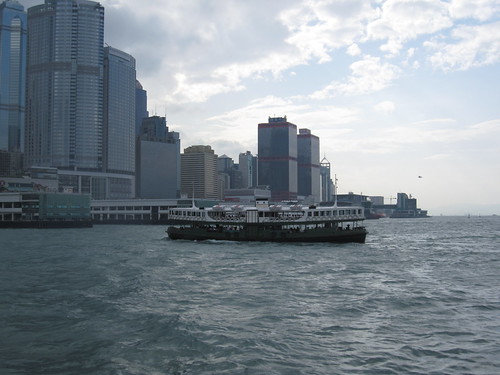
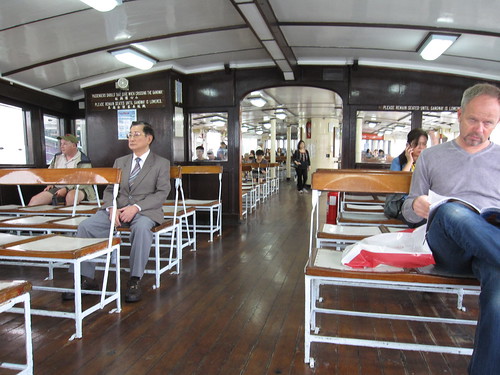
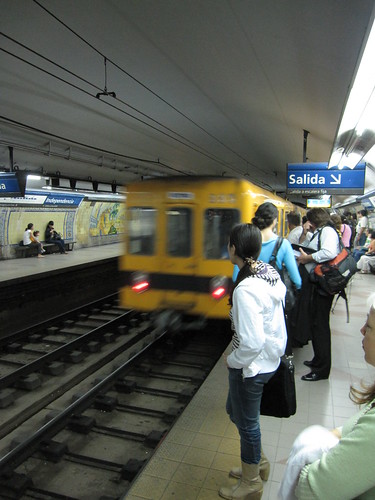
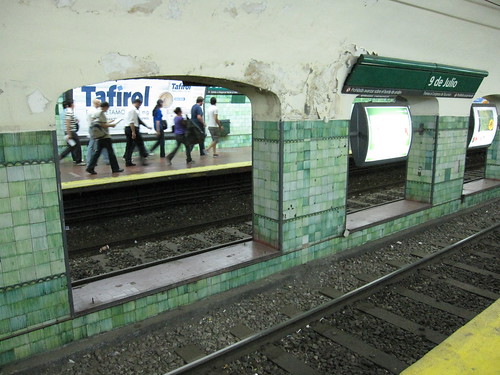
Fearless Overhead Wire correspondent and world traveler @nspicer just got back from his honeymoon in Argentina with @autgoff and took a few transit shots because he knows that I'm a nerd and I appreciate these things. He's also recently been to Hong Kong and rode the Star Ferry. Here are a few shots from his travels. Thanks Spicer and Anna!


Sunday, December 27, 2009

OT: There's More to College Than Football

I like football. I watch a lot of games during the season but as a former athlete in an Olympic sport I got really annoyed at the Football coaches at Texas fairly often. They have always been shortsighted in terms of other sports and academics. Take for example Jamaal Charles who is now the big play maker for Kansas City. The kid was super fast and ran track at Texas in the offseason. The short story of it all was that track in college gave Charles something to do in the offseason to keep his focus on something other than the street.
Back in Port Arthur, track had kept Charles focused. It had given him something to do during football offseason, when cousins found trouble .
Now I often defend athletics because I was an athlete who benefited from competing for a division one school. But there were times when I had to fight my guidance councilor to take harder classes. At times she would try to give me easy classes because of catering to the lowest common denominator in the program. People who just needed classes to stay eligible to play.

Speaking for myself, I chafed at the idea of not being able to take classes like Military History to 1900 because others said they would be hard. (One of the most fascinating courses I took in Undergrad outside of my major classes) But this also speaks to the fact that colleges don't see football players as part of the student body. In fact it is evidenced every time we get a good athlete who wants to run track and play football. Usually football wins out:
Charles says he was told that if he wanted to maintain his place as the Longhorns' starting running back, he'd have to abandon track and make football a year-round commitment.
There were many guys who liked to run who were told they couldn't. I don't doubt that studying more tape helps. But Football isn't the center of the universe. If they are enrolled in school, let them take the classes they want. And if they want to play another sport that helps their football playing in the offseason why not let them?

Thursday, December 24, 2009

Merry Christmas

Hope everyone is having a good Christmas. Here are some fun links for you:

Census shows slow in sunbelt burst.
~~~
Holland looks at per KM pricing.
~~~
Intercity trains in Germany beating the pants off of planes.
~~~
I WISH buses all had 5 minute headways.
~~~
Is China building HSR too fast? Like Robert, I feel like someone is trying to affect the US debate.

Friday, December 18, 2009

Road Building Paradox

Has anyone ever heard of the Downs - Thompson paradox?
“Downs-Thomson paradox, also referred to as the Pigou-Knight-Downs paradox, states that the equilibrium speed of car traffic on the road network is determined by the average door-to-door speed of equivalent journeys by (rail-based or otherwise segregated) public transport. It follows that increasing road capacity can actually make overall congestion on the road worse."
Sounds like some sort of variation of induced demand.

Pressure

Some telling comments from the Austin Chronicle:
Council Member Sheryl Cole sits with Leffingwell on the Transit Working Group; she had heard Allen say there he believed pressure to meet a November 2004 rail referendum deadline had shortchanged the design and engineering work on the Red Line. In Allen's assessment, inadequate early planning, design, and engineering work, combined with a failure to engage sufficient outside expertise, had led to an unrealistic budget and schedule.
I wrote about the quick switch from LRT to Commuter Rail in my Master's report. Capital Metro had only been working on the Red Line plan for a few months before they made the decision to put it before voters in the summer. They had been talking about LRT up until January of 2004. Contacts at UT had mentioned that Capital Metro had stopped talking to them cold turkey to pursue this other plan. From my Masters report (Thesis)
According to John Rishling, Vice President for Campus Planning at the University of Texas, light rail planning continued until January of 2004 when talks with John Almond, the lead engineer for the rail project, all of the sudden stopped. Rishling stated that the Pickle Research Center in North Austin between the red line and the Union Pacific line is being planned as a residential campus for students of the University of Texas and transit was needed to connect it to the main campus. Maps in Rishling’s office suggest light rail be built down San Jacinto Street but even by August he had not heard anything from the transit agency except for what he read in the news...In March of 2004 Capital Metro announced their proposed system.
From Doug Allen's account it seems as if they didn't have enough time to think this plan through before the election. More than likely they devised the plan for the Red Line in two months based on years of putting the alternatives against each other. In other words it smells of bad push politics from people like Mike Krusee, which we knew all along was spinning away from light rail and pushing for rail towards his district, not in Capital Metro's service area.

But even more hidden gold from interim CEO Doug Allen:
In October's meeting, Allen said the cost of the Red Line commuter rail system "probably could and should have" been $300 million (to build it out properly, with double tracking) to serve the transit ridership potential in that corridor – still a good price for a 32-mile system.
I don't think this should be hard for everyone to understand. 38,000 riders for LRT in 2000 versus 2,000 riders for Commuter rail in 2004. It's not rocket science. The politics was messy and Capital Metro allowed themselves to get pushed into it. This didn't start with the current contractor, this started back before 2000 with Krusee who was head of the House Transportation Committee. Again from my Masters Report:
Representative Krusee proposed a starter red line replacing the 1998 consultant’s green line light rail in 2000. Consultants in 1998 believed that the green line was a better route for ridership production however it was turned down by the voters in 2000. It seemed that commuter rail was on Senator Krusee’s mind even before the 2000 election. In a 2000 Austin American Statesman article, he was quoted, “I wish they would be more open-minded to alternatives to light rail”.
His fixation on that freight line led to a poorly planned line and here we are seeing the results in 2009. Thanks Mike, glad you had your revelations after you lost your power to do anything about it.