Visit msnbc.com for breaking news, world news, and news about the economy

Tuesday, June 29, 2010
Chris Matthews Says Stimulate With HSR
I posted a few weeks ago about an discussion on Real Time with Bill Maher where Chris Matthews was arguing with a "Amtrak does nothing" conservative. Today he goes on his show and says that HSR is the way to stimulate the economy. Obviously there is a lot more than that but I like the way he's going.

Friday, June 18, 2010
Trax Siemens Debut
Ok so two posts on this is a bit much but I wanted to compare the Charlotte and Utah vehicles side by side. These are for you Gordon. It looks as if the UTA vehicles are even shorter than the Charlotte LRVs and much shorter than the Houston LRVs which are all the same series. I had read before that this was done to accommodate four car trains.
Utah Transit Authority
 Courtesy of UTA
Charlotte CATS

Via Willamore Media Creative Commons on Flickr.
Houston Metro

Via Word Junky Creative Commons on Flickr.
Bonus video footage from today's car unveiling and wow is it going out into the boonies. Better do it right.
Utah Transit Authority
Courtesy of UTACharlotte CATS
Via Willamore Media Creative Commons on Flickr.
Houston Metro
Via Word Junky Creative Commons on Flickr.
Bonus video footage from today's car unveiling and wow is it going out into the boonies. Better do it right.
Thursday, June 17, 2010
What is Austin Thinking?
Ok. I guess I should come clean. In 2004 I held my breath and voted for the Capital Metro commuter rail line when I lived in Austin. Given my small coalition of activists couldn't quite push the commuter rail line away or spark greater talk than a study of streetcars I just closed my eyes and voted for the commuter rail line hoping that it would all work out in the end. At the time there was some despair that if it didn't pass there wouldn't be another rail election for a very very long time. The 2000 loss still stung and though we kept fighting for light rail down Guadalupe during the Calthorpe led public input and other avenues it just wasn't going to happen if the leadership didn't want it to.
Ultimately all of this led to me writing my graduate school thesis on the politics of rail in Austin where I concluded from lots of reading of past articles about the process that Mike Krusee basically manipulated the system to get transit to his part of the region, even though he wasn't even a representative inside the service area. Since then he's had a "come to jesus" on New Urbanism and left state office but every time I think of what happened it makes me sick to my stomach what could have been. But it turns out that it wasn't just him. It was former GM Fred Gilliam and a whole host of people that just didn't want to push for the right route down the center of the region for fear of political retribution. And apparently they still don't because the Red Line has sapped the energy out of any forward movement and other regional entities keep proposing suburban serving lines that do nothing for the constituencies that actually voted for rail in that 2004 election.
So color me annoyed when regional planners start talking about spending $340M on a line that might get 5,800 riders to Round Rock. The current line is under 1,000 riders a day and cost $120M. This is in contrast to the 2000 plan which was $740M for 37,400 riders. I still can't believe that no one in the city looks at these numbers and wonders, why the heck do we keep proposing to spend money on these lines that won't have ridership until we have a good core connection line. Sorry for the crude paint map, but the blue line is 2000 and the black line is the current commuter rail line. Always go where the people are, not where the freight line happens to go.

M1ek has been harping on this for a long time and he's always made some good points. Obviously I don't agree with everything he says and I do wish that he'd be a bit more diplomatic and less in people's faces about it because it seems like once he annoys someone, they tune him out. But at some point folks have to start thinking about whether they are continuing to throw good money after bad and just swallow their pride. Anything less than a line down Guadalupe is the city selling itself short. And if you don't believe me, take a look at the FTA document linked above. You want riders for cheap? Connect places where people are. It's not rocket science.
Ultimately all of this led to me writing my graduate school thesis on the politics of rail in Austin where I concluded from lots of reading of past articles about the process that Mike Krusee basically manipulated the system to get transit to his part of the region, even though he wasn't even a representative inside the service area. Since then he's had a "come to jesus" on New Urbanism and left state office but every time I think of what happened it makes me sick to my stomach what could have been. But it turns out that it wasn't just him. It was former GM Fred Gilliam and a whole host of people that just didn't want to push for the right route down the center of the region for fear of political retribution. And apparently they still don't because the Red Line has sapped the energy out of any forward movement and other regional entities keep proposing suburban serving lines that do nothing for the constituencies that actually voted for rail in that 2004 election.
So color me annoyed when regional planners start talking about spending $340M on a line that might get 5,800 riders to Round Rock. The current line is under 1,000 riders a day and cost $120M. This is in contrast to the 2000 plan which was $740M for 37,400 riders. I still can't believe that no one in the city looks at these numbers and wonders, why the heck do we keep proposing to spend money on these lines that won't have ridership until we have a good core connection line. Sorry for the crude paint map, but the blue line is 2000 and the black line is the current commuter rail line. Always go where the people are, not where the freight line happens to go.


M1ek has been harping on this for a long time and he's always made some good points. Obviously I don't agree with everything he says and I do wish that he'd be a bit more diplomatic and less in people's faces about it because it seems like once he annoys someone, they tune him out. But at some point folks have to start thinking about whether they are continuing to throw good money after bad and just swallow their pride. Anything less than a line down Guadalupe is the city selling itself short. And if you don't believe me, take a look at the FTA document linked above. You want riders for cheap? Connect places where people are. It's not rocket science.
Wednesday, June 16, 2010
More Electroexecution
This might be a little more gut reaction than normal but why in the heck would you get rid of trolley buses in Seattle? Honestly when everyone else is looking for ways to get on renewable energy and figure out ways to lower carbon footprints, you're going to really add more ghgs to save a little coin? When do we start pricing carbon so that these actually make Metro money?
This is a case where the bean counters are counting the wrong beans. The metrics they used are out of touch with what's going on in the world today and the whole host of externalities that bean counters are not generally meant to measure till they are forced to. I can tell you that the dismantling of the Milwaukee Road was the dumbest thing right before an oil crisis. He who does not learn from history is doomed to repeat it. I find it interesting that these studies keep coming out decade after decade against electric transport on cost or other issues. Edison's battery for cars seemed to be taken out this way, the Milwaukee Road got taken out this way, and now the Seattle Trolley buses might get taken out this way. I want to see a diesel vs. trolley bus test up a hill. Stop the insanity.
This is a case where the bean counters are counting the wrong beans. The metrics they used are out of touch with what's going on in the world today and the whole host of externalities that bean counters are not generally meant to measure till they are forced to. I can tell you that the dismantling of the Milwaukee Road was the dumbest thing right before an oil crisis. He who does not learn from history is doomed to repeat it. I find it interesting that these studies keep coming out decade after decade against electric transport on cost or other issues. Edison's battery for cars seemed to be taken out this way, the Milwaukee Road got taken out this way, and now the Seattle Trolley buses might get taken out this way. I want to see a diesel vs. trolley bus test up a hill. Stop the insanity.
New Siemens S70 LRV Debut in Salt Lake
We discussed these bad boys when the order was put in back in 2008. The thing I find interesting about this version of the S70 is that they are snout nosed and less archy on the ends than the new Portland and San Diego vehicles. This apparently was so that they could continue to run four car trains.
Here's a photo of Portland's new LRVs (with some older)

via Thomas Le Ngo on Flickr
Then the new Salt Lake City version
 via Transit in Utah
I think I actually like them better. If anyone in Utah gets some photos shoot em over and we'll post them.
Here's a photo of Portland's new LRVs (with some older)
via Thomas Le Ngo on Flickr
Then the new Salt Lake City version
via Transit in UtahI think I actually like them better. If anyone in Utah gets some photos shoot em over and we'll post them.
Thursday, June 10, 2010
Oakland Streetcars
The last few years have seen many ideas tossed around for a streetcar line up Broadway in Oakland. I like the idea personally because it would allow me to take the streetcar to Kaiser Hospital if I have Doctor's appointments during the work day and potentially revitalize a corridor with a huge economic upside. I've seen lots of floated ideas but none are as well thought out as Daniel Jacobson's plan. He really did his homework and has a great result. Hopefully some folks in Oakland take a good look at this work.


Saturday, June 5, 2010
Temporary Switch
I'm a fan of Veke on facebook but most of the time I have no idea what they are talking about because Hungarian to English translation leaves much to be desired. But I enjoy their work covering trams in Budapest and other Hungarian cities. So it was kind of cool to see how an emergency tram switch would be employed when a section of track was closed due to what I believe is some sort of flooding. While they fix it, this ramp allows trains to move forward without having to dig into the track surface. Check out the blog through google translate here. Also check out the youtube video below.
Friday, June 4, 2010
Midnight Notes
So sad to see that Elana Schor is moving on from Streetsblog. You can still follow her work but it's not likely to be all transportation all the time.
~~~
I can appreciate the want to allow people to walk and bike to the store and perhaps consume less in general. But saying that people can't buy a lot of groceries seems like a bit of overkill to me.
~~~
If you haven't seen the dramatic photos that show the change of the Vancouver skyline, i suggest taking a look at Price Tags.
~~~
I think Megan McArdle completely underestimates the value of buses and bikes in congestion pricing schemes. She doesn't make a single mention of them. While the subways in New York are crushed, if you limited traffic and gave buses and bikes some lanes, you might find that transit service could improve and people could get around the city just fine without their cars. While I love the subways and think many cities should have better subway systems (ie San Francisco) I think we discount the roll of buses and bikes at our own peril.
~~~
I can appreciate the want to allow people to walk and bike to the store and perhaps consume less in general. But saying that people can't buy a lot of groceries seems like a bit of overkill to me.
The plan intends to discourage large purchases, which will help ensure that people walk or bike home.I really only have time to go to the store once a week and I walk and use a single reusable bag. But if you have a large family that can be a bit tougher. What do you all think?
~~~
If you haven't seen the dramatic photos that show the change of the Vancouver skyline, i suggest taking a look at Price Tags.
~~~
I think Megan McArdle completely underestimates the value of buses and bikes in congestion pricing schemes. She doesn't make a single mention of them. While the subways in New York are crushed, if you limited traffic and gave buses and bikes some lanes, you might find that transit service could improve and people could get around the city just fine without their cars. While I love the subways and think many cities should have better subway systems (ie San Francisco) I think we discount the roll of buses and bikes at our own peril.
Tuesday, May 18, 2010
Kids These Days
The day that I went somewhere and said "dang kids" was the day I knew that I had grown old. Not that I am that old, but it just means I'd started desiring different things in my older life than that of my childhood. Kid me would probably be off buying packs of baseball cards and candy corn. Today though I can't even muster up the courage to throw down for an xbox 360 to finally play Halo 3.
But I'm not the point where I'm telling kids to get off my lawn like New Urbanist Andres Duany. In an article in the Atlantic in their very cool city section, Andres goes on to do just that:
But I'm not the point where I'm telling kids to get off my lawn like New Urbanist Andres Duany. In an article in the Atlantic in their very cool city section, Andres goes on to do just that:
There's this generation who grew up in the suburbs, for whom the suburbs have no magic. The mall has no magic. They're the ones that have discovered the city. Problem is, they're also destroying the city. The teenagers and young people in Miami come in from the suburbs to the few town centers we have, and they come in like locusts. They make traffic congestion all night; they come in and take up the parking. They ruin the retail and they ruin the restaurants, because they have different habits then older folks. I have seen it. They're basically eating up the first-rate urbanism. They have this techno music, and the food cheapens, and they run in packs, great social packs, and they take over a place and ruin it and go somewhere else.I'm not quite sure where this came from. It's pretty low to bash on the people who are moving to cities in droves because they want the urban experience. Do we all become angry at younger folks like this at some point? I sure hope not.
Monday, May 17, 2010
The Discussion is Lacking

This exchange on Real Time with Bill Maher between Chris Matthews and Ross Douthat is the perfect example of why this country is so misinformed. While Chris goes on extolling the virtues of High Speed Rail, all you can hear Ross say is that Amtrak is heavily subsidized. No mention of highway subsidies or other market distortions, just the fact that Amtrak is government run. And no one really fights back. Never mind that most of the time it has to borrow tracks or has a higher operating recovery ratio than any other mode in this country.
Anyway, listen to the exchange and see how the country can be mislead so easily by people that don't discuss things with the facts. I always say this when I listen to people I think might be smart talk about a subject I know something about, but I need to remind myself that if they are this unintelligent about a subject I know about, how much do they know about things I don't know about, and what kind of misinformation am I getting on other subjects?
You can listen here before the flash uploads.
For some reason the embed feature wasn't working. The audio is still at the link above...
Thursday, May 13, 2010
On Gentrification, Supply, and Expansion
Living in the bay area can be particularly maddening. Even if you're working hard and making a good living, you are likely to still not be able to afford a house in the neighborhood of your choice. The reason being its so hard to build anywhere without coming up against NIMBYs and people that already have theirs. Take the BRT disaster where Berkeley rejected even doing the study for dedicated lanes in the city limits. It seems like progress is just a step away but defeat is often snatched from the jaws of victory.
I sometimes wonder why we can't just build more dense housing in employment districts or places where NIMBYs don't exist. There's a huge supply of land in these areas of San Jose with parking lots that could use serious transit infrastructure expansion. But the fact of the matter is that areas that are really desirable and dense are for the most part built out, and since they are built out their cost continues to increase dramatically because people really want to live there and there is a limited supply.
Take for example the Mission in San Francisco. For many years it was a lower income neighborhood known for its culture but over time transitioned. There are still vestiges of this in the compact and livable urban environment, but now the hipsters have come. I'm not sure that's a bad thing per say but we've seen this story before. Certain parties populate an urban neighborhood and then others follow until it becomes upper class, it gentrifies/yuppifies (a good read here on this subject). This end state of neighborhoods is seen as awful for the folks that were pushed out, but it is also seen as progress for the city as buildings get painted and the garden flowers are potted. This very end state of the process or "Starbucks Urbanism" is what becomes the mark of progress for those seeking it.
The problem however I see with this is not the end state per say, but the fact that the process has to happen at all. The biggest issue I have with the gentrification claim is that it can be rendered useless if we actually supplied housing for the actual market for housing. I know this is a claim long pushed by the planners and CNU set, but there's actually something behind the idea that we've overproduced single family housing and under produced urban types. What we've seen in urban neighborhoods with good bones over the last decade or so is a transformation based on lack of opportunity to improve without pushing out the middle.
But I do see a possible opportunity in the massive expansion plans that exist due to the transit space race to improve without pushing away. With multi-line expansion plans in places like Los Angeles, Denver, and Seattle, so many stations will be brought on line, the market won't be able to get to them all at once. One of the major benefits and worries of these new transit lines is that they will bring increased property values and push out existing communities. While this will provide better mobility to many of these areas, it's not likely to bring wholesale change to each of them. But it does start to provide opportunities for building housing that starts to change the urban vs. suburban market, without focusing it all on one close in neighborhood such as what has been happening in smaller regions that build transit over the last boom. We'll see what happens, but this is the theory I have.
I sometimes wonder why we can't just build more dense housing in employment districts or places where NIMBYs don't exist. There's a huge supply of land in these areas of San Jose with parking lots that could use serious transit infrastructure expansion. But the fact of the matter is that areas that are really desirable and dense are for the most part built out, and since they are built out their cost continues to increase dramatically because people really want to live there and there is a limited supply.
Take for example the Mission in San Francisco. For many years it was a lower income neighborhood known for its culture but over time transitioned. There are still vestiges of this in the compact and livable urban environment, but now the hipsters have come. I'm not sure that's a bad thing per say but we've seen this story before. Certain parties populate an urban neighborhood and then others follow until it becomes upper class, it gentrifies/yuppifies (a good read here on this subject). This end state of neighborhoods is seen as awful for the folks that were pushed out, but it is also seen as progress for the city as buildings get painted and the garden flowers are potted. This very end state of the process or "Starbucks Urbanism" is what becomes the mark of progress for those seeking it.
The problem however I see with this is not the end state per say, but the fact that the process has to happen at all. The biggest issue I have with the gentrification claim is that it can be rendered useless if we actually supplied housing for the actual market for housing. I know this is a claim long pushed by the planners and CNU set, but there's actually something behind the idea that we've overproduced single family housing and under produced urban types. What we've seen in urban neighborhoods with good bones over the last decade or so is a transformation based on lack of opportunity to improve without pushing out the middle.
But I do see a possible opportunity in the massive expansion plans that exist due to the transit space race to improve without pushing away. With multi-line expansion plans in places like Los Angeles, Denver, and Seattle, so many stations will be brought on line, the market won't be able to get to them all at once. One of the major benefits and worries of these new transit lines is that they will bring increased property values and push out existing communities. While this will provide better mobility to many of these areas, it's not likely to bring wholesale change to each of them. But it does start to provide opportunities for building housing that starts to change the urban vs. suburban market, without focusing it all on one close in neighborhood such as what has been happening in smaller regions that build transit over the last boom. We'll see what happens, but this is the theory I have.
Tuesday, May 4, 2010
Bad Design and Money Disconnects
Hey everyone, I realize that the posts on here have slowed to a crawl. I don't meant to neglect them but sometimes life gets in the way. You can find links from me on twitter everyday @theoverheadwire. They are also on the bottom right of the blog. But on to biz:
I've had some tabs open that I really wanted to comment on but hadn't gotten a chance. So if this is old news I apologize:
First off, Kemper Freeman stands to gain a lot of development money from light rail. It's unfortunate that his head is so far up his ass that he can't see the dollar signs and is instead wasting them on lawsuits. No matter, give all those earnings to the lawyers and watch him lose anyway.
~~~
Second, I'm really annoyed at Yahoo's campus design. This is just more suburban crap and instead of creating buildings and a street network that actually form a true urban grid, such that other buildings could form some sort of urban neighborhood around them. This is what is wrong with our employment centers and why they aren't walkable, making it harder to take transit. Sure its better than what was there before, but it could have been used to set off a new way of developing office parks that was sustainable. Great you're next to a light rail line and it looks like a school campus. I still think Adobe is the champ for going downtown.

~~~
Finally. If you haven't seen it yet, the 1906 SF streetcar video is pretty cool. You can find more explanation at Market Street Railway.
I've had some tabs open that I really wanted to comment on but hadn't gotten a chance. So if this is old news I apologize:
First off, Kemper Freeman stands to gain a lot of development money from light rail. It's unfortunate that his head is so far up his ass that he can't see the dollar signs and is instead wasting them on lawsuits. No matter, give all those earnings to the lawyers and watch him lose anyway.
~~~
Second, I'm really annoyed at Yahoo's campus design. This is just more suburban crap and instead of creating buildings and a street network that actually form a true urban grid, such that other buildings could form some sort of urban neighborhood around them. This is what is wrong with our employment centers and why they aren't walkable, making it harder to take transit. Sure its better than what was there before, but it could have been used to set off a new way of developing office parks that was sustainable. Great you're next to a light rail line and it looks like a school campus. I still think Adobe is the champ for going downtown.
~~~
Finally. If you haven't seen it yet, the 1906 SF streetcar video is pretty cool. You can find more explanation at Market Street Railway.
Monday, April 19, 2010
Perhaps a New Game
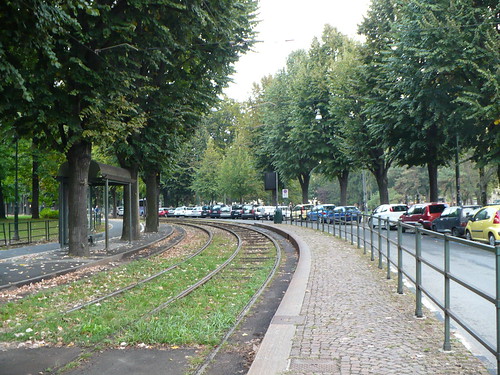
It's called, spot the wires. Sure are ruining this nature scene for everyone! This is Turin, Italy.
Thursday, April 15, 2010
Bigger Thinking on Texas Stadium Site
In my post below I talked about how hard it would be to connect the two parcels over the freeway. Looks like they have thought about that.
 In an article in Fast Company, the developers and city of Irving are looking to make the freeway choked property where the stadium once was into "the densest, most walkable neighborhood in the Dallas-Ft. Worth Metroplex outside of downtown Dallas." That's a pretty bold statement. But the renderings show they have some ideas about how its gonna be, and I must say, they do have a grand imagination.
 Via the Irving Chamber
If they can get this done more power to them. I especially appreciate them doing it on the transit line. Now how about that transit connectivity? This type of density needs more than just one rail line.
In an article in Fast Company, the developers and city of Irving are looking to make the freeway choked property where the stadium once was into "the densest, most walkable neighborhood in the Dallas-Ft. Worth Metroplex outside of downtown Dallas." That's a pretty bold statement. But the renderings show they have some ideas about how its gonna be, and I must say, they do have a grand imagination.Via the Irving ChamberIf they can get this done more power to them. I especially appreciate them doing it on the transit line. Now how about that transit connectivity? This type of density needs more than just one rail line.
Wednesday Night Notes
Notes for folks:
China is seeking their own manifest destiny with trains. (Reuters)
~~~
China's Urban property is going up in price. (Wall Street Journal)
~~~
A new (to me) place to get all of your transport research needs!
~~~
The most hilarious (unintended of course) trucks vs. trains conspiracy theory I've ever read. I probably shouldn't link to it, but I couldn't resist. (Examiner)
~~~
The Pedestrianist discusses what should happen to San Francisco's Central Freeway.
~~~
Why people underestimate the pain of their commute. (Frontal Cortex)
~~~
Why the Expo Line goes where it goes... (via @thetransitfan)
China is seeking their own manifest destiny with trains. (Reuters)
~~~
China's Urban property is going up in price. (Wall Street Journal)
~~~
A new (to me) place to get all of your transport research needs!
~~~
The most hilarious (unintended of course) trucks vs. trains conspiracy theory I've ever read. I probably shouldn't link to it, but I couldn't resist. (Examiner)
~~~
The Pedestrianist discusses what should happen to San Francisco's Central Freeway.
~~~
Why people underestimate the pain of their commute. (Frontal Cortex)
~~~
Why the Expo Line goes where it goes... (via @thetransitfan)
Sunday, April 11, 2010
How Things Should Work
Unfortunately it was raining pretty hard today, which means I can't get NBC and apparently AT&T service is somewhat haywire. But the Master's was on TV and there was a commercial that showed how AT&T wishes people could buy train tickets. While its nice to think that it would or could even work in this way, it will take upgrades to wireless in the subways and faster connections speeds. I wonder if they could have done this on a freeway.
Stadium Implosions and TOD
Well today was the day. 39 year old Texas Stadium was imploded as its functioning life was deemed over. However the death of a stadium opens up new opportunities for urbanism and some challenges.
The Loop 12 station is going to be located here when the development is finally ready for it but I question the planning of a station along a freeway or in a place where the freeway can severely hamper residential development. Part of the problem with getting cozy with the highway is that you cut off half of the walk shed from the station. In this instance, it's even more than half with the number of freeways that exist in criss cross. Below is the map of the regional transit plan and below that is the station location sourced from the environmental impact statement.


You can see Texas stadium where the main redevelopment opportunity is on city owned land. But the planned station is on the other side of a major freeway, and most of it is a private shipping company under the white blob I've drawn to show the area without a freeway barrier near the station. It's likely that this area will be best for office and some dense residential, but a grid network needs to be reintroduced on both sides for it to become a walkable urban place. It might be even better to route the transit through the center of the white blob to maximize the station area. It does move the station further away from the stadium parcel, but at the same time, it increases the probability of transit accessibility for buildings within the vicinity of the station.
It's a hard decision, but ultimately we need to stop building stations and alignments that are based on the previous freeway paradigm. Creating walkable urban places that connect to others through transit means that we need to connect opportunities, not freeway medians.
The Loop 12 station is going to be located here when the development is finally ready for it but I question the planning of a station along a freeway or in a place where the freeway can severely hamper residential development. Part of the problem with getting cozy with the highway is that you cut off half of the walk shed from the station. In this instance, it's even more than half with the number of freeways that exist in criss cross. Below is the map of the regional transit plan and below that is the station location sourced from the environmental impact statement.


You can see Texas stadium where the main redevelopment opportunity is on city owned land. But the planned station is on the other side of a major freeway, and most of it is a private shipping company under the white blob I've drawn to show the area without a freeway barrier near the station. It's likely that this area will be best for office and some dense residential, but a grid network needs to be reintroduced on both sides for it to become a walkable urban place. It might be even better to route the transit through the center of the white blob to maximize the station area. It does move the station further away from the stadium parcel, but at the same time, it increases the probability of transit accessibility for buildings within the vicinity of the station.
It's a hard decision, but ultimately we need to stop building stations and alignments that are based on the previous freeway paradigm. Creating walkable urban places that connect to others through transit means that we need to connect opportunities, not freeway medians.
Friday, April 9, 2010
Thursday Night Notes
Here's some news I wanted to share:
I did a report on aerial ropeways once. The City Fix shows they are used for transport around the world and even in their favorite place, South America.
~~~
The Cotton Belt rail line in Dallas might have an interesting funding mechanism.
~~~
DFLers are going to start playing hardball with U of Minn. I don't really see how a mitigated train is any different than a few thousand cars and huge buses on the same road.
~~~
Are we really going to be spending $3.7 billion or more for a subway stop in Livermore and (an overestimated) 34,300 riders? Have we learned nothing from any of the other transit lines we've built (or didn't build) in this region? If Pleasanton has 7,400 exits (14,800) on a weekday, how is Livermore going to add 30K more riders???
 ~~~
~~~
Baseball and Streetcars were bff back in the late 1800s.
~~~
One of my favorite things about the internet is all that it can do to break down international barriers. For example, this hungarian transport blog translated discusses the Salt Lake BRT line.
I did a report on aerial ropeways once. The City Fix shows they are used for transport around the world and even in their favorite place, South America.
~~~
The Cotton Belt rail line in Dallas might have an interesting funding mechanism.
The plan would most likely include much steeper fares for the Cotton Belt, paid parking, and the creation of special tax districts that would capture property tax increases associated with private development along the rail line.I'm always dubious of using value capture to pay for infrastructure. There's just not that much of an increment on commuter rail I think.
~~~
DFLers are going to start playing hardball with U of Minn. I don't really see how a mitigated train is any different than a few thousand cars and huge buses on the same road.
~~~
Are we really going to be spending $3.7 billion or more for a subway stop in Livermore and (an overestimated) 34,300 riders? Have we learned nothing from any of the other transit lines we've built (or didn't build) in this region? If Pleasanton has 7,400 exits (14,800) on a weekday, how is Livermore going to add 30K more riders???
 ~~~
~~~Baseball and Streetcars were bff back in the late 1800s.
~~~
One of my favorite things about the internet is all that it can do to break down international barriers. For example, this hungarian transport blog translated discusses the Salt Lake BRT line.
Tuesday, April 6, 2010
St. Louis Kinda Back in the Transit Space Race
I haven't talked about the transit space race in a while because not a lot of big news has been happening. That and I've been a bit busy lately. But tonight a huge event took place in which a half cent sales tax was passed to better bus service and build light rail extensions to other parts of the St. Louis region, building off of one of the great light rail success stories in this country.
Yonah over at Transport Politic drew a map earlier this year of what the increase could help build over a 30 year period, though some of it is a bit wishful thinking because while $75 million a year is a lot of money, it's not the same as say Measure R's $40B in Los Angeles. But what it also did is trigger a City of St. Louis tax that was approved in 1997, raising an additional quarter cent, valued by some at around $8 million per year.
I hope that they increase the bus service much more because currently the service is subpar. This infusion hopefully allows them to fix that and move forward. I'm hopeful that the anti-tax sentiment out there didn't get to this plan and transit marches forward. Even sweeter in Wendell Cox's backyard.
Yonah over at Transport Politic drew a map earlier this year of what the increase could help build over a 30 year period, though some of it is a bit wishful thinking because while $75 million a year is a lot of money, it's not the same as say Measure R's $40B in Los Angeles. But what it also did is trigger a City of St. Louis tax that was approved in 1997, raising an additional quarter cent, valued by some at around $8 million per year.
I hope that they increase the bus service much more because currently the service is subpar. This infusion hopefully allows them to fix that and move forward. I'm hopeful that the anti-tax sentiment out there didn't get to this plan and transit marches forward. Even sweeter in Wendell Cox's backyard.
Subscribe to:
Posts (Atom)