Sunday, November 21, 2010

Making Stuff Up

I know that Robert and everyone else is going to take a hammer to this one, but it's really annoying when people like Megan McArdle just make things up or toss out random numbers to make her feelings on a subject seem right. Here's the immediate culprit that made me want to post.
San Francisco-LA, the route my fellow journalist wanted to travel, isn't even on this map; the Bay Area MSA only has about 4 million people in it. By contrast, the smallest city on the Chinese map has a population over 5 million, and that's considerably understated, because I used just the population of the city, not the outlying areas that might conceivably drive in to use the HSR.
I know that blogs are blogs, but where is the sourcing for the numbers? If I use numbers I'm always trying to cite them. Why is she using MSA of San Francisco and Oakland instead of the Bay Area CSA? The Bay Area CSA is actually 7.4 million, not 4 million. That's a HUGE difference. Not to mention that she's talking about SF to LA, wherein LA's CSA is 17.8 million people! And then where's the link to Chinese cities? A simple wikipedia search would help even a little.

Finally, there are other high speed rail lines that were built WITH regard to environmental issues and have greater similarities to the possible US system. I think a comparison to France, Spain, or Netherlands/Germany would have been more apt in this circumstance.

Anyway, posts like this are why I get annoyed at general commentators taking stabs into my area of specialty. I've also mentioned before that if they are this bad at my subject, how are they in other people's areas? The focus of blogs like Human Transit, the Urbanophile, or the Transport Politic are always going to be much more informative than most of Megan's posts. But we push back on her because more people read her blog.

Wednesday, November 3, 2010

Replay 6.11.2008: A Very Moving Speech By Robert Caro

Note: Tonight for some reason I was watching Charlie Rose on PBS (I don't have cable and my netflix ran out) and he had Chris Matthews and David Brooks on talking about what the Democrats did wrong. Chris made the comment as I've mentioned here before that President Obama needs to do what Eisenhower did with the interstate and what happened with Lincoln signing the 1862 Railway Act. I agree with that, but I don't agree with what he said after. He said that people will accept liberalism if it means Robert Moses. Anyone who says that does not understand the pain that Moses caused in New York. They don't understand the destruction that happened in cities around the country due to the interstate highways ripping up city neighborhoods whole sale.

In any event, that made me think of Robert Caro's speech at CNU Austin in 2008. For anyone that doesn't know what Moses did, watch, and you will now know why Robert Moses should never be repeated.


Thanks to Lawrence and Jon. Here is the Caro speech from CNU in Austin. It might make you cry, but it explains how damaging Robert Moses was to the City of New York and this Country.

Tuesday, November 2, 2010

Transit Election Central 2010

Hey everyone. This post is going to be a liveblog this evening when the results are coming in. Key things around the country include Tampa Light Rail and Governors races that could make or break HSR. If you want a preview, check CFTE. We did this in 2008 and had a blast. Join us later this evening.

Check below for a local transport issue

6:58pm PT - O'Malley Wins Maryland Governorship, Purple line safe
7:49pm PT - John Hickenlooper wins Colorado, Good for transit
7:52pm PT - Scott Walker wins Wisconsin, good thing feds signed HSR agreements
8:17pm PT - Pretty official, Tampa Light Rail dies almost 60-40
8:53pm PT - Tenafly non-binding rail measure loses
9:18pm PT - Clayton County non-binding resolution for MARTA will pass
12:34am PT - Jerry Brown wins governors race, HSR is a go

I'll fill in more of these tomorrow as I get time, kind of a disappointing day but there will be other big wins in the future.

~~~~~~~~~~~~~~~~
California --

Prop 22 - Keeps the state from raiding local taxes including transportation

36% Reporting - 63% For 37% Against

________________
Lots of $10 registration fees, covering high transit percentage only

San Francisco Prop AA - $10 registration fee for roads, transit and ped improvements

60% Yes 40% No
________________
San Mateo Measure M - $10 registration fee for roads, transit, safe routes to school


________________
Sonoma Measure W - $10 registration fee, 60% for transit service

________________

~~~~~~~~~~~~~~~~~~~~~~~

Florida --

Polk County - (Loss) Half Cent Sales Tax for Transit

87% Reporting - 38% Yes 62% No
92% Reporting - 38% Yes 62% No
95% Reporting - 38% Yes 62% No
97% Reporting - 38% Yes 62% No
________________

Hillsboro County (Loss) - Half Cent Sales Tax for Light Rail, Roads

43% Reporting - 40% For 60% Against
68% Reporting - 41% For 59% Against
82% Reporting - 41% For 59% Against
86% Reporting - 41% For 59% Against
94% Reporting - 41% For 59% Against
________________
~~~~~~~~~~~~~~~~~~~~~~~
Clayton County GA (Win) - Nonbinding - Asking if Voters Want to Join MARTA

46% Reporting - 67% Yes 33% No
67% Reporting - 68.6% Yes 31.4% No
77% Reporting - 69% Yes 31% No
93% Reporting - 70% Yes 30% No
100% Reporting - 70% Yes 30% No

~~~~~~~~~~~~~~~~~~~~~~~
Oahu Hawaii - Question 1 - Would establish a transit agency to oversee rail construction


~~~~~~~~~~~~~~~~~~~~~~~
Tenefly, NJ (Loss) - Nonbinding Question #1 Should Tenefly Rail Service be Restored

Rejected - local news reports many upset that it would not provide a one seat ride to Manhattan thus voted against the line
~~~~~~~~~~~~~~~~~~~~~~~
Toledo, Ohio - (Win) Property Tax Renewal to Support Transit

1% Reporting - 54% For 46% Against
30% Reporting -54% For 46% Against
75% Reporting - 54% For 46% Against
84% Reporting - 54% For 46% Against

~~~~~~~~~~~~~~~~~~~~~~~
Portland, Oregon - $125M in bonding ability for Tri-Met

55% Reporting - 46% Yes 54% No

~~~~~~~~~~~~~~~~~~~~~~~
Texas

Austin - Prop 1, $90M in infrastructure

10% Reporting 56% Yes 44% No
37% Reporting 56% Yes 44% No
68% Reporting 56.6% Yes 43.4% No
92% Reporting 57% Yes 43% No

________________

Richland Hills - (Loss?) Asking voters if they want to leave the Fort Worth Transit Authority

Early Voting - 59% For 41% Against
12% Reporting - 61% For 39% Against
38% Reporting - 61% For 39% Against
100% Reporting 61.7 % For 31.3% Against
________________
~~~~~~~~~~~~~~~~~~~~~~~
Wisconsin

Dane County/Madison Asking for a half cent sales tax to fund a Dane County RTA

Note- Really hard to decipher results here given only advisory vote.

Sunday, October 31, 2010

Tight Spaces

I think it might be a bit tough to live in such a small space, but if you had to, this is quite an interesting way to go. via Americablog

Friday, October 8, 2010

Music Friday - Take the Light Rail

"If your cars too spendy and your bike is too slow, it will take you anywhere you want to go"

Tuesday, October 5, 2010

Why Not Rent?

(Once again, a guest post from Ed, kindly invited by notorious density lobbyist P. Trolleypole.)

Despite the collapse of the housing market, homeownership is still out of reach for many Greater Boston residents, according to a new study by the Urban Land Institute.
So begins an article from Saturday's Boston Herald. The article spends a lot of time tossing around median home prices in Greater Boston and discussing how out of reach they are for working class households, and then talks a little about an affordable housing program that is on the MA ballot in November. The option of renting never comes up, nor is there any talk about how to make or keep rents affordable.

I'm not opposed to worrying about rising costs of shelter in cities, but the outsized focus on homeownership drives me a little crazy. This fetishization is why we have tons of awful policy in this country:

- Mortgage interest tax deductions, which distort the home market, and the benefits of which go largely to the wealthy:
The deduction is wildly regressive. The tax savings for households earning more than $250,000 is 10 times the tax savings for households earning between $40,000 and $75,000 a year, according to recent research by James Poterba and Todd Sinai.
- Fannie and Freddie, which, for example, had the US taxpayer implicitly (de facto, at this point) guarantee 95% of new mortgages in 2009, and which have a heavy single-family bias, giving sprawl a helping hand

- FHA-subsidized loans, which explicitly put every taxpayer on the hook for tons of mortgages with only 3% down (and low downpayments are a strong predictor of default, especially when prices are falling)

The list goes on.

Meanwhile, this is all in support of a system that encourages households to (1) take on massive debts in order to (2) make a huge and completely undiversified investment in (3) a highly volatile asset. So, when bubbles pop and prices drop 20, 30, 40 percent, you have made sure that a large portion of your population has seen its wealth evaporate. On top of that, being so highly indebted makes households less mobile, and less able to find new opportunities - which is why you see higher unemployment in places with more homeownership - we've encouraged people to weld their escape hatches shut.

All of which is to say - maybe it's time to rethink how we house people. Should one's shelter really be tied to one's investments? Should we be paying more attention to affordable housing policies that help renters? Should we start dismantling all these subsidies, and maybe turning some of that money to causes that help low-income renters? This aspiring density lobbyist thinks so.

Wednesday, September 22, 2010

Giving Up and Release Valves

So it seems as if the Port Authority in Pittsburgh is giving up on a rail trip between the two largest employment centers in the region. Perhaps they'll get real BRT but given that opposition always goes to the lowest common denominator such as in Berkeley, you can bet there will be a fight over dedicating the lanes.

I'm disappointed because I feel like this is a travel corridor that could benefit from a direct link from the existing light rail system. However no one wants to actually invest in transit infrastructure these days. I can hardly blame them, once it gets built they have to fight for every penny to operate the thing. If we're ever going to get a real mode share out of transit, we're going to have to start investing in something real. Not necessarily in big projects, but real headways and dedicated lanes for places that will never have rail.

~~~
I guess I'm in a pessimistic mood tonight. New Jersey is thinking about stopping the ARC tunnel for road projects (blech) and the Twin Cities is thinking about how they are going to serve the suburbs of tomorrow when people can't drive. Newsflash! Peak oil isn't our only problem people. What about those folks who can't drive because they are too old! Paratransit is expensive.

~~~
This article irked me for some reason. In it Mary misses the major point about development and land value around transit and even "urban renewal" lessons. She complains about the high rises around transit close to single family neighborhoods.
That, of course, is precisely the problem with Charlotte's love affair with too-tall transit-oriented development zoning smack next to low-scale, historic Dilworth or - this will come - NoDa. Even if nothing's demolished, making land values so high so swiftly via zoning encourages large, expensive projects that will drive out small-scale enterprises.
You want to know why that property becomes so valuable? Because it is scarce! Contrary to popular belief, there is not enough supply of urban housing to meet the demand, so the speculators come in and jack up the prices. I bet you wouldn't have this problem if transit was built out such that neighborhoods didn't gentrify because people wanted the quality locations and access. In places like New York City or Chicago that have extensive transit systems to all kinds of neighborhoods, you see that transit stations are the more diverse income places than the region as a whole.

This is the problem with our thinking here. We complain about the results of our actions but don't think about the underlying actions themselves. Given that Charlotte is building its system line by line, you'll see development speculation and value increases acting as a release valve on the downtown market. If you built all the lines at once, that pressure gets relieved five or six ways instead of one way.

Right now this is just my theory, but when Denver and Houston open up their lines at relatively the same time, I am going to say that you are going to get a more diverse housing type in new stations than we've seen along corridors that are a first big transit investment in a city. The reason being is that they will meet the actual demand, instead of be a small rock in the pond.

So if regions are feeling for local businesses and the skyrocket land values around transit, the escape valve that creates greater opportunities in places that want to change is to build greater transit networks. More escape valves means greater distribution of different development and less pressure and speculation.

Thursday, September 16, 2010

The Final Countdown!

Magic from jrk on Vimeo.

T4 has awesomely put the source code for their transportation bill countdown clock on their website for share. Folks who are interested should pull it down. This is something that shows how lax our government has been on actually doing something they are supposed to do every 6 years. Instead they just put it off. Oh we have too much to do or there is an election coming up are always the big excuses. This is what we pay you for!


Wednesday, August 25, 2010

Hiroshima Trams

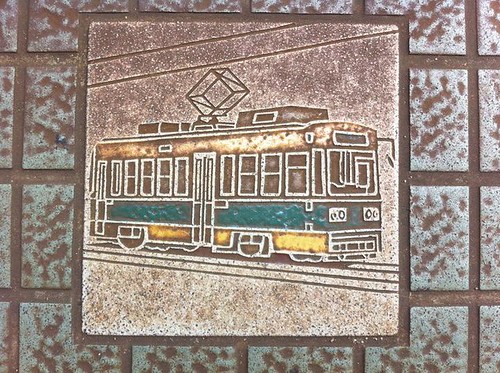
Apparently my friends think of taking pictures of trains/transit for The Overhead Wire when they are abroad. That's pretty awesome. Here's one tiled tram from Hiroshima last week that my friend and newest international correspondent @spicer took. You can check out his blog for more on his trip to Japan and a pretty stunning photo of the city after the bomb was detonated.

Hiroshima Tram Tile

Monday, August 23, 2010

Music Monday - I'll Take My Board

You take your car to work, I'll take my board. And when you're out of fuel, I'm still afloat - Weezer

Friday, August 20, 2010

Thursday Night Notes: Fake Trolleys and Blown Up Ridership Estimates

These articles are from a few days ago but I wanted to clear my tabs and get some opinions.

Ogden is going to spend some money on buses that they hope will stimulate streetcar ridership. While I've been impressed with the Broadway Shuttle in Oakland that recently started running given the short headways and fast access to Specialties bakery and Bakesale Betty from City Center, I have to wonder if people honestly think they are going to get a real estimate from these faux trolleys. (Calling them trolleys is a whole other can of worms I could get into in another post) It's understandable to want to know what is going to happen and spending less money to do it. But I'm convinced that given the completely different experience, you're almost dooming any streetcar to death by running the fake trolleys, especially if the headways are limited. Would like to hear more on this from others though.
~~~
I know we have to make ridership estimates for capital projects. Until recently ridership estimates made or broke your ability to build projects. So color me annoyed that Denver finally gets around to updating the regional land use estimates that boost ridership for the Fastracks plan. Should we think this estimate is correct? No. Ridership estimates will always be horrific when done using software built for estimating auto trips. Should Denver have gotten more federal money for the program? Yes. Given they are already underwater paying for it, why didn't they try to fix this earlier and get more than 20% from the Feds? Were they just lazy?

Regions that are doing these massive projects like LA, Seattle, Denver, Houston, and Salt Lake City should get more help from the feds. They have a plan and are moving forward with it. It's likely that these types of network expansions that make up the Transit Space Race will give more bang for the buck than one off single line expansions.
~~~
Here's an interesting article sent in by reader David. I'm always amazed at the different issues that places like Vancouver are dealing with than the majority of the United States in terms of ridership and development pressure along transit lines.
~~~
Finally, there are tons of academic journals out there. They make you pay for their products and don't really care if only a few academics read them. But there's always interesting things to be found. Here are some links to Elsivier journals with a barrel of research on transport issues you all might care about. If you're RSS junkies like me, put them in your reader.

Thursday, August 19, 2010

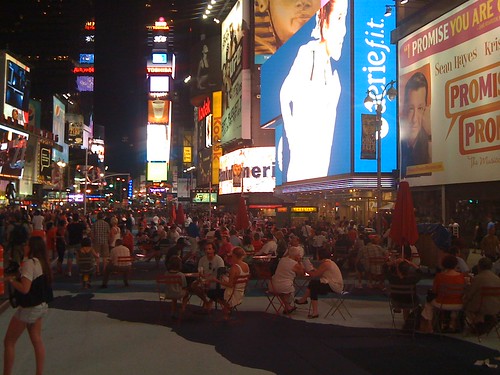
11:30 PM Tuesday Night Times Square

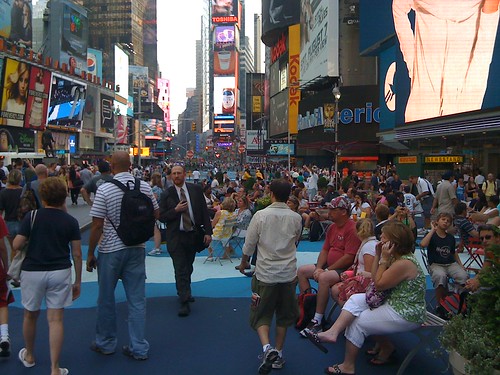
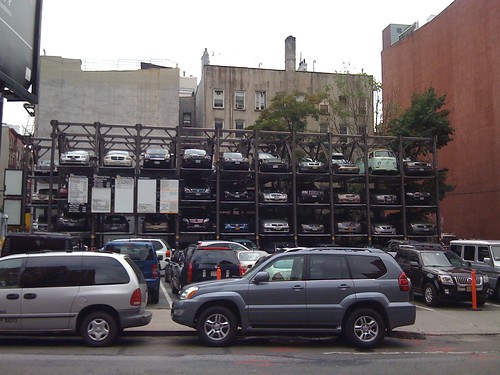
A few photos from my recent trip to NYC:

It's so busy, nobody ever goes there anymore...

Times Square Street Park 11:30pm

Don't forget in the daytime

Times Square

Apartments for cars near the Streetsblog offices

Parking!

Your friendly bike lane taker uppers

Blocking a Bike Lane

Reminds me of the Netherlands. Needs less fire escape

Dutch Style Buildings

Friday, August 13, 2010

I Am a Card Carrying Member

Recently Joel Kotkin wrote an article that accused everyone who likes rail transit's ability to shape communities of being part of the "density lobby". We've heard similar lines before from Randall O'Toole about the light rail cabal in Portland. We never hear about the road building lobby (You know, AASHTO, Highway Users Alliance, et al.) from these folks but what do you expect from the libertarian fun zone.

Also, I really wish these guys would do at least a little research before they write stuff and print it. This quote was pretty funny considering Houston already has a rail line between Downtown and the Medical Center that has 45,000 riders a day.
Some other urban routes--for example between Houston's relatively buoyant downtown and the massive, ever expanding Texas Medical Center--could potentially prove suitable for trains.
But we can have more fun with those guys. I am now a card carrying member of the density lobby. In light of the madness, I decided to go over the edge. Anyone who wants to be a card carrying member of the density lobby, shoot me an email and I'll make you one to display proudly on your site. Of course its a big joke, but so are people that say there is a big UN bike conspiracy or actually believe there is an organized lobby for "big density". If you meet anyone that wants to fund our cabal let us know. I'm sure there is someone out there who is rich and nefarious enough to take over the world with affordable TOD!

Email me at theoverheadwire at gmail | Send your name (real or fake), specific office (ie density integration), and location of choice. I will assign a member number and join date. Also if you just want the illustrator file I can send that along as well.

Even better, if I make you a card and you show it to me at the Rail~Volution blogger meetup in Portland in October, I'll buy you a beer. Cheers to density forever!

Wednesday, July 28, 2010

Frank Lloyd Wright the Villain?


There was an interesting Talk of the Nation episode on NPR about a month ago that discusses how Women as consumers are becoming a greater force and how smart businesses are changing to accommodate their needs. Keeping clean restrooms in auto dealerships and pointing to the room number on a sheet instead of saying it out loud in hotels are some of the changes that Paco Underhill writes about in his books that make a huge difference in safety and return business.

In this clip however, he talks about his belief that Frank Lloyd Wright and Henry Ford were the greatest villains of the 20th century in their encouraged suburban development taking us away from the beneficial village community and pushing us to rely too heavily on automobiles and suburban development. It's an interesting listen and while we often think about Hummers as the suburban evil and now folks see them in that way, another thing is houses and their true needs. People often talk about McMansions but do people really need $30,000 Wolf Ranges as well? Likely not but I hadn't thought of these extra issues before. It makes me wonder what else we are McMansioning.

It also makes me think about the flat that my parents had in Rotterdam. It was a very nice place and livable. Everything was available close by and the fridge was smaller than most here given you could get to the store everyday. The washer and dryer were small by American standards but again very efficient. Not everyone really wants to live that way of course but again there is this need to have choices for people such that they can decide how they want their lifestyle to play out.


But even though FLW and his broad acre city plan were something that some think led to a suburban ideal, there were obviously much larger forces at work (which we've discussed in many a post before). So I don't know if I would call him a villain, just someone who saw the car and suburban lifestyle coming before its time. If you had to pick just one villain, who or what would it be? Eisenhower Freeway System? Lending Practices? Zoning Laws?

Tuesday, July 27, 2010

Pushkarev & Zupan on Employment & Ridership

This is always a chicken and egg fight but I'm starting to believe that the residential density argument is a bit misstated in terms of its impacts on transit ridership. Specifically since you're talking about housing density and not employment density. Charlotte's Uptown development had a larger part to do in transit ridership than residential density does along the corridor. And ultimately the cycle of building housing is going to create more demand, the employment was the initial draw. The transit agency just figured out how to serve it.

Over 60% of transit trips are for work (See Commuting in America III). This is compared to just under 20% of overall trips. This means that the focus on where people work is important in monocentric cities such as Nashville. I'm not saying that residential density is ultimately unimportant. But I believe its less important for starting a transit system and more important for growing it. There are lessons on this in previous research works that we tend to ignore.

To be honest I hadn't really read Zupan in full until more recently on account of there is just too much to read in general. But when I caught up on it, the findings are quite interesting and get you wondering if we've been looking at this whole transit and development thing all wonky. In their seminal work Public Transportation and Land Use Policy (1977), Jeff Zupan and Boris Pushkarev made the following observations based on the existing data at the time:

Pushkarev & Zupan Pg 174-175:

1. Clustering or dispersing nonresidential space. Suppose 10 million square feet are to be added to a growing urban area. One option is to put the floorspace into two highway oriented non residential clusters, each 5 million square feet in size. Another is to create a new downtown of 10 million sq ft. In the second case, per capita trips by transit within a 3 to 5 mile radius will be 50 to 70 percent higher than in the first case, keeping residential density the same.

2. Enlarging downtown size or raising nearby residential density. Suppose the options are to double the size of a downtown from 10 to 20 million square feet, or to double the residential density within a few miles of it from 15 to 30 du/acre. The former will increase per capita trips by transit three to four times more than the latter.

3. Increasing residential density near downtown or farther away. Suppose the options are to double non-residential density from 5 to 10 dwelling units per acre either within one mile of a downtown of 10 million square feet or at a distance of 10 miles from it. In the first case, public transit trips per capacity in the affected area will increase seventeen times as much as the second case.

4. Scattering apartments or concentrating them near transit. Suppose a rapid transit station is located 5 miles from a downtown of 50 million square feet of nonresidential floorspace (the 1976 size of Newark). At a density of 15 du/acre, the square mile surrounding the station will send about 620 trips a day downtown by transit. Suppose speculative development scatters apartments throughout the square mile, raising its density by 20%. This will increase transit ridership at the station by about 24 percent. Yet if the apartments are clustered within 2000 feet of the station, preserving the rest of the neighborhood intact, transit ridership will increase by 34% or more; at least a car load of 62 people a day will be added not from any increase in average density within the square mile, but only from a new arrangement of the new development within it.

"Thus land use policies which will do most for public transportation are those which will help cluster nonresidential floorspace in downtowns and other compact development patterns. Downtowns of 10 million square feet of gross non residential floorspace, if confined within less than one square mile, begin to make moderately frequent bus service possible and to attract an appreciable proportion of trips by transit. By contrast, downtowns of 5 million square feet can support only meager bus service. Spread suburban clusters of nonresidential use can only occasionally support meager bus service, if they contain shopping centers, or if they are surrounded by residential densities in excess of about 7 du/acre.

Residential density is less important for transit use than residential location, ie proximity to a downtown of substantial size or proximity to a rail transit line. If greater transit use is the goal, it is more important to put housing close to a downtown than make it high density. In fact, moderate residential densities in the range of 7-15 du/acre can support moderately convenient transit service by any of the transit modes reviewed in this book. Of course, densities higher than this will support better service, as well as more trips on foot. Thus, a strongly transit-oriented city such as Montreal has an average density of 35 dwellings per acre; attached two-family houses form an important part of its newly developed neighborhoods. Evidence from New York suggests that the shift from auto to transit diminishes, and reductions in total travel per capita cease, at densities above 100 du/acre. This density can be represented by 13 story apartment houses covering 20% of their site; on transportation grounds, there appears to be no need to exceed this density. It is important to emphasize, though, that a 13 story building located amid open fields will make no contribution to transit; it will only make a contribution if embedded in existing urban fabric, close to downtown or a rail station.”
All of this says that increasing your downtown size, and putting dense housing near downtown is likely to increase transit ridership. Now this goes so far when we're talking about polycentric regions and employment clusters that we see today such as Tyson's corner etc. But ultimately I think this work has lessons for those places as well. It will be interesting to see where the next decade of TOD research heads because ultimately I think this is a part of the research that needs to be explored in greater detail.

Monday, July 26, 2010

Guest post: Why can't I find parking?

(Note from Pantograph: This is another guest post from my friend Ed. If you missed his first two posts, check back down the page for more of his work)


Spend any time driving in San Francisco, and you’ll notice that there isn’t a lot of parking. Then, just before you give up and put the car in a garage, it dawns on you that while there aren’t that many spaces, there also aren’t that many parked cars. Instead, driveway after driveway chops up the curb, leaving the street space unusable. Curb cuts are everywhere, of course, but San Francisco buildings seem particularly fond of them.

The obvious impact is that these curb cuts take away parking that could serve many different users of the neighborhood – residents, visitors, and shoppers, and put it into private hands. But there are a lot of other reasons to dislike curb cuts. They increase conflicts between pedestrians and vehicles, they set up hazardous situations as cars back out onto busy streets, they encourage sidewalk parking, and they can often leave a street without room for the trees and other amenities that improve the way pedestrians experience the street. Moreover, the garages they lead to take up space that could be used for a variety of things that add to street life, like storefronts or stoops.

The desire for off-street parking in some areas is certainly valid. However, because there isn’t a price attached to installing a curb cut, we see the type of “overfishing” that plagues any unpriced resource, with some buildings sporting rows of 4, 5, and even more garage doors fronting city streets. Fortunately, this is starting to change - the city is soon going to start charging at least $100 per year for installing a cut, and there have also been efforts to slow new installations in North Beach. Hopefully these measures will lead to efficient use of the city’s curbsides.

Sunday, July 18, 2010

Acres of Free Parking Actually Cost Something

Over at my own blog, I've complained about the focus in the livable streets movement on environmental benefits to urbanism. It's not that those issues aren't important - it's that for most people, and certainly for most local governments, it's the pocketbook issues that get all the attention. So I was happy to see this piece today that discusses the opportunity costs of having your city build a Walmart surrounded by a sea of parking rather than a compact mixed-use district:
[Sarasota County Director of Smart Growth Peter] Katz showed the results from retail properties. Here comes surprise No. 1.: Big box stores such as WalMart and Sam’s Club, when analyzed for county property tax revenue per acre, produce barely more than a single family house; maybe $150 to $200 more a year, Katz said. (Think of all those acres of parking lots.) “That hardly seems worth all the heat that elected officials take when they approve such development,” he noted in a related, written presentation.
[...]
But here’s the shocker: On a horizontal bar chart Katz showed, you see that zooming to the far right side, outpacing all the retail offerings, even the regional shopping mall, is the revenue from a high-rise mixed-use project in downtown Sarasota. It sits on less than an acre and contributes a hefty $800,000 in tax per acre. (Add in city property taxes and it’s $1.2 million.) “It takes a lot of WalMarts to equal the contribution of that one mixed-use building,” Katz noted.
It's worth clicking through to read the whole thing (and printing it out for your next local planning commission meeting about that TOD project you really like).

Tuesday, July 13, 2010

Guest post: Vegas Real Estate Explains it All?


Hi everyone, Ed here. Mr. Trolleypole has kindly invited me to do some guest posting here at the Overhead Wire, so I'll be writing here occasionally. Hope you enjoy. I figured I'd start off with everyone's favorite urban planning contrarian - Joel Kotkin.

Joel Kotkin is at it again.

It's funny. The links to this article from Kotkin (which also made it into the Wall Street Journal) suggested that it was about demographic trends and would include lots of evidence to show that people aren't moving to central cities anymore. But then I read the article, and the whole thing is really just a cautionary tale to the commercial real estate industry. Kotkin asserts that alleged trend of folks moving back into cities seems to be reversing itself. Now, maybe this is true. Maybe that's what the population data show. And this is an important conversation to have – it's not at all clear to me that cities are thinking rigorously enough about how best to grow, and who is likely to show up. We won't find any useful answers from Kotkin, though, who bizarrely bases the bulk his argument on price movements:

Housing prices in and around the nation's urban cores is (sic) clear evidence that the back-to-the-city movement is wishful thinking. … Condos in particular are a bellwether: Downtown areas, stuffed with new condos, have suffered some of the worst housing busts in the nation.

He then engages in some brazen cherry picking, discussing house-price declines in Miami, Vegas, and Los Angeles, and only focusing on new condo construction as opposed to the market at large. Beyond the fact that these aren’t exactly beacons of walkable urbanism, using these cities in particular to make a point is just misleading when you look at how their markets have been behaving:

These lines in the chart are the Case-Shiller Home Price Indices for the metros that Kotkin cites, along with the 20-city composite in purple (which isn’t exactly the same as a national average, but is a reasonable proxy). As you can see, LA, Vegas, and Miami all had much bigger bubbles and much bigger crashes than the nation as a whole. This means two things: 1. these are terrible examples to use for the nation, since they are where much of the bust has been concentrated, and 2. of course the market activity in these places looks terrible, and of course it looks really bad in their downtowns, which is where much of the growth had been taking place. You could make the exact opposite argument by choosing the Bay Area as your focus, and comparing price moves in exurbs like Stockton and Tracy to those in San Francisco. The truth is that this is just a nonsensical way to analyze a national trend since different metro areas have had very different experiences during the housing bust. The numbers he cites aren’t necessarily wrong, but they prove absolutely nothing, other than that people were making some crazy moves in Miami and Vegas during the housing boom.


Monday, July 12, 2010

Sunday Night Notes

Whew, it's been a little while. Still reading lots of news and tweeting nightly. Wanted to cover these few news articles in greater than 140 characters though:

Utah's possible new Senator is saying he's going to cut off the spigot for transit capital funding from the feds saying that he doesn't believe they should be spending money on state and regional priorities. I happen to disagree with this but its an interesting question of

A. what is a regional or state vs. a national priority
B. what would he stance be if it were regional freeway expansion instead of transit

Seems to me much of this debate seems to be framed by subsidization rather than investment. The language needs changing if the livable transportation movement is going to make any ground.
~~~
The Green Line extension to Boston which is a Big Dig offset is delayed again. I'm not sure how anyone could speed it up, but it seems like the state can't really be punished in terms of money more than it already has.
~~~
Transit Miami gets the scoop on the Heavy Rail plug being pulled in the Miami region. This will set Miami back a lot, though local officials say they will refocus on BRT. How much do you want to bet that BRT means limited stop buses only?
~~~
I think this article about job incentives moving employers from state to state which means no new jobs are gained but tax gains for the region are less is replicated around the country when cities fight so hard for sales tax dollars that they lop off the benefits of those jobs. The one that always comes to mind is Emeryville and Oakland.

Tuesday, June 29, 2010

Chris Matthews Says Stimulate With HSR

I posted a few weeks ago about an discussion on Real Time with Bill Maher where Chris Matthews was arguing with a "Amtrak does nothing" conservative. Today he goes on his show and says that HSR is the way to stimulate the economy. Obviously there is a lot more than that but I like the way he's going.

Visit msnbc.com for breaking news, world news, and news about the economy