At that point there was a lot of support from local mayors (like former Matthews Mayor Lee Myers) and communities for the light rail line but as usual no money. So the decision to pick a locally preferred alternative was shelved for a later date several years down the road when there might be money available.
However recently Mary Newsom at the Charlotte Observer tweeted then blogged about a ULI session that suggested that Independence should be HOV lanes and a Streetcar should be run up Monroe Road. Yonah has a good graphic for this over on the Transport Politic. Initially when I saw the tweet I thought that was a really dumb idea. I had seen the fight between LRT and BRT before and the current suggestions were for the line to be a rapid bus line in the HOV lane and a streetcar on Monroe Road.
While still rapid transit, all that type of transit would do is reward people living further and further away from the city without changing any of the land use patterns closer to the city center. The streetcar might do it but I'm starting to wonder whether line haul streetcars are a great idea for places that would rather have more rapid transit options. Just as Yonah points out, you aren't really going to be getting anywhere fast.
But then I started to warm up to the idea of HOV lanes considering that freeway alignments don't really work well for TOD considering most of the really good property is taken up by the size of the road. Especially if the road is going to be the size of a freeway at some point ceasing to be an actual boulevard. But that is the rub.
The problem here is the same problem that's happening when TTI releases its urban mobility report based on a travel time index. All the engineers at the state DOT care about at this moment are making the trip from a place outside of the Loop into downtown faster. They want to widen this road and make it a full fledged freeway. But that decision alone goes against the centers and corridors plan that Charlotte developed after they voted for the half cent sales tax initially and revamped in 2010.

The TTI travel time index is the wrong measure, especially if it is going to push infrastructure investment that drives the vicious cycle of speed to further away parts of the region. We know now rather that access is a more important measure. CEO's for Cities laid it out in their Driven Apart study, showing that travel time skews the data towards travel flow rather than closer access to work or other destinations.
What this means for Independence Boulevard is that if the NCDOT gets a hold of it and upgrades the outer sections to a grade separated highway, then the ability to change those patterns for better access to an employment node is lost forever. One of the commenters on Yonah's post noted that the outermost piece of Independence is actually a boulevard instead of a highway. Not a boulevard in the sense of a grand boulevard but it is still not a grade separated highway.
The one problem with changing it to a grand boulevard is that urban development patterns that people like are harder to realize further from the downtown or major employment cores. Because of land values and other market forces, the further you get out from major gravity centers like downtown Charlotte or the University, the harder it gets to realize new urban style development. In fact, the South Corridor already shows that development further out is harder to realize. The map below shows development projects from 2007 and before on the South Corridor. The basic distance from downtown before development starts to wane is approximately 3.5 miles. Basically, the strong market of downtown seems to be extended with access provided by the transit line. This is about a 13-15 minute trip to downtown.
 Source: Realizing the Potential One Year Later
Part of the reason for this is the travel time people are willing to endure to get downtown. It's not likely that people will take the streetcar from the outer edges of Monroe Road or Central Avenue unless they have no other options. Additionally, this is why an Independence Light Rail line gets a bit tricky. But we need to start thinking of Independence not as a corridor feeding downtown but rather as a future mass that will have its own gravity. And I believe that gravity can be achieved with a strategic investment in the road to make it an urbanism changing Boulevard.
Considering the section of Independence that is already most like a freeway is within the 3.5 mile radius, its hard to imagine much happening in the short term along the Boulevard. Below shows the ~3.5 mile radius. The yellow shows the part most like a freeway already. The red shows the Boulevard and the light blue is the railroad corridor that is parallel to Independence. The Orange is the Central Streetcar.

This means that a Monroe Streetcar would be good for the inner 3.5 miles but two different service types will be needed further out for shorter and longer types of trips. This also leaves an opportunity for a Grand Boulevard that can attract business and development over time if the road is done right and parcels are slowly transformed into gridded and walkable areas. The approximately 120 feet of right of way are more than enough to build a road that would be friendly to transit, bikes, pedestrians as well as autos.

This corridor specifically could pull offices out to 7.5 miles, creating a new employment corridor which could bring land values up and with it densities over time. Creating a new center should be the goal, not making it another pass through on the way to downtown with HOV lanes for buses that are going to get 5000 riders a day at best. Additionally, by creating two centers with a rapid transit line and streetcar between, the market between the two centers gets stronger, allowing it to support the types of urban development people always draw on their maps at public meetings.
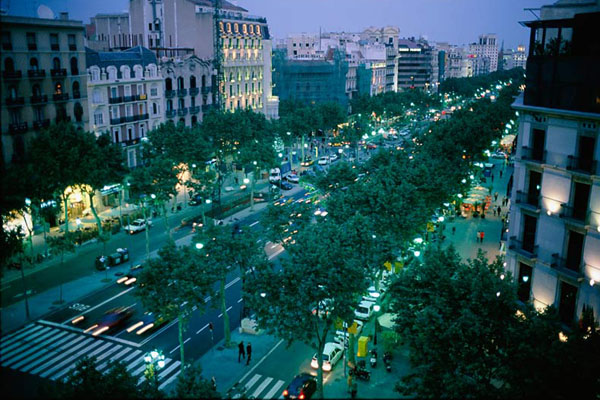 Photo via Hugeasscity
 I realize this might be a bit too forward thinking for some people but ultimately we have to change our mindset about what is possible in urban places if we are to give people opportunities to choose different housing and mobility types. Yes this corridor is going to be auto dominated for the near future but that doesn't mean we have to doom it to freewaydom and forever feed sprawling development patterns further and further out. In fact, it's possible to create a new center that attracts new transit trips from within its own gravitational field.