I just looked at the number of posts I have in the hopper and its depressing. I've started a lot of them but haven't finished any of them because I'm trying to address too many issues. So I thought maybe I should try to keep it a bit shorter (didn't quite work), but not quite twitter short. So a few issues that have been bothering me...
Transit that Tries too Hard
The first issue that's been poking its head out lately is that of the Southwest Corridor alignment in Minneapolis. It's been driving me nuts for a few years because I'm getting even more tired than I was before of freight rail alignments that are built just because of the cheaper cost. This should not be just an issue of cost but about the purpose of transit in a system. Right now it feels like the Twin Cities are just building light rail lines because they decided they want to and it has to serve everyone's politics, which makes for messy and mutli-serving transit that helps less than it should.
Streets.MN has a great number of posts about the background of this on the SW Corridor, but I wanted to focus on two issues in particular. The purpose of each piece of a transit network, especially the high capacity parts, and the actual alignment of the line.
Transit Building Blocks
Rail lines that are built should have a purpose. During the regional planning process, corridors should be sussed out based on their need in the overall system, not necessarily because of their technology. The first reason is that the technology becomes a major issue and argument when people don't quite understand how each works. And then second, it devolves into a money issue. It's too expensive!! They cry.
In the Twin Cities, you have a very low performing commuter rail line with limited service, and a somewhat high performing light rail line that actually acts more like a commuter rail line with greater service frequencies. The "light rail" line runs down an arterial, operating not like an urban line but more like a suburban line. It's basically the worst idea of all, putting a rail line in the center of a freeway.
Which, by the way Matthew Yglesias, is a great way to build a transit system that is predestined to not live up to its goals. This quote "with dedicated busways running in highway medians just as decent light rail lines do" killed me. Highway medians are a good way to deter transit ridership. Just ask the Harbor Freeway in LA. Well that made me mad, along with the rest of the post. Because the issue isn't bus versus rail. And don't get me started on the "just like light rail only cheaper" bullshit. The reason why its cheaper is that you're not doing as much! But this is a political will issue.
Yes a political will issue. We should have light rail (and subways) for heavily traveled segments that NEED transit capacity. This means the places where buses that come often are still sardine tins during rush hour. Even a place like Geary in San Francisco is an issue for BRT because by the time it opens, it will already be at capacity. Should be a subway. But we're too focused on cost.
But we do need BRT too! We should also give priority to buses in places where that means the
street will move more people with dedicated lanes. Take a lane from the
car. But this is the problem, we won't do it, because we won't take that step politically. Too sacred. Political issue.
But this leads me towards the point I'm trying to make. David Levinson did a cool thing and overlaid the London Underground onto the Twin Cities geography. What it also reminds me of, is the fact that European Cities like Budapest and Vienna have subway systems that feed the core circulation, while commuter lines perform a different function of bringing people in from the periphery, skipping a lot of stops in the core, while tramways and buses perform another function on the surface of local stop transit. This is all to say that each of the transit modes has a specific purpose in the network that we try to cram into a single transit project here in the United States.
In the Southwest Corridor light rail line, just like Mike Hicks mentions, you have an alignment that tries to be a commuter line with light rail technology. All fine but if you're trying to connect two major employment centers in the American freeway loop, it seems like not just the employment should be connected, but all the major service hungry places on the way that you should be building rail for in the first place. No more sardine tins at rush hour right?
If I had it up to me, I would build a subway network a la Vienna/Budapest. Short lines that stay in the historic streetcar suburb core whose endpoints can serve commuter networks and operate inexpensively (because they'll carry so many people) with 2-4 minute headways meaning no one has to wait very long, boosing transit ridership. In this same area on the surface, create bus lanes for those corridors that need it and build a central station where commuter rail lines and express buses can connect with the places further afield that don't need to be connecting every block with the surrounding neighborhoods. That's what the surface buses and internal subway network are for.
But that's a dream right? We live in the right now, and that right now is light rail on freight rights of way. Unfortunately. Again, we shouldn't be trying to cram three purposes onto one train.
The Twin Cities Alignment
Well if we're stuck in that paradigm we should at least do things right. What drives ridership? Because that's why we're building the line with better capacity, to serve a lot of people who are currently in sardine tins.
According to Gary Barnes (writing specifically about the Twin Cities) and Zupan, it's employment density being served by clustered residential densities. While the employment provides the ultimate destination which is MOST necessary, riders need to come from somewhere. So pockets of population density connecting to major employment centers are going to drive ridership, which in turn drives transit success, which in turn drives political will to do more GOOD transit projects.
So where are we at now? We're at a place on the Southwest Corridor where a bad decision was made because of the long gone FTA Cost Effectiveness Measure, which has been pushing stupid decisions ever since it was enacted. The running joke about the model was that the best transit line is one without any stops because it makes the train go faster. But what happens is a lot of freight rail transit lines. Some aren't too bad like Charlotte where the opportunities are high, but others are kind of lame.
So what was the bad decision in Minneapolis? Not connecting people with places they want to go. Or not connecting popular destinations with the people that want to go there.
The biggest trip on transit is the work trip. 59% of transit trips are work trips, meaning that's important to people. But work destinations are generally those of leisure and convenience as well. So let's look at the alignment, along with where people who WORK in downtown actually live.
The data below comes from the Census "On the Map" tool, which is an employment dataset with cool mapping features. Try it out for yourself sometime.
Residential Density of Downtown Workers
People that work downtown live in the area in darker blue along the red line (the line that should be) as opposed to the yellow line (the line that currently is in planning). 1,700-2,700 workers who work downtown per square mile in the areas that are darkest while only 100-400 in the light blue the yellow line occupies. See how its REALLY light blue.
I'm sorry if the map is a bit ugly, it's late and I wanted to get this out, but hopefully the point comes across. I don't understand why building something that is useful but a bit more expensive is harder than building something that is of less use. Perhaps the yellow line would be faster, but that only benefits the suburbs rather than everyone. Additionally, the people along the red line also have a higher propensity to work in the Golden Triangle further down the line. See below!
Residential Density of Golden Triangle Workers
The densities are much less as 200-300 people per square mile living in the darkest blue, but its still something more than the current yellow alignment.
And sure, you could say that it matches the residential densities of the place, but that's where high capacity transit should go! In any event, this is just to show that it seems silly that the corridor of most benefit would be bypassed, when it really should be considered more, if only for its long term value to the region. Yeah, it will cost more if you want to tunnel, but it will also serve an area that has a greater need, and can create greater value in the long run.
If you learn one thing from this post. Connecting people to dense employment drives transit ridership, so run the transit from where the people live to where they work in the highest densities. No brainer.
Thursday, August 8, 2013
Wednesday, February 6, 2013
On Charlotte's Fight with North Carolina, Itself
A fight is breaking out between former Charlotte Mayor/current NC Governor Pat McCrory and current Mayor Anthony Foxx over funding related to the local Streetcar and LRT projects. Charlotte, unlike many other states gives state level full funding grant agreements for capital transit projects. In 1998 Charlotte passed a half cent sales tax for transit expansion in the region with McCrory leading the charge. In 2007 the pro transit folks fought off another ballot measure to take away the half cent and won by 70% of the vote. This fight was partly started because of cost overruns that bothered libertarians, also chafing at the thought of having rail in the region. Apparently the most despised mode of all.
At this juncture, the city is looking to fund the streetcar project with local property taxes because there is no funding available from the half cent, which is tied up in the Northeast Corridor and operations of the expanded bus system. The bus system funding has worked so well, that its seen over a 100% ridership increase. Because of the lack of transit funding, the regional plan as seen below, is taking much longer than initially planned.
This seems to be the rub. McCrory believes that only the half cent set aside for transit should be used for expansion, and that funding from the state ($299m) is dependent on local funding being so constrained, that the city has to go through the state. Apparently trying to speed up the process of building out the network by locally funding is not allowed. One line at a time, and no streetcars. And forget that the roads don't pay for themselves. What this tells us is that decision makers in the state think that if Charlotte has its half cent of play money, the big boys can use the funding for the other interests.
But what else is going on in the region that would equate to other interests? How about the $3B in road projects that are happening in Charlotte currently. And they want to start a state fight over a few hundred million? What a disgraceful flareup. The State doesn't want to give money because they think Charlotte has enough, and Charlotte with the help of NCDOT wants to waste billions on sprawl highways. Building sprawl highways that have no use until the land around them is developed into oblivion. Charlotte pretends that it doesn't want to turn into over sprawling and traffic choked Atlanta, but it looks like being Georgia is the goal, and the state led by Pat McCrory, is more than happy to help them get there.
Saturday, January 12, 2013
Grating on a Curve
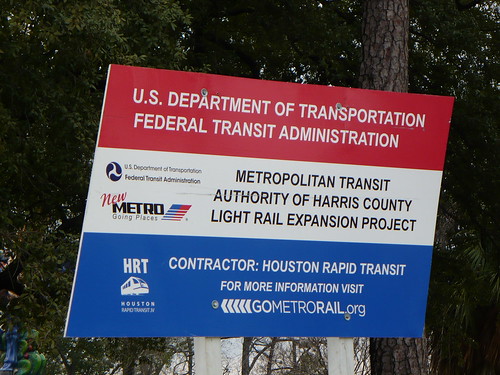
I was in Houston for a work meeting last spring and went on a tour with our good friend Christof Spieler who has taken a hiatus from blogging
at CTC Houston while he is an active member of the board for Houston
Metro. He was kind enough to take me around to a lot of the new
construction going on to complete Houston's three newest light rail
lines. I must say I was blown away at the progress and opportunities
that the system holds.
Houston's Light Rail Plans via Christof Spieler

I know there is a lot of consternation in Houston from certain congressional parties that if they had it their way would never have let the city build its first line. But I'm sure glad they did because it's allowed them so much political support to push forward with the system they are installing now. While even that had its fits and starts as well as issues with general managers and vehicle orders, I firmly believe that this will be the most European system in the United States when completed.
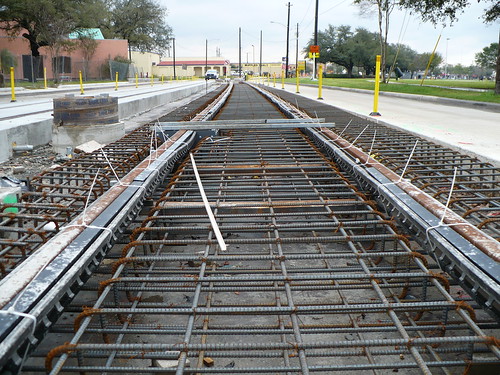
North Corridor Construction
Unlike any other LRT system in the United States, they eschewed existing freight rights of way and made the conscious decision to run in the major corridors with dedicated guideways. This is going to bring unprecedented mobility to the newly served areas as well as perhaps a few issues as well.
While many say that Houston has no zoning, what it really means is that Houston has no use restrictions. Unless your neighborhood has existing deed restrictions, anything is fair game as long as it pencils in your pro-forma. Making that pro-forma more difficult is all of the setback and parking regulations that are required from the city. It costs a lot of money and changes development dynamics but the lack of use restrictions allow development such as the housing below. Townhouses on small lots that would never have been allowed in any other single family neighborhood.
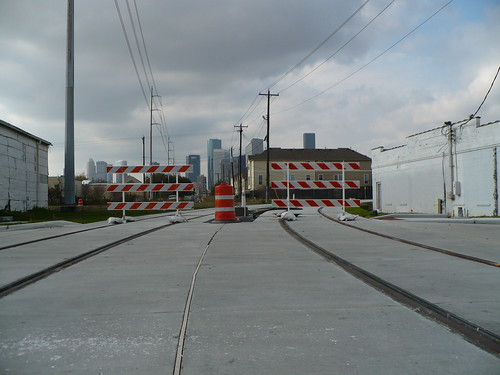
Southwest Corridor in East Downtown (EDO)
This also raises the issue of affordable housing. While the lack of building restrictions keeps prices fairly low, extremely low in fact when compared to SF or NYC, it doesn't mean that neighborhoods won't see some drastic changes coming to their neighborhoods.

If you would like to see a few more of the images from the trip, check out my Flickr page
Houston's Light Rail Plans via Christof Spieler

I know there is a lot of consternation in Houston from certain congressional parties that if they had it their way would never have let the city build its first line. But I'm sure glad they did because it's allowed them so much political support to push forward with the system they are installing now. While even that had its fits and starts as well as issues with general managers and vehicle orders, I firmly believe that this will be the most European system in the United States when completed.
North Corridor Construction
Unlike any other LRT system in the United States, they eschewed existing freight rights of way and made the conscious decision to run in the major corridors with dedicated guideways. This is going to bring unprecedented mobility to the newly served areas as well as perhaps a few issues as well.
While many say that Houston has no zoning, what it really means is that Houston has no use restrictions. Unless your neighborhood has existing deed restrictions, anything is fair game as long as it pencils in your pro-forma. Making that pro-forma more difficult is all of the setback and parking regulations that are required from the city. It costs a lot of money and changes development dynamics but the lack of use restrictions allow development such as the housing below. Townhouses on small lots that would never have been allowed in any other single family neighborhood.
Southwest Corridor in East Downtown (EDO)
This also raises the issue of affordable housing. While the lack of building restrictions keeps prices fairly low, extremely low in fact when compared to SF or NYC, it doesn't mean that neighborhoods won't see some drastic changes coming to their neighborhoods.

If you would like to see a few more of the images from the trip, check out my Flickr page
Silicon Valley's Transit AND Land Use Problems
There's been a lot of bashing of Silicon Valley lately. It's the butt of transit jokes because of its light rail line which is one of the least traveled LRT lines in the United States for its distance and service. At the time it was built, it was one of the first new non legacy lines in the country. Now that shouldn't be an excuse but we certainly know that in order to be successful you have to connect people with the places they want to go in a timely fashion. The 1st street line connects a lot of places, but it does it rather slowly.
So we would hope they learned from that mistake when they were planning BART and actually decide to connect places, but give people a faster option, but they decided to double down with aweful all in the same of saving money. Sure they are saving money using existing ROW for BART, but they are also skipping destinations they need to connect to make it successful.
Light Rail is Dark Purple, Caltrain is Red, Plannded BART is Steel Blue, Green are areas of high employment density.
You can see that the planned BART line skips all of the North Valley tech employment and instead makes people depend on a slow light rail system to connect. Even when BART is complete to Berryesa, it won't be as effective as it would have been going under or through this employment cluster into downtown. Yes it would have cost more but the investment would have been there for hundreds of years.
Additionally, as I've mentioned in previous posts (1, 2), when silicon valley does get dense, it's in horrible suburban layouts. You can see below along the San Jose LRT line how buildings suck ridership right out of the system with parking and bad design.
So we would hope they learned from that mistake when they were planning BART and actually decide to connect places, but give people a faster option, but they decided to double down with aweful all in the same of saving money. Sure they are saving money using existing ROW for BART, but they are also skipping destinations they need to connect to make it successful.
Light Rail is Dark Purple, Caltrain is Red, Plannded BART is Steel Blue, Green are areas of high employment density.
You can see that the planned BART line skips all of the North Valley tech employment and instead makes people depend on a slow light rail system to connect. Even when BART is complete to Berryesa, it won't be as effective as it would have been going under or through this employment cluster into downtown. Yes it would have cost more but the investment would have been there for hundreds of years.
Additionally, as I've mentioned in previous posts (1, 2), when silicon valley does get dense, it's in horrible suburban layouts. You can see below along the San Jose LRT line how buildings suck ridership right out of the system with parking and bad design.
The last image above below shows how many buildings you could fit in this space if they had better non auto oriented design. And I guarantee this would drive ridership along the line.
Now there have also been discussions of how Silicon Valley needs to become Manhattan in order to keep talent that wants to live in urban places instead of valley sprawl. An article in the Awl made this claim but in reality, Silicon Valley doesn't need a hefty core of ultra tall buildings, it just needs to use the space it has better and become the DC or Paris of the Western United States. There's so much opportunity, yet it is completely wasted.
So in my eyes the transit is part of the problem for not making the connections that increase property values to do this type of infill, but its also the fault of developers who don't understand that a classic way of building for pedestrians is needed to attract pedestrians and quality of life that people are moving to San Francisco to attain. Sure some people don't want that, but we have more than enough supply of single family homes if there's more of a choice.
Subscribe to:
Posts (Atom)