I've collected a good amount of transit passes over the past few years and noticed that Muni had perhaps the most colorful. Well someone else noticed, actually a lot of people noticed and John Kuzich is creating art with them. Very cool. Check it out.
H/T Rescue Muni
Thursday, March 27, 2008

Obama on Congestion Pricing
Obama just keeps getting better and better.REPORTER: Later, in an exclusive interview with WNYC, Senator Obama said he supports congestion pricing.
OBAMA: I think Mayor Bloomberg's proposal for congestion pricing is a thoughtful and innovative approach to the problem.
REPORTER: Obama said congestion pricing should not replace federal funding of mass transit.
H/T Streetsblog
The Language of Transit
Who else thinks the word subsidy needs to be ejected from the lexicon of transit advocates and opponents? Dan at Permanent Campaigns writes a piece for MassTransitMag on Language which should start a larger discussion on framing the issues we care about.
We transit advocates have a problem: bad language. Listen to what we ask for:
Operating assistance
Formula funding
Guaranteed appropriations
Boring!
Right now we seem like we’re still on the welfare train, asking for government handouts without any compelling, exciting opportunities for the nation to embrace.
Wednesday, March 26, 2008
Our Low Gas Taxes
Stephen Rees has a post up from the Economist showing gas taxes around the world. On this list we're the lowest! Yay....or something...not. We don't pay the full price for the externalities of using oil. Not only that, we've developed in a way that forces our dependence on it.
Last week I filled up my tank and saw it was about $50. Not a big hit considering the next time I go back to the pump will be about a month and a half from now. Last year I figured out that I spent 4% of my income on transportation. The average American spends 17.5%. So imagine if every person had an option to reduce their transportation costs by 10% or more. For a family that makes $35,000 per year, thats $3,500 that could go to a new home, to education, to local businesses, or to better food. Otherwise that 10% goes to an oil company, which I must say paid my dads salary which kept a roof over my head and well fed, but also makes a lot of fat cats at the top rich, and can send money to folks that don't like us.
If we paid the true cost of gas and everyone could have access to transit like Fred, Adron, or Ben we'd be a lot better off as a country and investing more in our respective communities.
Last week I filled up my tank and saw it was about $50. Not a big hit considering the next time I go back to the pump will be about a month and a half from now. Last year I figured out that I spent 4% of my income on transportation. The average American spends 17.5%. So imagine if every person had an option to reduce their transportation costs by 10% or more. For a family that makes $35,000 per year, thats $3,500 that could go to a new home, to education, to local businesses, or to better food. Otherwise that 10% goes to an oil company, which I must say paid my dads salary which kept a roof over my head and well fed, but also makes a lot of fat cats at the top rich, and can send money to folks that don't like us.
If we paid the true cost of gas and everyone could have access to transit like Fred, Adron, or Ben we'd be a lot better off as a country and investing more in our respective communities.
Tuesday, March 25, 2008
Sprawl and Regeneration in Budapest
Sprawl is not limited to the United States. In fact my favorite transit city is under attack from all flanks. Budapest is feeling the horrors of eurosprawl and like everywhere else, it comes with a cost.
The main culprit? American style suburbs. Never would have guessed."We've exchanged [Victorian-era] London-type smog for Los Angles-type smog," laments Janos Zlinszky of the Regional Environmental Center for Central and Eastern Europe. "The nature of our environmental problems is shifting."
Across east-central Europe, a region once blighted by Communist-era pollution, economic development is bringing on a new set of environmental problems and, in some cases, bringing back old ones.
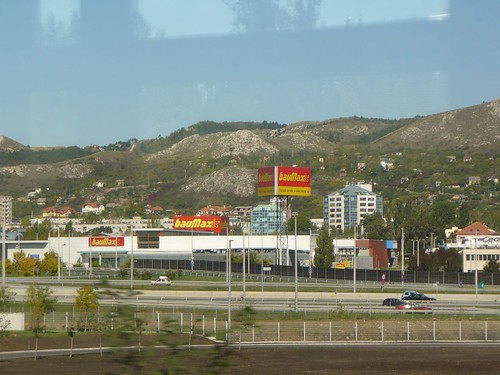
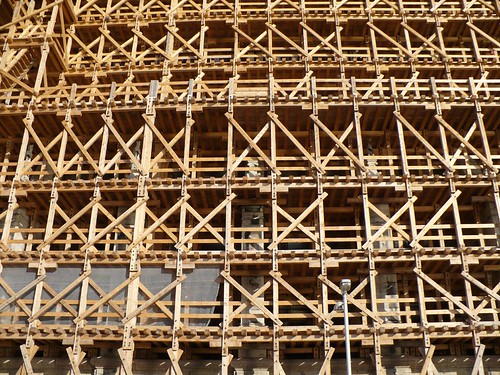
Budapest's worsening air pollution is due in large part to the advent of American-style suburban housing developments and shopping centers, according to Andras Lukacs, president of the Clean Air Action Group. "Several hundred thousand people have moved out of central Budapest and gone to these new so-called residential parks in what used to be green areas," he says. "Each day they come back to their jobs here, but because public transportation isn't so good out there, they take their cars."But public transit is awesome in the city. They are building two new subway lines in addition to the three they have already. During communism, the transit share was 80% but that system came with a heavy price including an underinvestment in all infrastructure. Many buildings are falling apart and have to have some really hefty scaffolding. Here is a photo I took of the big box sprawl. It was noticeable on the train so I took a shot. The photo below the sprawl is some building scaffolding that keeps building pieces from falling while they are repairing it.
Monday, March 24, 2008
AC on Density #2
I mentioned AC's post on Density earlier. In his most recent post, he calculates the weighted densities for 34 regions. I'm wondering how San Jose had such a high density. Perhaps for the same reason that Los Angeles' density is relatively high, due to natural boundaries hemming in exurban growth. Atlanta on the other hand is flat as a pancake and is the worst sprawl offender.
Want to Chat With Fellow Transit Nerds?
I like discussions on transit. It's fun to sit around and shoot the breeze about whatever is going on. Here in San Francisco there used to be forums over at the SF Cityscape where the folks would gather to talk about transit, but its migrated over to Ess Eff. Cityscape still has some awesome resources including a huge blogroll.
As forums go though, I don't think there has ever been one about the transit oriented lifestyle but over at the Metro Rider LA Fred Camino and the gang have done just that. So if you want to go talk transit, check it out. And if anyone wants visit Frank up in Seattle and jump start a conversation there, he's got one too, although the comments section to his blog and over at STB are pretty lively. And down in my hometown of Houston Christof and the gang have the CTC forums.
Are there any other transit forums out there? I know there are a number of yahoo groups with epic battles taking place daily between the transit folks and anti-planners/libertarians but I hadn't seen any in other places.
As forums go though, I don't think there has ever been one about the transit oriented lifestyle but over at the Metro Rider LA Fred Camino and the gang have done just that. So if you want to go talk transit, check it out. And if anyone wants visit Frank up in Seattle and jump start a conversation there, he's got one too, although the comments section to his blog and over at STB are pretty lively. And down in my hometown of Houston Christof and the gang have the CTC forums.
Are there any other transit forums out there? I know there are a number of yahoo groups with epic battles taking place daily between the transit folks and anti-planners/libertarians but I hadn't seen any in other places.
Sunday, March 23, 2008
Greening Car Myth + Capacity Issues
In Forbes, Michael Repogle writes an article on the problems with auto travel increases even in the face of new technologies.
The thing that bothers me most is what if a lot of people need to use transit in cities? On some lines, particularly in San Francisco, there is a capacity problem. A recent study to open up Muni for free rides showed how overwhelmed the system would be if a substantial number of new people hopped on due to free rides. This scares me a bit. New York City has been handling massive increases quite well but even they need to expand and are in the process of building new subway tunnels. If we ever have a big shock and a ton of people hop on transit, there are going to be problems. And not having the capacity of a subway system spine here, it will show the limits of buses as the only solution as peddled by many rubber tire advocates. Buses will always be the bones of a transit system, but our spine should have capacity to move more people than a 60 foot bus.
A key arena for innovation will be finding ways to grow the world's communities and economies while at the same time reducing how much driving the population is doing. The forecast growth in motor vehicle traffic--60% over the next two decades in the U.S. and many times that in China and India--threatens to overwhelm gains won through increasing vehicle fuel efficiency.Which is the main rub, that VMT will increase so much that it will overwhelm any solutions we come up with such as everyone having a Prius type gas sipper. The only way to solve this issue is with more compact development and better transit.
The key to success is to keep car traffic from growing to unsustainable levels to begin with. A 2007 Urban Land Institute study found that shifting two-thirds of new U.S. growth to compact neighborhoods where cars are not the only transportation option would save 85 million tons of CO2 annually by 2030. That figure is more than the combined annual emissions of over 16 million regular passenger cars.While Michael claims the transit solution is BRT, I think he's been drinking too much of the Bill Vincent cool-aid. In keeping with most BRT peddlers out there, he spreads the rumor in a major print medium that BRT is cheaper than LRT. With most new BRT lines in the United States built as hybrid buses instead of trolleybuses, and just operating as express buses they are not helping the problem either. In suburban areas and less congested routes BRT will be a major part of the solution, but in urban areas, it is a necessity that we build rail lines that can have multiple car consists and have major capacity. The Orange Line in Los Angeles which is already at capacity and takes 15 minutes longer to finish the same distance as the Gold Line LRT, even with its speed limits. The LACMTA is looking to expand it but there is hardly room for more people.
The thing that bothers me most is what if a lot of people need to use transit in cities? On some lines, particularly in San Francisco, there is a capacity problem. A recent study to open up Muni for free rides showed how overwhelmed the system would be if a substantial number of new people hopped on due to free rides. This scares me a bit. New York City has been handling massive increases quite well but even they need to expand and are in the process of building new subway tunnels. If we ever have a big shock and a ton of people hop on transit, there are going to be problems. And not having the capacity of a subway system spine here, it will show the limits of buses as the only solution as peddled by many rubber tire advocates. Buses will always be the bones of a transit system, but our spine should have capacity to move more people than a 60 foot bus.
Saturday, March 22, 2008
Acela Gains Travel Share on Airlines
Showing what is possible for the future of many corridors across the country, the Acela (Kinda High Speed Rail) has been gaining share on the airlines in the same corridor. It kind of strikes me as silly that anyone would want to go through crazy security lines and airport traffic when you can just hop on the train in the city.
Wired has a few reasons why the train is gaining.
Wired has a few reasons why the train is gaining.
Thursday, March 20, 2008
Obama on Transit
In today's Charlotte Observer, staff asked Barack Obama how he felt about federal support for mass transit:
His response:
His response:
I'm a strong supporter, as part of our broader energy strategy. You know, if we are designing cities, and urban communities and suburban communities around two-hour commutes, then we are destined to continue down the course of climate change. And mass transit not only is far more environmentally sound, but with oil prices sky high, and not likely to go down significantly, because of increased demand by China and India, it gives individuals much more of an incentive to look at trains and mass transit as an alternative.Eh. I want to hear a more substantive discussion, but anything beats McCain, who has said he wants to kill Amtrak through privatization. I imagine Mary Peters will get to stick around too, and we already know her record.
Putting It Into American Terms
So Bush's budget wants to shift money from the transit account into the highway account. PIRG is getting really aggressive on this now and made this statement at the end of a recent press release:
“Bush’s proposal is like taking your star quarterback out of the game because the defense is giving up too many points”
Right on.
“Bush’s proposal is like taking your star quarterback out of the game because the defense is giving up too many points”
Right on.
Wednesday, March 19, 2008
Rail to Oakland, The Other Oakland
That PIRG report has made its rounds and now a group in Pittsburgh wants to use the evidence from it to kick off a campaign to take rail from Pittsburgh to Oakland, the neighborhood. It is the third largest downtown center in Pennsylvania and has many Universities and a top notch medical center. It's also where Mr. Rogers began discussing his neighborhood at WQED.
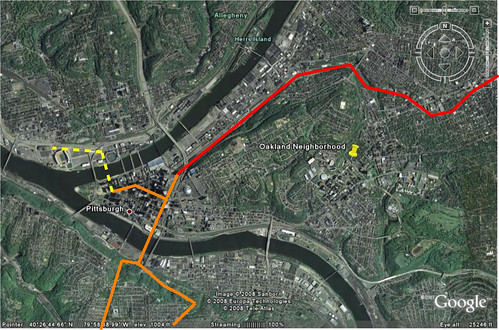
It's also not connected by any of the rail lines or busways that Pittsburgh has built over the years. Given the previous cost estimate of $750 million dollars 15 years ago, I'm imagining this 2-3 mile expansion will be a subway. The layout for those not familiar is below. The orange is the existing light rail which includes a downtown subway and tunnels in the hills. The red is the east busway, the first 6.8 mile section was completed in 1983 at a cost of $115 million ($244 2007 or $36M per mile) and the yellow is the currently under construction North Shore Connector which will open up the north side for rail expansion. It's a rather hilly landscape and like San Francisco, one of the reasons the light rail lines were saved is because of their tunnels.
It's also not connected by any of the rail lines or busways that Pittsburgh has built over the years. Given the previous cost estimate of $750 million dollars 15 years ago, I'm imagining this 2-3 mile expansion will be a subway. The layout for those not familiar is below. The orange is the existing light rail which includes a downtown subway and tunnels in the hills. The red is the east busway, the first 6.8 mile section was completed in 1983 at a cost of $115 million ($244 2007 or $36M per mile) and the yellow is the currently under construction North Shore Connector which will open up the north side for rail expansion. It's a rather hilly landscape and like San Francisco, one of the reasons the light rail lines were saved is because of their tunnels.
Tuesday, March 18, 2008
If You See Someone, Say Something
Ben has an post up about subway love in NYC. I've often wondered what, if any, etiquette there was to talking to girls (or guys) that caught your eye on transit. Some of my friends have said that it creeps them out while others are indifferent. One of my friends said that she gave a specifically creepy guy an evil look until he moved seats.
Apparently its not unusual to find creepy people on the subway, but its not unusual to see cute girls either...although most seem to have wedding rings. I certainly don't want to get the evil eye and I usually try to follow the golden rule, do unto others... And since I really don't like being bothered, I find it really hard to bother other people. So I end up listening to NPR or watching Diggnation and every once in a while catching a glimpse of a cute girl walking on or off the Muni or BART.
Apparently its not unusual to find creepy people on the subway, but its not unusual to see cute girls either...although most seem to have wedding rings. I certainly don't want to get the evil eye and I usually try to follow the golden rule, do unto others... And since I really don't like being bothered, I find it really hard to bother other people. So I end up listening to NPR or watching Diggnation and every once in a while catching a glimpse of a cute girl walking on or off the Muni or BART.
Monday, March 17, 2008
"He Had No Transportation Experience"
Anyone know an arabian horse judge for the DOT job? Today in the Washington Post there was an expose on Tyler Duval, a Bush appointee because of connections ("It was a friend of a friend thing") and DJ Gribbin who was a family friend of Dick Cheney. Their goal is to reduce the roll of government in transportation expenditures and instead privatize everything. But transit means nothing to them because as it stands, it can't be sold off to the highest bidder. So as we've been saying, they have been trying to kill transit as evidenced by their recent try to get toll roads into the new starts program.
But here's a catch with the congestion money giveaways. The funding for those pilot congestion pricing projects came from funds that usually go to replacing buses in cities and the small starts program. Congestion pricing has nothing to do with funding for buses in rural areas or in cities that need to replace older buses but have seen their funding continue to sucked up by gasoline prices.
Even if the next president reverses its policies, the Bush administration will leave a legacy of new toll roads across the country, a growing number of public roads leased to private companies, and dozens of stalled commuter rail, streetcar and subway projects -- including the $5 billion extension of Metro to Dulles International Airport.As mentioned in a post by Steve Davis at Smart Growth America, one of the targets Duval and Gribbin hope to get rid of with congestion pricing is earmarks. But as he also mentions, earmarks are a small part of the total expenditures with most of the money going to state DOTs who spend it without goals or measures of success on freeways. But many of the earmarks are projects that have merit, but can't wrestle funding away from We've seen this in the last week where there has been a fight over an earmark for the Central Corridor, a very worthy project.
But here's a catch with the congestion money giveaways. The funding for those pilot congestion pricing projects came from funds that usually go to replacing buses in cities and the small starts program. Congestion pricing has nothing to do with funding for buses in rural areas or in cities that need to replace older buses but have seen their funding continue to sucked up by gasoline prices.
"I couldn't believe they could get away with this, to just take that money away," said Mark Munson, director of the Regional Transit Authority in Dubuque, which has been frequently forced to deny trips to the elderly and disabled because there are not enough buses and volunteers can't fill all the gaps.Duvall is unapologetic, saying the traditional pork-barrel process of divvying up transportation dollars is bad policy. The proof, he said, is the fact that increased government spending on transportation has not slowed congestion.
If pricing is implemented, there should be a real plan to give people an alternative of real rapid transit. The New York plan is great because they have plenty of alternatives to get places in the pricing zone. Ryan discusses the need to do both as well. And Frank at Orphan Road warns us to be wary of going too far.
This is the reason why it really matters who becomes President next. Political appointments really have a huge push on policy and if we keep the same trajectory, we'll be stuck with these two guys for 4 more years.
And if you think there were a lot of innocent contractors on the death star, Ryan has some conspiracy theories for you as well. I'm not sure if they are that far from the truth given what has happened since Bush took office.
Sunday, March 16, 2008
Real Density Comparisons
AC calculates real density by weighted averages of census tracks. Check it out.
Saturday, March 15, 2008
Why Are We Giving People Money?
The recent downturn in the economy and the credit crunch/housing crash have left a lot of people wondering, how do we fix this problem. Jerome a Paris who diaries at Daily Kos has stated that part of the problem is that we are creating too much debt for ourselves and our income has been level on average since 2001. But how do we generate more income for workers who have seen wages stagnate and some jobs shipped elsewhere or flat out disappear from the coming(if not already here) home construction bust? Also how do we create lasting value?
A national infrastructure program. That is spending on alternative energy infrastructure and massive transit upgrades. This would do two things as Jerome states so well:
 (H/T Free Public Transit Blog)
A national infrastructure program. That is spending on alternative energy infrastructure and massive transit upgrades. This would do two things as Jerome states so well:
...provide a real boost to the economy in the sectors that actually need it, would reduce oil&gas consumption and carbon emissions, and be an actual investment in the future, as opposed to the current drain on the future that's been engineered via debt used on mindless consumption of junk.It would sure beat everyone getting $600 dollars to spend on goods made overseas. But what makes this a better investment? Recently a report from the Institute of Policy Studies came out that discussed the jobs created in the defense industry versus other key sectors that need investment. Spending on education and transit created far more jobs than defense. Transit was the highest job creator and created predominantly middle class jobs with incomes between $32-$64k. I would imagine greater increases in spending for transit would generate even more jobs as there are needs for manufacturing when demand is created.
 (H/T Free Public Transit Blog)
Thursday, March 13, 2008
More Research and Reports
APTA - The Broader Connection Between Transit and Energy/GHGs
The Greenness of Cities - Edward Glaeser
People living in households near public transit travel 12 fewer miles per day which is 27 percent less than persons in households with no access to public transit according to the study. This equates to an individual household reduction of 223 gallons of gasoline a year.Smart Growth America - Growing Cooler
They warn that if sprawling development continues to fuel growth in driving, the projected 59 percent increase in the total miles driven between 2005 and 2030 will overwhelm expected gains from vehicle efficiency and low-carbon fuels. Even if the most stringent fuel-efficiency proposals under consideration are enacted, notes co-author Steve Winkelman, “vehicle emissions still would be 40 percent above 1990 levels in 2030 – entirely off-track from reductions of 60-80 percent below 1990 levels by 2050 required for climate protection.“Department of Homeland Security - Transit Threat Assessment
The Greenness of Cities - Edward Glaeser
Over the past 50 years, automobile oriented suburbs have grown much more quickly than denser urban areas, and over the past six years, the four fastest growing American metropolitan areas have been Atlanta, Dallas, Houston and Phoenix—all hot places that use an impressive amount of electricity to create a pleasant year-round climate. Cars and air conditioners both lead to signifi cant emissions of carbon dioxide, which an increasing body of evidence has linked to potentially dangerous climate change. If this evidence is correct, then there are serious social costs associated with new forms of development that tend to be extremely energy intensive.
It's Space Race Time, and LA is Rockin!
We've been following the Transit Space Race for over a year now and more cities keep jumping into the race. Yesterday Los Angeles vaulted into the upper tier of the race with an announcement of their long range plan. We've covered them before, but there are some extra goodies in the announcement. Now if we could only get increased federal funding for rail projects...
From Curbed LA:

From Curbed LA:
Strategic Unfunded Projects
Tier 1: Currently Under Planning or Environmentally Cleared/Route Refinement Study-Regional Connector
-Metro Subway Westside Extension to La Cienega
-Harbor Subdivision Alternate Rail Technology between LA Union Station and Metro Green Line Aviation Station
-Metro Subway Westside Extension to City of Santa Monica
-Burbank/Glendale Light Rail from LA Union Station to Burbank Metrolink Station
-Metro Gold Line Eastside Extenstion from Atlantic/Pomona Station to City of Whittier
-Metro Gold Line Foothill Extension from Sierra Madre Villa Station to Azusa
-Metro Green Line Extension from Redondo Beach Station to South Bay Galleria
-Metro Gold Line Extension from Sierra Madre Villa Station to Montclair
-Metro Green Line Foothill Extension between Norwalk Station and Norwalk Metrolink Station
-Mero Green Line Extension to LAX
-West Santa Ana Branch ROW Corridor Maglev between LA Union Station and Santa Ana Metrolink StationTier 2
-Metro Red Line Extension from North Hollywood Station to Burbank Airport Metrolink Station
-Vermont Corridor Subway
-"Yellow" Line Light Rail between Metro Red Line North Hollywood Station and Regional Connector
-I-405 Corridor Busway between Metro Orange Line Sepulveda Station and Metro Green Line Aviation Station
-"Silver" Line Light Rail between Metro Red Line Vermont/Santa Monica Station and City of La Puente
-Metro Green Line Extension from LAX to Expo Santa Monica Station
-SR-134 Transit Corridor Bus Rapid Transit between Metro Red Line North Hollywood Station and Metro Gold Line Del Mar Station
-Metro Green Line Extension between South Bay Galleria and Pacific Coast Hwy Harbor Transitway Station

Wednesday, March 12, 2008
Why Are the Goal Posts Moving?
The FTA is really trying to kill rail projects in the United States. So it seems are the folks over at the Sierra Club in Seattle. In Charlotte, the FTA is requiring that the North Corridor LRT be 65% through preliminary engineering before they can enter into preliminary engineering in the federal process. This means that you can do all of the work and they can come in and say they don't like it, which means you might be out of luck and need to spend millions to re-engineer something they don't like. It used to be 30% so the plan could be analyzed earlier. My first question would be if they make BRT projects do the same or if they get special treatment because they are the administrations favorite mode. Another question is why does the FTA have so much power over transit projects but the FHWA just doles out highway money to the states to spend on whatever freeway they like? They pay 80% for freeways and 50% for transit, doesn't seem fair that they have control over where your line goes or define your project by what they think cost effectiveness is (hint: no one's cost effectiveness is the same as theirs except anti transit folks).
I wouldn't have a problem with this if the FTA had more money and was likely to fund more projects. But they don't and they aren't. In fact lately they have been tightening the screws. This year had the least number of projects in the new starts process than any year previous. In the late 90s there were usually around 40 projects in Preliminary Engineering. Today there are 10. Yes 10 projects. Out of all the planned projects (At least 50) that I've listed in the Transit Space Race for expansion in the United States, there are only 10 projects in preliminary engineering. Administrator Simpson claims that the Bush administration has funded more projects than during Clinton, but we know that most of these projects were started during the 90s and they are only now able to start shutting off the money with Secretary Peters at the helm.
This is a direct result of the Bush administration's disdain for transit. And while its likely to get better with a new administration, there is going to be a big fight for the new transportation bill to see where money goes in 2009. The Mary Peters set including Wendell Cox and Ken Orski are saying that there is no need for new rail starts in the United States. They say the rail expansion is over and right now they have the ears of the politicos at the FTA.
Which brings me to Seattle. The Sierra Club all over the United States has really fried my bacon, with the exception of Boston. Those guys are doing a great job, but here in Marin and up in Seattle they don't get it. In Marin like Seattle, the SC is lobbying against the train because it will bring growth. It's coming whether you like it or not. You can let all those people drive all the way into town or you can build a line that allows for TOD and expansion of transit PMT. But in addition, whether you like it or not, parking is big in the FTA models I discussed above which are a large part of the cost effectiveness measure. In fact, I would wager that if the Sierra Club got its wish, there would be no federal money for the extensions in Seattle and the lines would be funded completely by local taxes. I'm not sure that would sit well with folks up there. There are better ways to control growth than not building an important transit line.
I wouldn't have a problem with this if the FTA had more money and was likely to fund more projects. But they don't and they aren't. In fact lately they have been tightening the screws. This year had the least number of projects in the new starts process than any year previous. In the late 90s there were usually around 40 projects in Preliminary Engineering. Today there are 10. Yes 10 projects. Out of all the planned projects (At least 50) that I've listed in the Transit Space Race for expansion in the United States, there are only 10 projects in preliminary engineering. Administrator Simpson claims that the Bush administration has funded more projects than during Clinton, but we know that most of these projects were started during the 90s and they are only now able to start shutting off the money with Secretary Peters at the helm.
This is a direct result of the Bush administration's disdain for transit. And while its likely to get better with a new administration, there is going to be a big fight for the new transportation bill to see where money goes in 2009. The Mary Peters set including Wendell Cox and Ken Orski are saying that there is no need for new rail starts in the United States. They say the rail expansion is over and right now they have the ears of the politicos at the FTA.
Which brings me to Seattle. The Sierra Club all over the United States has really fried my bacon, with the exception of Boston. Those guys are doing a great job, but here in Marin and up in Seattle they don't get it. In Marin like Seattle, the SC is lobbying against the train because it will bring growth. It's coming whether you like it or not. You can let all those people drive all the way into town or you can build a line that allows for TOD and expansion of transit PMT. But in addition, whether you like it or not, parking is big in the FTA models I discussed above which are a large part of the cost effectiveness measure. In fact, I would wager that if the Sierra Club got its wish, there would be no federal money for the extensions in Seattle and the lines would be funded completely by local taxes. I'm not sure that would sit well with folks up there. There are better ways to control growth than not building an important transit line.
Tuesday, March 11, 2008
Parking Lot Congestion Pricing?
I was reading up on the Seattle congestion pricing debate over at Seattle Transit Blog and Orphan Road and was thinking about ways to address the equity issue of congestion pricing. I'm wondering what kind of tax isn't regressive. Is it the land tax? Perhaps.
But what about a rush hour parking tax?
Parking garages have meters that do timestamping, so why not charge a fee for parking between 8:00 and 9:30 and leaving between 4:30 and 6:00. When you use that funding for expanding transit, you can then expand to road based congestion pricing after expanding transit. That way if you don't have any other options, you can still get in and park if its early or late making people vary their timing surely making it more equitable. I'm sure there are drawbacks because this just popped into my head and I didn't think it through completely but I'd like to hear people's take on it. It could be too limited to workers downtown for instance. Or people could just write it off on their taxes unless that benefit was taken away.
But what about a rush hour parking tax?
Parking garages have meters that do timestamping, so why not charge a fee for parking between 8:00 and 9:30 and leaving between 4:30 and 6:00. When you use that funding for expanding transit, you can then expand to road based congestion pricing after expanding transit. That way if you don't have any other options, you can still get in and park if its early or late making people vary their timing surely making it more equitable. I'm sure there are drawbacks because this just popped into my head and I didn't think it through completely but I'd like to hear people's take on it. It could be too limited to workers downtown for instance. Or people could just write it off on their taxes unless that benefit was taken away.
"Auckland, One of the Most Auto Dependent Cities in the World"
So these videos have been going a bit viral lately, but I haven't seen them all in one place except on YouTube. So here they are, Peter Newman and Todd Littman on Aukland New Zealand doing their best opposite day impression of Wendell C and Randall O. I posted part three a few days ago, but here they are together.
Part 1. City of Cars
Part 2. It's Too Spread Out for Transit
Part 3. Sustainable Transport is Uneconomic
Part 1. City of Cars
Part 2. It's Too Spread Out for Transit
Part 3. Sustainable Transport is Uneconomic
Monday, March 10, 2008
U.S. Transit Takes 10.3 Billion Trips in 2007
I'd like to say that this is impressive, but it's not. If we are going to get something done in this country we can't be happy just going to the Olympics, we should want to win the gold. I will say that light rail again led the way for ridership increases at 6% but we need more.
For comparison to the much touted 10 Billion number that we've had the last two years consider this, Budapest (my favorite transit city) residents took over 1.4 Billion trips in 2003 in a region of 2.4 million people. The population of the United States is around 300 Million. While there are obvious differences in urban form and the availability of transit there versus here, its telling of what is possible if we design transport systems correctly and design our neighborhoods accordingly.
For a better western example that wasn't over run by communism until 1989, Vienna (A metro of 2.2 million) takes 700 Million annual trips. The tram network carries 280,000 passengers a day. The U Bahn metro carried 427 million trips in 2005. They began building their metro system in the 60s and finished in 1982. While they had a legacy street railways network, that can be done in time as well.
It's possible for us to catch up, but we gotta start moving a little faster. If each of the top 50 metro regions can get 700 million trips per year, we can increase ridership to 35 Billion trips. Is that possible? I don't know, I'm just tossing out numbers, but it would be amazing and would do a lot for the environment and create jobs.
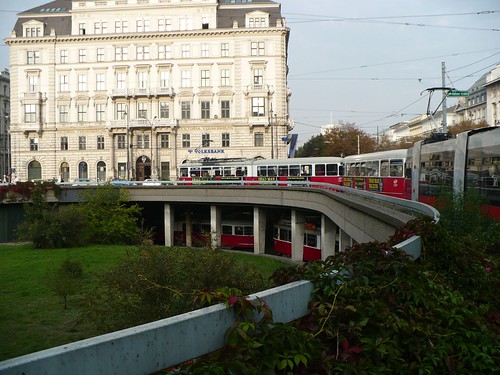
I also love a good reason to use pictures from my trip last fall. The one below is a tram loop on the Ringstrasse in Vienna.
For comparison to the much touted 10 Billion number that we've had the last two years consider this, Budapest (my favorite transit city) residents took over 1.4 Billion trips in 2003 in a region of 2.4 million people. The population of the United States is around 300 Million. While there are obvious differences in urban form and the availability of transit there versus here, its telling of what is possible if we design transport systems correctly and design our neighborhoods accordingly.
For a better western example that wasn't over run by communism until 1989, Vienna (A metro of 2.2 million) takes 700 Million annual trips. The tram network carries 280,000 passengers a day. The U Bahn metro carried 427 million trips in 2005. They began building their metro system in the 60s and finished in 1982. While they had a legacy street railways network, that can be done in time as well.
It's possible for us to catch up, but we gotta start moving a little faster. If each of the top 50 metro regions can get 700 million trips per year, we can increase ridership to 35 Billion trips. Is that possible? I don't know, I'm just tossing out numbers, but it would be amazing and would do a lot for the environment and create jobs.
I also love a good reason to use pictures from my trip last fall. The one below is a tram loop on the Ringstrasse in Vienna.
Sunday, March 9, 2008
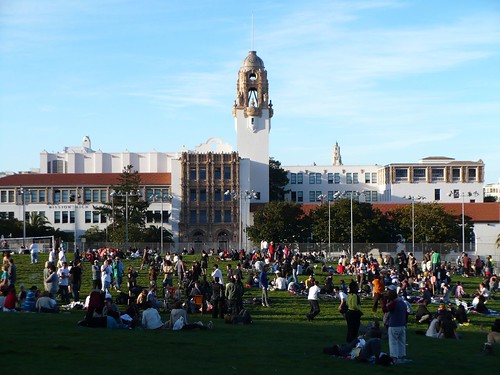
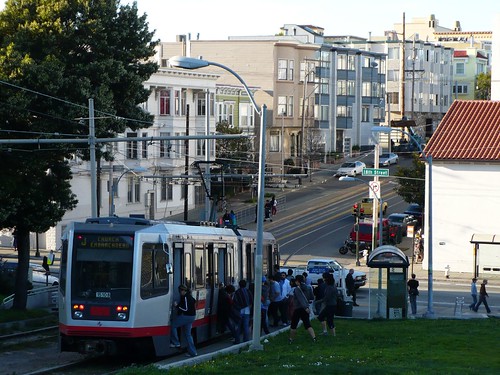
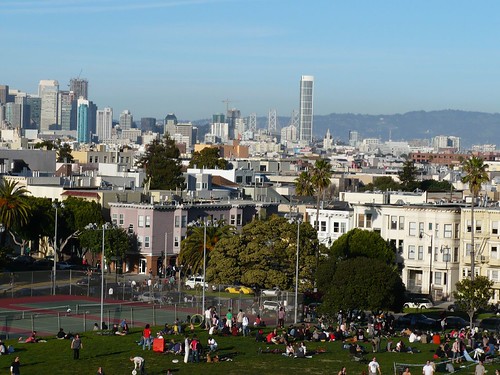
Dolores Park Blogging
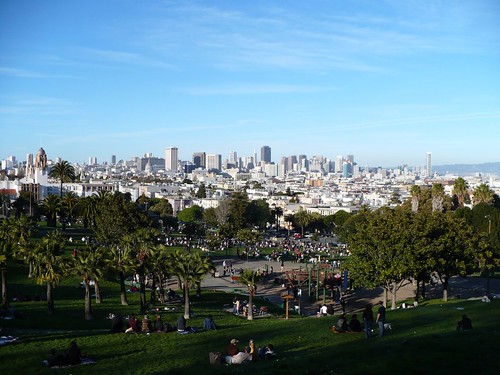
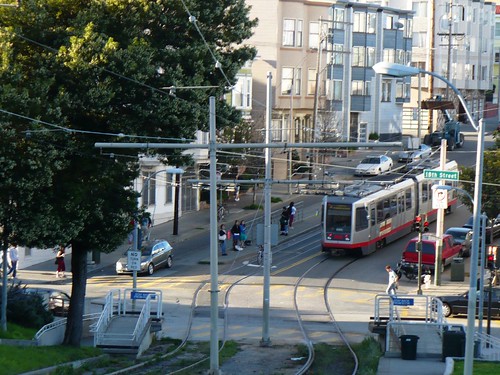
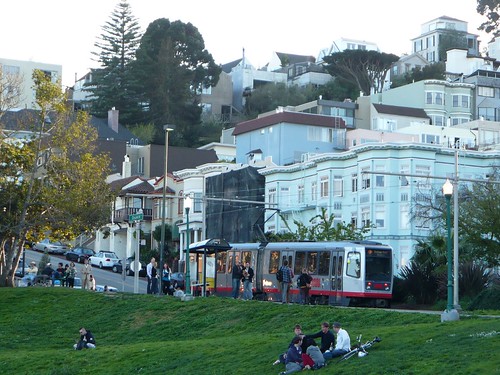
I live a few blocks away from Dolores Park which some also call Dolores Beach because on sunny San Francisco days everyone is out in the sun having a good time. It's a wonderful thing. Here are a few images collected today. It also showcases the ability to get to nice parks and views in San Francisco by transit.
US PIRG Releases Transit Report
The US Public Interest Research Group released a report titled 'A Better Way to Go' this week. If you're a transit advocate and need some ammo for any coming fights I highly recommend it. The chapter that most interested me was the one about underinvestment in transit. They did some digging and found out how much investment we've made in transit versus highways in this country and even I was shocked at the chart. And this is just highways...not local roads, parking spaces etc.

A few other pieces of information from the report:
Carbon dioxide from our automobiles equals the total emissions from Germany, Japan and Canada.
Commercial Parking lots in this country cover more space than the state of Delaware.
Rail saves a lot of oil with heavy rail systems like the subways in New York and Washington DC doing most of the heavy lifting. The chart below shows oil savings from LRT.
 Transit provides a wide range of benefits including, reduced road expenditures, reduced cost from traffic accidents and reduced public and private costs to providing parking.
Investments in transit create 19% more jobs than equivalent investments in roads.
In 2005, the subsidy to highways was $39 billion dollars.
In 2005, the state expenditure on highways was $100 B dollars. Transit was $7.8B
And many more...
At the end of the report PIRG advocates that we stop spending money on new highways and shift to building more transit. The Interstate Highway Program has funded all of the necessary highways in this country and its time to fill the gap between what was neglected in the last half of the 2oth century.

A few other pieces of information from the report:
Carbon dioxide from our automobiles equals the total emissions from Germany, Japan and Canada.
Commercial Parking lots in this country cover more space than the state of Delaware.
Rail saves a lot of oil with heavy rail systems like the subways in New York and Washington DC doing most of the heavy lifting. The chart below shows oil savings from LRT.
 Transit provides a wide range of benefits including, reduced road expenditures, reduced cost from traffic accidents and reduced public and private costs to providing parking.
Investments in transit create 19% more jobs than equivalent investments in roads.
In 2005, the subsidy to highways was $39 billion dollars.
In 2005, the state expenditure on highways was $100 B dollars. Transit was $7.8B
And many more...
At the end of the report PIRG advocates that we stop spending money on new highways and shift to building more transit. The Interstate Highway Program has funded all of the necessary highways in this country and its time to fill the gap between what was neglected in the last half of the 2oth century.
Saturday, March 8, 2008
You Work on Friday to Pay for Your Auto Dependence
Peter Newman is the person who gave us the term Automobile Dependence and has been an excellent fighter in the war against it. He also has been looking at density as it pertains to transit usage and walkability. What I like best about this interview in the Oregonian is that he refutes the myth and conservative talking point that planners and transit agencies are in search of the perfect city and ultimately want you to get rid of your car. I certainly don't advocate that as I own a car myself, but am lucky enough to use it very little.
Q: So you don't advocate some sort of wholesale getting rid of the automobile or that people will on a large scale in small or midsize cities not use cars at all?A: No. The ideal city, I reject.
You can have carfree areas. I would say the city center of Portland is car free in that sense. There is a freedom from the car. You don't have to have a car there. You can live there, you can work there, in a way that enables you to have that freedom.
He also discusses the subsidies for automobiles that only recently have been gaining attention such as health care for auto accidents and big oil.
But to attack transit as being subsidized whilst not seeing the subsidies for car dependence is not a level playing field. We do those numbers in Australia, they're similar in America.And the kicker is he punches a hole in the freeway capacity issue. We've got to stop building wider freeways. He even suggests ripping them down like the Embarcadero or such as what should happen to the Viaduct in Seattle. I'm not sure if that is palatable for interstate highways but who am I to keep anyone from dreaming big. It's amazing how much tax base is taken away by these huge roads that move cars as fast as possible through cities instead of creating value.The politics is changing. We can no longer subsidize the increase in VMT - we have to subsidize the decrease in VMT. There is no choice in that.
Q: We have a $4 billion proposal to replace a six-lane highway bridge on Interstate 5 with a new bridge that would have six highway lanes, plus six auxiliary lanes. It would also extend light rail to the northern suburbs and have generous pedestrian facilities. It's been billed as having a little bit for everyone. Is that kind of project worth pursuing?This video is great. My favorite quote is when he states you are basically working one day a week to pay for your transport. I'm gonna make it Friday.
A: Four billion dollars is what you're going to need for building these transit lines and subcenters. Keeping the traffic moving is what you have to stop doing. VMT (vehicle miles traveled) reductions are not going to be promoted by that bridge. There will be a whole series of freeways taken down when they reach the end of their life in cities around the world. The one in Seoul (South Korea) came down. Now it's a beatiful river, and a park with transit. The mayor who did it is now the president.
Q: So increase rail transit, to the detriment of roads?
A: Any decent rail system can carry eight lanes of traffic equivalent - on this narrow little track. It's a capacity issue. You can only carry 2,500 people an hour down a freeway lane. You can get 50,000 an hour on a rail system - 20 times as much. That space is enormously valuable. There's no doubt in my mind that's what you've got to do.
Thursday, March 6, 2008
Why the Line MUST Go Up Guadalupe Street
If what M1ek said in the comments of a previous post is true about the route for light rail in Austin being the Streetcar route that Capital Metro has put forth, they are making a really bad politically motivated move. I'm tired of Austin getting a raw deal from it's political deals and this is clearly a political deal with outgoing Republican Mike Krusee (just like the commuter rail line was) and the University of Texas, both of whom seem to not care about the needs of the population.
It's been stated before that Krusee plans to use the streetcar as a redevelopment tool to turn over some of the parking garages at the State into redevelopment opportunities. I'm all for redevelopment and streetcars as I've said before, but if this line gets built, they're risking possible expansion and political will by not building where people really want to go. There is one route that is a home run that will guaranty expansion...Guadalupe.
Here are 4 reasons why Austin needs to start light rail with the best starter light rail line possible
1. 1994 Denver - Built a very successful starter line and used that success to go after a 119 mile expansion plan
2. 1999 Salt Lake City - Opened North South Line connecting major destinations blowing out ridership projections. Recently passed a sales tax to build 5 new lines.
3. 2004 Houston - Built a starter line through the center of the two largest job centers in the city. Ridership is highest per mile of any new LRT line in the United States. 5 new lines are being planned and 2 are expected to be funded by the FTA later this year.
4. 2004 Minneapolis - Built Hiawatha line which exceeded 2025 projections. 30,000 riders and the DFL party just forwarded a bill that will give the region 8 corridors by 2020.
Let's take a look at how to do this in Austin because you don't often get a second chance.
Through the Capital Complex
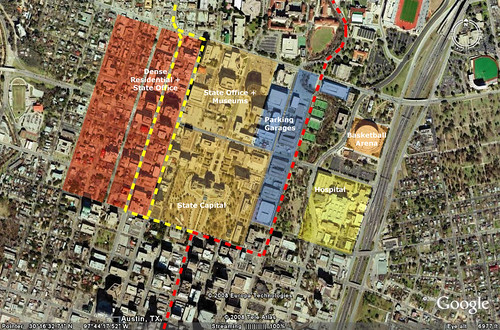
The red line is the "preferred alignment" by Capital Metro and the political backroom dealers. As you can see, the blue are parking garages and the red is existing dense development that is served by the most used bus corridor in the City (#1). Which one makes more sense? Go where the people are? or go where the cars are housed?
Through the University

UT is one of the largest Universities in the country. There is a large concentration of students going to classes every day in the area I've labeled main university where the Guadalupe alignment should go. On the left side of the Guadalupe alignment, the West Campus area where the highest concentration of students live has just been rezoned for high density mixed use. Think the Pearl District and South Lake Union. The Back Room alignment goes by all of the facilities that people use perhaps 8-10 times a year. The swimming pool, the track, the stadium, the LBJ Library and the Bass Concert Hall. The problem is, people don't go there often from Downtown or from up North. The area east of the red alignment is generally dead space...I spent most of my time at UT running around that track and just outside its walls. Not too many people there.
Next we'll talk about the more northern options but lets do the first section right this time.
It's been stated before that Krusee plans to use the streetcar as a redevelopment tool to turn over some of the parking garages at the State into redevelopment opportunities. I'm all for redevelopment and streetcars as I've said before, but if this line gets built, they're risking possible expansion and political will by not building where people really want to go. There is one route that is a home run that will guaranty expansion...Guadalupe.
Here are 4 reasons why Austin needs to start light rail with the best starter light rail line possible
1. 1994 Denver - Built a very successful starter line and used that success to go after a 119 mile expansion plan
2. 1999 Salt Lake City - Opened North South Line connecting major destinations blowing out ridership projections. Recently passed a sales tax to build 5 new lines.
3. 2004 Houston - Built a starter line through the center of the two largest job centers in the city. Ridership is highest per mile of any new LRT line in the United States. 5 new lines are being planned and 2 are expected to be funded by the FTA later this year.
4. 2004 Minneapolis - Built Hiawatha line which exceeded 2025 projections. 30,000 riders and the DFL party just forwarded a bill that will give the region 8 corridors by 2020.
Let's take a look at how to do this in Austin because you don't often get a second chance.
Through the Capital Complex
The red line is the "preferred alignment" by Capital Metro and the political backroom dealers. As you can see, the blue are parking garages and the red is existing dense development that is served by the most used bus corridor in the City (#1). Which one makes more sense? Go where the people are? or go where the cars are housed?
Through the University
UT is one of the largest Universities in the country. There is a large concentration of students going to classes every day in the area I've labeled main university where the Guadalupe alignment should go. On the left side of the Guadalupe alignment, the West Campus area where the highest concentration of students live has just been rezoned for high density mixed use. Think the Pearl District and South Lake Union. The Back Room alignment goes by all of the facilities that people use perhaps 8-10 times a year. The swimming pool, the track, the stadium, the LBJ Library and the Bass Concert Hall. The problem is, people don't go there often from Downtown or from up North. The area east of the red alignment is generally dead space...I spent most of my time at UT running around that track and just outside its walls. Not too many people there.
Next we'll talk about the more northern options but lets do the first section right this time.
Wednesday, March 5, 2008
Tuesday, March 4, 2008
Two Views of Gentrification
There was an article in the Washington Post discussing the renaissance of Columbia Heights around the Metro Station. $1 Billion dollars worth of development is rising from the ground with apartments, shops, and the usual chain stores like Target the ubiquitous Bed Bath & Beyond. It's TOD at its best.
But the redevelopment with affordable housing we see as awesome is seen completely differently by a number of people around the country that see their neighborhoods change before their eyes. In a recent This American Life (if you don't listen I highly recommend it), there was a discussion about 'The Plan'. 'The Plan' theory is the idea that the white population of DC uses planning and backroom deals to get rid of the african american population; condemning their public schools and infrastructure while using the land to build condos and upscale shops. It's not just about the real estate market, but blatant intent.
It's interesting to see the Post article the day after listening to the podcast, mostly because of the stark differences in the views portrayed. The awesome redevelopment around transit versus the displacement of residents and a plan to dilute the population with whiteness such as sushi.
But the redevelopment with affordable housing we see as awesome is seen completely differently by a number of people around the country that see their neighborhoods change before their eyes. In a recent This American Life (if you don't listen I highly recommend it), there was a discussion about 'The Plan'. 'The Plan' theory is the idea that the white population of DC uses planning and backroom deals to get rid of the african american population; condemning their public schools and infrastructure while using the land to build condos and upscale shops. It's not just about the real estate market, but blatant intent.
It's interesting to see the Post article the day after listening to the podcast, mostly because of the stark differences in the views portrayed. The awesome redevelopment around transit versus the displacement of residents and a plan to dilute the population with whiteness such as sushi.
Located near the District's geographic center and bound by 16th Street and Georgia Avenue, Columbia Heights' disparate narratives play out on the neighborhood's Internet mailing list, in which one posting last month was headlined "Sushi Coming to Columbia Heights!" Another updated viewers about a late afternoon shooting.
Black residents made up just over half the neighborhood's population in the 2000 Census, although their share had declined since the previous count while the numbers of Hispanic and white people grew. From 2000 to 2005, home buyers' median income rose from $76,000 to $103,000, according to the Urban Institute .
I suggest listening to the podcast before reading the article, and seeing if you can spot the differences portrayed.
Monday, March 3, 2008
Multiplied By $10 and Divided By Something Else
So after we pick a route, get city, county and Broward Metropolitan Planning Organization approval, if we don't get Congress to change the rules governing small transit grants, is this project still possible?This is an actual newspaper quote from Fort Lauderdale. While the city didn't get a straight answer from "consultants" they also won't get a straight answer as to why the Feds won't fund it. But why is that? Because the FTA has been doing a slow bloodletting that no one really noticed until now. Every year there have been less and less projects entering the New Starts program. I'm getting the feeling there will be less projects if no one can coherently explain the process and then Ken Orski will get his way. He says there are no more new systems to be built. Well we know from the transit space race he is full of baloney.
"It's still possible, yes," Smelley answered.
"Define possible," Ladd demanded. "10 percent? 80 percent?"
"Gee," the consultant answered. "I don't know how to do that." It boils down to The Wave's "cost effectiveness," Smelley said. He launched into a complicated equation involving "travel time saving hours" multiplied by $10 and divided by something else.
And on a related note, why aren't we trying to design expensive projects. $50 million per mile for a downtown circulator is ridiculous. Don't consultants want to make more money? It's insane to me that they aren't trying to do what Kenosha did and build affordable systems. They are biting the hand that feeds them and screwing mobility and economic development in the process. The city shouldn't get off scott free though. They should have done their research and figured out what costs should be so they can do like Sacramento did in their streetcar design. Put a cap on the cost and design from there. Is it really so hard?
Sunday, March 2, 2008
Subway to the Sea Badge
In an earlier post I discussed blog support badges and listed some I'd like to see. I created one for the Subway to the Sea for kicks. Feel free to use it.
Level the Urban Playing Field
A blog I really like to check out is the Bellows. Today Ryan discusses a response to an article about equity in cities vs. suburbs by economist Ed Glaeser. I agree with what he and Ed are saying about cities having to pay for some of suburbanites negative externalities which to him include the urban poor and the car based lifestyle. (Side note: A related recent article that people should read is about the movement of McMansions to McSlums by Chris Leinberger in a recent issue of the Atlantic.)
Back to Ed though; Back during the industrial revolution who could blame people for wanting to get away from the black soot and overcrowding that made up cities. It's different now though and there are lots of rules that keep cities from being the slums they were before. But today, cities pay (or as some say export tax base) to the suburbs in the form of road subsidies versus before when streetcars and streetcar suburbs were funded by the people in those suburbs. This to me is the biggest force today that promotes and spreads real sprawl. There have been policies after WWII that accelerated it including the Federal Highway System and suburban lending practices but those now are more of the beginning of the inertia rather than what is happening now. Now pro-suburban policies include job subsidies and the expansion of roads instead of maintenance. Now let's level the playing field.
Back to Ed though; Back during the industrial revolution who could blame people for wanting to get away from the black soot and overcrowding that made up cities. It's different now though and there are lots of rules that keep cities from being the slums they were before. But today, cities pay (or as some say export tax base) to the suburbs in the form of road subsidies versus before when streetcars and streetcar suburbs were funded by the people in those suburbs. This to me is the biggest force today that promotes and spreads real sprawl. There have been policies after WWII that accelerated it including the Federal Highway System and suburban lending practices but those now are more of the beginning of the inertia rather than what is happening now. Now pro-suburban policies include job subsidies and the expansion of roads instead of maintenance. Now let's level the playing field.
No region should receive special favors from the federal government; no city should get special treatment from Beacon Hill. But our cities deserve a level playing field. A level playing field requires that urbanites should not bear an undue burden of caring for the poor and that suburbanites should pay for the environmental costs of energy-intensive lifestyles.Back to the Bellows, some don't think that we should level the playing field to cities but Ryan gives this response:
His follow-up point that we shouldn’t do things to benefit cities because those things will unfairly benefit the rich is dreadfully off the mark. Glaeser is saying that society as a whole would be more urban if we got rid of some of the distortions preventing such a change (by charging, say, for pollution and congestion externalities). His broader point is that this will make society as a whole better off. And yes, policies to make life better in cities will have the effect of making life better for people in cities, and possibly harder for those in suburbs. So what? If the world needs to reduce carbon emissions, then it’s going to be the case that people who have to cut back most on their emissions get hurt the most. The alternative is to continue to allow those folks to not have to pay for the damage they inflict on the rest of us.
We Want the Line Away from Dense Places
Even though the extension of the Gold Line from Pasadena to the east has not even begun construction, there is already talk of expansion to Ontario Airport. There is hope that this would take expansion pressure off of the region's main airport LAX. As of now the extension to Ontario has three alternative routes and local NIMBY's are already starting to show their colors including elected officials.
Unfortunately for any city, the route with the least impacts is also usually the route that goes where no one wants to go or come from. Usually we would like these rail lines to go through the denser areas to help people get from here to there. But some believe otherwise:"The Gold Line will be another transportation mode available to residents, and it could help revitalize the downtown area, so it's a good thing for Upland, in a general sense," said Anthony La, the city's public works director.
"Upland's preferred alignment is the one with the least impacts to Upland," he said. "We want to know the interests of the community are protected."
Mahdi Aluzri, deputy city manager of Rancho Cucamonga, said his residents will not be fond of that option as it puts the line in the San Bernardino Associated Governments-owned right of way currently occupied by the city's newly completed popular bike path.Perhaps someone local can shed a little more light on this but it's getting more and more apparent that the biggest obstacle to building good transit is people not wanting the line to go where the people are located. In this instance it might not be a concern in that these last sections are just route options with perhaps one station, but if that station is located away from people then it doesn't really help ridership or development opportunities.
"It passes through a bunch of densely populated residential areas," Aluzri said of the route. "It would have a negative impact, and I expect that to come up in the community meeting."
WMATA and Joint Development
The Washington Post has an article on the restructuring of the Joint Development (Read TOD) program at WMATA. This is good news in that they will look at better development around the stations rather than just building anything to get money. This should pay off long term.
Too often in the past, board members said yesterday, land around stations was sold mainly to raise cash. The new rules focus on increasing transit-oriented residential and commercial development to encourage Metro ridership and reduce automobile traffic. The Ballston corridor in Arlington and Columbia Heights and Gallery Place-Chinatown in the District are considered examples of successful transit-oriented development.
Friday, February 29, 2008
The Glorious Transit Web
It's the web 2.0 and if you have a cause for transit, create a badge so it gets more recognition. Below are a few badges I've seen and causes I'm down with, others I'd like to see a badge for in no particular order:
Sound Transit 2.1
Austin Guadalupe Light Rail
California HSR
Geary Subway
Subway to the Sea


I've also been thinking about the need for a national transit campaign infrastructure. Everyone is really good at keeping up with the local causes but does there need to be some central place for organizing or getting the word out? I'm interested in the model that is used by Daily Kos or MyDD where they have a blog but also have user diaries. Instead of diaries however, because everyone has their own blog, perhaps it would be campaigns. This central blog would have contributors from each metro area discussing what is happening on the battlefield and where things are headed. Many of the blogs do that but this could be a central place to see what is going on nationally kind of like what the City Transit aggregator is trying to do. Perhaps it's a glorified version of the City Transit Aggregator.
Another important thing about this national info hub would be the ability to raise money around campaigns like Act Blue does for Democrats and Slatecard does for Republicans. Basically there are a whole lot of people out there who are interested in national transit policy and could use this as a way to get involved locally where alot of the big decisions are being made and help influence policy at the national level that helps cities get the funding they need for local projects. What do folks think? Is it something that should be fleshed out? Would people be interested in this kind of thing?
Sound Transit 2.1
Austin Guadalupe Light Rail
California HSR
Geary Subway
Subway to the Sea
I've also been thinking about the need for a national transit campaign infrastructure. Everyone is really good at keeping up with the local causes but does there need to be some central place for organizing or getting the word out? I'm interested in the model that is used by Daily Kos or MyDD where they have a blog but also have user diaries. Instead of diaries however, because everyone has their own blog, perhaps it would be campaigns. This central blog would have contributors from each metro area discussing what is happening on the battlefield and where things are headed. Many of the blogs do that but this could be a central place to see what is going on nationally kind of like what the City Transit aggregator is trying to do. Perhaps it's a glorified version of the City Transit Aggregator.
Another important thing about this national info hub would be the ability to raise money around campaigns like Act Blue does for Democrats and Slatecard does for Republicans. Basically there are a whole lot of people out there who are interested in national transit policy and could use this as a way to get involved locally where alot of the big decisions are being made and help influence policy at the national level that helps cities get the funding they need for local projects. What do folks think? Is it something that should be fleshed out? Would people be interested in this kind of thing?
Thursday, February 28, 2008
The Twin Cities Entrance into the Space Race
Welcome Minneapolis-St. Paul to the Space Race. Let's see what they're up to.
LRT
Central Corridor - This line has received lots of press and was just approved by the Met Council.
Southwest Corridor - This is the next light rail line. It will travel to the Southwest through some high employment centers in that part of the region.
Bottineau Boulevard - This line was going to be BRT but might be changed back to LRT.
Robert Street Corridor - South of St. Paul, they're doing the alternatives analysis now.
Commuter Rail
North Star Corridor - This line is under construction.
Red Rock Corridor - This line will go to the Southeast of St. Paul and will be the high speed rail connection to Chicago. If its electrified this would be a great addition.
Rush Line Corridor - This line will go Northeast of St. Paul.
BRT
Cedar Avenue and I-35W
That's a lot of transit. They've also just finished a Minneapolis Streetcar study as well.

LRT
Central Corridor - This line has received lots of press and was just approved by the Met Council.
Southwest Corridor - This is the next light rail line. It will travel to the Southwest through some high employment centers in that part of the region.

Bottineau Boulevard - This line was going to be BRT but might be changed back to LRT.
Robert Street Corridor - South of St. Paul, they're doing the alternatives analysis now.
Commuter Rail
North Star Corridor - This line is under construction.
Red Rock Corridor - This line will go to the Southeast of St. Paul and will be the high speed rail connection to Chicago. If its electrified this would be a great addition.
Rush Line Corridor - This line will go Northeast of St. Paul.
BRT
Cedar Avenue and I-35W
That's a lot of transit. They've also just finished a Minneapolis Streetcar study as well.
Looks Like Houston Is In for 2 More, Space Race Heats UP
2 Lines and an FFGA by the end of the year. Kay Bailey has been good on rail issues. The Houston Chronicle reports:
Lot's of Space Race movement lately, might have to upgrade the rankings soon.The Federal Transit Administration is committed to helping the Metropolitan Transit Authority qualify for funding of two light rail lines by the end of the year, Sen. Kay Bailey Hutchison said Tuesday.
Hutchison's statement came after a closed-door meeting in her Washington office, where FTA Administrator James Simpson and Deputy Administrator Sherry Little talked with Mayor Bill White, Metro President and CEO Frank Wilson, board chairman David Wolff and a bipartisan congressional delegation from the Houston area.
Wednesday, February 27, 2008
Austin Article Update
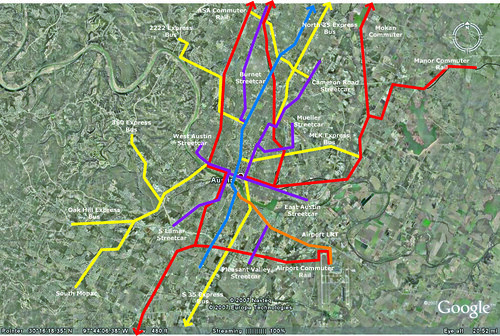
Are we going to see a plan from Austin soon? The Austin Chronicle has this cool little schematic but it doesn't tell us very much. At the bottom is a dream map I created a while ago. Perhaps this is the first step...I'm not holding my breath.

Tuesday, February 26, 2008
DFL Veto Override Starts Minnesota on the Space Race
Man these guys made a tough political call. Some Republicans have already paid the price for it, but everyone in Minnesota will be better off because of it. The Democrat-Farmer-Labor party or DFL decided that they needed to pay for infrastructure by raising the gas and car tab taxes. Of course this doesn't mean much for people who drive fuel efficient cars. But here is the Republican complaint...
The $6 Billion + dollar bill is also good for transit...
Geez, whine a little more about paying for what you use why don't you. If you drive more, that means you're using the roads more, whats wrong with paying more? It was their choice to live in a place where they had to drive more.He said higher gas taxes and registration fees for more expensive and larger vehicles could encourage people to buy more fuel-efficient vehicles, "which will save families money."
But Republicans stressed that families who drive long distances in larger vehicles would be hit harder.
As an example, they said a family of four in Bemidji could see its total taxes increase as much as $373 per year, assuming that the family bought a 9-year-old car and a one-year-old SUV and drove more than 35,000 miles a year. The SUV in the example gets 17 miles per gallon, and the car gets 22.
The $6 Billion + dollar bill is also good for transit...
Under another provision, a quarter-cent sales tax increase would occur in the seven-county Twin Cities metro area without a referendum, with all proceeds going to transit projects. The sales tax needs action by the county boards.
The sales tax would raise an estimated $1.1 billion over 10 years. In Hennepin County, the state's most populous, it would generate more than half of that amount, or $606 million. Last year, Hennepin County residents began paying a 0.15 percentage point sales tax, approved without a referendum, to help fund a stadium for the Minnesota Twins.
It would allow 8 planned rail and bus corridors to be built by 2020, entering the Twin Cities officially as a serious contender into the Transit Space Race! Welcome to the club.
Advocates estimated the bill would provide an extra $117 million to $173 million a year for rail and bus service. If federal matching funds could be secured, that would be enough to deliver eight new transitways, for trains or buses, by 2020 -- including the southwest light-rail line eagerly awaited by the western suburbs, the advocates said Wednesday.
Monday, February 25, 2008
Bills, Codes, and Engineering...News Update
The Colorado legislature looks like it will pass an eminent domain bill that will leave the ability to take property for parking lots but will not allow any other development on the land. The Rocky Mountain News has an editorial on the matter.
Dallas is looking to update its zoning code. This would enable more transit oriented development and better street design. In addition, the development at Las Colinas which will have 3 light rail stops on the new Orange Line, is really taking off.
The state of North Carolina is looking to create a fund for transit projects around the state that would provide a quarter of the capital cost for new high capacity projects. Also included are improvement funds for intercity rail and bus improvements.
Michigan Tech is going to open a new rail engineering school. This includes both freight and passenger rail. It's amazing but we've lost a lot of knowledge about how to engineer these systems over the years. Apparently we've also lost welding prowess. In an article in Der Spiegel engineers at Siemens describe their first foray into building light rail vehicles in the United States. They had to fly in 50 engineers from Munich with the skills needed:
Dallas is looking to update its zoning code. This would enable more transit oriented development and better street design. In addition, the development at Las Colinas which will have 3 light rail stops on the new Orange Line, is really taking off.
The state of North Carolina is looking to create a fund for transit projects around the state that would provide a quarter of the capital cost for new high capacity projects. Also included are improvement funds for intercity rail and bus improvements.
Michigan Tech is going to open a new rail engineering school. This includes both freight and passenger rail. It's amazing but we've lost a lot of knowledge about how to engineer these systems over the years. Apparently we've also lost welding prowess. In an article in Der Spiegel engineers at Siemens describe their first foray into building light rail vehicles in the United States. They had to fly in 50 engineers from Munich with the skills needed:
Hauck knows what he's talking about. He runs German engineering giant Siemens' streetcar manufacturing plant in Sacramento. But when the German company showed up in the California capital more than two years ago with its plans to build trams there, it found little evidence of craft or even skill. Hauck couldn't find a single welder with the right skills for the job anywhere in the region.Making meter-long welds across thin sheet metal without the car "bending like a banana," says Hauck, takes talent and sensitivity. More important, it takes good training. To provide that training, Siemens flew 50 welders from its Munich locomotive plant to California, where they spent six months retraining local welders. Now the Sacramento plant is up and running.
Hopefully this is a sign of growth in the industry.
Sunday, February 24, 2008
More Rapid Streetcars
Both Ann Arbor and Davis County in Utah are considering rapid streetcars. That is using streetcar vehicles that can carry up to 160 people on a 66 foot long platform versus light rail vehicles which typically are about 90 feet and have a capacity of over 230. Compare that to an articulated bus which only holds about 100.
Both are discussing using exclusive lanes in the street to move much faster than traffic. The applications however are a bit different. Ann Arbor is looking to build lines on four main corridors and feed them with neighborhood shuttle buses. It's more like a city tram system.
The Davis County version is a feeder to commuter rail and would travel in its own lane except in two places. I wish I knew where those two places were but I'm guessing we'll find out eventually.
Both are discussing using exclusive lanes in the street to move much faster than traffic. The applications however are a bit different. Ann Arbor is looking to build lines on four main corridors and feed them with neighborhood shuttle buses. It's more like a city tram system.
The Davis County version is a feeder to commuter rail and would travel in its own lane except in two places. I wish I knew where those two places were but I'm guessing we'll find out eventually.
Friday, February 22, 2008
A Sad Trend in Boston
All around the country cities are trying to add light rail lines, yet some cities have the infrastructure and are failing to see the value. The Arborway is no different. In one of the first posts on this blog I discussed why buses sucked compared to reinstating the streetcar when tracks already existed. Seems like we lost the battle, but not the war. Switchback has more.
Baghdad to Basra by Rail
From Reuters:
Like a stitch across a deep wound, the train between Iraq's two biggest cities reminds people of a more peaceful time before sectarian carnage nearly tore their country apart.The service between Baghdad and Basra resumed with little fanfare in December after a hiatus of 18 months. Few dared use it at first, but word has spread of a safe and cheap journey, and railway officials are scrambling for funds for more carriages.
...
Passenger after passenger praised the comfort of traveling on the train compared with stopping at checkpoints on the road from Baghdad to Basra, a grueling journey of 550 km (340 miles).
"First of all, it's the cost. And it's comfortable and safe," said Um Khaled, surrounded by her children, explaining why she was happy to be making the journey.
Passengers were also thrilled about the government-subsidized price.
At 4,000 dinars ($3.33) for a seat, the trip is almost a quarter of the price of the lowest fare to Basra by public minivan, the more common form of transport. A sleeper ticket costs 10,000 dinars.
The cost of petrol has rocketed to 450 dinars per liter from about 50 dinars before the fall of Saddam Hussein.
"This is not the true ticket price, which does not cover the service cost at all. It's priced low as a service to the Iraqi people," Baghdad rail chief Mohammed Hashem said. "They're tired of going by car and constantly stopping at checkpoints."
Thursday, February 21, 2008
Is Auto Ownership Tied to a Reduced Savings Rate?
We know that cars cost a lot of money. Aside from the up front capital cost, operations cost people at least $8,000 per year. But ever since cars were produced for the working man by Henry Ford, it looks as if the purchase and ownership of these vehicles has cut into American wealth accumulation. If you look at the savings rate over the last century, it seems to be an inverse relation to auto ownership. This chart created by Scott Bernstein at the Center for Neighborhood Technology shows this relationship. (I've seen this chart in a number of iterations but this is all I could find online)

 While everyone thinks that America is a wealthy nation, many people spend a good portion of their money on transportation. But it doesn't have to be this way. Cities that have good transit networks allow people to save money and cut overall emissions.
I want to reiterate that I think cars are an important part of our transportation network, but I think our complete dependence on them in most of the United States will lead many to the poorhouse sooner rather than later. In order to stem the tide, we need good transit. It allows people to pool their resources to pay for transport and allow for the building of wealth.

 While everyone thinks that America is a wealthy nation, many people spend a good portion of their money on transportation. But it doesn't have to be this way. Cities that have good transit networks allow people to save money and cut overall emissions.
 I want to reiterate that I think cars are an important part of our transportation network, but I think our complete dependence on them in most of the United States will lead many to the poorhouse sooner rather than later. In order to stem the tide, we need good transit. It allows people to pool their resources to pay for transport and allow for the building of wealth.
How Much Will My Trip Cost?
Google transit has added something really cool to their information. When you type in a route, they'll tell you how much money you save instead of driving. John at RTRider has more. Very Cool.
Wednesday, February 20, 2008
Inflation Hits Everyone
They are going to point to the trains as being over budget,
but they will ask why there is a "gap" in road funding or fudge it.
Inflation hits everything and everyone the same
but some like to pick their least favorite modes to blame.
but they will ask why there is a "gap" in road funding or fudge it.
Inflation hits everything and everyone the same
but some like to pick their least favorite modes to blame.
Large Misallocation of Resources
There is a new report out from an independent auditor that asserts Minnesota has been spending too much on expansion of roads and not enough on maintenance and repair. This report should be done all over the country because this is what it tells us: we've been wasting resources and subsidizing sprawl with bigger and bigger roads when we should be attending to the core capacity of our transportation systems. I'm not sure people will be able to stomach this for much longer. Soon there will be toll roads everywhere and people will be asking why we didn't build more alternatives....
...Frank might have an answer.
...Frank might have an answer.
Tuesday, February 19, 2008
Very Cool Subway Commercial
Check out MetroRider LA for the coolest transit commercial ever. I remember I heard somewhere that the auto industry spends more on ads in this country than we do on transit operations. Go figure.
Monday, February 18, 2008
Dulles Rail Gets a Slight Boost from House Republicans
While Mary Peters and Company are looking to stymie transit development around the United States, several lawmakers are having none of it in the DC area. Is this a start towards looking into the cost effectiveness measure as a false measure of the benefits of transit projects? Hopefully. While they don't discuss that issue specifically, the Washington Post has more on the push the project is getting from a couple of house bigwigs:
Two Republican leaders of the U.S. House of Representatives have asked the Transportation Department to move forward with the "critically important" but struggling plan to extend Metrorail to Dulles International Airport.
Minority Whip Roy Blunt (Mo.) and Deputy Whip Eric Cantor (Va.) sent Transportation Secretary Mary Peters a letter this week, saying: "It is vitally important that this project move forward. Open dialogue between Virginia and the Department of Transportation will make certain that lawmakers are best able to alleviate the burden of increasing traffic congestion and transportation demands across the entire national capital region."
Send Steve at Urban StL Some Love
Steve Patterson who blogs over at the popular Urban St. Louis suffered a stroke in early February. Steve and I presented on blogging and transit last year in Miami at the Rail~Volution conference. He's recovering well but it wouldn't hurt to send him some love. If you haven't checked out his blog before. You can do so here. Get better soon Steve!
Subscribe to:
Posts (Atom)