Sunday, March 1, 2009

Connecting the Dots

Looks like BART to San Jose has hit another snag because of the economy. The ~20 mile extension from the Fremont station all the way to the San Jose airport via downtown has been delayed for a number of years because of funding issues. Last fall the county passed an 1/8th cent sales tax to fix some of this but according to one analysis it won't be enough. I'm not sure if this is really true because the projections show flat sales tax revenues until 2036, which seems to me to be seriously wrong.
Board members used words like "shocked" and "astonished" at the report by consultant Bob Peskin, who analyzed sales tax projections through 2036. Once inflation is factored out, his sales tax projections are essentially a flat line.
But if true, this comes at the same time as a SPUR report that states suburban job growth imperils emissions reductions due to increased driving. As a practical goal, the region should focus growth in the more urban downtowns and urban areas that aren't office parks.
The city, and other urban areas better served by mass transit than suburban business parks, must adjust policies to attract a greater share of office development and employers, concludes "Recentering Work: The Future of Transit-Oriented Jobs in Downtown San Francisco," released by the San Francisco Planning and Urban Research Association.
So while the BART extension to downtown San Jose might seem like a good idea, its important to note that the round about way in which BART reaches downtown doesn't connect the areas which hold most of Silicon Valley's jobs but rather takes the path of least resistance (ie: existing ROW).

This is a big problem. The line which was conceived many years ago is a continuation of BART and regional authorities poor planning for rapid transit integration with land use. While it might have been state of the art as an idea decades ago, we've learned so much since then about TOD and how connecting destinations strengthens them. No longer will the suburban to urban model work with parking lots catering to the automobile. We need a better analysis of what to do but unfortunately it seems like nothing will stop this move from going through.

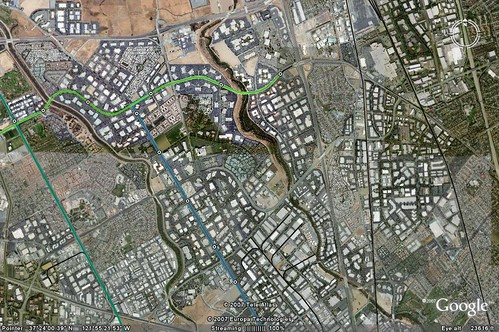
The map below shows job density in the valley (From LEHD 2004). Areas with the darkest green are over 20 jobs per acre. But the new BART line (dark blue) touches only the clusters downtown and extension of the VTA light rail line (light purple) go nowhere near the jobs that would attract transit riders.

The VTA Light Rail line hits a lot of the dense job clusters but underperforms because it is seen as slower. I don't know how many people who live in San Francisco have told me that the killer for thier connection to a job in San Jose is the slow round about light rail. This will be the same excuse for BART to light rail on the other side of the Valley.
SanJoseJunk

When we look into these long term Bay Area projects, we need to push planners to think about where people work and where they want to go. It's really important to think about these long term strategies to connect people with jobs and connect jobs to each other. If we're going to be dependent on a knowledge economy here in the bay area, allowing people easy access through transit to amenities and each other is the best way to facilitate energy and emissions reductions. Even if TOD springs up along the new BART line, it won't be as good as connecting the existing clusters of dense jobs with tons of redevelopable parking spaces (see above photo) that might not be needed with rapid transit easily accessible.

Don't Leave Things Behind

I was encouraged the other day when I got out of a cab and the driver asked me to check the seat to make sure my cell phone and wallet were in my possession. It was a nice gesture that I hope takes off in other places, perhaps on public transit as well. A good example of where this would have helped is in Sweden, where an elderly woman lost her life savings on the train on her way to the bank.
A woman lost her life savings when she forgot 500,000 kronor ($86,206) on a Swedish tram as she was headed to the bank to deposit the money, a newspaper reported on Sunday.
That is crushing. It's really sad that no one realized it was someones savings and it's really upsetting that there wasn't some other way for her to securely move her money. Though if I had such a huge sum of money in my possession, it would be tied to me...even stapled to my clothes. Hopefully they can recover the money, but it seems as if it might be a lost cause.

Taiwan HSR Doubles Annual Ridership

High speed rail in Taiwan doubled in patronage over the last year. Apparently the increase also corresponded with an increase in public transit ridership.
Domestic flights continued to suffer as a result of the high-speed rail. Last year, the number of passengers on domestic flights dropped 22.5 percent from the previous year.

Ministry statistics meanwhile showed an increase in the use of public land transportation systems. The number of passengers taking the high speed rail rose from about 15.56 million in 2007 to 30.58 million last year, close to a 100 percent increase. Despite the impressive passenger growth last year, the Taiwan High Speed Rail Corp announced on Friday it would reduce the daily train runs from 942 to 816, starting on March 16.

Saturday, February 28, 2009

Roads & Bridges

Everyone remembers the constant repeating of Roads and Bridges during the campaign and during the process for the stimulus package. I'm pretty sure when he was discussing this he meant existing roads and bridges instead of new ones. Well this wasn't so clear to the road warriors:
"The President's strong support for roads and bridges serves him well. Despite the controversy over the Economic Recovery package, 94% of Americans supported the President's call to increase infrastructure investments. Roads and bridges rank #2 in importance among infrastructure priorities for the American people. And while Congress only provided 3.6% of the Economic Recovery funds for roads and bridges, the President's consistent promotion of highway infrastructure made his views crystal clear.
I think its funny that when roads and bridges are discussed, people on the road side automatically think highways. It's like a dog whistle but in this case it might not mean what they think it does, which to us should be heartening. There are also plenty of complaints about tolling and the feeling that there won't be enough money to build the highway system all over again.
  1. The proposal implies that the 87-year old budgetary mechanism known as "contract authority" be deleted from the budget. Without contract authority, multi-year highway projects cannot be fully-funded.
  2. There is no mention of President Obama's support for roads and bridges anywhere in DOT's budget framework.
  3. "Road pricing" is discussed as an option in the budget framework, despite Secretary LaHood's opposition to tolling existing roads.
  4. There is no room in the budget for any substantial increase in highway funding, despite the President's recent call for investment levels that would rival the funding for construction of the Interstate Highway System.
Perhaps Mr. Obama tricked us during the election with the whole roads and bridges comment on repeat. I for one would welcome the trick if it meant we are changing the way we're funding new capacity and alternative transportation modes. We will see.

People Love the Trains

The new Siemens SD70s in Portland are popular. And they haven't carried a revenue passenger yet.

Does This Look Familiar?

I believe it looks like the creation of sprawl. If you wanted this to happen, why are you in the city at all? Why not just move to the exurbs. It already exists like that there. It's another example of the car companies and traffic engineers fantasy that everyone wants a car and everyone can have a car if we just pave the city with lanes to accommodate it. It's just cleverly repackaged as a promo for GPS navigation. Fortunately, we're beginning to think differently about the roll they play.

Friday, February 27, 2009

Preserving Affordable Housing Near Transit

In a recent report, my day job with the National Housing Trust looked at the number of expiring section 8 and 202 units near fixed guideway transit stations in 8 cities. In these cities, 63% (65,000) of the units that are located within a half mile of the station will have their section 8 and section 202 housing contracts expire in 2012.

This is only eight cities with rail transit but when you think about the mobility that transit allows for people who already have a hard time, it's an even bigger deal when it disappears. A recent Center for Housing Policy report found that low and moderate income families spend as much or more on transportation than they spend on housing. So you can see why it would be important to preserve housing such as this near transit stations in order to give folks more opportunities than they would have if they lived on the periphery. There should be a concerted effort to preserve these affordable units near transit.

So imagine my hope rising when the MacAurthur Foundation along with Enterprise Community Partners pledged $3.5 million dollars to fund new and preserve affordable housing units in the Denver region near transit corridors.

ULC — a nonprofit group affiliated with the Denver Foundation that buys, preserves and develops urban real estate — is expected to be the sole borrower of the fund, and will be responsible for buying property for the TOD housing and partnering with local companies for site redevelopment.

For the TOD housing project, the ULC will target three types of properties — existing, federally assisted rental housing; unsubsidized rental properties; and properties that currently are vacant or used for commercial purposes that have desirable locations for new affordable housing.

This is a way to get out in front of the market. If used intelligently, much of the money could be used for landbanking along future transit corridors then provided to affordable housing developers who could never get in on the market later on. I hope this is replicated in other cities soon.

Thursday, February 26, 2009

File Under, Are You Serious???!!

I just couldn't help myself. I had to share these two insane articles with you all. I keep telling myself I'm not going to post this drivel, but these are pure comedy.

Randall O'Toole - Save Washington Metro by Privatizing It
Reason Online - Rant against the Cinci streetcar, comparing it to a monorail

A good measure of our success over the next 4 years will be how crazy we can make these guys. Looks like we're off to a good start.

Related Comedy: Parking

From Seinfeld:
George: Look, I have my system. First I look for the dream spot right in front of the door, then I slowly expand out in concentric circles.

Elaine: Oh come on, George, please put it in a garage. I don't want to spend an hour looking for a space.

George: I can't park in a garage.

Elaine: Why?

George: I don't know, I just can't. Nobody in my family can pay for parking, it's a sickness. My father never paid for parking; my mother, my brother, nobody. We can't do it.

Elaine: I'll pay for it.

George: You don't understand. A garage. I can't even pull in there. It's like going to a prostitute. Why should I pay, when if I apply myself, maybe I could get it for free? (he hears a horn honking) What? What do you want? Go around me, I'm looking for spaces.
And people wonder why there is so much traffic!

Vintage Trolley Bus

I love the English Russia blog. You have to see these pictures of old trolley buses still in service that look like they have been to hell and back. I'm glad Muni keeps its trolley buses together better than this.

Extra: If you don't have a ROW, run your tram on the ice.

Midweek High Speed Rail Links

My feed reader is getting bombarded with high speed rail articles. It's crazy how much attention something gets when leadership in this country gets behind it. In addition, things are heating up in California and the nuts on the Peninsula are trying to weasel out. Some of the anon comments on Robert's HSR blog are quite hilarious. I'm paraphrasing but when you say "Rich people live here and will sue so move the alignment to where the poor people are" it's time to rethink your priorities.
~~~
An article in the San Jose Mercury News discusses the possibility of trenching. This is a better option than ending the line at San Jose and running Rapid Rail (which I assume is BART or electrified Caltrain) up the peninsula.
~~~
One of China's High Speed Rail lines is going to start construction soon. Ahead again.
Groundwork started Thursday on a high-speed passenger rail line that will link Shanghai with Hangzhou in east China with trains that can run up to 350 km per hour.
And if only the United States worked like this...
Rail capacity in the Yangtze River Delta region has reached saturation point, said Yu. He said that during peak travel seasons, cargo transport was often suspended to make way for passenger trains.
Firefox warned me about the site so probably not a good idea to click...but if you must.
~~~
It looks like Richard Branson wants to wring more money out of the trip between San Francisco and Los Angeles. He has me sold on Virgin America. Robert says he'd rather an agency cover it so we can pump profits back into expansion.
~~~
Newsflash. People who are bashing high speed rail as a Disneyland Ride are out of touch with America. It would also do them some good to get out of thier congressional district, state, or Washington DC once in a while to that crazy socialist Europe part of the world. I mean, Bulgaria will have HSR soon! BULGARIA!!!

Wednesday, February 25, 2009

LRT Number Crunching

I got into a debate on Streetsblog about passenger miles and capacity and saw a calculation I had never seen used as a reason that light rail sucked. It's an interesting calculation but it tells me nothing. GaryG states:
You simply multiply vehicle revenue miles by vehicle capacity in passengers to get total revenue capacity in passenger-miles. You then divide actual passenger-miles by revenue capacity passenger-miles to calculate the share of capacity that was actually used to transport passengers in revenue service. The calculation works out to an average occupancy of about 14 passengers per light rail vehicle. Each vehicle has a capacity of 140 passengers or more.
This makes no sense what so ever to me. First off, averaging anything over the whole day seems silly to me. Do we talk about roads being a waste when they don't carry cars at midnight? Another thing is that there's no filter for the peak period which is what of these lines relieve pressure on. The telling thing is that when we looked at the New York Subway, it was only 28 passengers per car. It reminds me of that calculation done a few years ago that all transit systems except for BART are worthless.

Anyways, my argument was that we should look at cost per passenger mile to see the efficiency of each mode. There was a fight about capital costs as there always are from people who think buses can do any job rail does but it led me to the 2007 National Transit Database numbers in easily readable format. Check out some of these numbers:

Cost Per Passenger Mile 2007

Denver
34 cents Light Rail
67 cents Bus

Portland
39 cents Light Rail
93 cents Bus

San Diego
27 cents Light Rail
71 cents Bus

Houston
53 cents Light Rail
55 cents Bus

Minneapolis
42 cents Light Rail
72 cents Bus

San Jose
103 cents Light Rail
155 cents Bus

Buffalo
1.63 cents Light Rail
1.24 cents Bus

Muni
116 cents Light Rail
101 cents Bus

Perhaps light rail in San Francisco is a waste. We should just rip out the tracks, no one likes riding on rails anyways...right? Wouldn't it be nice to toss a three car train on the N or KLM? Perhaps making Muni less like a bus stopping at every stop sign in the Avenues and on Church would help too.

Tuesday, February 24, 2009

Trains Vs Trucks?

I think this is a perfect example of single mode network thinking. Yes the rail lines don't go to the back of the Best Buy but they shouldn't. The rail lines do certain jobs well and trucks do other jobs well. Why not work together?

In transit, my favorite example is the CityCargo tram. Yes it's a tram that delivers cargo, but it has little electric trucks to deliver directly to the door to merchants in Amsterdam. It only works with both modes.

Dedicated Funding Source

In the long run, there was not a single person writing in the National Journal transportation panel section that said the VMT tax was an inherently bad idea. Very interesting.

On a similar note, Tennessee is looking to give regional transit authorities the ability to have a source.
First, it would allow other major municipalities in Tennessee to establish their own Regional Transportation Authority, like the one already in place for Middle Tennessee.

It would then allow a local RTA to take one of two routes in order to establish a dedicated funding source for regional transportation. An RTA could take a dedicated funding proposal to voters for a referendum, or it could ask a local legislative body like Metro Council to pass a law created a new funding source for mass transit.
Nashville recently opened the Music City Star which hasn't performed as well as perhaps it should and is also looking at alternatives on two other corridors. It seems as if these projects could be sped up by a dedicated source. We'll be watching to see how this progresses.

Monday, February 23, 2009

Meeting Hints at Greater Transit Funding from Obama Administration

I was reading through an article on Mayor Ralph Becker snagging stimulus money for Salt Lake City and noticed a passage that stood out near the bottom:
Becker on Friday also huddled with Obama's Transportation Secretary Ray LaHood, whom the mayor says suggested Salt Lake City's transit plans dovetail with the White House's so-called Livable Communities Initiative. There is "no question" that will translate to a bigger Beltway bankroll in the future for streetcars and a downtown TRAX circulator, Becker said.
Salt Lake City has a massive plan for expansion that includes five new transit lines and they have started recently talking about streetcars. I've seen a number of different livable communities initiatives in the past including an old FTA version and one from when Al Gore was Vice President but hadn't heard of a current one. Has anyone else heard of this initiative? I know LaHood mentioned it in his confirmation hearings but we haven't heard many more details except on the White House Urban Policy Page it states:
Build More Livable and Sustainable Communities: Our communities will better serve all of their residents if we are able to leave our cars to walk, bicycle and access other transportation alternatives. President Obama will re-evaluate the transportation funding process to ensure that smart growth considerations are taken into account.
If this is what the Obama administration is going to follow, we can see Mayor Becker's comments as a sign that they could be looking to act on it. Let's hope they do.

Listen for HSR Story on NPR

Tomorrow morning NPR is going to run a story on High Speed Rail on Morning Edition. In case you miss it, here's the transcript.

Sunday, February 22, 2009

No Vote for Austin?

Kirk Watson is pushing a bill in Austin that would allow an urban rail line, whether its light rail or a streetcar without a vote. The bill would specify that Austin or any other entity could build a line and have Capital Metro operate it but Capital Metro would have to go to referendum to expand the commuter rail network if greater than one mile.

This seems fair to me considering the 2000 election for light rail passed overwhelmingly inside of the City of Austin. Ok. Now get it passed and get building already. Preferably from the Triangle to Riverside to start.

Oscars Lame Again

Located at Hollywood & Highland, how many so called green loving stars took the subway to the Oscars? ZERO!!!! They closed the station again for "security reasons". LAME. They are making traffic worse for themselves when they don't have to and contributing more to the problem.

Hidden Trains of New York

Very cool article via Planetizen. It would be interesting to be there when they open up that Brooklyn subway wall and find a tipped over steam engine.

Since his big reveal in 1980, Mr. Diamond, the 49-year-old founder of the Brooklyn Historic Railway Association, has been conducting tunnel tours via the manhole with the blessing of the D.O.T. But of late, Mr. Diamond has been pushing for another potential urban architectural “get.”

Behind a wall in the tunnel, near Atlantic Avenue and Hicks Street, he believes, there is a steam locomotive lying on its side like an abandoned toy train, in “pristine condition, a virtual time capsule.” And he wants to dig it up.

Seems to me that instead of digging it up, you could do some sort of ultrasound scan or something to make sure its there before you start digging. You can check out the location on Wikimapia here.

Stealth Developer

There's an op-ed on Planetizen discussing the MTA in Los Angeles as a stealth development agency. I don't know if I would go that far. I think most people know they have eminent domain power and that they can redevelop property close to the stations but it's not as powerful as say the rail agencies in Hong Kong or Japan.

If any transportation agency was going to be a true development agency it would have even more power to land bank and develop properties than is currently allowed in the United States. In fact, this is how transportation worked during the streetcar era. Property was the main money maker rather than transportation, the transportation was the hook. But it created some great places such as the inner ring suburbs we now love. I would love to see transit agencies have more power to develop, but surely that won't happen because of property rights activism among other barriers.

Metroplex Residents Want Rail Too

Utah residents on the Wasatch Front are looking for expansion in transit while those in the Dallas Fort Worth are as well. Fortworthology has more:
This is big news for the Rail North Texas proposal: a new survey shows that 85% of voters surveyed support the regional rail plan

Saturday, February 21, 2009

An Urban A's Stadium

Since their Fremont plan crashed and burned and neighbors close to the future Warm Springs BART station have shut down the second option the A's are now going to have to look elsewhere for a stadium. They might even start looking in San Jose for a place. Not that I don't like San Jose, but Oakland is a much better place for a baseball team and they have so much history here, I'd like to make another suggestion. What about an Urban Stadium in downtown Oakland?

Other Urban Stadiums around the country are a success and most of them have really good transit access. A few examples are in Colorado, Boston, and Chicago. The Rockies Play at Coors Field - Access at Left to Union Station which will be the major hub of the Fastracks commuter and light rail network.

Fenway in Boston - Access to the Green Line


Wrigley in Chicago - Access to the Red Line


For an example, look what San Francisco has been able to do in SoMa with AT&T park. There's even an urban Safeway as seen in the picture below.


So why not accomplish two things in Oakland, extend good transit up Broadway and have a built in audience for restaurants and retail in a refurbished Auto Row until it takes off on its own. This would help stem the extreme retail leakage to Emeryville and San Francisco that Oakland suffers from. Having this anchor ramp up redevelopment of auto row and the hospital district would go a long way. I had a little fun with this and photoshopped in a stadium just south of 26th and north of 24th just west of Broadway where there is an empty auto dealership.


Another need is extending transit. It's easily walkable(.3 miles) from the site to the 19th street BART station/AC Transit 2oth street transit center but it would be nice to either have a subway extension to Kaiser or at least a streetcar line. Such a streetcar line has been proposed in other places such as at SF Cityscape.

Obviously the stadium would be a tough sell because there would be so many landowners but its a fun excersise. I would go to tons more games if it were located here which is close to my work downtown. Is anyone in A's land interested in an Urban Stadium? Thoughts from locals?

Urban Planning for Kids

A quick shout out to my buddy Tim Halbur. Aside from introducing me to a sweet Chinese New Year Scavenger Hunt that we do every year, Tim and Chris Steins (both of whom work at Planetizen) have written a book for kids based on the transect. I haven't read it yet but the New York Times has a profile on it today that I suggest reading. Apparently planning is getting cooler than it used to be. Congrats Tim!

Unlucky Tram 13

If you're ever in Zagreb, don't get on the 13 tram, its dangerous. So dangerous and unlucky, the locals are boycotting it.
Superstitious passengers are boycotting a number 13 tram after official figures showed the route suffers the most death crashes in Zagreb, Croatia. The route - where a passenger died in a crash this week - is running empty as passengers switch to other trams and buses.

Friday, February 20, 2009

Vehicle Miles Traveled Tax

Man there was quite the firestorm on the blogs today about the idea floated on a VMT tax by Secretary LaHood. Apparently it was such a bad idea to the Obama administration that they smacked down the idea later in the day. While that was the political thing to do, I'm not sure it was the smart thing to do. I'd like to see more studies on it before we come with a verdict.

Lets take a look at all the comments we saw today from progressives on a number of different blogs...

1. It will hurt the poor
2. It will cost a lot
3. It invades my privacy
4. It was proposed by a Republican
5. Why not just raise the gas tax?
6. Why not have a complicated weight and energy efficiency tax
7. Why do we even need a GPS collector instead of just reading odometers
8. It's hard for shift workers to take transit
9. Heavy trucks do more damage
10. My Prius driving will be punished
11. Senators will vote no because they are from low density states
12. If fuel efficiency goes to zero where does money for roads come from?
13. How about better road surfaces?
14. We'll need an electricity tax in ten years
15. We're not taxing vegetable oil for carbon
16. The only house I could afford was on the periphery
17. I don't want to pay anymore money for highways
18. What do miles driven have to do with anything?
19. A mileage tax doesn't distinguish between a hybrid and a hummer
20. People in Idaho live far away from where they work
21. I prefer to pay the traditional way, gas tax
22. Cheap gas is a birthright
23. It might encourage people to live closer to work
24. Miles tax is a GOP plan to save the gas guzzler
25. I don't want to punish people who live in rural areas
26. It's a trucking industry ploy to keep freight off the rails
27. I have a libertarian streak so i don't like it

Honestly, to me a lot of these are silly, but I thought you all would get a small chuckle.

The reasons for a mileage tax would be to push people into really thinking about how far away from work and other amenities they are living. They are already paying the price for their decisions given that people in location efficient areas can spend very little on transportation costs while folks in the worst sprawl spend up to 25% or more, but with a mileage tax, they'll be thinking about it even more. As that TXDOT study said (it's subsequently been taken off their site), a heavily traveled road in Houston would need $2.22 a gallon in taxes to actually pay for it. Many of the arguments for an increased gas tax would never likely get up that high, and that is actually the low end of what is really needed according to TXDOT, and that is just for federal and state roads, not bike lanes, transit and sidewalks/city streets.

I'm not saying that we don't need to make people pay for the negative externalities of the weight of thier vehicle or the gasoline they guzzle, but people need to start connecting the dots on housing and transportation costs that are killing family budgets and they lifestyles and driving patterns that lead to them. I'm not going to toss the mileage fee out yet. It might be a good idea or a bad idea. Let's just wait and see when the trials in Oregon and other places are completed instead of just throwing it out right away. There are plenty of arguments each way, I look forward to seeing them all.

Thursday, February 19, 2009

Don't Party On the Tracks

If a first grader gets it, you think that everyone else would as well.
"You should never have a party on the train tracks," said Max Schultz, first grader.
H/T Meg M.

Utah Residents Want Rail

79% is not too shabby.
A survey by the University of Utah's Center for Public Policy & Administration finds overwhelming public support for continued investment in rail transit projects. Among 1,002 residents polled statewide, 79 percent said continued funding for rail projects either is very important or somewhat important.
It's interesting how different the conservative strain is there. It's a collective thing, not a social thing. Why's it so hard to get others on board in other places?

Wednesday, February 18, 2009

Maddow "Geeks Out" on HSR


I believe this map was released in 2005. So not new, but cool its getting props on the cable.

Phoenix Ridership to a Good Start

It's a little early to claim victory here because of all the special events that have been going on since this line opened as well as the "new" factor, but it looks promising. Current weekday ridership numbers are at 30,000 while the projections for opening day were at 26,000. Long term 2030 numbers are expected to be around 50,000. And hey, look! A low-medium cost-effectiveness rating! Again, today it takes a medium because of a 2005 Bush administration edict. This could turn into yet another ridership projection FAIL if the ridership stays at it's current level during a severe downturn.

Ridership projection FAIL = Cost Effectiveness Index FAIL.

Just One More Thing From Charlotte...

David Hartgen is just looking for a backdoor way to bring down Charlotte's transit expansion. Even after getting beat down by 70% in the last election, the other side just won't give up trying to kill rapid transit expansion in Charlotte.

Hartgen said he thinks ridership will drop further because uptown layoffs are only starting, and that the drop in ridership should spur CATS to consider halting its ambitious plans to build more rapid transit. “We should be saving for our operating budget,” Hartgen said.

If anything, we should be building more transit to create jobs and shape the next housing boom. If we wait till the next housing upswing to build these types of lines around the country, we'll miss a huge opportunity to shape development. We can't afford it.

Not Dense Enough

Even in the downturn the Charlotte light rail line beat its projections. Currently ridership is down from its highs, but it makes me think that there needs to be a working over of the transportation models at the FTA. Under the current process that requires a medium rating for cost effectiveness, Charlotte would not have made the cut with its ridership projection as it was. It had a low medium rating in 2003, yet was recommended because of its land use planning. Which brings me to a second point.

An excuse for Kansas City not going back after light rail is the usual complaint. We're not dense enough. Via the Urbanophile from the KC Star:
The city is set up for cars. As a result, most of the metropolitan area is not densely populated...Generally, an average of 6,600 to 10,000 people per square mile is needed to score federal funds. But Kansas City isn’t close to that number along the 14-mile route that voters rejected in November.
So now, since they aren't dense enough currently(even in AC's weighted density) and use that as an excuse to not move forward, there will be no change and they'll continue to drift in autodom. But the problem here is not just the lack of imagination and foresight, but also that the current FTA gives no hope of change. People will continue as long as we let them to refer to the cost-effectiveness index as god's law. It's all about the now when in reality we should be planning for the future.

The point of building a rail line today, whether it's light rail, a subway line, or a streetcar is the shape the future development of a corridor but this is something that isn't measured in the current process, at least with any meaning. This is something Congressman Oberstar is looking to fix, but we need to help.

At this point, however, the Federal Transit Administration has declared the cost effectiveness index number and not transit oriented development as the critical factor in giving a thumbs up or down to a project. It's time for the CEI not just to be amended, but eliminated, says Rep. Jim Oberstar, chair of the House Transportation and Infrastructure Committee says.

"As soon as there is a Federal Transit Administrator I will encourage that person to, by executive order, erase it from the books. And if they don't we'll do that in legislation."The cost effectiveness index became the deciding factor for transit projects in April, 2005. That's when the FTA received a letter from the Bush administration's Office of Management and Budget proclaiming the CEI's primacy.

So Charlotte gives us some clues as to what we can look forward to in terms of changing neighborhood dynamics and creating a demand for future density in transit corridors. It also shows that the cost effectiveness index does not determine the success of a project, no matter how much weight seem to put on a single metric based in auto engineering. That doesn't mean we shouldn't look at the costs and weight it against the benefits. It just means the way we're doing it now is weighted towards killing meaningful projects. Places that need subways are forced by cost shock and the CEI to look at light rail and places that should have light rail are forced to BRT and so on down the heirarchy. I hope this changes, and that the "not dense enough" canard can't be used against a city looking to change its ways ever again.

Charlotte South Corridor:

Light Rail TOD

Tuesday, February 17, 2009

"Virgin" Rail's No Kissing Zones

Virgin rail is urging people to move along after they are dropped off at the train station. This has prompted a no kissing zone. I can understand if its crowded but don't stick too close to the name...
Virgin Rail says that if passengers want to share an embrace before they part company, they should pay to park their cars nearby where they can kiss all they want.
Photo via Independent UK

In Case You Missed Them...

Two articles were bouncing around more than others today. Politico has an article about how HSR got into the stimulus bill and David Brooks talks about a really poorly defined pew poll on urban preferences for living. What if I don't want to live next to a McDonald's or Starbucks?

Practice What You Preach

Does anyone know if one of these transportation officials that doesn't take transit is Nat Ford? (CBK notes he takes the bus) It kind of makes me angry when people don't practice what they preach, especially in transit. If I didn't believe in what I was talking about, I wouldn't be living it, and I think that if you're going to be working for a transportation agency and saying people should be living a certain way there's really no excuse for living the opposite.

There's An Idea

Take away the banker's money and build streetcars.

Would Have Gotten Away With It...

If it weren't for those locals. These are the types of things I like to see. More local control over local decisions. Federal and State funding is good and should be available, but it's the local folks that know what they need.
The local-state show of support was far different from the 2007 lawmaking session. Some lawmakers then gave only grudging lip-service to the rail plan; others were hostile or resentful that local officials had pushed them to support the ambitious project.
Obviously there is still a vote needed, but this is a good step for local option transportation funding, hopefully more transit funding than roads.

Monday, February 16, 2009

Build In California Alone

So says Ed Glaeser. He states that because of the temperate climate, more people should live in density in California cities to increase environmental savings. Though this doesn't really work if the people moving here don't have water, the climate changes, and we can't grow food in the central valley.

If this is along the same lines as Randal O'Toole and Wendel Cox are pushing, build in the preserved open spaces at existing densities with limited regulation, then no thank you. However, if its building more density in greyfields and on transit corridors with better transit then sure. But people shouldn't mix the two, that would be a disaster.

Taking or Easement?

Bernie at Orphan Road found an interesting article from Spokane. Seems as if the local government is looking to preserve right of way through zoning. Is there a way to preserve ROW that isn't a taking but doesn't cost the city money? I would have thought this qualified as an easement where the city can push for the land owners to allow the city to use the property for a specific use such as ROW, but the city has to get permission from the land owner.

In Portland, the Lake Oswego rapid streetcar would run on an existing easement that allows the rail line to run. If the current shoreline trolley stops operating, the easement reverts to the original landowners. This was discussed in recent comments at Portland Transport.

Big Cities That Are Going Bust

We've seen numerous stories about Dubai, a city that is rapidly losing people as they jump ship or man made sand island but what about American cities? It looks like we have the usual suspects with a few new friends. Cities that have been known as thriving metropolis' but also allowed real estate to run wild. The two big ones that would have probably been on my own list are Las Vegas, Atlanta, and Orlando. Other cities in the rust belt such as Detroit and Dayton are not a surpirse but what about Richmond Va? The best cities are Boston, New York, and Honolulu, areas with hefty real estate and living costs.

I'd love to see other statistics on these cities such as the types of growth patterns over the last 15 years and see if the disconnected nature has something to do with it. I'm not sure if that would show anything, but it would be something to think about. I also wonder about the soul of these cities. What are they known for. Obviously we know Vegas is entertainment but what are Atlanta and Orlando known for? Would having more of an identity make them more like a New York or Boston? Would it have precluded the real estate mess? I don't know the answers, but its always interesting to ask them.

Expanding Highways Bad for Environment

Duh. NPR has a story on the stimulus and how spending on highways is not really green. Next up, they tell you that eating things with high fat content is bad for your health.

Sunday, February 15, 2009

Oh the Logic

O'Toole writes his rules of the stimulus, wherein I immediately start dying of laughter at his rules and claims...
User fees must cover all operating and most capital costs...Many, if not most, wish-list projects fail this test. House Transportation Committee Chairman James Oberstar, Minnesota Democrat, wants to increase transit's share of federal surface transportation funding from 15 to nearly 30 percent. But transit riders pay only a third of the operating costs and none of the capital costs of transit, while highway users pay 80 to 90 percent of highway costs. This suggests transit will not have anywhere near the stimulative effect of highway spending.
It's official, my mind is officially blown. He's basically saying that since we spend a whole lot of money on driving cars, freeways are the only way to stimulate the economy. I should just give up now because transit is wasteful and doesn't make me spend a lot of my money on cars. In fact, I save so much money from taking transit, it doesn't count when I spend it on something else, like say a nice dinner locally. Let's send our money to the Saudis instead.

Ooh Look, Something Shiny

Maybe keeping Larry Summers busy with cars will keep him from messing with transit.

Bounce on the Bus Goes Up and Down

While riding the 704 Rapid on Santa Monica Blvd in LA two weeks ago, I took a video. There were a number of times where I almost fell down and many more times where I became unbalanced trying to keep my suitcase upright and my body off the floor. I tried to keep the camera level. But here's the result of a 40 second stretch.

Destroying What You're Trying to Protect

The divide in understanding transportation's value to working families is rather disheartening. At one time, automobiles were seen as the great equalizer, allowing upward mobility for the masses. Sometime along the way, they went from being a benefit to being a burden. Costs of ownership increased as land use patterns led Americans to drive even further away from their workplaces in search of an inexpensive place to raise a family that had a yard for the dog. But that house was in a place where the family had to buy two or even three cars to keep mobile.

But that push through subsidy towards the suburban ideal, has left us with lopsided policy that spends more money than we need to on urban development and mobility. It also leads people to believe that transit is a tool of the poor alone, not seeing the possible benefits to them personally. A recent New York Review of Books (via T4A) article notes that the poor are a large part of the transit constituency and that the regressive effects of a carbon tax should be offset by building more buses.
Investment in the infrastructure of a post-auto-industrial society would provide some compensation for the regressive effects of a carbon tax (or of the increase in prices that would result from a "cap and trade" scheme, as industries passed on the costs of compliance to consumers). It would be an investment in the technologies that are used by poor people, including buses, bus stops, and information about the departures of buses and transit vans.
But what about the middle class? They are squeezed as well with rising costs of automobiling and rising home costs in cities. An answer that has become more palatable is increasing transit funding and moving towards better land use patterns and policies that would increase housing in the core. This change would allow people to save money, and allow them to live within their means by saving money on transportation costs.

But others don't see it that way. Some conservatives and especially libertarians would have you think that freedom is the automobile and that everyone wants to live in a big house with three cars. They believe so much so in this that anything else is forced upon those who we know are actually self selecting. Here is Milwaukee uber conservative Patrick McIlheran:

What's more, people can and do live transit-oriented lives along these Milwaukee streets and others. While Bernstein argued that people here are made poorer by having to drive a lot, the fact is that there's a lot of reasonable real estate next to scheduled transit, should you want it.

...

Dense, transit-oriented living is good and useful for those who seek it. Where its enthusiasts err is in feeling that many more people, maybe all, should be seeking it and that spending lots of tax money will make that happen.

Yeah, TOD isn't going to be everyone's choice, rational thinkers know that, but the problem here is that we're spending lots of tax money to make automobiling happen and not investing in the other pieces of the transportation spectrum or sustainable development. But the mistake he makes here is the idea that buses are for the poor or people who want that lifestyle, but they don't deserve better service that might increase the demand.

Sure people could choose to live a transit oriented lifestyle on the existing bus system, but last time I heard, Milwaukee conservatives have been starving it to death, creating a situation where its not really an option. They don't just have a thing against trains, they have a thing against quality transit. And that is too bad because they are punishing those who they think they are trying to help. Since when did the idea of pooling money for an outcome that is a common good become a bad idea? The savings would be incredible and its unfortunate that the disconnect is even there.

The thing that Patrick is railing against is actually what he's advocating on the other end. It's hypocrisy at its greatest, pushing away from what the market is actually working towards and artificially going the other way. One would hope that if he really wanted to save taxpayer money, he would advocate for the most efficient land use patterns and push for less tax revenue going to large road projects and into projects that could save a lot of people money. In essence, he's pushing for people to spend thousands more so they can save hundreds. This never made sense to me.

Digging Up the Past

I always like reading these articles. It's cool that you can find history right under the streets. Usually it's just utilities and such, but sometimes you find more...
When the site for MacArthur Center was excavated in 1997, discoveries included a Hessian gold coin, 4,000-year-old spear points, Colonial-era pottery shards and a 19th-century medicine bottle.
...
Streetcar tracks are not uncommon, he said, and often "ugly to remove. There's usually a large concrete footer beneath the tracks to work around." Streetcars ran in Norfolk from about 1870 to 1948. He's also come across old retaining walls and bulkheads since parts of Norfolk were underwater."We just punch our way right through them," Swan said. When improving Boush Street several years ago, he said, the most unexpected obstacle was a live Western Union telegraph line.
In other places around the world such as Rome, it can get a bit crazy digging for subways.

Saturday, February 14, 2009

Rainy Saturday Links

Looks like planning for the streetcar and future fixed guideway transit is in the works for Portland. You can find more info here at Metro's site.
~~~
More proof that the Republicans are morons and have devolved to a party that just tries to win the news cycle. The cries that Harry Reid wants HSR to Vegas to get all the money is just ridiculous and is unfounded. Give me a break guys. Grasping at straws. And the fact that the media is reporting this dreck is disgusting. Yonah has more info, and it shows what kind of junk we'll have to fight back against. Good thing we've had some good training against the likes of O'Toole, Cox and the lot. Quote of the day from the LA Times...
(Dem Rep. David) Obey also took issue with Republicans' efforts to portray the rail funding as an earmark. "The worst thing that people can do in this town is to believe their own baloney," he said. Noting that funding decisions will be made by the Department of Transportation, he added, "The last time I looked, the new Cabinet secretary was a Republican."
~~~
Bills are expected to go through the Texas legislature soon that would allow Dallas - Ft. Worth to have a vote to build a regional rail network.
~~~
Salt Lake City is looking to use redevelopment districts to help pay for the streetcar. I think consultants and locals are not thinking outside the box on funding. This seems to be the first answer they come up with, as we saw in Charlotte recently. Consultants, stop being so boring!!!
~~~
An interesting story about streetcars that once ran in Jamaica.

Friday, February 13, 2009

PBS Program NOW Talks Transit

I've been watching the PBS Now program live on transit and it's great. I highly suggest it. Check your local listings for this program over the weekend or watch it below.

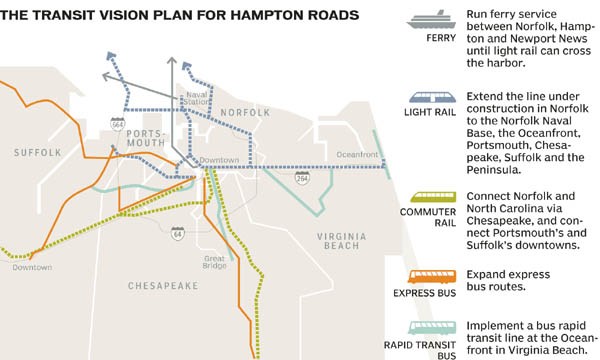
Norfolk Officially Enters Transit Space Race

Sure they don't have funding but they are building their first line and have big plans for a regional transit network chock full of commuter rail, light rail, express buses and more. That's right Norfolk Virginia, the 34th largest metropolitan area by population just ahead of Charlotte, Providence, Milwaukee and Austin.

It looks like about 4 light rail extensions would be planned and commuter rail that would stretch to Richmond. The thought that they would shift monies to transit away from highway projects would be huge as well. It looks as if regions are starting to figure it out.

Robert Case, a transportation engineer who manages the study for the Hampton Roads Metropolitan Planning Organization, said there is growing political interest in shifting resources from highway projects to transit. He said such a shift would be a "sea change" and would require changes in land use and funding priorities.

The plan calls for creating higher-density and mixed-use development patterns in some areas to support an expanded transit network.

Thursday, February 12, 2009

Whither Dubai

Since the workers and money are leaving in droves, I wonder if this means that the Alstom APS light rail system and subway will be put on hold soon.

Elizabeth Avenue

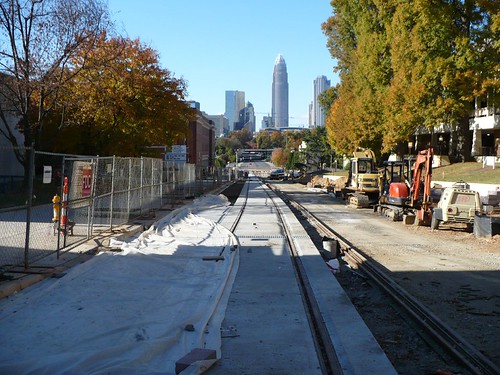
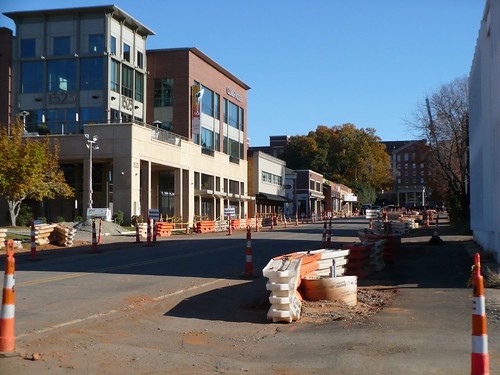
Elizabeth Avenue in Charlotte is getting reconstructed. Instead of ripping it up again later for the streetcar, they are putting in the tracks now. It cost $5 million extra to do it but it's well worth it. Today they are done with the first section of the street, and the businesses are worried because the second section will affect them but they understand that once its done, they'll be better off.

P1010549

P1010564

P1010547

P1010573

P1010589