My favorite comment, "We all, collectively and for the most part unwittingly, agreed to approve and finance that funding package." We only seem to complain when gas prices get a little higher.So if we consider that, in 2005, the most recent year for which I have stats at arm’s length, Bay Area motorists drove nearly 58 billion miles, at AAA’s average U.S. operating cost of 52 cents a mile, that’s $30.2 billion to add to our transportation funding formula, and that still doesn’t include the purchase price of new cars.
That’s like a once-in-a-generation statewide transportation bond measure, but just for the Bay Area. We all, collectively and for the most part unwittingly, agreed to approve and finance that funding package.
So here’s the new math: $3 billion a year for transit, including fares paid by individual commuters, and $31.9 billion a year for the streets, roads and vehicles that operate upon them. That would be 8.5 percent of the Bay Area’s transportation spending.
Friday, January 25, 2008
Calculating the Taxpayer's Real Expense
There is a discussion going on over at the Capricious Commuter about transportation funding resources. It was mentioned in a comment on a previous entry that 63% of the area's resources are going to transit when it only carries a limited amount of trips. But CC sets us straight by trying to calculate how much we spend all together on transit versus cars, not even counting all the parking garages.

Thursday, January 24, 2008
Central Corridor Issues
I often wonder if the Twin Cities is ever going to get its act together on the Central Corridor. I think Governor Pawlenty is part of the problem by not getting funding for the project earlier, and now holding out. He's acting a bit like the FTA with the Dulles Rail line or Arnold with High Speed Rail. All wanting to hold it back until it dies.
Wednesday, January 23, 2008
Property Rights, Transit , and Urban Design
Property rights activists in Denver are fighting hard to curtail the eminent domain abilities of the Regional Transit District. While I do personally believe that the government shouldn't be able to just take your property and redevelop it at random, I also believe that there are certain urban design considerations that should be allowed when land must be taken for transit. At issue here is what happens after RTD takes land and builds a parking garage which is an allowed transit use. The second part is the ability to wrap that parking garage with retail which is what property owners do not want their land taken for, what they call economic development. This taking for economic development was the subject of the recent supreme court case Kelo vs City of New London.
Now this is a very thin line drawn in the sand, but what is the difference between pure economic development and good urban design? I don't think RTD is trying to take the property to build a casino or shopping mall. I do think they should be able to do as much with the land as they can to make it pedestrian friendly and a part of the surrounding neighborhood. No one wants a hulking parking garage on their street face or as a next door neighbor and RTD should be doing as much as it can to get a return on their investment, which in transit is ridership and revenue.
In order to get a return on investment, they need to create an environment that supports transit usage from modes other than the automobile and trip reductions.
In my dream world I wish that transit authorities had real estate departments that could buy up key pieces of land at fair market price (not through eminent domain) and lease them after the line is built when value has been created. I've actually wondered at times if a non-profit entity could be set up that raises money for the transit agency's capital projects. At one time the way streetcar companies made money off of land was by building lines to it. In Hong Kong and Japan, the rail lines make money off of developing property more than operating the trains, but they operate in a symbiotic way generating ridership and demand as well as an efficient means of transport.
I'm not sure how this is going to end up, and I'm not sure how you can legislate the difference between economic development and proper urban design issues, but there must be some way to strike a balance between ugly and nothing.
Now this is a very thin line drawn in the sand, but what is the difference between pure economic development and good urban design? I don't think RTD is trying to take the property to build a casino or shopping mall. I do think they should be able to do as much with the land as they can to make it pedestrian friendly and a part of the surrounding neighborhood. No one wants a hulking parking garage on their street face or as a next door neighbor and RTD should be doing as much as it can to get a return on their investment, which in transit is ridership and revenue.
In order to get a return on investment, they need to create an environment that supports transit usage from modes other than the automobile and trip reductions.
In my dream world I wish that transit authorities had real estate departments that could buy up key pieces of land at fair market price (not through eminent domain) and lease them after the line is built when value has been created. I've actually wondered at times if a non-profit entity could be set up that raises money for the transit agency's capital projects. At one time the way streetcar companies made money off of land was by building lines to it. In Hong Kong and Japan, the rail lines make money off of developing property more than operating the trains, but they operate in a symbiotic way generating ridership and demand as well as an efficient means of transport.
I'm not sure how this is going to end up, and I'm not sure how you can legislate the difference between economic development and proper urban design issues, but there must be some way to strike a balance between ugly and nothing.
Tuesday, January 22, 2008
LRT Vehicle Design Elements
There have been many discussions recently about light rail but not much about vehicle design. Well there are a number of elements that make a tram attractive to passengers, not just from a visual standpoint, but also from a physical comfort standpoint.
Visual Appearance:
Whether its a Porche designed tram from Skoda to one of the older PCC's that used to run in most american cities, appearance has mattered a great deal to patrons. Recently tram designs have gone from functional designs that served tram companies from the 50s, 60s, and 70s to the more stylish models that are seen today. Some will say that today's designs aren't as classic. Below are a few examples.
The Trams in Prague are functional and to those who ride them familiar. Many of you know my favorite below, the Siemens Combino Supra "Caterpillar". It's a bit boxy but others such as the Siemens SD70 Avanto used in San Diego, Charlotte, and Houston are much more streamlined.
Seats:
Now some don't think this is very important, but there are a few who push the need for soft seats every chance they get. It's important to be comfortable, especially as Light Rail travels further out of the city and people need to sit longer. I noticed that seats in Denver had nice cushions while the Muni LRVs here have hard seats that I wouldn't want to sit on for very long and don't. I usually stand, but its not uncomfortable for the few minutes I'm on. The PCC seats remind me of school bus rides in 9th grade. They aren't super plush but they aren't uncomfortable either.
 Flickr photo of Muni Metro Seats by Digiyesica.
 Flickr Photo of PCC Seats by Jef Poskanzer.
Complaints about trams aren't just for folks in the United States. A blogger in Prague has been complaining and for some of the commenters, it seems a bit like sour grapes. There is also a facebook group against the new trams as well which my dad happened to take a photo of this fall in Prague.

Accessibility:
This is a major issue and drives a lot of decisions in planning for new light rail lines, streetcars and tramways. Buses, even low floor, have ramps that can be flipped up and down. Many light rail vehicles have level boarding which means they pull up next to the platform and there is no need for a ramp or bridge plate. This makes the train more accessible, especially since in trains, wheelchairs don't need to be strapped in with belts as they do in buses.
 Flickr photo of Level Boarding in Seattle. Photo by Bejan.
 Portland Streetcar Bridge Plate. Photo by the City of Albuquerque.
This brings up another important consideration of LRV design which is aisle width. Moving around inside of the vehicle is important. A currently cited issue with many BRT vehicles is that the aisles where the wheel wells are very narrow. Light rail of the low floor variety is rather wide in the center.
 Flickr Photo NJ Transit LRV Interior. Photo by Manish Karnik.
All of these things are important. Depending on the length of the trip, some are more important than others. More standing room in streetcars is better because there are lots of ons and offs while LRVs need more seats for longer distance passengers. And then there is the future. What will future designs bring? I've only covered a few of the most discussed elements but does anyone have more of what they look for in a LRV?
Visual Appearance:
Whether its a Porche designed tram from Skoda to one of the older PCC's that used to run in most american cities, appearance has mattered a great deal to patrons. Recently tram designs have gone from functional designs that served tram companies from the 50s, 60s, and 70s to the more stylish models that are seen today. Some will say that today's designs aren't as classic. Below are a few examples.
The Trams in Prague are functional and to those who ride them familiar. Many of you know my favorite below, the Siemens Combino Supra "Caterpillar". It's a bit boxy but others such as the Siemens SD70 Avanto used in San Diego, Charlotte, and Houston are much more streamlined.
Seats:
Now some don't think this is very important, but there are a few who push the need for soft seats every chance they get. It's important to be comfortable, especially as Light Rail travels further out of the city and people need to sit longer. I noticed that seats in Denver had nice cushions while the Muni LRVs here have hard seats that I wouldn't want to sit on for very long and don't. I usually stand, but its not uncomfortable for the few minutes I'm on. The PCC seats remind me of school bus rides in 9th grade. They aren't super plush but they aren't uncomfortable either.
 Flickr photo of Muni Metro Seats by Digiyesica.
 Flickr Photo of PCC Seats by Jef Poskanzer.
Complaints about trams aren't just for folks in the United States. A blogger in Prague has been complaining and for some of the commenters, it seems a bit like sour grapes. There is also a facebook group against the new trams as well which my dad happened to take a photo of this fall in Prague.
Accessibility:
This is a major issue and drives a lot of decisions in planning for new light rail lines, streetcars and tramways. Buses, even low floor, have ramps that can be flipped up and down. Many light rail vehicles have level boarding which means they pull up next to the platform and there is no need for a ramp or bridge plate. This makes the train more accessible, especially since in trains, wheelchairs don't need to be strapped in with belts as they do in buses.
 Flickr photo of Level Boarding in Seattle. Photo by Bejan.
 Portland Streetcar Bridge Plate. Photo by the City of Albuquerque.
This brings up another important consideration of LRV design which is aisle width. Moving around inside of the vehicle is important. A currently cited issue with many BRT vehicles is that the aisles where the wheel wells are very narrow. Light rail of the low floor variety is rather wide in the center.
 Flickr Photo NJ Transit LRV Interior. Photo by Manish Karnik.
All of these things are important. Depending on the length of the trip, some are more important than others. More standing room in streetcars is better because there are lots of ons and offs while LRVs need more seats for longer distance passengers. And then there is the future. What will future designs bring? I've only covered a few of the most discussed elements but does anyone have more of what they look for in a LRV?
Monday, January 21, 2008
"...They Wasted Everyone's Time and Money"
Update: I wrote this post last week and this morning right after posting, there is an article in the Washington Post about Mary Peters Ideology when it comes to transit and investment in infrastructure. You can find it here.
In the Washington Post there was an article which discussed that even though the Dulles Airport Extension to Metro has gone through all of the hoops that the FTA has set up for it, it might still not get funded. Why? Because the Bushies don't like rail transit. In fact they don't like it so much that they are willing to kill it because of a famous road project that cost way more than it was supposed to and still hasn't delivered on its environmental offsets; The Big Dig.
But basically the DOT is waging an ideological battle. And so far, as Ryan states at The Bellows quite succinctly, "...they wasted everyone's time and money".
This comes just a few days after the release of a National Surface Transportation Commission Report panned by DOT Secretary Mary "Bikes Aren't Transportation" Peters where the dissenting side led by the Secretary claimed falsely that there were not enough cost-effective rail projects to spend money on. Looks like there is a project in DC that needs some money and has merit. And there are more like it such as the Subway to the Sea in Los Angeles.
But in addition, there have been rumors floating around that certain pieces of that report pertaining to light rail and electric transit were approved by the commission but taken out mysteriously before the final printing. When learning about pro-rail segments being taken out of the report, Commissioner,Staunch Conservative, and rail advocate Paul Weyrich stated,
In the Washington Post there was an article which discussed that even though the Dulles Airport Extension to Metro has gone through all of the hoops that the FTA has set up for it, it might still not get funded. Why? Because the Bushies don't like rail transit. In fact they don't like it so much that they are willing to kill it because of a famous road project that cost way more than it was supposed to and still hasn't delivered on its environmental offsets; The Big Dig.
Federal officials remain skeptical of the plan to extend Metrorail to Dulles International Airport and might reject it, even though their consultants recently found that the proposal meets requirements for full funding, government and project sources said.And what is this comment about moving away from infrastructure as Quade points out? Surely that can't be true? Why didn't they say the same thing about three other projects in the New Starts pipeline that have big budgets? Seattle's line to the University($1.6 Billion), New Jersey's Access to the Core ($7.3 Billion), and the Long Island East Side Access Project ($2.6 Billion). But the Dulles project is about $2.06 Billion. So what's the rub? Why pick on this project? This screams a basic ideological bias. But tell us something we didn't know right? Congressional backers of the project even stated to the Post:
Officials with the Federal Transit Administration say they are concerned about the price tag and the specter of another Big Dig, the Boston project built by the same contractor in charge of the Dulles rail line, which took years longer and cost millions more than planned, according to the sources, who spoke on the condition of anonymity because the negotiations are sensitive. In addition, the agency has been reluctant to promote large-scale transit projects.
Officials on Capitol Hill, in Richmond and at the airports authority's headquarters have speculated in recent days about what the problem might be. Some say the FTA has long been skeptical of expensive rail projects; in recent years, it has more often championed bus rapid transit projects.Bingo. There has been no recent evidence to be against big rail projects. In fact does anyone know of a big rail project that hasn't delivered recently? I know the Silver Line BRT in Boston hasn't delivered on promises and locals call it the Silver Lie but light rail projects in Denver, Houston, Charlotte, Minneapolis and St. Louis have delivered, all of them far exceeding ridership projections.
But basically the DOT is waging an ideological battle. And so far, as Ryan states at The Bellows quite succinctly, "...they wasted everyone's time and money".
As the linked Post piece makes clear, it’s not the Silver Line’s specifics that are the issue, it’s an ideological opposition to big new transit lines. I think that’s dumb, but I think it’s even more dumb to nonetheless pretend that normal operating rules apply with regard to consideration of big new transit lines only to back out for ideological reasons after all the planning has been done and construction is underway. At any moment during this process, the feds could have said, we’re not going to go ahead with this money, because we don’t like new heavy rail lines. Instead, they wasted everyone’s time and money.
This comes just a few days after the release of a National Surface Transportation Commission Report panned by DOT Secretary Mary "Bikes Aren't Transportation" Peters where the dissenting side led by the Secretary claimed falsely that there were not enough cost-effective rail projects to spend money on. Looks like there is a project in DC that needs some money and has merit. And there are more like it such as the Subway to the Sea in Los Angeles.
But in addition, there have been rumors floating around that certain pieces of that report pertaining to light rail and electric transit were approved by the commission but taken out mysteriously before the final printing. When learning about pro-rail segments being taken out of the report, Commissioner,Staunch Conservative, and rail advocate Paul Weyrich stated,
“It is disappointing that after the paragraphs indicated were passed by a nine to three vote that someone without ever asking me would see to it to do away with these important policy considerations, Weyrich said to NCI. “ It is the kind of gutter politics which make people hate their government, and Washington in general."Now we know where the battle lines are drawn. It's time for a new direction.
Sunday, January 20, 2008
Local Money for Starter Lines
There has been a lot of news lately on the federal process in Kansas City and in Houston. Kansas City is floundering and their leaders have about 10 different ideas as to what to do. Some say streetcar (please no), others say rapid streetcar or LRT (yes) and others are even calling for subways (perhaps but not likely). Aside from that, the debate is also about whether to go with federal funding or not. Some argue that it needs to be done with federal funding because then the starter line will get 50% funding (It should be 80% like freeways but that's another post). I'm going to argue that cities today should start on their own. The reason? Time and Politics.
What has time got to do with it? Everything. Because time means political will and citizen backing, time means money and time means solutions. The shorter amount of time that occurs between the start of the idea and operation of the first line, the better off the city is and the more people see tangible results.
Charlotte just opened its first light rail line and used federal funding to build it. The CATS experience serves as a warning to new transit cities who take the network view on transit expansion. When we look back at it now, it does not seem like such a long time, but the 10 years or so it took to build caused a lot of trouble and roadblocks along the way. Charlotte escaped but others have not been so lucky.
The time it took for this project to be completed led to cost overruns because of inflation and a referendum that almost stopped expansion. The Seattle streetcar (This is just a time comparison, not technology) took from idea to opening only five. The Seattle Streetcar didn't seek federal funding, didn't have to wait for the federal government to approve the process. Phoenix's Light Rail system first showed up in the federal process in 1999 and will be completed next year 2008.
But why is this important? The time it takes to build a line is not and should not be ten years. Whole interurban and street transit networks were built in 10 years at the end of the 19th century. The wait for federal funds in todays highway centric government is not worth the wait in
A. Cost
B. Political Will.
The cost issue rears its ugly head when calculating for inflation. You can't calculate that far ahead of time as to what inflation is going to bring. And you don't start buying materials until later on in the process. Charlotte saw this happen as are other projects, not just rail. And recently the Light Rail to Milwaukie in Portland has a high cost estimate, I'm guessing because the planning is keeping up with the federal timeline (Now 10 years standard). Not that this is a starter line, but its been under planning for so long, its no wonder the cost keeps getting higher.
Another issue is political will. The longer the process is, the less people who were involved at the start are likely to still be involved and 10 years in politics is eons. Charlotte was lucky to have the same Mayor and Transit Chief throughout the whole ordeal. I would say that is one of a few reasons why Austin moved to commuter rail, because they lost pro rail leaders along the way like Kirk Watson who now happens to be back as the head of CAMPO.
But not only do leaders matter, the opposition solidifies behind mistakes and as we saw in Charlotte can led to a referendum or a no vote for more funding. Salt Lake City has been the beneficiary of good news and good moves when it comes to politics. And we saw they will be rewarded with a huge 70 mile expansion and 5 new lines. This is after a starter line and very short extensions that have surpassed ridership expectations by leaps and bounds breeding confidence in the system and creating a mostly (there will always be naysayers) positive political environment.
So the time issue is important. The next issue is the expansion. Generally large cities are trying to build expansive transit networks instead of just one line. So the starter line is really just that, a start. But its an important step again because of the politics aspect. Cities such as Houston and Minneapolis are enjoying pro transit political will because of their great ridership numbers and community benefit. Minneapolis went with federal funding for the first line and is going for it again for the Central Corridor. If they keep up at this rate, they will have a transit network in 50 years with 5 lines. Remember, 50 years is the total amount of time it took to build the national federal highway system and all they are going to get through the federal process is 5 lines and maybe a city center streetcar?
Houston on the other hand, along with Salt Lake City and Denver will build 5 new lines in the next ten years. Why? Because they got political will from their starter lines and have forged ahead with local and federal funding for expansion. Salt Lake City signed a deal for the FTA to pay for 20% of their expansion after upping their sales tax for new transit while Houston will likely get 50% funding for two lines. Houston was able to build light rail on its corridors because they also got their rail bias ridership set and networked the corridors in the modeling. This means that any cities first line might be able to qualify for federal funding because its a good candidate, but it will be even better for expansions to other areas of the city which might not have as good of numbers. Cities might also be able to spend a little more money on the starter making sure everything is right instead of letting the feds take out elements that increase ridership like an extra station here and a subway segment there. The rail bias adjustment makes the extensions better able to qualify for federal funding under the cost effectiveness measure.
So if we are playing by the current rules set by the FTA and current funding levels, you can bet that cities will be waiting even longer for transit money. Especially if cities that already have starter lines are starting to ask for money for expansions making the field even more crowded than it is currently. In short, if you want it done fast and you want to build out fast, build it yourself, and come for help on a network later.
What has time got to do with it? Everything. Because time means political will and citizen backing, time means money and time means solutions. The shorter amount of time that occurs between the start of the idea and operation of the first line, the better off the city is and the more people see tangible results.
Charlotte just opened its first light rail line and used federal funding to build it. The CATS experience serves as a warning to new transit cities who take the network view on transit expansion. When we look back at it now, it does not seem like such a long time, but the 10 years or so it took to build caused a lot of trouble and roadblocks along the way. Charlotte escaped but others have not been so lucky.
The time it took for this project to be completed led to cost overruns because of inflation and a referendum that almost stopped expansion. The Seattle streetcar (This is just a time comparison, not technology) took from idea to opening only five. The Seattle Streetcar didn't seek federal funding, didn't have to wait for the federal government to approve the process. Phoenix's Light Rail system first showed up in the federal process in 1999 and will be completed next year 2008.
But why is this important? The time it takes to build a line is not and should not be ten years. Whole interurban and street transit networks were built in 10 years at the end of the 19th century. The wait for federal funds in todays highway centric government is not worth the wait in
A. Cost
B. Political Will.
The cost issue rears its ugly head when calculating for inflation. You can't calculate that far ahead of time as to what inflation is going to bring. And you don't start buying materials until later on in the process. Charlotte saw this happen as are other projects, not just rail. And recently the Light Rail to Milwaukie in Portland has a high cost estimate, I'm guessing because the planning is keeping up with the federal timeline (Now 10 years standard). Not that this is a starter line, but its been under planning for so long, its no wonder the cost keeps getting higher.
Another issue is political will. The longer the process is, the less people who were involved at the start are likely to still be involved and 10 years in politics is eons. Charlotte was lucky to have the same Mayor and Transit Chief throughout the whole ordeal. I would say that is one of a few reasons why Austin moved to commuter rail, because they lost pro rail leaders along the way like Kirk Watson who now happens to be back as the head of CAMPO.
But not only do leaders matter, the opposition solidifies behind mistakes and as we saw in Charlotte can led to a referendum or a no vote for more funding. Salt Lake City has been the beneficiary of good news and good moves when it comes to politics. And we saw they will be rewarded with a huge 70 mile expansion and 5 new lines. This is after a starter line and very short extensions that have surpassed ridership expectations by leaps and bounds breeding confidence in the system and creating a mostly (there will always be naysayers) positive political environment.
So the time issue is important. The next issue is the expansion. Generally large cities are trying to build expansive transit networks instead of just one line. So the starter line is really just that, a start. But its an important step again because of the politics aspect. Cities such as Houston and Minneapolis are enjoying pro transit political will because of their great ridership numbers and community benefit. Minneapolis went with federal funding for the first line and is going for it again for the Central Corridor. If they keep up at this rate, they will have a transit network in 50 years with 5 lines. Remember, 50 years is the total amount of time it took to build the national federal highway system and all they are going to get through the federal process is 5 lines and maybe a city center streetcar?
Houston on the other hand, along with Salt Lake City and Denver will build 5 new lines in the next ten years. Why? Because they got political will from their starter lines and have forged ahead with local and federal funding for expansion. Salt Lake City signed a deal for the FTA to pay for 20% of their expansion after upping their sales tax for new transit while Houston will likely get 50% funding for two lines. Houston was able to build light rail on its corridors because they also got their rail bias ridership set and networked the corridors in the modeling. This means that any cities first line might be able to qualify for federal funding because its a good candidate, but it will be even better for expansions to other areas of the city which might not have as good of numbers. Cities might also be able to spend a little more money on the starter making sure everything is right instead of letting the feds take out elements that increase ridership like an extra station here and a subway segment there. The rail bias adjustment makes the extensions better able to qualify for federal funding under the cost effectiveness measure.
So if we are playing by the current rules set by the FTA and current funding levels, you can bet that cities will be waiting even longer for transit money. Especially if cities that already have starter lines are starting to ask for money for expansions making the field even more crowded than it is currently. In short, if you want it done fast and you want to build out fast, build it yourself, and come for help on a network later.
Saturday, January 19, 2008
Oil Money Buys Rail Transit
The Middle Eastern boomtown of Doha, Qatar which makes a lot of money off of oil exports is looking to build 140km (87 miles) of light rail for an Olympic Bid in 2016. The bid isn't really surprising to me given that in the past Qatar has been known to just buy athletes from other countries including Kenya. It's also proof that they will do whatever it takes to get the Olympics. The construction timeline is nothing short of amazing either given they plan to get 85km done in 6 years. Again showing us up like China in getting things done.
Friday, January 18, 2008
That Sounds Kinda Expensive
The planned Milwaukie Max in Portland had its cost estimates released and it wasn't pretty if you're thinking about raw numbers. Yes $1.2 to $1.4 Billion is a lot of money but what is involved? Materials are skyrocketing and the project plans to build a transit bridge over the Willamette River (which will cost $340 million itself) that would carry the Milwaukie Max and East Side Streetcar extension along with bikes and peds.
It will also allow any further light rail expansion to the east side and create a second river crossing for light rail which would be important should one of the bridges go down in the chance of an earthquake. This is all about expanding the network as Metro Councilor Robert Liberty States.
It will also allow any further light rail expansion to the east side and create a second river crossing for light rail which would be important should one of the bridges go down in the chance of an earthquake. This is all about expanding the network as Metro Councilor Robert Liberty States.
As Liberty sees it, completing the Portland-to-Milwaukie line will keep the promise of the original system and open up new possibilities, including an extension to Oregon City and east-west connections that do not pass through downtown Portland.As I think further about this and look at the distance, even with the bridge section, 6.5+ miles at a billion dollars seems like a lot of money. It works out to around $150 million per mile (without the bridge section costs). Are they building a trench for it? Is it a subway? Especially since the Yellow Line was under budget and $60 million per mile in 2004. Folks at Portland Transport are commenting on this as well. I wonder what costs so much? Specifically after the Portland folks have gotten good at the track work after the Streetcar and Yellow Line. We really need to reign in these cost issues or new lines will never be built. I believe thats what the opposition wants, as well as our very best friends in Washington DC. Perhaps its time for the rapid streetcar but we'll figure out what is behind the costs soon.
Thursday, January 17, 2008
Seattle Action Alert!
Martin has more at Seattle Transit Blog. Save the University Link and Sound Transit.
Wednesday, January 16, 2008
When You Ride With...
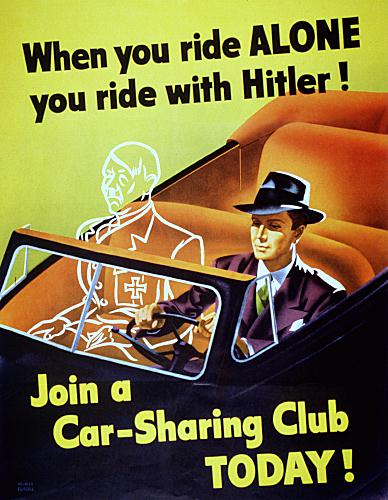
Martin over at Seattle Transit Blog has a good discussion going about how to appeal to anti-transit conservatives on issues of transit expansion. The Bill Maher book cover that he uses is taken directly from a WWII poster that promotes carsharing. 60 years ago they had carsharing yet we're just starting to pick it back up.

Subscribe to:
Posts (Atom)