
Tuesday, July 29, 2008
Budapest Trams
Get your hands on them while you can. $7,000 for the vehicle is a bargain. I bet it wouldn't take much to fix it up to code here either. So if you want a vehicle for the same cost as a bus or even less after being refurbished, take a look.

Statesman Road Block
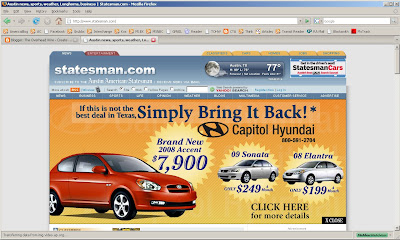
Here's the obstructionist Statesman with lots of reasons for delay, yet no solutions of their own. I bet they don't even understand why light rail is important. You know, that whole thing about changing development patterns to reduce VMT, and reducing operating costs and increasing capacity on key corridors. They'll just be happy driving their cars to work on Congress Avenue. It's important to worry about costs, but they've been saying let's wait for as long as I can remember. It's no surprise either that the front page looks like this when you type in the URL.

Honolulu Noise Machine Might Have Hit a Wall
Constant noise coming from opponents to the rail system seems like just that, noise. As with Charlotte, it seems like the opposition just has a whole lot more time to make noise and money to spend making it. Wonder where it came from.
But we find out that contrary to the noise, a big majority supports the mayor in his handling of the transit situation. It's a pretty safe bet that they are just tired of the noise and are glad someone is taking leadership on the issue.

But we find out that contrary to the noise, a big majority supports the mayor in his handling of the transit situation. It's a pretty safe bet that they are just tired of the noise and are glad someone is taking leadership on the issue.
There are people that say the poll proves the mayor is losing speed such as his opponent. However it seems like they are grasping at straws.As reported yesterday, the Star-Bulletin/KITV poll found that 60 percent of the respondents wanted the city to continue with its rail development plan, while 24 percent wanted it stopped, and the remainder either were not sure or refused to answer.
"I am finding more people from East Honolulu and from the Windward side (two areas that have not strongly supported rail) who are starting to get behind rail," Hannemann said. "They are seeing that this is about the entire island eventually being connected."

Monday, July 28, 2008
Miracle Light Rail Bill Passes
Again it's mainly symbolic but it opens up the discussion to connect Virginia Beach to Norfolk. And it gives me a good feeling about Tim Kaine on transit if he were to say be nominated for Veep. It's better than the Tomnibus bill which again shot down Metro funding.
Why Does High Standard of Living = Bigger House
Mr. Glaeser annoys me again.
If you think about the lifestyle of ordinary Americans living on the fringe of Houston or Dallas, for example, compared to what their lifestyle would be in an older European city -- living in a walk-up apartment there compared to a 2,500-square-foot house here they bought for $130,000 with a 24-minute commute -- it's extraordinary in the low-cost areas of this country what a $60,000 family income gets you.Obviously I would take the walk-up in downtown or a European suburb anytime. I feel like analysts and newspaper writers don't get it. They don't understand that big house does not equal better lifestyle for everyone. Sure there is a segment of the market that wants that. But again, there is a reason why its more expensive to live in San Francisco than other places, it provides a certain type of lifestyle you can't get in the outskirts of Dallas. How many people in Plano can walk down the street to their grocery store or the local park where a movie plays with hundreds of people watching every Wednesday?
Sunday, July 27, 2008
Sunday News Links
The Orange Line BRT estimated initial ridership on a hunch. Models drive me crazy, but this seems a bit nuts as well. From the LA Times:
Finally comes a blog post from Bill Fulton's blog. Seems that Starbucks has bucked the trend of picking the 100% corner and instead is concentrating more on auto orientation in Redding. Really? Seems a bit strange to me at this time that they would want someone to get in their car making them think about gas to go buy an expensive cup of coffee. But the poster makes a good point that its partly the citizens that are to blame.
MTA officials denied that they lowballed Orange Line ridership predictions but conceded that their forecasts might be more art than science. "We didn't put it into a computer model," said Rod Goldman, the MTA's deputy executive officer for service development. "A lot of it was our educated guesswork based on our experience."Charlotte's mixed use market is doing better than single family homes. Seems to me like this might be from lack of supply over the years. Complaints of expense just prove this point. From the Charlotte Observer:
“There's an immediate crisis feeling about the price of gas, but there's also a different living preference now,” said Laura Harmon, economic development program manager for the Charlotte-Mecklenburg Planning Commission. “Those of us who might be baby boomers didn't have those options. But now the millennials and so forth are wanting to live differently.”As noted in the guest post by J.M. it will be interesting to see how Norfolk's light rail line comes out. But while they were pushing forward, their sister city rejected the idea. Now the local paper thinks its time to get back on the train.
Finally comes a blog post from Bill Fulton's blog. Seems that Starbucks has bucked the trend of picking the 100% corner and instead is concentrating more on auto orientation in Redding. Really? Seems a bit strange to me at this time that they would want someone to get in their car making them think about gas to go buy an expensive cup of coffee. But the poster makes a good point that its partly the citizens that are to blame.
The Starbucks with a drive-through window at the edge of downtown? That one stays. So does the Starbucks at the other end of downtown inside of Safeway. But the coffee house at the most visible corner in downtown? The store that was supposed to anchor a cornerstone redevelopment project? It’s closing.
...
Ultimate responsibility, though, lies with the community. Redding is a town where people rush to the newest franchise restaurant. Earlier this year, they lined up overnight for the opening of a Chipotle in a rebuilt strip center. Seriously. It’s a town where Wal-Mart, Costco, Target and Home Depot have big boxes within walking distance of each other – although you’d take your life in your hands trying to make the trip on foot.In other words, most people who live in Redding don’t care about having a vibrant downtown full of local flavor. And no one – including an urban planning journalist who thinks he knows better – can make them care.
A Car in Every Garage 2.0
That's the plan an "eco-town" in the UK has put forward. In trying to sell the house, the developers are going to toss in a hybrid car and a bike with the purchase. If that means that home owners go from two diesel/gasoline to one hybrid I don't think its such a bad upgrade as long as the town is walkable and bikable enough to reduce VMT that way. The developers are going to upgrade rail links but that would be for not if there are three cars in every garage, which I'm afraid could be the end result.
Saturday, July 26, 2008
Public Transportation in Advertising
My dad sent me a Shell ad from The Economist a few weeks ago. He thought it was good that they mentioned the importance of urban planning and public transport. My guess is that this was from the Shell International Office in Den Haag. It is a dutch company. I wish they would say this a little louder here, perhaps in newspapers and TV advertisements.

You can find the full text here at the Shell site.
(Full disclosure: My dad worked for shell for over 30 years before retiring.)
The United Nations predicts that half the world’s population will live in urban areas by the end of 2008 and about 70% will be city dwellers by 2050. There are expected to be more than 27 ‘mega-cities’ - each with more than 10 million people - by 2050.
More crowded cities means more fumes, more noise and more smog. So what to do?
At Shell, we believe the solution is a combination of cleaner fuels, cleaner engines, better public transport and better urban planning. We are doing our best with fuel improvements.

You can find the full text here at the Shell site.
(Full disclosure: My dad worked for shell for over 30 years before retiring.)
Cost Effectiveness Disconnect
It was mentioned in an email exchange about this article on the Pro Bus NIMBYs in Chevy Chase that just because you have a cheap project that the federal government will fund, doesn't mean that it is more cost effective. It just means that you'll get more federal money. Everyone knows about the FTA's magic computer that determines the CEI. From a January 31st article in the Pioneer Press that was archived and under a paywall.
There's a high-end computer outside of Washington, D.C., that takes all night to calculate a single fraction. Each morning, it e-mails the result of its toils -- a number rounded to the nearest hundredth -- to Mark Fuhrmann and his staff in St. Paul. And in that e-mail lies the fate of the proposed Central Corridor light-rail line connecting St. Paul and Minneapolis.
HUD + FTA (Could =) FTHA
Ryan has a post up discussing the idea of reorganization or mission change at HUD. I completely agree with him that transportation and housing go together making people's lives more affordable to live and should be considered as the strategy for addressing affordability. But what would this combination look like? The silos in Washington are pretty strong unless they are pushed a little harder . In fact, the FTA and HUD had never worked together on a project until a report done in 2006-7 on affordable housing and transit strategies.
But perhaps a way to break down the silo is to combine the two organizations. A possible model for such a relationship can be seen in Charlotte. Unlike most other cities around the country, the county and city are the same entity and the transit agency is under their umbrella with city planning, housing etc. In many other cities, the transit agency is outside of the umbrella of all other organizations which makes agency coordination much harder. The rezoning. development, and construction of the south corridor light rail line shows the power of coordination It also helps that Mecklenburg County is so big that it encompasses a great portion of the region.
Another issue is kind of the elephant in the room called DOT. The FHWA builds highways and doesn't really coordinate land use, which is unfortunate because they are likely the largest driver of new housing placement with their locational building decisions. A way to address this could be to pull the DOT and HUD along with other related agencies into an Urbanism or livability working group. Or even more strength would be achieved through a cabinet position of Urbanism that dealt with transportation, land use, poverty and other related issues.
It's a thought but we really need to start considering how to get agencies that work against each other in policy decisions to work together to aid in the greater affordability of living in the United States. Location efficiency such as is available in major cities and downtowns shouldn't be limited because transportation options aren't available just like programs like hope IV shouldn't negate gains in affordablity by locating somewhere auto dependent.
But perhaps a way to break down the silo is to combine the two organizations. A possible model for such a relationship can be seen in Charlotte. Unlike most other cities around the country, the county and city are the same entity and the transit agency is under their umbrella with city planning, housing etc. In many other cities, the transit agency is outside of the umbrella of all other organizations which makes agency coordination much harder. The rezoning. development, and construction of the south corridor light rail line shows the power of coordination It also helps that Mecklenburg County is so big that it encompasses a great portion of the region.
Another issue is kind of the elephant in the room called DOT. The FHWA builds highways and doesn't really coordinate land use, which is unfortunate because they are likely the largest driver of new housing placement with their locational building decisions. A way to address this could be to pull the DOT and HUD along with other related agencies into an Urbanism or livability working group. Or even more strength would be achieved through a cabinet position of Urbanism that dealt with transportation, land use, poverty and other related issues.
It's a thought but we really need to start considering how to get agencies that work against each other in policy decisions to work together to aid in the greater affordability of living in the United States. Location efficiency such as is available in major cities and downtowns shouldn't be limited because transportation options aren't available just like programs like hope IV shouldn't negate gains in affordablity by locating somewhere auto dependent.
Subscribe to:
Posts (Atom)