I've seen a lot of people hit hurdles. It's tough every time. Probably the worst was Steve Slattery at the Big 12 Championships in 2002. He did a windmill flip over a steeple hurdle after hitting his shin. Looked like it hurt, but he got up and kept running.
My heart goes out to Lolo Jones. She was ahead and on her way to gold when she hit a hurdle. We all hit hurdles, usually of a different type. But I always hope that when we do, we come out stronger, tougher, just as she has shown she will. A true champion. (Video here)
Wednesday, August 20, 2008

Tuesday, August 19, 2008
Subways Could Have Been
Eric at Transbay Blog has an interesting post on the subways of San Francisco's past, built and still unbuilt.
Share the Tracks
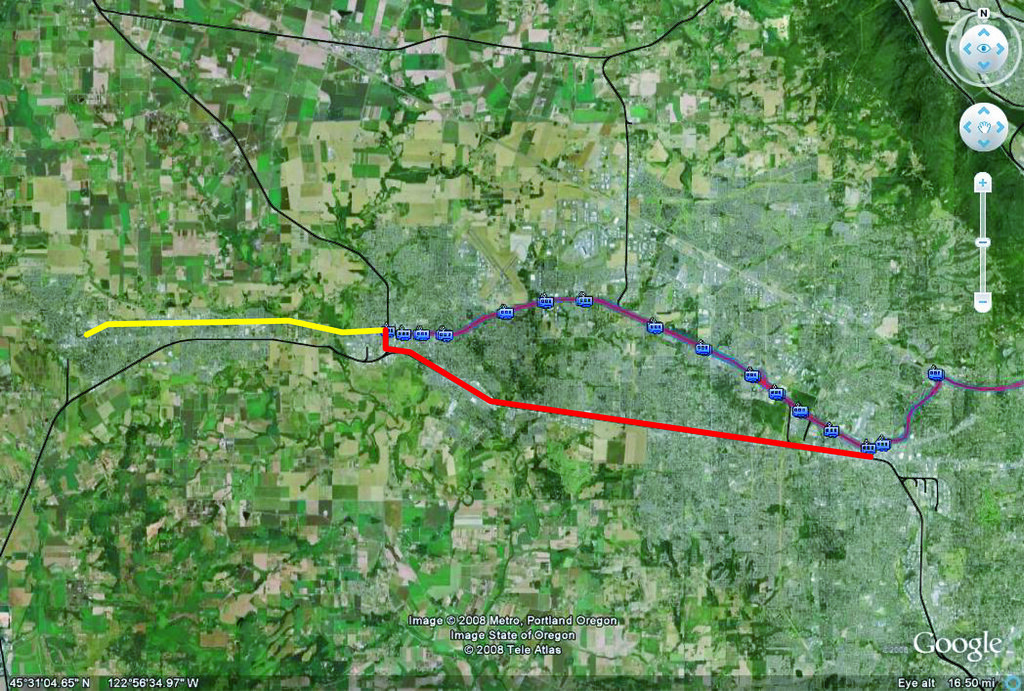
An interesting proposal in Portland that would be pretty inexpensive introduction of Commuter Rail:

A representative for Portland & Western Railroad approached local leaders about the idea this summer. Larry Harvey, a senior consultant with PacWest Communications, said the railroad's line just north of Oregon 8 is deteriorating.
Without an upgrade, it will no longer be able serve the five or so companies now using it for freight, he said, forcing them to relocate or start contracting with truck companies.
"Portland and Western said, 'Gee, if we committed to only running freight on that line between midnight and 4 a.m., then passenger cars could run between 6 a.m. and 7 p.m.," Harvey said.
The railroad has approached local governments about cooperating to find funding for what Portland & Western estimates would be a $30 million project, in 2008 dollars.
They will have to deal with the FRA which means they wouldn't be able to use lightweight vehicles. It is a rather short route and I wonder if they should just run the line all the way to Beaverton catching a lot of the commercial corridor left unserved by the light rail line (represented by the red extension to the yellow).
Merry Peters! Houston Edition
Instead of Merry Christmas or Happy Birthday, It's Merry Peters! In this edition, Houston was really excited to have her come down this morning to give a major speech. My assumption as perhaps was others is that she was going to fund the two light rail lines now in preliminary engineering or perhaps move them to final design. From the Houston Chronicle two days ago:
But yet again she doesn't tell the truth about what is really happening in Washington, with the DOT trying to steal from the transit fund to pay for roads and last year trying to allow HOT lanes to be funded by the New Starts transit program. Here's her most recent tall tale:
Forbes actually described it correctly with their headline. "Bush administration pushing new roads." It has a money quote from the Secretary as well that shows her true intentions, as she mentioned earlier this year. Bikes and alternative transport are not transportation:
Well those hopes were unfounded as Secretary Peters came to hock her hopes for a privatization heavy transportation policy. Touting her metro mobility program, she stated that new systems like Houston's Light Rail could be funded through her new program. But with the funds somewhat open ended, many feel like its a back door gift for road builders and could be a blow to the livability movement in regions where DOTs are basically highway departments."We wouldn't be coming there to announce bad news," said the spokeswoman, declining to elaborate.
The site of Peters' announcement will be the northern end of the Metropolitan Transit Authority's Red Line light rail tracks. Metro's planned North Line would link to them and continue to Northline Mall. Metro is seeking federal funding for half the cost of the North Line and the planned Southeast Line, which would cross the Red Line at Main and continue through southeast Houston to Palm Center.
Metro also wants federal funding for an Intermodal Terminal just north of UH-Downtown where buses, light rail and commuter rail trains would converge. Metro spokeswoman Raequel Roberts said she she does not know what Peters will announce.
But yet again she doesn't tell the truth about what is really happening in Washington, with the DOT trying to steal from the transit fund to pay for roads and last year trying to allow HOT lanes to be funded by the New Starts transit program. Here's her most recent tall tale:
"The bottom line is that our current approach to transportation discourages, actively discourages instead of encourages the type of innovative approaches to financing and building like the north transit corridor that Houston needs to keep its residents moving," said Peters earlier today.The current approach to transportation is YOUR approach Ms Peters. You're in control of how things work, yet you keep pushing towards faux BRT and more privately funded roads. You wanted to make it harder to build beneficial rail projects because you don't understand the benefits to cities. The benefits to people, not cars. Don't give us this crap about who discourages innovative transport when its you. You're in the way. Portland is looking at innovative ways to fund the east side streetcar with developers but you won't allow it to complete the process.
Forbes actually described it correctly with their headline. "Bush administration pushing new roads." It has a money quote from the Secretary as well that shows her true intentions, as she mentioned earlier this year. Bikes and alternative transport are not transportation:
"Under our approach, communities will no longer have to slice and dice every federal dollar to qualify for niche programs that do little to improve their communities or commutes," Peters said. "Instead, projects that make sense for commuters get funded, while projects designed only to help politicians won't."Niche programs like the New Starts Program? Niche Program like safe routes to school? How about programs that promote cycling? The problem with this is the sole focus on the commute. Improving communities does not mean speeding up traffic on roads or creating new concrete for cars that are the main part of our national energy addiction. I'm so tired of this BS. Just say what you really mean Mary. Tell us how you really feel. You and your friends hate cities. Speeding up the commute is just code for building freeways through them. I can't wait for November.
Monday, August 18, 2008
Blog Credentials Available at Rail~Volution Conference
Hey Transit, TOD, and Livability Bloggers. We've arranged to have bloggers get press credentials at Rail~Volution this year to cover the event. It's in San Francisco so it should be a good time had by all and very informative. Take a look at this years info.
Here is what Rail~Volution is all about...
If you're not a blogger, but a transit or community activist, there are scholarships available for folks in the Bay Area and outside of the Bay Area. You'll have to apply soon but if you're interested in coming please fill one out.
Spread the word...
Here is what Rail~Volution is all about...
Rail~Volution is, first and foremost, a conference for passionate practitioners - people from all perspectives who believe strongly in the role of land use and transit as equal partners in the quest for greater livability and greater communities.So if you want to blog on the conference you can apply here.
If you're not a blogger, but a transit or community activist, there are scholarships available for folks in the Bay Area and outside of the Bay Area. You'll have to apply soon but if you're interested in coming please fill one out.
Spread the word...
Roads Unpaid For
I often wonder why there is a double standard. Many critics of the Portland Streetcar point to its success as a function of subsidies for developers. There are some projects in the Pearl that have gotten tax breaks, but let's remember that Homer Williams didn't have to upzone his property from 15 units per acre to over 100. 30% affordable housing and parks were also provided. So while there were breaks, there have also been benefits.
But on the other side, there are roads that are built into no-where because of expected future demand. There are very few cars traveling there at the time, but its expected to grow. So why the double standard? Why say that building a rail line to support future density is worthless while turning your head when a road is built to support future sprawl. One is enabling infrastructure waste and the other efficient development. Especially at a time with increasing energy costs and a need for alternatives.
The blog bleeding heartland covers a local example of this in Iowa.
But on the other side, there are roads that are built into no-where because of expected future demand. There are very few cars traveling there at the time, but its expected to grow. So why the double standard? Why say that building a rail line to support future density is worthless while turning your head when a road is built to support future sprawl. One is enabling infrastructure waste and the other efficient development. Especially at a time with increasing energy costs and a need for alternatives.
The blog bleeding heartland covers a local example of this in Iowa.
On a related note, this past Saturday 1000 Friends of Iowa organized a "tour de sprawl" in northern Polk County as part of its annual meeting. The bus tour took us through several areas in the corridor being considered for a four-lane beltway in northeast Polk County.
It is incredible to realize that Congressman Leonard Boswell will be seeking hundreds of millions of dollars in federal funding for this road project. A very small number of people would benefit (primarily developers who are buying up farmland near the beltway's path).
Meanwhile, valuable farmland could be lost and irreplaceable natural areas such as the Moeckley Prairie could be threatened.
The opportunity cost of spending hundreds of millions on a new road heading north from Altoona and then east to I-35 would be enormous. Traffic flows do not justify this project through sparsely-populated rural areas, especially when gasoline is expensive and many Americans are seeking alternatives to driving.
Olympics Update! Track is Back! (Spoiler Warning)
After a dismal day on Saturday where my buddy Leo got DFL in his qualifying heat of the 1500 and the Jamaicans destroyed us in the sprints, we came back Sunday with a vengeance going 1-2-3 in the 400 hurdles. The Marathon is going to be a good one with super whiz kids Ryan Hall and Dathan Ritzenhein.
Sunday, August 17, 2008
A National Expansion Strategy
Since the FTA and the federal government are always looking at ways to judge projects based on how they fit into a national strategy, it might be good to think about funding transit in this way. Not because we want to be forced into the frame of the FTA, but rather it might get more interest and importance if it ties into a national strategy. Much like the 1950 federal defense highway system, this could be the national defense transit network.
The idea is that if you hop on a plane and go to Columbus, you can get to the major destinations within Columbus and then hop on a train to Pittsburgh or Cleveland and get around in those places without a car. It seems to me that if you made it easy for people from outside of the city to operate without a car, it would make it easier to operate inside of the city.
There are two components, good metro networks and good city high/moderate speed networks. The larger network should connect cities together that are larger but probably don't get as good of airplane service and major cities that generate a lot of short flight trips. The smaller networks should connect, as said before, the major destinations in a region. For example, Denver's transit network is connecting the Federal Center, the Tech Center, Downtown, and Boulder together with transit. To me, making all of these connections should make it easier for creating transit villages where people can walk or bike for many of their trips and make intercity travel easier as well.

The idea is that if you hop on a plane and go to Columbus, you can get to the major destinations within Columbus and then hop on a train to Pittsburgh or Cleveland and get around in those places without a car. It seems to me that if you made it easy for people from outside of the city to operate without a car, it would make it easier to operate inside of the city.
There are two components, good metro networks and good city high/moderate speed networks. The larger network should connect cities together that are larger but probably don't get as good of airplane service and major cities that generate a lot of short flight trips. The smaller networks should connect, as said before, the major destinations in a region. For example, Denver's transit network is connecting the Federal Center, the Tech Center, Downtown, and Boulder together with transit. To me, making all of these connections should make it easier for creating transit villages where people can walk or bike for many of their trips and make intercity travel easier as well.

Saturday, August 16, 2008
NYT Streetcar Article Makes Impression
After articles in the Wall Street Journal and USA Today about streetcars didn't generate a lot of buzz, the NY Times article rocketed up to the 3rd most emailed article on NYTimes.com at one point yesterday. This was brought to my attention by Frank over at Orphan Road.
But in the last few days, that one article set off a flurry of streetcar articles around the country.
Los Angeles - Downtown business organization sets up Streetcar Non Profit.
An investment blog, Common Census, has an interest in the investment opportunities around streetcars. This is the first time I've seen this outside of the transit blogosphere.
But in the last few days, that one article set off a flurry of streetcar articles around the country.
Los Angeles - Downtown business organization sets up Streetcar Non Profit.
Over its first eighteen months, LA Streetcar, Inc., would look to raise just under $400,000. The money would be used to advocate and coordinate the streetcar effort.Pasadena - An editorial in the town paper on beginning to consider streetcars
And the thing about such momentum is that streetcar building is so much simpler than other kinds of transit, with tracks that don't require deep digging, that city blocks are just closed down to auto traffic for a few weeks. And Seattle's line was up and running in December of last year just four years from the time it was conceived. That's unheard of in the transit world.Minneapolis - The city has a streetcar network plan, they look towards Seattle and Portland for ideas. Also check out this "new to me" blog Twin Cities Streets for People.
An investment blog, Common Census, has an interest in the investment opportunities around streetcars. This is the first time I've seen this outside of the transit blogosphere.
As major cities look to build new streetcar systems and extend additional lines, investors should be aware of the potential opportunities these new public transportation lines could bring.Treehugger makes the point about dedicated right of ways and calls Randall O'Toole full of %$!*
I would politely suggest that Mr. O'Toole is full of crap- I live in a streetcar city and the lines do not all go downtown, they do connect with the subway which does, but are used to go in all directions by all kinds of people. Drivers hate them (they are hard to pass and definitely slow down automobile traffic) but riders love them. When dedicated rights-of-way go in, they become fast, dependable and have huge capacity.The Chronicle of Higher Education makes the case that streetcars and transit in general are good for student populations and school coffers.
And while streetcars can save hundreds of dollars a year in commuting costs for students and others, the lines save millions for universities that would otherwise have far more serious parking problems — and many more costly garages and space-hogging lots.
Subscribe to:
Posts (Atom)