Friday, September 19, 2008
Park(ing) Day + Speak Like a Pirate Day
Check out Streetsblog for awesome photos of Park(ing) day. I would have taken some here in SF but I forgot my camera. Arrr. Which reminds me, it's also talk like a pirate day.

Radio Killed the Railroad Star
In Milwaukee the meme is beginning to form that conservative talk radio killed transit and should be tied to its failure to emerge. I've seen it a number times in the last few days in the JS. Our friend Jim Rowan gives us the history of how transit was killed in an article he wrote for the Journal Sentinel.
Examples of the meme recently:
Jim Rowen:
Examples of the meme recently:
Jim Rowen:
And "light rail" was and continues to be aimed as a partisan, fear-laden phrase against Milwaukee and its urban, Democratic majority on conservative talk radio and in some Republican-dominated suburbs.Mayor Barrett:
"I think it's driven by conservative talk radio," Barrett said. "There are many people who are suffering because of ideological opposition to rail. ... If you listen to conservative talk radio, you'd think having some sort of rail in Milwaukee is the end of Western civilization as we know it."Letter to the Editor:
Maybe the service cuts down the road will wake people up. The year 2010 promises a 30% cut in bus service and elimination of the freeway flyer service. The proposed 1% sales tax is the most feasible answer to saving our bus system. The Milwaukee County Transit System is the only system of its size that totally relies on property tax. A sales tax increase would be paid not only by county residents but anybody who visits Milwaukee County. We are not in the hell-hole talk radio talks about.
Lobby or Chalk
A recent article in St. Louis discusses the want to expand the highly successful Metrolink System. People want it, but the money for expansion has been scarce, especially from the Feds.
Yes the feds could help out a lot more than they are and they should (This means you congress, not just the FTA). They should be at the forefront of a national transit movement, especially now. And I honestly don't see how with a wonderful system like Metro in Washington people still can't see the benefits of capital transit investments. They must be rather blind. But we must get more money out of the MPO and somehow fix it so that regions stop spending on the periphery and start spending in the core.
And that money, at least historically for big transit projects, comes from familiar coffers: the federal government, which supplied the bulk of funding for previous MetroLink expansions. Plesko said many blame Metro for not wanting to build in Madison County, when in reality it's the lack of federal support preventing it.I often complain about the federal process and the new starts program because Todd Plesko is right, they are awful. But so are MPOs. They have enormous power to program more money for transit and less for roads than they let on, but people have been so lopsided in focus on automobiles that if you dare take away thier highway money you're the devil.
...
Plesko said the Bush administration has severely sliced funding for light rail projects in recent years, forcing cities hungry to expand systems to lobby heavily or chalk up the cash themselves. "If you want federal funds, then you must compete for them. The current administration makes it really hard to get light rail," Plesko said.
Yes the feds could help out a lot more than they are and they should (This means you congress, not just the FTA). They should be at the forefront of a national transit movement, especially now. And I honestly don't see how with a wonderful system like Metro in Washington people still can't see the benefits of capital transit investments. They must be rather blind. But we must get more money out of the MPO and somehow fix it so that regions stop spending on the periphery and start spending in the core.
Minneapolis Bridge Opens
The bridge is back up after a year. Imagine if we were allowed to replace infrastructure that was there before that fast, you know, like streetcars. One of the craziest things to me is going through a whole environmental process to put something back that was there before. Heck, the studies sometimes cost as much as construction. There's gotta be a way to go about it faster and cheaper.
Thursday, September 18, 2008
Go PRT!
Bwahahaha!! Oh those PRT people. Hilarious.
The proposed system involves a 100 percent fare box cost recovery. Imagine: no subsidies for operation and maintenance costs.Because why build one to see if it works as advertised when we have computers!
The much-touted San Jose light (sic) rail recovers just 10 percent of its O & M costs. A.C. Transit recovers just 30 percent. BART recovers so little, it survives on a $250 million annual subsidy.The CyberTran System, already off the design boards and proven feasible in numerous computer simulations, is ultra-light and involves no grade crossings. Instead, the few intersections encountered are all safely grade-separated. Why? Speed and safety.
Documents You Shouldn't Use Against Transit
I have a problem with people using documents they don't quite understand to fight against transit they don't understand. In a recent Daily Planet article, there's a lady who argues that transit lines often overestimate ridership and underestimate cost. She uses the Contractor Assessment Report to make her point.
This is a document that was done a number of years ago but recently cleaned up and released by the Bush administration folks under Ma Peters. It was a follow up to the famous Pickrell Report which was used by wingers and libertarians alike to say that transit was worthless. But as Todd Litman notes, you can't take the start number and compare it to the end when you have design changes in the middle of the plan among other things.

 The Capital Costs aren't anything different from what you would find with major freeway projects. Some over and some under the final estimate. But my main problem is using this report against transit at all, especially since the processes are completely different now. I know this report will get used again against transit at some point in the future, but I really wish it wouldn't, because without context, its worthless.
An August 2007 study by the Federal Transit Administration entitled “Contractor Performance Assessment Report” compared average weekday boardings for completed projects with the predictions made during the EIR process. Of 19 New Starts projects (mostly light rail), 16 had boardings below the forecasts, with some as low as 20-30 percent of forecast figures.First off, the busways in this study were either in freeway right of ways like Houston or built on an existing freight right of way as a new road like in Pittsburgh. These bear no resemblance at all to the arterial running Oakland BRT plan and should not be compared to them as much as I think these first generation busway projects show that buses are no replacement for rail.
Ridership forecasts for busways performed even more poorly, according to the report, where “none of the available busway forecasts proved to be accurate. It appears from the limited sample that forecasts of ridership on busway projects . . . will not exceed 41 percent of the forecasts.”
This is a document that was done a number of years ago but recently cleaned up and released by the Bush administration folks under Ma Peters. It was a follow up to the famous Pickrell Report which was used by wingers and libertarians alike to say that transit was worthless. But as Todd Litman notes, you can't take the start number and compare it to the end when you have design changes in the middle of the plan among other things.
Studies by Pickrell (1992) and Flyvbjerg (2005) suggested that many earlier rail transit projects exceeded projected costs and failed to achieve first-year ridership predictions. But much of what Pickrell classified as cost overruns where actually adjustments due to design changes...The FEIS numbers are also from the late 80's early 90's when ridership models for transit were still being honed due to the fact that we had just started building transit projects again after a long time off with a few metro subway lines in between. I'm not going to say things were perfect and there were some mistakes made, but I feel like now the FTA is starting to overcompensate for that. Recently ridership has been going over estimates like Charlotte, Denver, Minneapolis etc etc. In this report, the ridership estimates are extrapolated which make it look a bit worse if you look at the numbers without looking at the year they were forcast for. I'll also note that building automated guideways was a bad idea back then. 6% of ridership is really bad.
Ridership forecasts are developed to reflect trips in a particular year. For eleven of the twentyone projects included in this study, the ridership forecast year remains in the future (as of this writing).

 The Capital Costs aren't anything different from what you would find with major freeway projects. Some over and some under the final estimate. But my main problem is using this report against transit at all, especially since the processes are completely different now. I know this report will get used again against transit at some point in the future, but I really wish it wouldn't, because without context, its worthless.
Guess Who!
Just when you thought you could go a year without hearing his name, he pops his car loving face up through the wack a mole hole to write another bs study on rail. Never mind that he has been debunked more times than anyone can remember, he still gets his funding from the Reason Foundation. You know, that place that doesn't believe in transportation choice and believes that the free market = automobiles. It doesn't hurt that they are funded by oil companies and beneficiaries.
But on to the report. Here's the first zinger.
Here's another favorite:
I could go on but you really don't want to read my rant. If so inclined you can read the report for yourself. It's pretty gross and has a lot of generalizations.
And yes...they play the fear card.
But on to the report. Here's the first zinger.
It is possible that HSR can serve legitimate public and environmental purposes and be a financial success in California. However, the current CHSRA proposal cannot achieve such objectives.I'm not sure what other CHSRA proposal they were referring to, like they were proposing another one? Perhaps we should wait 20 years right? Because it will be so much cheaper. Why do they even say this when they don't even believe it.
Here's another favorite:
It should give pause that previous HSR projects have been halted in three states—California (for Los Angeles–San Diego), Texas and Florida. The federally sponsored HSR program for Boston– New York–Washington serves only a fraction of its projected ridership and carries a fraction of the passengers that European and Japanese lines carry.Because you can compare real high speed rail with a line that barely gets over 100 miles per hour. Apples to Apples right? And how about the Texas comparison, where HSR was stopped by airline lobbiests for Southwest Airlines, because they were so scared of what it would do to thier business.
I could go on but you really don't want to read my rant. If so inclined you can read the report for yourself. It's pretty gross and has a lot of generalizations.
And yes...they play the fear card.
Terrorism against rail targets is a concern considering the extent of attacks that continue to occur on rail systems around the world.Typical of current culture warrior thinking. When you can't win with the facts, try to scare people.
Wednesday, September 17, 2008
Turn of the Century
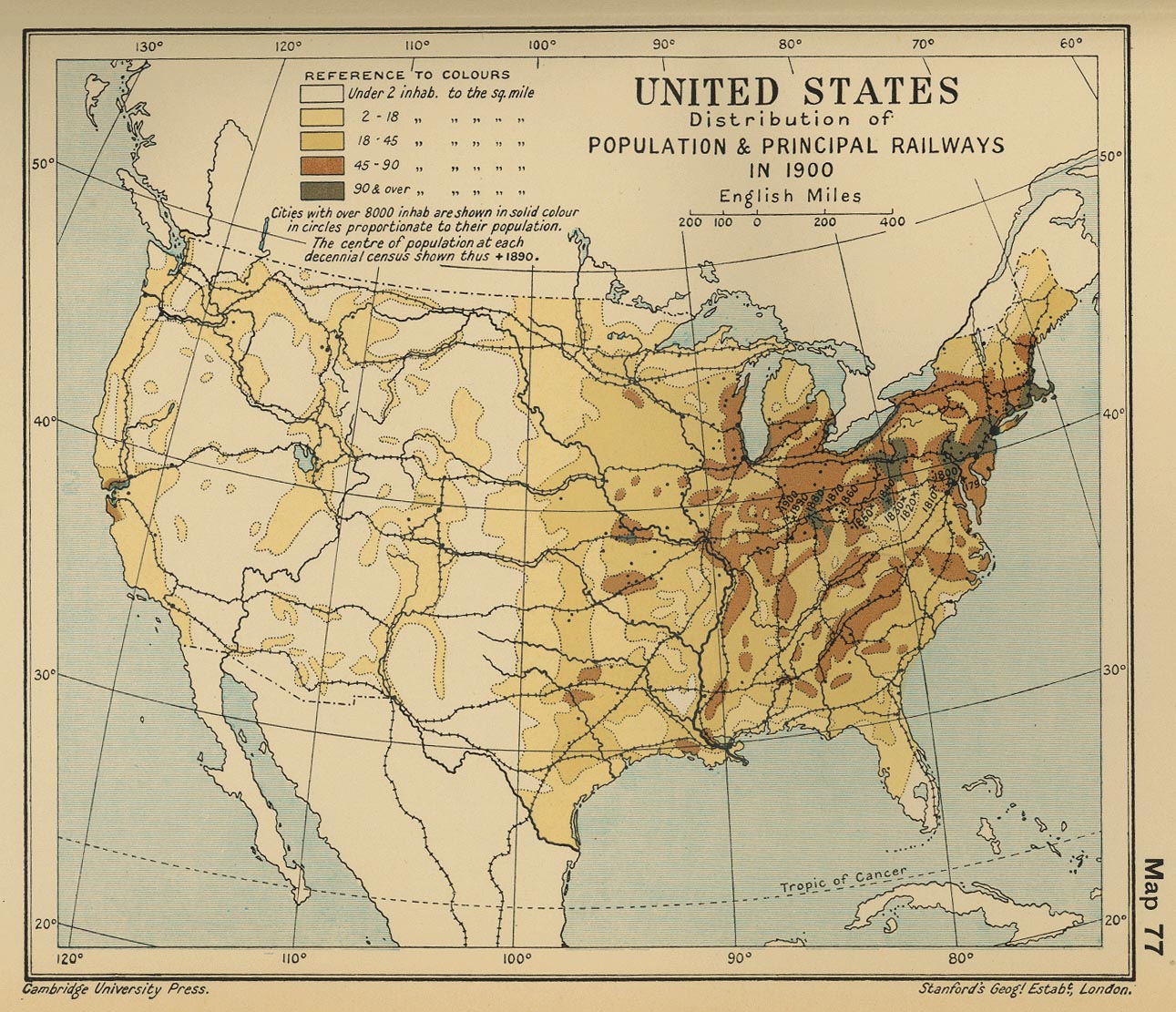 Ever wondered where the population centers were at the turn of the century after the railroads had taken hold? Well here's your map. Very cool.
H/T Mike Lydon
Courtesy of the University of Texas Libraries
Tuesday, September 16, 2008
Super Capacitors in Transit
New technology is gaining ground really fast. A promising development in energy storage is the nanoflower supercapacitor. The reason why its so important is that if perfected, it would be possible for light rail lines to gain more power through regenerative breaking and burst through intersections or short stretches of track without connecting to overhead wires.
Subscribe to:
Posts (Atom)