I was going to write this comment in the last subways post but I thought it might warrant its own post.
Folks have been asking why we need subways or why surface transit expanded won't do the trick. I think Zurich, Budapest, and Vienna for example have excellent surface transit systems. As 295bus points out in the comments, Zurich has been very progressive with their que jumping tram systems. But I don't have that kind of faith in San Francisco to do it right. Everything seems to get messed up in engineering. But even if what they say about the signal priority is true on the T Third, something like a 10% increase in travel time on the whole line, that still doesn't do much for me. That trip from end to end is still makes you budget an hour for your trip. It still gets caught up in lights and there are way too many stops because of crossing streets. Same with the N, same with the L etc.
I know you all have probably heard me complain about this before, but here is the basic comparison and reason for my angst on this subject.
I live by the 24th and Church J Stop. It's exactly a half mile from my door to the 24th street BART. Now, in the morning going to work, I walk down the hill to BART and get on a train. They come every 4 minutes to Oakland which means I almost never have to wait very long. I take the train 18 minutes (almost never changes) to the 12th street station and walk up the stairs to my office. That trip of 11 miles takes me 30 minutes every day. That means I'm going 22 miles per hour.
Now let's say I'm going to Union Street to watch the game. I watch Next Muni to see when the J is coming, I go and hop on the J and take it to Church and Market. At Church and Market I switch to the 22 trolley bus which then travels down Fillmore. This whole trip is three miles and takes about 40 minutes.
Here's another trip I take. Take the J downtown then get on the 45 or the 30 to go into North Beach to meet friends. That trip takes me 40 minutes as well. That's about a 4 mile trip made faster by the Market Subway but I still have to crawl through Chinatown on Stockton Street. That is about 6 miles per hour.
But imagine if we had a subway. That trip to Union Street would take about 15 minutes. Wow. That would be amazing! I wouldn't have to budget an hour each way just in case a car stopped in front of the bus or the signals were having a bad day. It would be the same time every time we took it. I could go to the Richmond for Dim Sum or North Beach for Italian deli meat.
This is not Houston or Austin where we can say, 'we're not as dense as San Francisco or New York'. We ARE San Francisco. The city IS dense. We should have a Metro system just like DC or Vienna or Prague. I realize its expensive but so will be cleaning the air and allowing people greater mobility. Imagine not having to worry about places to park ever! When we make people have to budget an hour for what should be a short trip, we are making them choose thier car. Because our streets are narrow and we need to start thinking about giving bicycles and pedestrians space as well, our precious street space should be used for that and surface transit with many stops, and people should be able to get across town in a timely fashion underground. Just my opinion.
Sunday, November 2, 2008

Saturday, November 1, 2008

Friday, October 31, 2008
San Francisco Fantasy Map & Investment
We're a bunch of wimps. Why is investing in infrastructure a luxury when people go out and spend so much money on their cars. A commenter (btw, please stop posting as anon. I don't care if you want to be anon, but make up a name so I can tell between commenters) in the post below called High Speed Rail a luxury we can't afford and wanted the money spent on local transit. Why the hell isn't anyone logical out there? Why are we pitting a long distance mode that will decrease airplane trips, the most dirty climate change inducing trips out there, versus a short distance mode that everyone knows is needed?
This isn't about one or the other, it's about both. Stop pitting HSR against the budget. Stop pitting HSR against schools. And stop pitting HSR versus better local transit. If we didn't pass this bond, it's not like the state will toss up $10 billion for a local transit bond. They have already stolen $3 frakin billion!!! in the last 3 years.
Then I started thinking about it. If the County of San Francisco asked me for an extra $100 a year for better transit, I would give it in a hearbeat. Heck I would give $500. Because it would make my life and everyone else's life in the city so much better. Think about it. If every citizen in the city gave $500 a year, this would be $41 per month. That's ~$383 million per year. Over 30 years, that is ~$11.5 billion. What could we do with $11.5 billion here? Well we could build 46 miles of subways at $250 million per mile. That is 4 north South Subway lines and 3 east west subway lines. We'd have a real freakin metro here! $41 per month is all it takes. That is one tank of gas per month. What could we get? Something like this:
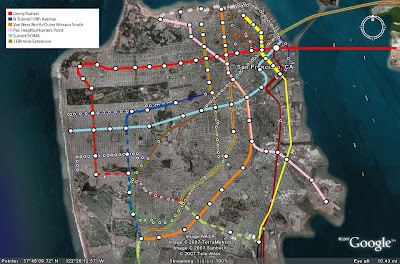
Who would want anything like that? That's just a luxury.
This isn't about one or the other, it's about both. Stop pitting HSR against the budget. Stop pitting HSR against schools. And stop pitting HSR versus better local transit. If we didn't pass this bond, it's not like the state will toss up $10 billion for a local transit bond. They have already stolen $3 frakin billion!!! in the last 3 years.
Then I started thinking about it. If the County of San Francisco asked me for an extra $100 a year for better transit, I would give it in a hearbeat. Heck I would give $500. Because it would make my life and everyone else's life in the city so much better. Think about it. If every citizen in the city gave $500 a year, this would be $41 per month. That's ~$383 million per year. Over 30 years, that is ~$11.5 billion. What could we do with $11.5 billion here? Well we could build 46 miles of subways at $250 million per mile. That is 4 north South Subway lines and 3 east west subway lines. We'd have a real freakin metro here! $41 per month is all it takes. That is one tank of gas per month. What could we get? Something like this:

Who would want anything like that? That's just a luxury.
Friday Night Linkage
Time to figure out which route is best for the Southwest Corridor in Minneapolis.
~~~
Pelosi for HSR. Major firepower will make sure that this project gets its federal funding in the next congress.
~~~
A Streetcar for Middletown Connecticut?
~~~
Is a DDOT Streetcar ever going to get built?
~~~
More on Denver's property increases near light rail:
~~~
Pelosi for HSR. Major firepower will make sure that this project gets its federal funding in the next congress.
~~~
A Streetcar for Middletown Connecticut?
~~~
Is a DDOT Streetcar ever going to get built?
~~~
More on Denver's property increases near light rail:
As I've mentioned previously, many of the people that I've talked with on my trip have mentioned that transit is not good where they are, and it's a deciding factor not just in what neighborhood they move to, but what city they move to. We don't have any data yet on the West Corridor, but anecdotally, I have seen a lot of competition for properties on the west corridor. We lost a bid on a property that was listed for around $100,000, even though we bid $25,000 over the list price.
Property Near Light Rail Weathers the Storm
While housing values around the country are falling, there has been anecdotal evidence of value near rapid transit staying high or even going up. Now we have empirical evidence in Denver that this is true:
Homes near light-rail stations along the southeast line, which opened in November 2006, have increased by an average of nearly 4 percent over the past two years, according to an analysis by Your Castle Real Estate. But the rest of the Denver market declined an average of 7.5 percent.
"I know that it's always been a good neighborhood, but I didn't think it was like that," said Humphrey, who doesn't drive and frequently uses public transportation.
The closer a home is to the station, the more its value increases, according to the Your Castle analysis. Homes less than a half-mile from a station increased an average of 17.6 percent, while those 1 1/2 to 2 miles away increased just 0.1 percent on average. The data varied widely among stations, however.
17.6% is no slouching in this economy. I'd love to see the study in more detail, but the initial findings reported look very promising.
Election Night Reminder
We're going to be liveblogging the national election. I encourage folks to come by election night to find out what is going on with transit issues around the country. Here's what we're covering.
St. Louis - An election is being held to give Metro a half cent more in order to keep up with operating expenses and expand Metrolink, the region's light rail system. It's called Proposition M.
Santa Fe - A Sales Tax to extend Rail Runner into the city from Albuquerque.
Oakland/Berkeley - AC Transit is looking to raise the parcel tax $48 annually to pay for operations. This measure is called VV. KK is also on the ballot and would allow AC Transit to build BRT on Berkeley streets.
Los Angeles - This would be a half cent sales tax for capital expansion. It's called Measure R.
Sonoma Marin - SMART will go back to the polls to ask for an 1/4th cent sales tax to build a commuter rail line. It is called Measure Q.
Honolulu - Island residents are being asked whether they approve of a steel on steel transit system.
Kansas City - A half cent sales tax is on the ballot to build a starter light rail line.
Seattle - Prop 1. I'm not going to be covering this as much except for some crucial updates. I'm sure the boys at STB got it covered.
High Speed Rail - $9.9 billion dollar bond for a statewide high speed rail line. This one is Prop 1a.
Falling Off the Edge...
of the ocean isn't fun.
“The opponents of this light rail campaign are like the people of the 15th Century that were arguing that the Earth was still flat when people have already been around the world,” said Kansas City lawyer Pat McLarney.
Libertarian Backlash
Like Adron and others, I sometimes wonder what it would be like if we operated in a true libertarian based market in terms of land use and transportation. Apparently, so do other libertarian commenters who in a recent blog post on the reason foundation blog take Wendell Cox to town. We all know that he and Randal and other sprawl apologists are just vulgar libertarians, using the ideology as a corporate protection racket. In thier case it's the highway and auto industry. Here's a comment that hits the mark for me:
I fully understand the idea that excessive land use regulation can raise the costs of home ownership. Smart Growth or anti-sprawl regulations, however, are just as much an implementation of greater flexibility in urban development, by allowing greater densities of housing, tenure and use, than it is a restriction on building. It is pretty well established that sprawl producing land use regulation is that which creates an artificial scarcity by requiring large lots, minimum square footage, and lower densities - driving up prices.HT PublicTransit.US
Wednesday, October 29, 2008
Kansas City Opposition Flow Chart
Wow. This is crazy. In a good way. The anti-light rail flowchart. Perhaps every campaign should have one of these.
HT KCLR

HT KCLR
Hawaii Appropriations
Matt has a post up on Committees that could be changing (Nothing is set in stone and I'll believe it when I see it). If as he predicts Inouye goes to appropriations, this means that Honolulu's chances of getting its transit project funded are that much better. Given the fighting that is going on there, and Inouye's pledged support for the rail project, this could possibly be a huge deal for them.
Subscribe to:
Posts (Atom)