Tuesday, July 28, 2009

The Short End of the Stick Is Still Long

The transportation bill is stuck and as its written might increase transit's share of funding by a whopping 2% and the road people are already going nuts.

Utah transportation officials fear a proposed six-year federal highway-spending bill will siphon money from new roads in growing states like Utah and reward transit systems instead.

Why these strikes extreme fear into their hearts I don't know. Perhaps because they know that people are starting to change their minds about the great freeway subsidy experiment. What I do know is that it's a little bit funny that on the same day that the Moving Cooler report came out supported by government agencies including the Federal Highway Administration, a new website from AASHTO came out as well touting 'REAL' solutions to climate change that include cars, cars, and did we mention cars? Their big suggestion? Reduce annual growth in driving through smarter driving. But initially they were on the committee for Moving Cooler but were conspicuously absent from the final report pages. It seems as if someone decided to take their ball and go home because the results didn't cater to them.

But it's interesting that AASHTO was trying to cut them off at the pass after being part of the team. It's also likely that groups like AASHTO are more aligned with county and state DOTs than they are with cities, which means that if AASHTO exerts its power on congress, it's likely to push further away from the interests of cities. In the stimulus and in the climate bill, cities have been getting the shaft even though they are the nation's biggest economic engines and have the most to lose.
Washington's omission is troubling to metropolitan areas like New York City and Chicago because they are the dominant source of carbon dioxide in their regions and will face the earliest impacts.
Those in the status quo of road building have much to lose as well if we are to believe thier howls, even if the opposite of Transit expansion will benefit places like Salt Lake more.

Utah's reluctance to embrace more transit money puzzles him {Rob Puentes}. The Wasatch Front's train system is growing, he noted, and he believes it makes no sense, at a national level, to fight carbon emissions with energy policy while ignoring them in transportation policy.

The Utah Transit Authority finds the bill a possible upgrade because it streamlines the grant process for new projects, spokesman Gerry Carpenter said Tuesday, although it's too early in the legislative process to comment on details.

Yeah, you know that broken new starts process. Congressman Oberstar gets this which is why I'm glad he's on our team:

"When highway planners sit down to build a roadway," Oberstar said today, "they don't go through the gymnastics of a cost-effectiveness index," as transit planners are currently required to do. "They sit down, get the money, and build a road." Expanding transit, the House chairman concluded, is difficult "if you've got a millstone around your neck."

But all of this leads to the fact that Salt Lake City and other regions need to do something other than the status quo proposed by AASHTO (people are already lowering driving habits because of the economy), because on many days of the year, look how well the AASHTO way works out for them:

Ogden Trip

Alone in a Sea of People

I actually like to go get a bite to eat on my own and have seen a few movies on my own. A few folks I know are amazed because they could never go out by themselves. I think that if there are things you enjoy and you want to do, why not do them! If you can get friends to come, even better.

Cities are funny places. You're not quite so alone in your neighborhood when you meet all the people that live and work in the establishments around you. I know the bartenders and the bagel makers as well as the local sushi chef. That last one is a bit hard since he notices when I don't come back every week and gives me a hard time. But cities are places you can do that. I certainly couldn't do that in Austin, at least not where I was living on 38th street. But my friends lived further away there as well, so I had to drive. Here many of my friends are within a bus ride or a short walk. Makes it easier to run into them unintentionally on the street, which always feels good.

Things Going On

Check out this really cool/not cool video of the swaying Manhattan Bridge. Kind of freaky when you think about how many full bends it took to break that really hard chewing gum in an old pack of baseball cards or a paperclip.
~~~
Tom Toles is a great cartoonist.

Via GGW
~~~
Matt Johnson has a map of ridership on the Washington Metro. Pretty informative and good lookin.
~~~
Saying yes to the ballot measure that would outlaw streetcars in Cincinnati also outlaws any type of rail. What were they thinking?
~~~
2/3rds in California is really annoying for tax increases. Over 62% of citizens in Marin voted for the train yet they are fighting about whether the Sonoma+Marin = 2/3rds rule applies. When do we get rid of prop 13 again?
~~~
Shanghai Subway to be longest etc etc etc. The Chinese are moving fast.

Via Metro Librarian
~~~
Houston one step closer to sprawl inducing road.
~~~
A New York woman who owns a house near Columbia Pike doesn't like what will happen (italics mine):
A streetcar line would encourage further development along the Pike, generating windfall increases in property values to adjacent homeowners. I am one of those homeowners and lived in Arlington from 1991 until 2007. As much as I like to see my home value go up, I do not consider this an adequate justification for the proposed system.
Of course it's not the only consideration. But what happens when all that further development is walkable and lessens the need to drive everywhere for everything.
~~~

Monday, July 27, 2009

1000 Words

This is likely what the United States looked like in parts of the 1950s and 1960s. These days complete neighborhood deconstruction wouldn't happen in the United States, especially not being paid until after your home had been demolished.

The Lagos State Governor, Babatunde Fashola, who was at the meeting, said that the government had not decided on what to pay as compensation.

“Even, beside that, the process of determining the amount of what to pay as compensation is not easy. But we would ensure that those who are qualified receive the payment. Nobody would suffer deprivation,” a report quoted Mr. Fashola as saying.

Begin the Begin

I think Tom Radulovich hits the nail on the head with the basic tenants of this post. Infill stations are a no brainer, especially where suggested and core capacity and operating should be addressed. Don't forget to check all the rosy ridership assumptions at the door. However I don't think we can just sit and rest on our laurels. We need to find ways to build in greater capacity within Oakland, San Francisco and to a certain degree San Jose so people don't rely on thier cars as much. And while there are several BRT lines on the books, that is not going to be enough to deal with the rising tide of need. The longer term needs to be considered right now including that second tube and more urban extensions. Currently the plan calls for that tube, but more and more outward extensions are planned, meaning more and more funding will go to places that shouldn't get it. It's an export of our tax dollars to elsewhere and a practice that should be rectified.

San Francisco should have built a true Metro long ago and I still believe that is one of the major things this city can do to enhance existing service and get people out of thier cars (There are also a million little things that should be happening as we speak) As other cities have shown, 10,000 passengers per mile is possible with greater network connectivity. If we have core rapid transit within San Francisco and Oakland with quality bus and trams as redundancies and networks, there's no reason why we can't get a million more trips a day. Sure that might sound like a daunting number, but we need to look into the future of what is needed.

When my grandmother was born, there were still streetcars in every major city and very little automobile traffic. In her lifetime, there has been a huge change. Systems such as BART and WMATA have been constructed and the region has invested billions in its highway systems. We CAN invest in our future again. There's no reason why another Great Society Subway can't be constructed. And for those who say we don't have the money or that we're asking for the impossible, take a look at yourself and ask why that is.

You can call me a dreamer or an ivory tower thinker. Worse things have happened. But I'd hate to look back and see some kid like me drawing fantasy lines on a map and wishing that we would have invested in his generation, instead of just thinking of ourselves and our own defecits of imagination. If we listened to the same types of people that said no then, we wouldn't have a BART or Muni system to worry about now. Imagine San Francisco without rapid transit at all.

While we might not be able to plan and construct Metros right now, we can start to think about how a better region can emerge from our planning. Just because we don't have money now doesn't mean we should toss out these ideas or shouldn't plan for them. It just means we need to incubate them, for that point in the future when they should bloom.

Music Monday: Not Too Late for Coffee

We'll hit that all night diner...act like big city kids in a small town.

Sunday, July 26, 2009

Sunday Night Notes

The mean green of UNT have done another study looking at the economic effects of constructing light rail in the Dallas region. The study says $5.6 Billion in economic benefits just from construction, not from development near the stations.
~~~
This seems to be an issue all around the country. State roads are under state control, so it becomes harder to get local changes on them including transit. Places that are designated as State Roads seem to add another level of bureaucracy, even if they likely get gas tax money for repairs. This issue is popping up in Ogden Utah as well as on Van Ness.
~~~
I wish alignment decisions weren't so political. The realistic solution is to look at the numbers for the starter line as we discussed in the job center post below. Check the places with the highest bus ridership and see what major job centers need to be connected. Granted I'm not familiar with Tampa, but you wouldn't need a million dollars to do a study of where the first line should go.
~~~
The FHA is going to start giving mortgage credit for living near transit. This is part of the ACES bill better known for its fights over cap and trade:
Similar concessions on loan applicants' incomes would be extended for properties located in areas close to employment centers or mass transit lines. No concessions would be made for homes in far-flung neighborhoods that eat into family incomes because of long commutes, which would add to carbon emissions.
~~~
An interesting article about the folks who operate out of coffee shops and other people's houses for work by internet. The digital nomad.

Thursday, July 23, 2009

Importance of Employment Centers

Jarrett has an interesting post on how LA is more like Paris with their polycentric form than a more monocentric place like New York City. I've been looking all week at LEHD data, mapping out job clusters and have noticed that many places in the United States are polycentric. This is also something Richard Layman talks about a lot as well, but in a slightly different way.

For example, the Twin Cities has a number of job clusters that could be made walkable if given a push. It's quite possible that this is a better way to look at transit possibilities, rather than the traditional hub and spoke. Jared makes this point, but the proof is in how our regions are laid out and how people already commute. I don't have the maps here now, but most of the major clusters in the twin cities draw residents from around that cluster. Meaning many people live closer to where they work than we might have thought, they just don't live close to the major center of the region, but rather thier own major cluster.

This all leads up to talking about how to fill in the centers and connect those people to thier cluster. Chris Leinberger talks about Walkable Urbanism and building up centers. You can see this in DC where places have grown up around the Metro lines. In other regions, places have grown up where there are metro lines such as Atlanta, but also have grown densely but not as walkable in other places. Many of these places could be added to and reconfigured for walking.

I once thought Phoenix would be hard pressed to change its ways. But it has really good bones and a regional grid that is almost unmatched in the United States. There are also two major places outside of downtown that could be even more dense than they are today with greater access. They could already support high capacity transit, the one area north of downtown just got attached to the new light rail line.

North Central
Camelback Road

But you also have to do it right. In my travels to Denver, I noticed that the Tech Center which has the most jobs outside of downtown has fairly lousy access to the light rail line. This place will not transform as easily as it might have with the line running straight through the center of the density existing, density you can tell was created by cars.

Denver Tech Center

These pop up in other regions as well, and usually represent the best place to connect downtown with another major job center. These corridors also make for the best starter transit lines, especially if you're having to work with the cost effectiveness measure, because you're going to get the most riders from them. Houston knows this for certain, because in connecting Downtown to the Medical Center, they were able to build the highest passenger density new light rail line in the United states.

Medical Center and Rice University

In Atlanta, it's Peachtree outside of Downtown on MARTA and Buckhead just a bit further north. The point I've been trying to make is that more of these places could be created and ultimately connected together in a web with better transit. But it's much easier to demonstrate in pictures than with just words.

Peachtree

Looks kind of like Arlington no?


Buckhead Station in Atlanta

Which kind of looks like Bethesda


The biggest thing I think we see here is how if there is a station, the density fills in between the lines. The Phoenix example is just density for cars, not people. This all can change though, and more centers could pop up around the region to foster more walkable urban development. These centers need to be connected by transit, and if connected, will follow Jarrett's ideal:
If you want a really balanced and efficient public transit system, nothing is better than multiple high-rise centers all around the edge, with density in the middle, because that pattern yields an intense but entirely two-way pattern of demand. If balanced and efficient transit were the main goal in Los Angeles planning, you'd focus your growth energies on Westwood, Warner Center, Burbank, Glendale and perhaps new centers in the east and south, while continuing to build density but not necessarily high rise in the middle.
This way we can accommodate the complete market for housing, not just the segment that is single family, and most can have access to quality transit. We can also cut down on VMT while serving our polycentric regions with quality transit of all types.

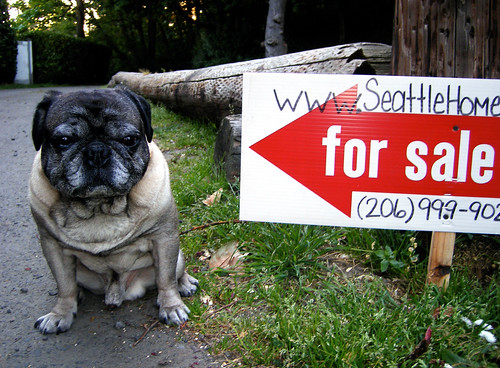
For Sale Signs

Google is starting to mesh maps with real estate listings. How long will it be until there is an API for this that you can customize and search for properties near transit? Some sites are starting to do this. Perhaps at some point it would be good to mix in the H+T index to see what your monthly transportation bill will be when you buy a house. If you live in a more walkable neighborhood, you can offset the perhaps higher cost of your home with less transportation costs. It's coming, hopefully someone is on the case.

H/T On the Block

Flickr photo by Zoomar

$eeking A Green Funding Scheme

Congress is looking hard for a funding source for all things transportation. With the gas tax woefully inadequate, they are looking for other sources. One that continues to come up is the VMT tax. While this is a promising idea, no one likes to think further or beyond the box. I was actually surprised when people immediately let an idea like DeFazio's oil futures tax even sit for a while. But for the most part, congress is boring. It's like people are stuck going in circles.

But in the Streetsblog article there are some ideas that have floated before, in other forms that might be a bit innovative. For example the tax break idea has been floated before and discussed here, albeit for a somewhat different cause. Alan Drake has been proposing for a long time that we use property tax breaks to electrify the main freight lines across the country. This is just an addition.
Rep. Kendrick Meek (D-FL) touted his bill to provide tax credits for companies that build new freight tracks or terminals. Rep. Ken Calvert (R-CA) suggested levying a freight fee of 0.075 percent per shipment, with a maximum of $500, on goods that arrive at the nation's ports.
But what about other ways to find funding for transport. Are there any other innovative mechanisms for a national scale? The Transport Politic says we should take it from the general fund. How about if we can carve out some of the income tax for transportation. Perhaps you can see how much you're paying into it on your weekly statement, kind of like FICA. Especially since everyone uses transportation to get to work where they get income. And if they don't, they are living at home and should get a break for that.

Or one of my favorite ideas is an electric bill surcharge, perhaps one for commercial electricity and one for residential. This might accomplish two goals, one being a reduction in energy usage from higher price points and another being when more electric automobiles and other vehicles start coming, they will be paying into the transportation fund. Obviously not completely thought out, but there's something in there somewhere.

I really wish we could throw all kinds of crazy ideas on the table and see what might stick. Any other ideas out there we should know about?