Thursday, March 13, 2008

More Research and Reports

APTA - The Broader Connection Between Transit and Energy/GHGs
People living in households near public transit travel 12 fewer miles per day which is 27 percent less than persons in households with no access to public transit according to the study. This equates to an individual household reduction of 223 gallons of gasoline a year.
Smart Growth America - Growing Cooler
They warn that if sprawling development continues to fuel growth in driving, the projected 59 percent increase in the total miles driven between 2005 and 2030 will overwhelm expected gains from vehicle efficiency and low-carbon fuels. Even if the most stringent fuel-efficiency proposals under consideration are enacted, notes co-author Steve Winkelman, “vehicle emissions still would be 40 percent above 1990 levels in 2030 – entirely off-track from reductions of 60-80 percent below 1990 levels by 2050 required for climate protection.“
Department of Homeland Security - Transit Threat Assessment

The Greenness of Cities - Edward Glaeser
Over the past 50 years, automobile oriented suburbs have grown much more quickly than denser urban areas, and over the past six years, the four fastest growing American metropolitan areas have been Atlanta, Dallas, Houston and Phoenix—all hot places that use an impressive amount of electricity to create a pleasant year-round climate. Cars and air conditioners both lead to signifi cant emissions of carbon dioxide, which an increasing body of evidence has linked to potentially dangerous climate change. If this evidence is correct, then there are serious social costs associated with new forms of development that tend to be extremely energy intensive.

It's Space Race Time, and LA is Rockin!

We've been following the Transit Space Race for over a year now and more cities keep jumping into the race. Yesterday Los Angeles vaulted into the upper tier of the race with an announcement of their long range plan. We've covered them before, but there are some extra goodies in the announcement. Now if we could only get increased federal funding for rail projects...

From Curbed LA:

Strategic Unfunded Projects
Tier 1: Currently Under Planning or Environmentally Cleared/Route Refinement Study

-Regional Connector
-Metro Subway Westside Extension to La Cienega
-Harbor Subdivision Alternate Rail Technology between LA Union Station and Metro Green Line Aviation Station
-Metro Subway Westside Extension to City of Santa Monica
-Burbank/Glendale Light Rail from LA Union Station to Burbank Metrolink Station
-Metro Gold Line Eastside Extenstion from Atlantic/Pomona Station to City of Whittier
-Metro Gold Line Foothill Extension from Sierra Madre Villa Station to Azusa
-Metro Green Line Extension from Redondo Beach Station to South Bay Galleria
-Metro Gold Line Extension from Sierra Madre Villa Station to Montclair
-Metro Green Line Foothill Extension between Norwalk Station and Norwalk Metrolink Station
-Mero Green Line Extension to LAX
-West Santa Ana Branch ROW Corridor Maglev between LA Union Station and Santa Ana Metrolink Station

Tier 2
-Metro Red Line Extension from North Hollywood Station to Burbank Airport Metrolink Station
-Vermont Corridor Subway
-"Yellow" Line Light Rail between Metro Red Line North Hollywood Station and Regional Connector
-I-405 Corridor Busway between Metro Orange Line Sepulveda Station and Metro Green Line Aviation Station
-"Silver" Line Light Rail between Metro Red Line Vermont/Santa Monica Station and City of La Puente
-Metro Green Line Extension from LAX to Expo Santa Monica Station
-SR-134 Transit Corridor Bus Rapid Transit between Metro Red Line North Hollywood Station and Metro Gold Line Del Mar Station
-Metro Green Line Extension between South Bay Galleria and Pacific Coast Hwy Harbor Transitway Station

Wednesday, March 12, 2008

Why Are the Goal Posts Moving?

The FTA is really trying to kill rail projects in the United States. So it seems are the folks over at the Sierra Club in Seattle. In Charlotte, the FTA is requiring that the North Corridor LRT be 65% through preliminary engineering before they can enter into preliminary engineering in the federal process. This means that you can do all of the work and they can come in and say they don't like it, which means you might be out of luck and need to spend millions to re-engineer something they don't like. It used to be 30% so the plan could be analyzed earlier. My first question would be if they make BRT projects do the same or if they get special treatment because they are the administrations favorite mode. Another question is why does the FTA have so much power over transit projects but the FHWA just doles out highway money to the states to spend on whatever freeway they like? They pay 80% for freeways and 50% for transit, doesn't seem fair that they have control over where your line goes or define your project by what they think cost effectiveness is (hint: no one's cost effectiveness is the same as theirs except anti transit folks).

I wouldn't have a problem with this if the FTA had more money and was likely to fund more projects. But they don't and they aren't. In fact lately they have been tightening the screws. This year had the least number of projects in the new starts process than any year previous. In the late 90s there were usually around 40 projects in Preliminary Engineering. Today there are 10. Yes 10 projects. Out of all the planned projects (At least 50) that I've listed in the Transit Space Race for expansion in the United States, there are only 10 projects in preliminary engineering. Administrator Simpson claims that the Bush administration has funded more projects than during Clinton, but we know that most of these projects were started during the 90s and they are only now able to start shutting off the money with Secretary Peters at the helm.

This is a direct result of the Bush administration's disdain for transit. And while its likely to get better with a new administration, there is going to be a big fight for the new transportation bill to see where money goes in 2009. The Mary Peters set including Wendell Cox and Ken Orski are saying that there is no need for new rail starts in the United States. They say the rail expansion is over and right now they have the ears of the politicos at the FTA.

Which brings me to Seattle. The Sierra Club all over the United States has really fried my bacon, with the exception of Boston. Those guys are doing a great job, but here in Marin and up in Seattle they don't get it. In Marin like Seattle, the SC is lobbying against the train because it will bring growth. It's coming whether you like it or not. You can let all those people drive all the way into town or you can build a line that allows for TOD and expansion of transit PMT. But in addition, whether you like it or not, parking is big in the FTA models I discussed above which are a large part of the cost effectiveness measure. In fact, I would wager that if the Sierra Club got its wish, there would be no federal money for the extensions in Seattle and the lines would be funded completely by local taxes. I'm not sure that would sit well with folks up there. There are better ways to control growth than not building an important transit line.

Tuesday, March 11, 2008

Parking Lot Congestion Pricing?

I was reading up on the Seattle congestion pricing debate over at Seattle Transit Blog and Orphan Road and was thinking about ways to address the equity issue of congestion pricing. I'm wondering what kind of tax isn't regressive. Is it the land tax? Perhaps.

But what about a rush hour parking tax?

Parking garages have meters that do timestamping, so why not charge a fee for parking between 8:00 and 9:30 and leaving between 4:30 and 6:00. When you use that funding for expanding transit, you can then expand to road based congestion pricing after expanding transit. That way if you don't have any other options, you can still get in and park if its early or late making people vary their timing surely making it more equitable. I'm sure there are drawbacks because this just popped into my head and I didn't think it through completely but I'd like to hear people's take on it. It could be too limited to workers downtown for instance. Or people could just write it off on their taxes unless that benefit was taken away.

"Auckland, One of the Most Auto Dependent Cities in the World"

So these videos have been going a bit viral lately, but I haven't seen them all in one place except on YouTube. So here they are, Peter Newman and Todd Littman on Aukland New Zealand doing their best opposite day impression of Wendell C and Randall O. I posted part three a few days ago, but here they are together.

Part 1. City of Cars


Part 2. It's Too Spread Out for Transit


Part 3. Sustainable Transport is Uneconomic

Monday, March 10, 2008

U.S. Transit Takes 10.3 Billion Trips in 2007

I'd like to say that this is impressive, but it's not. If we are going to get something done in this country we can't be happy just going to the Olympics, we should want to win the gold. I will say that light rail again led the way for ridership increases at 6% but we need more.

For comparison to the much touted 10 Billion number that we've had the last two years consider this, Budapest (my favorite transit city) residents took over 1.4 Billion trips in 2003 in a region of 2.4 million people. The population of the United States is around 300 Million. While there are obvious differences in urban form and the availability of transit there versus here, its telling of what is possible if we design transport systems correctly and design our neighborhoods accordingly.

For a better western example that wasn't over run by communism until 1989, Vienna (A metro of 2.2 million) takes 700 Million annual trips. The tram network carries 280,000 passengers a day. The U Bahn metro carried 427 million trips in 2005. They began building their metro system in the 60s and finished in 1982. While they had a legacy street railways network, that can be done in time as well.

It's possible for us to catch up, but we gotta start moving a little faster. If each of the top 50 metro regions can get 700 million trips per year, we can increase ridership to 35 Billion trips. Is that possible? I don't know, I'm just tossing out numbers, but it would be amazing and would do a lot for the environment and create jobs.

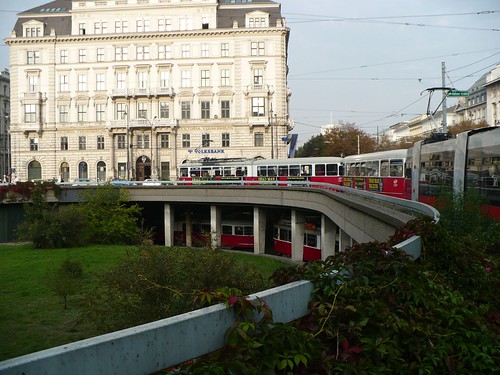
I also love a good reason to use pictures from my trip last fall. The one below is a tram loop on the Ringstrasse in Vienna.

Vienna_TramLoop6

Sunday, March 9, 2008

Dolores Park Blogging

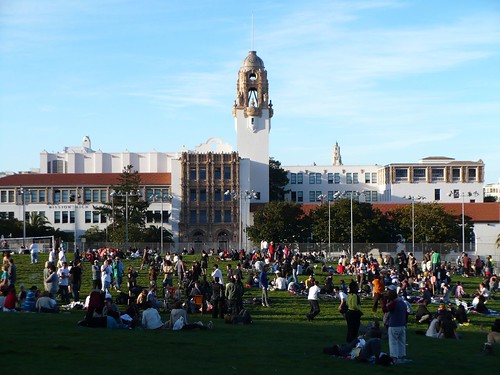
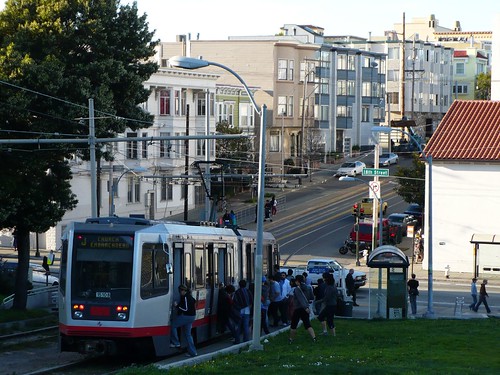
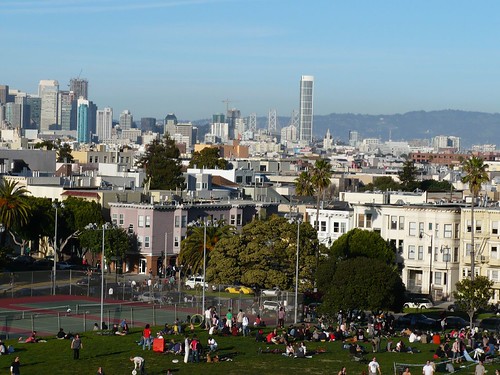
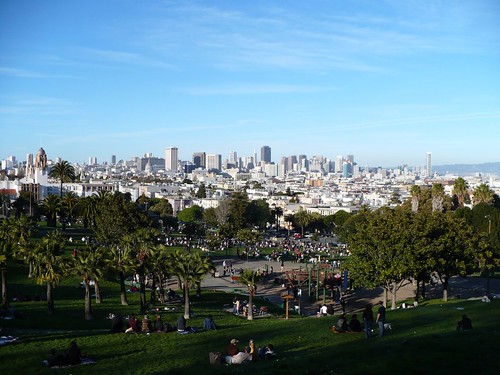
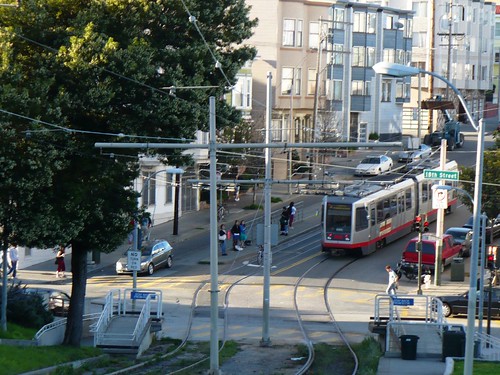
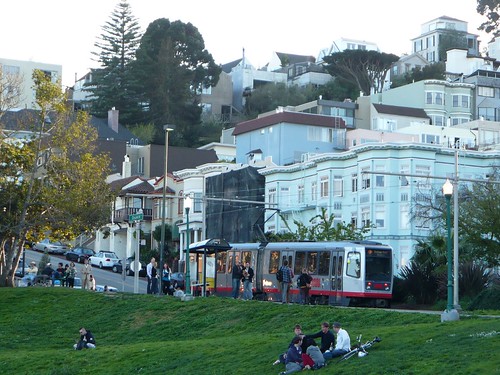
I live a few blocks away from Dolores Park which some also call Dolores Beach because on sunny San Francisco days everyone is out in the sun having a good time. It's a wonderful thing. Here are a few images collected today. It also showcases the ability to get to nice parks and views in San Francisco by transit.

Mission High School

J Church at Dolores Park

Downtown San Francisco

Downtown High School

J Church at Dolores Park

J Church at Dolores Park

US PIRG Releases Transit Report

The US Public Interest Research Group released a report titled 'A Better Way to Go' this week. If you're a transit advocate and need some ammo for any coming fights I highly recommend it. The chapter that most interested me was the one about underinvestment in transit. They did some digging and found out how much investment we've made in transit versus highways in this country and even I was shocked at the chart. And this is just highways...not local roads, parking spaces etc.


A few other pieces of information from the report:

Carbon dioxide from our automobiles equals the total emissions from Germany, Japan and Canada.

Commercial Parking lots in this country cover more space than the state of Delaware.

Rail saves a lot of oil with heavy rail systems like the subways in New York and Washington DC doing most of the heavy lifting. The chart below shows oil savings from LRT.

Transit provides a wide range of benefits including, reduced road expenditures, reduced cost from traffic accidents and reduced public and private costs to providing parking.

Investments in transit create 19% more jobs than equivalent investments in roads.

In 2005, the subsidy to highways was $39 billion dollars.

In 2005, the state expenditure on highways was $100 B dollars. Transit was $7.8B

And many more...

At the end of the report PIRG advocates that we stop spending money on new highways and shift to building more transit. The Interstate Highway Program has funded all of the necessary highways in this country and its time to fill the gap between what was neglected in the last half of the 2oth century.

Saturday, March 8, 2008

You Work on Friday to Pay for Your Auto Dependence

Peter Newman is the person who gave us the term Automobile Dependence and has been an excellent fighter in the war against it. He also has been looking at density as it pertains to transit usage and walkability. What I like best about this interview in the Oregonian is that he refutes the myth and conservative talking point that planners and transit agencies are in search of the perfect city and ultimately want you to get rid of your car. I certainly don't advocate that as I own a car myself, but am lucky enough to use it very little.

Q: So you don't advocate some sort of wholesale getting rid of the automobile or that people will on a large scale in small or midsize cities not use cars at all?

A: No. The ideal city, I reject.

You can have carfree areas. I would say the city center of Portland is car free in that sense. There is a freedom from the car. You don't have to have a car there. You can live there, you can work there, in a way that enables you to have that freedom.

He also discusses the subsidies for automobiles that only recently have been gaining attention such as health care for auto accidents and big oil.

But to attack transit as being subsidized whilst not seeing the subsidies for car dependence is not a level playing field. We do those numbers in Australia, they're similar in America.

The politics is changing. We can no longer subsidize the increase in VMT - we have to subsidize the decrease in VMT. There is no choice in that.

And the kicker is he punches a hole in the freeway capacity issue. We've got to stop building wider freeways. He even suggests ripping them down like the Embarcadero or such as what should happen to the Viaduct in Seattle. I'm not sure if that is palatable for interstate highways but who am I to keep anyone from dreaming big. It's amazing how much tax base is taken away by these huge roads that move cars as fast as possible through cities instead of creating value.
Q: We have a $4 billion proposal to replace a six-lane highway bridge on Interstate 5 with a new bridge that would have six highway lanes, plus six auxiliary lanes. It would also extend light rail to the northern suburbs and have generous pedestrian facilities. It's been billed as having a little bit for everyone. Is that kind of project worth pursuing?

A: Four billion dollars is what you're going to need for building these transit lines and subcenters. Keeping the traffic moving is what you have to stop doing. VMT (vehicle miles traveled) reductions are not going to be promoted by that bridge. There will be a whole series of freeways taken down when they reach the end of their life in cities around the world. The one in Seoul (South Korea) came down. Now it's a beatiful river, and a park with transit. The mayor who did it is now the president.

Q: So increase rail transit, to the detriment of roads?

A: Any decent rail system can carry eight lanes of traffic equivalent - on this narrow little track. It's a capacity issue. You can only carry 2,500 people an hour down a freeway lane. You can get 50,000 an hour on a rail system - 20 times as much. That space is enormously valuable. There's no doubt in my mind that's what you've got to do.
This video is great. My favorite quote is when he states you are basically working one day a week to pay for your transport. I'm gonna make it Friday.

Thursday, March 6, 2008

Why the Line MUST Go Up Guadalupe Street

If what M1ek said in the comments of a previous post is true about the route for light rail in Austin being the Streetcar route that Capital Metro has put forth, they are making a really bad politically motivated move. I'm tired of Austin getting a raw deal from it's political deals and this is clearly a political deal with outgoing Republican Mike Krusee (just like the commuter rail line was) and the University of Texas, both of whom seem to not care about the needs of the population.

It's been stated before that Krusee plans to use the streetcar as a redevelopment tool to turn over some of the parking garages at the State into redevelopment opportunities. I'm all for redevelopment and streetcars as I've said before, but if this line gets built, they're risking possible expansion and political will by not building where people really want to go. There is one route that is a home run that will guaranty expansion...Guadalupe.

Here are 4 reasons why Austin needs to start light rail with the best starter light rail line possible

1. 1994 Denver - Built a very successful starter line and used that success to go after a 119 mile expansion plan

2. 1999 Salt Lake City - Opened North South Line connecting major destinations blowing out ridership projections. Recently passed a sales tax to build 5 new lines.

3. 2004 Houston - Built a starter line through the center of the two largest job centers in the city. Ridership is highest per mile of any new LRT line in the United States. 5 new lines are being planned and 2 are expected to be funded by the FTA later this year.

4. 2004 Minneapolis - Built Hiawatha line which exceeded 2025 projections. 30,000 riders and the DFL party just forwarded a bill that will give the region 8 corridors by 2020.

Let's take a look at how to do this in Austin because you don't often get a second chance.

Through the Capital Complex

Austin-DT Route

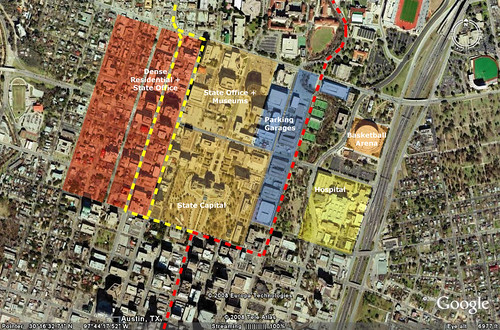
The red line is the "preferred alignment" by Capital Metro and the political backroom dealers. As you can see, the blue are parking garages and the red is existing dense development that is served by the most used bus corridor in the City (#1). Which one makes more sense? Go where the people are? or go where the cars are housed?

Through the University

Austin-UT Route

UT is one of the largest Universities in the country. There is a large concentration of students going to classes every day in the area I've labeled main university where the Guadalupe alignment should go. On the left side of the Guadalupe alignment, the West Campus area where the highest concentration of students live has just been rezoned for high density mixed use. Think the Pearl District and South Lake Union. The Back Room alignment goes by all of the facilities that people use perhaps 8-10 times a year. The swimming pool, the track, the stadium, the LBJ Library and the Bass Concert Hall. The problem is, people don't go there often from Downtown or from up North. The area east of the red alignment is generally dead space...I spent most of my time at UT running around that track and just outside its walls. Not too many people there.

Next we'll talk about the more northern options but lets do the first section right this time.