Friday, May 2, 2008

Kenworthy Speaks

Fred at MetroRiderLA went to a lecture by Australian researcher Jeff Kenworthy. Here are a few things from Fred's overview that caught my eye.

1. LRT(Tram) Patronage in Europe has been increasing while bus ridership falls.

This is interesting to me because unlike the United States, Europe has kept a good amount of its tram systems. In many large cities, they are still networked to go a lot of places.
According to Jeff, in Europe, over a period of 10 years, Light Rail Transit (LRT) patronage rose 20.3% while bus patronage fell 5.6%. His implication is that people, the masses, simply and unequivocally prefer rail over bus. And surprisingly, it’s actually what are commonly considered the disadvantages of rail that turn out to be it’s advantages over bus transit in encouraging use. The high cost and inflexibility of rail creates a permanence that people prefer over the impermanent and unreliable nature of bus transit.
2. Rail Focuses Development, Buses Follow it
Another polished gem Jeff provided us with was the idea that rail systems “focus” a city and development while bus systems simply “follow” development. So buses, because of their impermanence and reliance on auto roads, must heed to the “predict and provide” game and attempt to follow wherever development may randomly occur. Rail on the other hand spurs and centralizes development, creating a sense of permanence not found in no rail cities. Rail and streets renaissances go hand in hand.
I've said this a few times before. Rail has the power if harnessed to focus development unlike buses that just respond to it. But it's not going to just happen. There need to be plans and policies in place to do it right. In the comments below Fred's post, a discussion started on San Jose. This is the perfect example of just saying that light rail is going to do all the work. I posted a while ago on employment sprawl. Well here again is an aerial of San Jose's system by all the tech jobs, something to not emulate.

San Jose Sprawl

Here is the Pearl District, which used to be a rail yard and was helped by the plans and policies of the PDC and the streetcar

Pearl District

Update: ABC in the comments asked that we use a more suburban area to show what's possible instead of an urban area. In the situation like San Jose above with 3 -5 story office buildings I think it's perfectly ok to expect a street grid like the Pearl Districts, there was a thought that it was the Pearl was predestined to turn out that way. Before the development agreement it was supposed to be tops 15 units an acre and the developer had thought about doing townhomes. Here is what it looked like in 1996.

But as suburban examples go, here is another from Portland with single family homes in a grid South of Orenco Station.

Orenco South

Downtown Plano trying to reintroduce Urbanism

Downtown Plano

And a Heavy Rail Subway example, Rosslyn Ballston on the Metro Orange Line. I've discussed this before but this used to be a strip suburban corridor. These things take time, this has been over 30 years.

RB Corridor

Thursday, May 1, 2008

Obama on HSR

Yesterday we talked about the dumb gas tax holiday. Also yesterday Obama was talking about real solutions including high speed rail. It didn't get a lot of airtime from the MSM probably because it had nothing to do with...i digress.

Grist has the money quote:

The irony is with the gas prices what they are, we should be expanding rail service. One of the things I have been talking bout for awhile is high speed rail connecting all of these Midwest cities -- Indianapolis, Chicago, Milwaukee, Detroit, St. Louis. They are not that far away from each other. Because of how big of a hassle airlines are now. There are a lot of people if they had the choice, it takes you just about as much time if you had high speed rail to go the airport, park, take your shoes off.

This is something that we should be talking about a lot more. We are going to be having a lot of conversations this summer about gas prices. And it is a perfect time to start talk about why we don't have better rail service. We are the only advanced country in the world that doesn't have high speed rail. We just don't have it. And it works on the Northeast corridor. They would rather go from New York to Washington by train than they would by plane. It is a lot more reliable and it is a good way for us to start reducing how much gas we are using. It is a good story to tell.

Wednesday, April 30, 2008

Holiday from Real

Why can't we have a real discussion about energy and alternatives in this country? As we continue to talk about worthless alternatives like gas tax holidays and price caps, real solutions to our energy problems get tossed aside. Today Thomas Friedman writes in the New York Times that the United States passed on giving tax breaks to alternative energy. Soon we will have tax credits for oil companies that are making record profits on the market while alternative energy credits run out. While this would not really help in the transportation sector that uses the most oil, it most certainly would have the effect of getting the ball rolling on ways to get us off the sippy cup. Even carbon taxes as Ezra Klein points out would help give us a push.

But there is another problem that plagues us now and long term. The Gizmo Green. This is the hope that technology alone and not also behavioral modifications will save us from ourselves. Barack Obama even has an ad out discussing what we can do including:

Raising fuel efficiency standards
Alternative fuel research
Middle class tax cut

Whew. Once we do that the problems will be solved! Not. That is all about cars. What about modes of electric transit? What about development patterns? Walkable, bike friendly communities? Anyone? Bueller?

Matt at track twenty-nine says it best:
Still, Mr. Obama's message leaves a little to be desired. He recently reiterated his support for Amtrak and for building a better high-speed rail network in this country, but he has not yet asked Americans to change modes, nor has he promised to significantly change the way we build transit in America.

In all of President Bush's States of the Union, he called for us to reduce our dependence on foreign oil. Not once did he ask Americans to try the bus. Not once did he promise a spending package that would start a wave of new transit construction across the nation. Instead, he called for new fuels (to be delivered sometime in the future) and a switch to biofuels (also to be delivered sometime in the future).

Asking Americans to switch to transit would produce an immediate reduction in oil usage, especially if it was coupled with subsidies to reduce fares and the construction of new lines.
Seems to me we did this with the Interstate Highway Act. Not to mention that more transit means more jobs in an ailing economy. Perhaps a new program is in order to change our possible transport and neighborhood choices, not just what powers our cars. Now when buying your first house, you can choose between suburbs. It's annoying to hear folks say that the market prefers suburbs when downtowns are so expensive because of the market for living in them. I wish those people that hated living here in dense ole San Francisco would move out because its dang expensive due that pesky market demand for a transit-oriented lifestyle people sure don't like.

Tuesday, April 29, 2008

Road Networks Grow Like Leaves

Very cool article posted by Christian Peralta at Planetizen. The article discusses how road networks grow organically like leaves with major arterials connected to smaller collector routes.

The researchers developed a simple mathematical model that can recreate the characteristic leaf-like patterns that develop, growing a road network from scratch as it would in reality.

The main influence on the simulated network as it grows is the need to efficiently connect new areas to the existing road network – a process they call "local optimisation". They say the road patterns in cities evolve thanks to similar local efforts, as people try to connect houses, businesses and other infrastructures to existing roads.


This is important for transit. The reason being that roads have evolved over hundreds of years often one street at a time. But we always get hammered when one transit line doesn't cure all of the region's ills. The reason being that we're providing core arterial service and depend on the smaller connections to be made by foot, bike, and car. In cities such as New York where the transit system starts to mimic the road network do we see how transit can help everyone with affordability, mobility, and energy independence. I wish folks would realize you have to start small, and grow to a network.

Transit Etiquette

In my daily catch of articles I came across a really cool new blog on transit etiquette. Today, TriMetiquette discussed feat on the seats. Grrr. Check em out.

Monday, April 28, 2008

Streetcar Scalability and Capacity

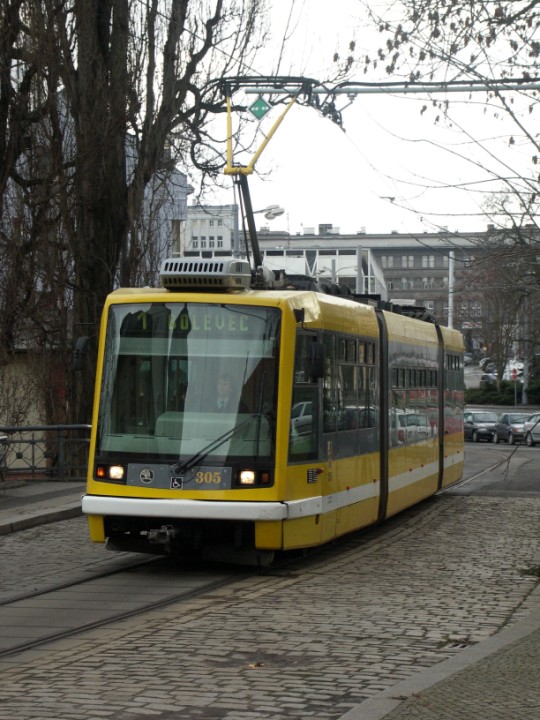
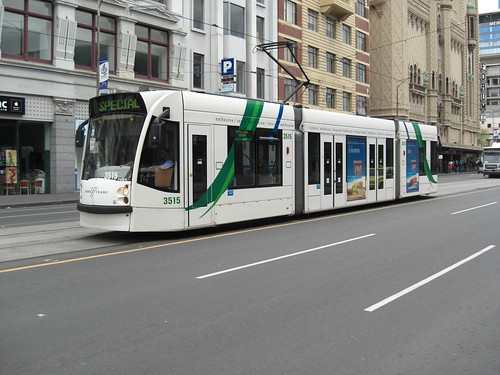
Over at M1ek's I posted a few photos of some Combino trams from different places around the world to show how you can scale the vehicles to fit within any environment. Depending on the capacity needs, there might only use for one streetcar. However, if there are higher passenger volumes, then there are two ways to accommodate this. Either by coupling cars or modular design. Coupling cars is possible, below is a photo of the Skoda T3 in Plzen Czech Republic, the same vehicle as the Portland Streetcar, with couplers.


Photos Courtesy of NYCSubway.org

The next option is the modular tram. Basically, you can build to specifications you want. According to the Siemens website, they c trams from 18 to 72 meters (60 feet to 236 feet) almost 4/5ths of a football field.

Sorry for the bad picture but I stole it from Tom Furmaniak's powerpoint on streetcar tech.

Real Examples below:

Combino - 3 Sections

Flickr Photo by: Johnzebedee

Combino Ultra - 5 Sections

Photo Courtesy of Gen Gibson

Combino Supra: 6 Sections

Flickr photo courtesy of Tschaut

This is the same for the other tram companies including Ansaldo Breda, Skoda, Kinky Sharyo, Bombardier, and Alstom's Citadis Tram.

Sunday, April 27, 2008

Transport Genocide and the Revenge Veto

I like competition but not when its at the expense of working people and pits cities in the United States against each other. This isn't a strategy, its a systematic genocide by the road warriors and privatization crowd at DOT. I know that we talk about the transit space race but its supposed to be a healthy competition rather than a death match. But it's what is happening around the country. The federal government, instead of figuring out how to build the transit projects that everyone wants, is pitting cities against each other for funding. Why doesn't this happen for roads? And why, if one entity with selfish interests in mind instead of the interests of the overall consensus in a region, is a project put in jeopardy?

But an official familiar with the federal transit funding process said, "This is a competitive process with projects around the country. The more everyone's singing off the same page, the more it moves it ahead of other projects"

The most recent example of this idiocy is the Central Corridor in the Twin Cities. Basically though, after the DFL party overrode a major transportation veto by Governor Pawlenty, he decided to veto the funding for the Central Corridor. No one has come out and said it, but its revenge. Nothing more and nothing less. He is certainly in the minority on this issue in the state and is being a good little Republican and hoping to get some street cred for opposing transit it seems like it could be in part for a chance at being John McCain's second hand man.

But this also opened up an opportunity for others to kill the project because they don't like the idea that it would slow auto oriented culture. Let's not put our heads in the sand, all of this is a fight against the status quo of all cars all the time. This line is going to give Washington Street incredible people capacity, but again its all about cars.
In 2001, the Board of Regents passed a resolution stating it wanted a tunnel under Washington Avenue. If not that, a route along the northern edge of campus, through Dinkytown. If not that, a ground-level route along Washington — but only if someone could figure out how to fix the resulting traffic nightmares and how to pay for those fixes.
Since the U didn't get its tunnel because of our favorite "Cost Effectiveness Measure" it started throwing a fit over the fact that the line was going to be on Washington Avenue. All along the way though, the University threw up road blocks:

The Met Council briefly looked at the Dinkytown route but discarded it out of concerns it would be too expensive. The tunnel was in. Then, the U decided to build a Gophers football stadium on the tunnel's route, forcing a rerouting of the already pricey tunnel and adding more than $100 million to its price tag. The tunnel was out; Washington Avenue at street level was in.

...

The full weight of the U's position wasn't widely understood April 7, when Gov. Tim Pawlenty vetoed $70 million in state funding for the Central Corridor, citing, among other things, concerns surrounding the route through the university.

Two days later, the U released preliminary findings of its consultant's report on the Dinkytown route. The findings suggested that route would be cheaper and faster than one along Washington Avenue. The preliminary findings do not yet project ridership levels or how that route would measure up to a complex federal funding formula.

The change will not kill ridership on the line, but will lower the cost effectiveness rating. Perhaps to the point where the line does not pass muster with the FTA. How many times does it have to be said that you can't go around a major center of activity. The measures for transit are bad, this all could have been avoided with the initial tunnel that the University wanted and everyone was willing to invest in. Instead, the line is in limbo all due to the fact that the process can't measure a line for its real benefits and the government does not see the importance of new rapid transit lines enough to fund more. Lets hope this changes soon.

Saturday, April 26, 2008

Why I Love Taking BART to My Gramma's House


Here is a video I took with my digital camera on the way to my Gramma's last week. I had decided not to drive and call my Dad to pick me up because my folks were in town. Good thing I did!

P1010105

Sometimes however I walk the three miles instead of calling for a ride. And I always go up this street:

P1010101

And down this trail that was once a railroad right of way:

P1010102

Needless to say I actually do go over a river and through the woods to my Gramma's house.

Thursday, April 24, 2008

$8 Dollar a Gallon Gas

In Europe. They've known about how to deal with high gas taxes for a long time. Even so some are feeling the pinch, but most have alternatives. Here is an article from the San Francisco Chronicle discussing the issue:
"We are much better equipped than the U.S. to deal with higher prices and a more volatile market because we are so much less oil intensive than you are," said Noel, who bikes to work.

Europe generally has far better public transportation than the United States, with workers in countries like Britain, Belgium and France packing morning commuter trains and subways. Transportation planning increasingly factors in bike lanes, and more innovative mayors like those in Paris and London are designing schemes to facilitate alternative transport - and to make driving an ever more arduous option.

Wednesday, April 23, 2008

Do Things Like This Hurt or Help?

Ugh...while we've been working hard to get the word out on transit and I wrote in an earlier post that electric rail as we know was actually created after the auto as we know it, we still get folks like Jon Stewart who should be a great help doing stuff like this. I know he's trying to be funny, but does this really help the cause? Perhaps you can tell me if I'm being too persnickety. The section is 47 seconds in.


Hat tip to reader Joe C.