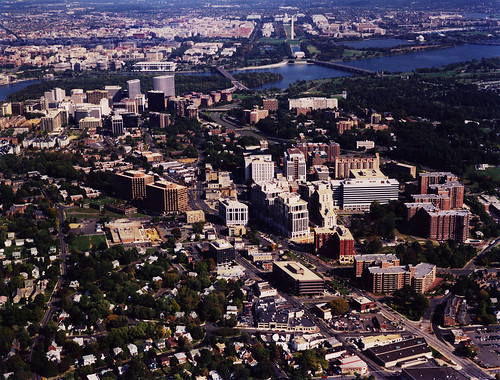
Arlington County Virginia
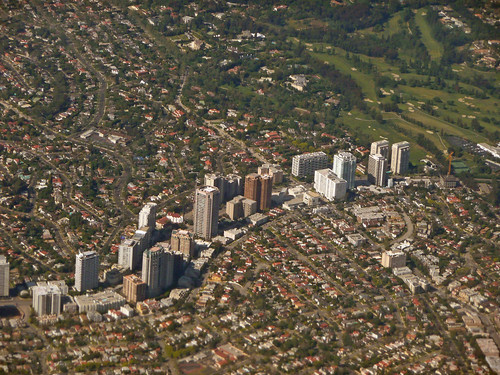
Wilshire Blvd: Flickr by ATIS 547
Boston Back Bay on the Green Line


Peachtree Street in Atlanta

I know there are more. Anyone have a corridor to share?
On Wednesday, a survey of 900 Coldwell Banker agents showed a remarkable 96 percent said that rising gas prices were a concern to their clients, and 78 percent said higher fuel costs are increasing their desire for city living.Worth the read. H/T Eliza H.
...
"When we decided that we were going to make a move we basically put a dot in the middle of the map where my office is and said, `We are not going to live farther than essentially a 20-minute circle around that,'" Bulkeley said.
Recent news that a Baltimore Red Line with all the proverbial bells and whistles may not be eligible for federal funding should come as no surprise. The Federal Transit Administration funding formula is notoriously stingy, and an east-west light rail line with much tunneling would be pricey.This is understandable, we want to be smart with our money, but they go on to make more good points...
Every new transit line must demonstrate cost-effectiveness. That's just common sense. But the Bush administration tends to view such proposals far too conservatively while appropriating too little for transit.This is proven true by Transportation Secretary Mary "Bikes Aren't Transportation" Peters commentary which ignores what has been going on around the country and how the FTA has been manipulating ridership estimates in many communities including Portland and Norfolk by ripping planned development out of the models that estimate ridership. They just don't seem to understand the benefits of transit investment and that shows through with their rating system which offsets future planning with existing density. If you have one or the other, you end up at medium and get no boost at all. Here's her spin from her blog.
The part that frustrated me the most, however, is that the Post is calling for massive increases in federal transit investments (on top of existing massive increases to federal transit spending) while calling for an end to performance standards designed to ensure that money is invested wisely. That the Post’s writers consider it bad policy to set performance standards, demand greater accountability and require honest ridership estimates before investing billions of the taxpayer’s dollars is nothing short of shocking.Honest ridership estimates huh? How about those estimates in Charlotte and Minneapolis? They weren't allowed a modal constant and look what happens, over estimates! The fact of the matter is that using today's cost effectiveness measures, both of those projects would not have been funded! Today the CE measure must be a medium to receive funding. Both of these projects had medium low measures because of their lame ridership estimates pushed by the FTA.
Meanwhile, the administration has slashed spending on new mass transit projects while toughening approval criteria and insisting that states and localities pony up greater shares of such projects, often up to half. That has slowed the development of projects and, by so doing, has driven up costs. And while the administration is right to push congestion pricing, tolling and public-private partnerships as means to generate additional revenue and projects, they are not substitutes for a robust federal role in building the nation's mass transit capacity.The Post has it right. The trend for cities now is to not even apply because the line is so long for funding. There is cutthroat competition for so little money that many don't even want to bother. What kind of system is that? It's sad that the spinning from the Bush administration has bled into the transportation department but what can we expect from folks who don't even understand why its important to build a tunnel or an electric light rail line. They see in one dimension, moving people. Many of us see in multi-dimensions, moving people and building places where people can move themselves with low energy. This however isn't counted in the formulas and that is exactly what the Washington Post and Baltimore Sun are getting at.
Instead of providing an informed analysis of our substantial transportation record, the Post’s editorial writers offered a simplistic rehash of special interest groups’ talking points. Instead of asking whether transit agencies are using the money they have today either wisely or well, they called for fewer federal investment standards. And instead of offering a relevant contribution to the transportation dialogue, they offered rusty rhetoric and faulty facts.A substantial record that has called bike lanes a waste of money, has tried to build freeway toll lanes with transit capital money and taken bus capital money and given it to a select five cities to push their congestion pricing agenda. Spending money wisely includes figuring out ways to use less oil and allow people to spend less money on transportation. Rail and other new starts projects have proven their worth in this regard, which makes it hard to understand her reasoning that boosting investment and using better measures should be stalled using "cost effectiveness". Like the Post says, pricing has its place, but in her mind, Secretary Peters will always be about making it easier for cars in cities, but without alternatives we'll all choke, coughing up more of our hard earned money to get where we want to go.
A commuter rail study for the Houston area, unveiled Tuesday, recommends starting with five lines — but none would provide direct service to Sugar Land, The Woodlands or Kingwood, or to Bush and Hobby airports.You can find the HGAC plans here.Alan Clark, who heads transportation planning for the Houston-Galveston Area Council, where the plan was presented, said conflict with heavy freight rail operations would prevent commuter rail to those destinations in the near future.

