Elaine:
Think about that. This is nothing. No, it's not nothing, it's something. It's a nightmare! Help me! Move it! Com'on move this fu(beep) thing!! Why isn't it moving?!? What can go wrong with a train!?! It's on tracks, there's no traffic! How can a train get stuck. Step on the gas!! What could it be? You'de think the conductor would explain it to us? 'I'm sorry there's a delay we'll be moving in 5 minutes'!! I wanna hear a voice. What's that on my leg?!! *Lights in the train go off*

Wednesday, October 15, 2008

Tuesday, October 14, 2008
Magical Density Machine
In a recent email exchange on one of my numerous listserves, a bus booster has been trying to downplay the impact of light rail and streetcars on new development and shaping growth. If this is really the case, I have to wonder why those in opposition to such lines are always so worried about them changing the neighborhood. In a local Milwaukie paper (Milwaukie, Oregon not Wisconsin) a citizen worries about the density and character changes that will come with the rail line.
If I were in opposition, I would just do what all opponents do, say the next lowest mode on the totem pole would be better and cheaper. This would effectively kill the density and the transit project keeping the status quo, just like the Nimbys want.
...all are part of a thrust by the regional government to dictate the forced density they advocate. Light rail is basically a density tool, and Metro’s vision of Milwaukie is as one large Transit Oriented Development hub and over-populated switching yard.Much like the Berkeley regressive progressives (TM), its understandable that people are worried about change. But I believe this mans fears are unfounded.
As they expound on the wealth that density and rail will bring to Milwaukie, the throngs of people who will come to shop, the jobs that will be created here, I cringe. They have it backwards. Our valuable downtown property will be converted into park-and-rides or jam-packed transit-oriented developments with inadequate parking; the shoppers and jobs will go to Portland, along with the money. Remember, all roads lead to Rome.Anyone who would take valuable land and turn it into a park and ride doesn't really want to make money. Also, regional centers don't drain to the downtown and the constant worry about parking belies a autocentric thinking that is all too common in this country. I would be surprised if Milwaukie's downtown didn't turn into a vibrant center.
If I were in opposition, I would just do what all opponents do, say the next lowest mode on the totem pole would be better and cheaper. This would effectively kill the density and the transit project keeping the status quo, just like the Nimbys want.
Transportation for America Asks the Candidates to Talk About Transportation
The Transportation for America Campaign is launching tomorrow. As the last debate is tomorrow, T4A is asking folks to sign on to ask the candidates to talk about transportation issues.


Transit Not Stadium
Richard is right. We should be building transit, not sports stadiums. Even if stadiums did help districts, the investment in one place for games eight times a year is a waste compared to daily linear transit lines that can have the affect of changing the city, instead of one district. Not to mention in 20 years, stadiums are obsolete according to team owners.
UTA Ridership Up
JMD covers the surge in ridership at UTA. The new commuter rail line and light rail lines have been good investments. The expansion of five more lines will give the region an even better access and mobility.
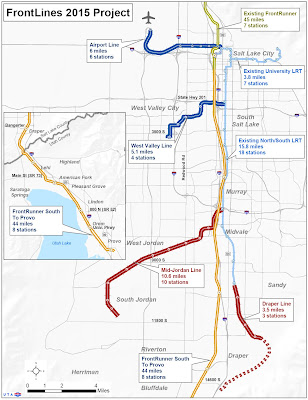
It is clear that the investment in TRAX and Front Runner is paying off. Despite there being only two TRAX lines it carries 34% of UTA's ENTIRE ridership. Add Front Runners numbers into the equation and it is at 40%. When you consider the bus system covers six counties and a couple of hundred routes, it truly shows how well TRAX and Front Runner is doing.Here's the official map they have recently put up on their website for the expansion:
Trax - 51,849
Front Runner - 8,250

I Hate It When He Does This
I'm annoyed. When Obama talks about transportation he talks about cars and roads. There have been a few times like in Portland where he talked about bikes or in PA when he talked to the GE train makers. Those are site specific and everywhere else it's usually about cars. I don't want to hear about cars. And I certainly don't want us giving money to companies who can't seem to get it right in the first place.
"We'll create 5 million new, high-wage jobs by investing in the renewable sources of energy that will eliminate the oil we currently import from the Middle East in 10 years, and we'll create 2 million jobs by rebuilding our crumbling roads, schools, and bridges," he said.
He revisited the subject again later in the speech: "It is time to protect the jobs we have and to create the jobs of tomorrow by unlocking the drive, and ingenuity, and innovation of the American people. And we should fast-track the loan guarantees we passed for our auto industry and provide more as needed so that they can build the energy-efficient cars America needs to end our dependence on foreign oil."
Why is it that Toyota and Honda consistently get the market here in America right but Detroit can't seem to figure it out? Obama talks alot about changing the way things are done in Washington. I think he needs to go a step further and talk about changeing the way we do things in State DOTs, MPOs, and Detroit.
Monday, October 13, 2008
1925 San Francisco Street Map
I wish this streetcar network were still around...

1925 San Francisco Street Map
Originally uploaded by Dollar Bin
1925 San Francisco Street Map
Originally uploaded by Dollar Bin
Living in Exurbia Getting Expensive
In case you missed it, this PBS show NOW talks about the tough times people are having living far from their jobs. My coworker Gloria is in the film too. I will say, one thing that bothered me is the interviews almost seemed like caricatures of people who live in urban places and in the exurbs. But at least we're starting to cover the issues as they continue to hit people hard.
Some Things Never Change: Part 3,000
In a Metropolis, Everybody benefits from Public Transportation...
H/T RS
H/T RS
Congrats to Krugman
Seems he won some Nobel Prize. From Nobel:
Economies of scale combined with reduced transport costs also help to explain why an increasingly larger share of the world population lives in cities and why similar economic activities are concentrated in the same locations. Lower transport costs can trigger a self-reinforcing process whereby a growing metropolitan population gives rise to increased large-scale production, higher real wages and a more diversified supply of goods. This, in turn, stimulates further migration to cities. Krugman's theories have shown that the outcome of these processes can well be that regions become divided into a high-technology urbanized core and a less developed "periphery".Let's look back to what he's said on transit...
But none of it amounts to much. For example, some major public transit systems are excited about ridership gains of 5 or 10 percent. But fewer than 5 percent of Americans take public transit to work, so this surge of riders takes only a relative handful of drivers off the road.Any serious reduction in American driving will require more than this — it will mean changing how and where many of us live. To see what I’m talking about, consider where I am at the moment: in a pleasant, middle-class neighborhood consisting mainly of four- or five-story apartment buildings, with easy access to public transit and plenty of local shopping.
It’s the kind of neighborhood in which people don’t have to drive a lot, but it’s also a kind of neighborhood that barely exists in America, even in big metropolitan areas. Greater Atlanta has roughly the same population as Greater Berlin — but Berlin is a city of trains, buses and bikes, while Atlanta is a city of cars, cars and cars.
Subscribe to:
Posts (Atom)