After years of defeats and futility, Blumenauer is convinced the odds are increasing that Congress could approve this investing as much as $50 billion to improve infrastructure with more next year if Obama is elected.I'm sure we'll see more discussion of this as we get closer to and after election day. Depending on who gets elected, it could break either way. I've already seen a number of opposition blogs and talkers posting an earlier post from the DOT's economist that was posted to Ma Peters blog. That post has also been discussed by Ryan as well. I remember when people were saying Gore and Bush were the same. Even though they were different, no one would make such a statement today with the current candidates and on issues like this.
Tuesday, October 21, 2008
The Earl of Transit
The push for an infrastructure stimulus is ramping up and Congressman Earl Blumenauer of Portland is taking the lead.

TODcasts Available from MTC
Even if you can't be in the station areas, these Podcasts about TOD in the Bay Area are interesting and have a lot of information. I highly recommend them if you're in the area and want to go TOD sightseeing as well. There are five of them including Hayward BART, San Pablo's BRT, San Francisco's Third Street Corridor, Redwood Caltrain, San Jose Downtown. Check em out.
Repaving on the Orange Line
While the transit agency is blaming the contractor, the contractor is blaming the weight of the buses. The total cost will be about $2 million dollars to repave to the right strength. I wonder how soon the pavement will deteriorate on the rest of the line that was built correctly. Does anyone know how long until they fixed the Pittsburgh busway? I can't seem to find any information on it.
Monday, October 20, 2008
Transit Trouble Coming from Wall Street
This could cause transit agencies trouble. Basically, transit agencies make deals for cash where they sell their capital assets such as buses and trains then lease them back. Metro could owe millions over those leaseback deals.
It hasn't happened yet, but if it does, the agency would have no choice but to slash service drastically. It could also hit BART, Muni, WMATA, and the CTA though there was no hint AIG was involved in those as well.Things started to go downhill when AIG ran short of cash after running up billions in losses tied to the housing slump. Its credit ratings were slashed and the firm was on the verge of collapse last month when it was bailed out by the federal government.
The lower credit ratings triggered a clause in the lease-back agreements that require the MTA to either find a new firm to guarantee the deals, or reimburse investors for their down payments and lost tax benefits, — a scenario that could cost the transit agency between $100 million and $300 million.
Many of the nation’s largest transit agencies participated in such deals. Among them are the San Francisco Muni system, the BART rail system in the Bay Area, the Chicago Transit Authority and the Washington, D.C., Metro system.
Investment Spending
This is what I talk about when I get annoyed that the FTA won't build tunnels and instead points the cost effectiveness of bus rapid transit. While the cost of the tunnel is more, it sure lasts a long time, and should be amortized as such.
And as people like Minnesota congressman James Oberstar have pointed out, the failure to separate government investment from government consumption has perverse effects on how the government spends money, leading it to emphasize projects that cost less on an annual basis but more on a long-term basis, while also leading us to underestimate the benefits to the economy at large of investments in things like infrastructure, basic research, and so on.As Oberstar said:
Many argue that our current method of accounting biases spending decisions against physical infrastructure by requiring infrastructure to be paid for all at once rather than over its useful life. Thus, infrastructure investments are not judged on their long-term economic return, but rather on a distorted view of their "up-front" impact on the budget.H/T Bellows
Sunday, October 19, 2008
No Typewriters?

With gas prices coming down many transit agencies might be feeling a bit better about their balance sheets. But it's a short term deal. The oil cartel is looking to boost prices again. I feel like we need to invest more in electric transit including trolleybuses on core routes. Unfortunately, a trolleybus revolution does not seem to be upon us. Wires baby wires?
October in San Francisco
Another weekend, another Muni Fail to the game. I got passed by three 22 Fillmore buses before I could get on one. I'm even more convinced now that more buses on routes are not the answer with the constant special events on the weekend. It's a North South subway. Even if the J just went underground at Market Street and continued North to the Marina it would be worth it. In any event, I had another exciting Saturday watching the Texas game and went to the Red Bull Soap Box Derby which was only a few blocks from my house.
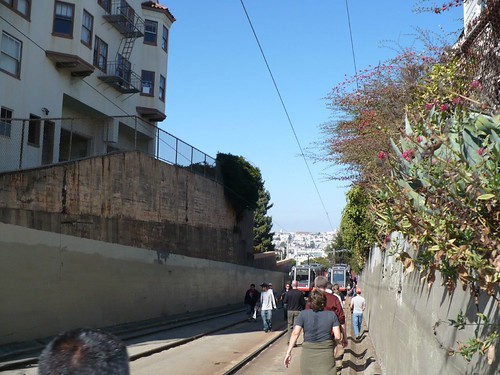
Muni LRV at Dolores Park

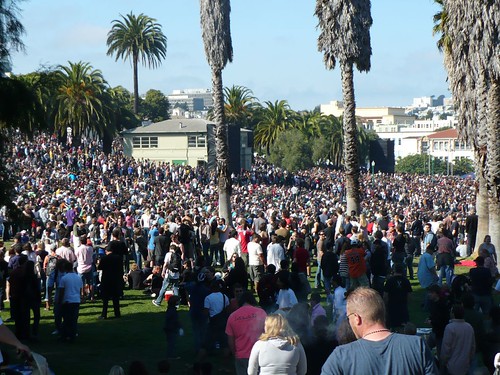
The Derby had an attendance of 75,000.

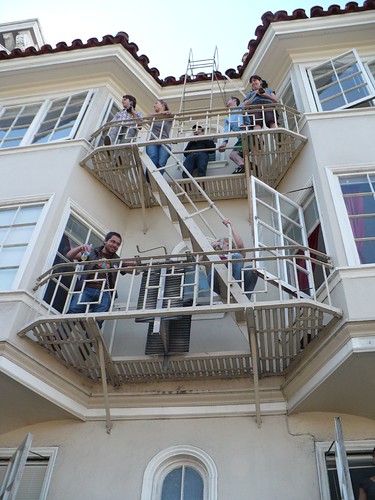
People were hanging from windows and fire escapes

Lots of trespassers on the private ROW

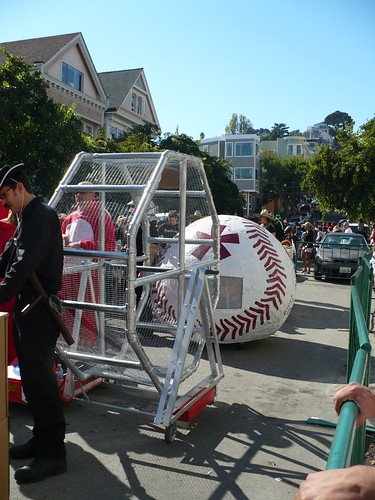
Soap Box Vehicles. A hamster wheel that spun and a baseball

Here are a few Videos from the Derby. My favorite was the Death Star, but the fastest I saw was the fire truck....woosh.
Fire Truck
Death Star
Rubicks Cube
Muni LRV at Dolores Park
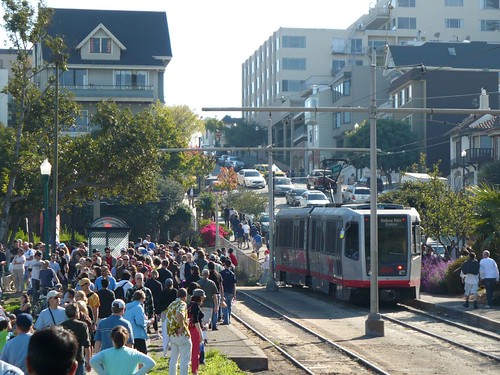
The Derby had an attendance of 75,000.
People were hanging from windows and fire escapes
Lots of trespassers on the private ROW
Soap Box Vehicles. A hamster wheel that spun and a baseball
Here are a few Videos from the Derby. My favorite was the Death Star, but the fastest I saw was the fire truck....woosh.
Fire Truck
Death Star
Rubicks Cube
Queen Sized Microcosm
Charlotte leaders asked the federal government to pay for their new light rail line, platform extensions and new vehicles for the existing line, and a north commuter line. Given funding constraints at the federal level you can probably guess what happened. The FTA said they didn't have enough money. As discussed previously, there is a 77 year demand for transit expansion in this country and this just proves that there is either going to need to be a serious infusion of funding for transit on the federal level or cities are going to have to come up with the money themselves. Keith Parker at CATS has made these types of comments as well saying:
...Parker said he'll likely brainstorm other ways to raise money so rail lines can be built sooner.After years of spending on things other than transit, the Mr. Parker has the right idea about trying to catch up, which would make it cheaper in the long run. Their 10 year wait for the first line did nothing but cause project inflation and almost lost them thier funding source all together with the referendum last year. Yet Pat McCrory, the Mayor, Gubernatorial candidate, and staunch transit supporter, is against the idea of using any funding outside of the current half cent funding stream.
...
With the cost of raw materials rising, Parker believes it's important to build Charlotte's rapid transit in the next decade, rather than by 2035, the finish line in the current plan. If the federal government isn't willing to send more money to CATS, Parker said he may bring the Metropolitan Transit Commission and the Charlotte City Council options.
McCrory said this week he doesn't want to consider a new tax or bond to build the transit system sooner. CATS already wants to use some property taxes to build the commuter rail line, and the city of Charlotte is considering the same for the streetcar.
“We'll have to live within the confines of the half-cent sales tax,” McCrory said. “During these economic times we'll have to be both economically and politically pragmatic. And at times, patient.”
In transit funding, patience costs money, and there are other ways to pay for transit projects. Because transit creates value that often isn't credited to it, there needs to be more attention paid to the value is created and capturing it to pay for the project. Putting a cage on it isn't the answer.
Subscribe to:
Posts (Atom)