Saturday, November 22, 2008

Not a Train, Never Will Be

BRT is not "rail-like". It is not a replacement for rail but rather an upgrade on a specific corridor from what exists. Buses in their own lanes are better, but they are not "rail-like".

In addition, the opposition needs to stop whining about the bus bringing higher densities to the corridor and reducing parking spaces. Parking is not free and the pavement has a better use than storing your car. You live in the East Bay on the best corridors to reduce VMT and oil dependence, and I imagine you talk about being green all the time. Yet you oppose density and better transit that will help that goal.

Cunradi agreed parking space losses are a serious issue. To offset the impact, the transit district will consider developing parking lots or garages, or installing parking meters on commercial side streets so the spaces turn over faster, he said.

Greg Harper, an AC Transit board member from Emeryville, said the fear of denser development is an underlying fear that has fueled opposition to bus rapid transit.

The transit district should not be responsible for replacing parking. The city should not be responsible for paying for parking for specific merchants or anyone for that matter. Parking is not free. Losing a number of parking spaces is a small price to pay for better transit.

Also a bit of warning to those who think that BRT is "rail-like". BRT will never be replaced by light rail. There is no example of BRT ever being taken out and replaced by rail. Once its there, that's it. Buses. That is not to say that it doesn't have its place in the network, but if a corridor needs rail, and buses are used, an upgrade is a long time coming, if ever.

Friday, November 21, 2008

Friday Night Linkfest

More requests for the Orange Line to be Light Rail. They even quote us. But please stop using the most recent light rail line in Los Angeles is the end all of cost estimates for light rail. It would NOT cost $150 million a mile to build light rail.
~~~
Dan at HugeAssCity hopes for better urban design for the Viaduct replacement. I hope for a rapid streetcar instead of just the waterfront trolley.
~~~
I don't see why they can't charge for parking at Metro Stations during inauguration. Perhaps that would pay for the extra rush hour service that's going all day.
~~~
Good thing the opposition in Salt Lake didn't get UTA rolled into UDOT. From Transit in Utah:
UDOT puts $3.9B in projects on hold. While I have mentioned this over and over again, I must hammer this home. If a certain group of puppets from a certain so called riders union would have gotten their way and transferred UTA over to UDOT, transit funding would now moved over to highways and that is the goal of the people who run that organization.
~~~
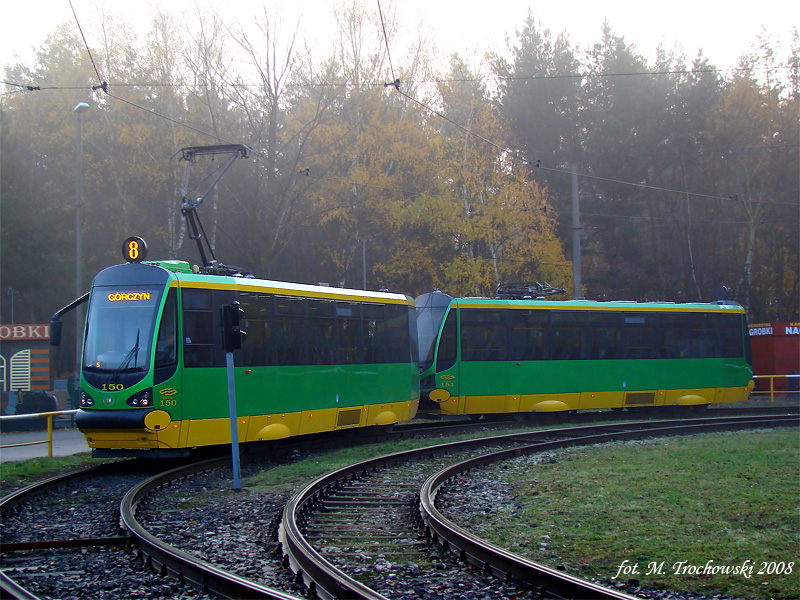
There are seven Tram companies in Poland. Seven. Some of the models look pretty sweet.
As many as seven companies are active in the tram building market in Poland, suggesting that competition may develop in the coming years. In many ways the market is quite open, as conditions are similar in the various cities.

Thursday, November 20, 2008

Running: NCAA XC Championships on Monday

It's that time of year. The Monday before Thanksgiving is always XC day. My buddy Jake runs for Texas and is going to be in the hunt, below he talks about his chances. He just missed the Olympics in the Steeple by one place and is looking for some redemption. Below, Jake talks about nationals coming up Monday: "It's always nuts, Terra Haute is crazy. It's like a war. Running through this field is like Braveheart."

Visit Flotrack For More Videos

If anyone is into the running thing, the places to be are Flotrack and Letsrun.

GMing the System

For years the auto industry hid behind Jon Dingell as they constantly lobbied against requirements to raise fuel efficiency. No more hiding behind those coat tails. Waxman is in charge. Now let's not forget what Waxman has done in the past. His own constituent pandering led to a ban on federal funds being used for a Westside Subway, one that would have been much cheaper than it is now. That's not to say that prudence wasn't necessary after the explosion, but once it was deemed safe to tunnel it shouldn't have stayed a ban.

He recently redeemed himself when he helped to lift the ban, but let's hope there aren't any more of these types of issues. To be fair, I don't see any of these problems arising and I see a new generation shift. We're looking at the environment, energy and transportation different than before. And the vote today shows that shift happening.
Sources inside the Democratic House Caucus say the vote against outgoing Energy and Commerce Committee Chairman Rep. John Dingell turned partly along generational lines - with young turks lining up against the old - and partly because of Dingell's record on environmental issues.
They would have gotten away with it, if it weren't for those pesky kids.

Obama Writes to the T4 Campaign

The letter was released a bit late for the election, but I think it says what we all like to hear. Now its that implementation thing that's tricky. My favorite section:
I will also re-commit federal resources to public mass transportation projects across the country. I’ve worked to improve transportation access to jobs for people with lower incomes since my time in the Illinois State Senate, and I will continue this work as President. And I will further promote transit by creating incentives for transit usage that are equal to the current incentives for driving.

As you know, all of these measures will have significant environmental and metropolitan planning advantages and help diversify our nation’s transportation infrastructure. Everyone benefits if we can leave our cars, walk, bicycle and access other transportation alternatives. I agree that we can stop wasteful spending and save Americans money, and as president, I will re- evaluate the transportation funding process to ensure that smart growth considerations are taken into account.

I will build upon my efforts in the Senate to ensure that more Metropolitan Planning Organizations create policies to incentivize greater bicycle and pedestrian usage of roads and sidewalks. And as president, I will work to provide states and local governments with the resources they need to address sprawl and create more livable communities.

Wednesday, November 19, 2008

Is TOD the New Black?

So says a paper in Brisbane. I think people put a lot of effort into TOD and sometimes they put too much pressure on them. Loading TOD up with affordable housing, infrastructure upgrades, transit upgrades, urban design, density, parking etc etc is more likely than not to kill good projects or make them scaled down from what they could be.

I'm worried about making TOD the answer to all of our problems. It's a PART of the solution but there are a lot of things that need to be done. As well, we need more transit if we're going to get more TOD. The more transit you have, the more ability more of the market has to get access to it which is always a good thing. Making high quality transit an exclusive good is never a smart bet.

New Poll: Newest Member of the Transit Space Race

Ok, since there were a lot of poll requests today, we're going to do another week long poll. I liked all the ideas that were posted and I'll try to get to all of them in some form or fashion. So here's today's poll. What will be the next city to pass a tax or figure out a way to generate massive revenue to expand their system multiple lines and enter the Transit Space Race?

Poll is below the pantograph picture again.

Here are the choices:

Atlanta - They have a concept 3 idea, but no money to fund it as of yet.
Austin - Planning for years, commuter rail and light rail ideas on the table
Norfolk - They are constructing their first LRT line and the new Mayor of Virginia Beach is getting excited about extensions
Raleigh Durham - They have a plan but no huge cash to play with
Sacramento - Having discussions, problems too.
St. Louis - Just missed the half cent this last time, next time better?
Tampa - Mayor Pam is on a roll lately
Cincinnati - Building a Streetcar soon, but will they be tough enough for more?
Columbus - Will they beat thier neighbor Cinci for faster expansion?
Detroit - Planning for light rail on Woodward is underway, will there be a funding source larger than TIFs?
Madison - They have a plan too, but is an RTA forthcoming?
Milwaukee - They just passed a transit operations fund, Capital coming?
Dallas - They are already expanding fast, but will they get a regional commuter rail plan together?

So there you have it, if there is another city that should be in the mix, you'll have to vote other, and leave a comment about which one I missed.

Take a Walk Down To Electric Avenue

There was an article today in the New York Times discussing spending out infrastructure money wisely. So many times we've build freeways to nowhere and sports stadiums instead of things that will actually make our cities livable. It's kind of funny because the article really repudiates everything that Mary Peters is all about, yet she twisted it to her idea of funding. No Ma Pete, it's not about toll roading for new capacity. The article discusses what is wrong with the system:
It’s hard to exaggerate how scattershot the current system is. Government agencies usually don’t even have to do a rigorous analysis of a project or how it would affect traffic and the environment, relative to its cost and to the alternatives — before deciding whether to proceed. In one recent survey of local officials, almost 80 percent said they had based their decisions largely on politics, while fewer than 20 percent cited a project’s potential benefits.
This means most of those toll roads that she wants. It also means the sprawl roads that really have no environmental or fiscal benefits, such as the one we discussed yesterday. Yet Mary Peters still wants a cost benefit analysis done on projects. If it's the one that she's performing on the Central Corridor or the Dulles extension no thanks. We need better measures, and ones that put livability before driving fast or moving more cars.

But we also see articles like this, where the utilities are thinking about ordering electric cars. What the heck are you thinking? String up some wires on major corridors and order some buses that can be made fast. If they were so worried about making the shift to electric vehicles, they should start with modest changes now and public transport.
One interesting point the Journal piece gets into is that utilities want to play a much bigger role in managing the shift to electrified transport, to ensure that it doesn't put strain on the grid the way that the sudden burst in popularity of air conditioners did after World War II, taking the power industry by surprise.
On trunk lines this would be cheaper for the transit agency and the electric company, not diesel makers, would be pulling in more money. I'm ashamed we have such tunnel vision.

Tuesday, November 18, 2008

LRV Poll Results

Obviously not scientific, but interesting nonetheless.


Anyone have any further poll requests?

Too Easy to Build Roads

The Mountain View Corridor in Salt Lake City is a freeway to nowhere. It's basically a sprawl inducer and didn't have to go through any rigorous alternatives analysis to be built or have a cost effectiveness measure attached to auto trips, it also didn't need to prove that future residential infrastructure could pay for itself. And already, they are admitting the fault of freeways in general by paying for mitigation for local elementary schools. Well only little kids are in those schools and only a certain amount of time during the day. When are we going to figure it out?
The state also compromised with groups fearing the freeway's placement near several schools endangered children's lungs. UDOT will spend $3.1 million to filter air inside the schools and $1 million to monitor the air outside. It also will pay to relocate Hillside Elementary if school officials request that.
They are putting bus rapid transit in a separate parallel corridor which was a concession to environmentalists but instead of building a freeway up the corridor, why not just build a boulevard that could be used for better development and transit integration in the future. This is extremely short sighted and not very innovative. Another blown chance for a smarter way to grow.