Sunday, February 15, 2009

Destroying What You're Trying to Protect

The divide in understanding transportation's value to working families is rather disheartening. At one time, automobiles were seen as the great equalizer, allowing upward mobility for the masses. Sometime along the way, they went from being a benefit to being a burden. Costs of ownership increased as land use patterns led Americans to drive even further away from their workplaces in search of an inexpensive place to raise a family that had a yard for the dog. But that house was in a place where the family had to buy two or even three cars to keep mobile.

But that push through subsidy towards the suburban ideal, has left us with lopsided policy that spends more money than we need to on urban development and mobility. It also leads people to believe that transit is a tool of the poor alone, not seeing the possible benefits to them personally. A recent New York Review of Books (via T4A) article notes that the poor are a large part of the transit constituency and that the regressive effects of a carbon tax should be offset by building more buses.
Investment in the infrastructure of a post-auto-industrial society would provide some compensation for the regressive effects of a carbon tax (or of the increase in prices that would result from a "cap and trade" scheme, as industries passed on the costs of compliance to consumers). It would be an investment in the technologies that are used by poor people, including buses, bus stops, and information about the departures of buses and transit vans.
But what about the middle class? They are squeezed as well with rising costs of automobiling and rising home costs in cities. An answer that has become more palatable is increasing transit funding and moving towards better land use patterns and policies that would increase housing in the core. This change would allow people to save money, and allow them to live within their means by saving money on transportation costs.

But others don't see it that way. Some conservatives and especially libertarians would have you think that freedom is the automobile and that everyone wants to live in a big house with three cars. They believe so much so in this that anything else is forced upon those who we know are actually self selecting. Here is Milwaukee uber conservative Patrick McIlheran:

What's more, people can and do live transit-oriented lives along these Milwaukee streets and others. While Bernstein argued that people here are made poorer by having to drive a lot, the fact is that there's a lot of reasonable real estate next to scheduled transit, should you want it.

...

Dense, transit-oriented living is good and useful for those who seek it. Where its enthusiasts err is in feeling that many more people, maybe all, should be seeking it and that spending lots of tax money will make that happen.

Yeah, TOD isn't going to be everyone's choice, rational thinkers know that, but the problem here is that we're spending lots of tax money to make automobiling happen and not investing in the other pieces of the transportation spectrum or sustainable development. But the mistake he makes here is the idea that buses are for the poor or people who want that lifestyle, but they don't deserve better service that might increase the demand.

Sure people could choose to live a transit oriented lifestyle on the existing bus system, but last time I heard, Milwaukee conservatives have been starving it to death, creating a situation where its not really an option. They don't just have a thing against trains, they have a thing against quality transit. And that is too bad because they are punishing those who they think they are trying to help. Since when did the idea of pooling money for an outcome that is a common good become a bad idea? The savings would be incredible and its unfortunate that the disconnect is even there.

The thing that Patrick is railing against is actually what he's advocating on the other end. It's hypocrisy at its greatest, pushing away from what the market is actually working towards and artificially going the other way. One would hope that if he really wanted to save taxpayer money, he would advocate for the most efficient land use patterns and push for less tax revenue going to large road projects and into projects that could save a lot of people money. In essence, he's pushing for people to spend thousands more so they can save hundreds. This never made sense to me.

Digging Up the Past

I always like reading these articles. It's cool that you can find history right under the streets. Usually it's just utilities and such, but sometimes you find more...
When the site for MacArthur Center was excavated in 1997, discoveries included a Hessian gold coin, 4,000-year-old spear points, Colonial-era pottery shards and a 19th-century medicine bottle.
...
Streetcar tracks are not uncommon, he said, and often "ugly to remove. There's usually a large concrete footer beneath the tracks to work around." Streetcars ran in Norfolk from about 1870 to 1948. He's also come across old retaining walls and bulkheads since parts of Norfolk were underwater."We just punch our way right through them," Swan said. When improving Boush Street several years ago, he said, the most unexpected obstacle was a live Western Union telegraph line.
In other places around the world such as Rome, it can get a bit crazy digging for subways.

Saturday, February 14, 2009

Rainy Saturday Links

Looks like planning for the streetcar and future fixed guideway transit is in the works for Portland. You can find more info here at Metro's site.
~~~
More proof that the Republicans are morons and have devolved to a party that just tries to win the news cycle. The cries that Harry Reid wants HSR to Vegas to get all the money is just ridiculous and is unfounded. Give me a break guys. Grasping at straws. And the fact that the media is reporting this dreck is disgusting. Yonah has more info, and it shows what kind of junk we'll have to fight back against. Good thing we've had some good training against the likes of O'Toole, Cox and the lot. Quote of the day from the LA Times...
(Dem Rep. David) Obey also took issue with Republicans' efforts to portray the rail funding as an earmark. "The worst thing that people can do in this town is to believe their own baloney," he said. Noting that funding decisions will be made by the Department of Transportation, he added, "The last time I looked, the new Cabinet secretary was a Republican."
~~~
Bills are expected to go through the Texas legislature soon that would allow Dallas - Ft. Worth to have a vote to build a regional rail network.
~~~
Salt Lake City is looking to use redevelopment districts to help pay for the streetcar. I think consultants and locals are not thinking outside the box on funding. This seems to be the first answer they come up with, as we saw in Charlotte recently. Consultants, stop being so boring!!!
~~~
An interesting story about streetcars that once ran in Jamaica.

Friday, February 13, 2009

PBS Program NOW Talks Transit

I've been watching the PBS Now program live on transit and it's great. I highly suggest it. Check your local listings for this program over the weekend or watch it below.

Norfolk Officially Enters Transit Space Race

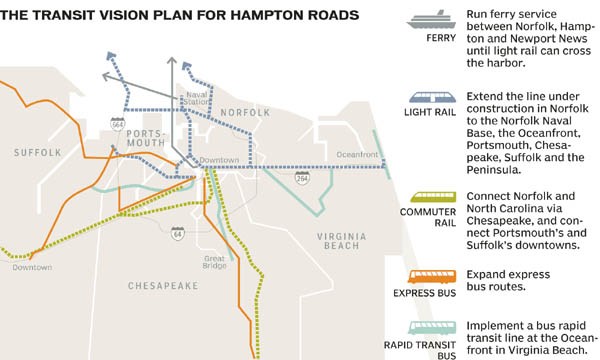
Sure they don't have funding but they are building their first line and have big plans for a regional transit network chock full of commuter rail, light rail, express buses and more. That's right Norfolk Virginia, the 34th largest metropolitan area by population just ahead of Charlotte, Providence, Milwaukee and Austin.

It looks like about 4 light rail extensions would be planned and commuter rail that would stretch to Richmond. The thought that they would shift monies to transit away from highway projects would be huge as well. It looks as if regions are starting to figure it out.

Robert Case, a transportation engineer who manages the study for the Hampton Roads Metropolitan Planning Organization, said there is growing political interest in shifting resources from highway projects to transit. He said such a shift would be a "sea change" and would require changes in land use and funding priorities.

The plan calls for creating higher-density and mixed-use development patterns in some areas to support an expanded transit network.

Thursday, February 12, 2009

Whither Dubai

Since the workers and money are leaving in droves, I wonder if this means that the Alstom APS light rail system and subway will be put on hold soon.

Elizabeth Avenue

Elizabeth Avenue in Charlotte is getting reconstructed. Instead of ripping it up again later for the streetcar, they are putting in the tracks now. It cost $5 million extra to do it but it's well worth it. Today they are done with the first section of the street, and the businesses are worried because the second section will affect them but they understand that once its done, they'll be better off.

P1010549

P1010564

P1010547

P1010573

P1010589

Energy Question

So I've been thinking a lot about the BRT report and comments on the (edited from CCT: Purple Line) in this post. The WRI study states that BRT is better for reductions in GHGs than LRT because LRT comes from dirty sources such as coal. Ok, I'll bite. Here's Greg Fuhs (from WRI) very fair comment at the end of my last post:
What we (and MTA) are saying is that by building a medium or high investment BRT system in the corridor, this would reduce GHG emissions from current levels by getting more people out of single vehicles and moving them more efficiently along the corridor than is currently the case. The significant fuel savings from this system would lead to the reduced GHG levels.

The reason light rail would increase GHG emissions over No Build is due to the electricity source, which for this region is primarily coal-fired power plants. While people would leave their cars and move more efficiently along the corridor with light rail, the coal plant emissions generated to produce the electricity required for the Purple Line would exceed the emissions savings from getting people out of their cars.
Now I understand this argument, but I have to dive in a little deeper. I'm wondering if the following thought is true. If you build an electric system, bus or rail, more electricity has to be produced during peak periods where the rail line is more efficient than the buses burning diesel. At the same time, during the off-peak, does the powerplant have to produce extra power or does that energy already exist in the grid.

I've heard ideas about the power grid benefitting from off peak power usage because the plant was going to run no matter what, but I'm wondering if the GHG's are already being produced, therefor any other emissions such as those from the bus are on top of what already existed from the power plant whether the light rail line was there or not. If this were the case, doesn't that reduce the emissions factor of the LRVs because the emissions are already out there from the coal plant? Does anyone know the answer to this or other ideas?

Wednesday, February 11, 2009

Signs of the Apocalypse 2

The editor of an automotive magazine (Auto Week) commented that auto makers should start building light rail systems in the United States.
One of the shrewdest things the domestic auto industry could do is begin planning to produce light-rail systems.
...

OK, light rail would be competition for cars and trucks. But if it's coming anyway, why not get a piece of the action?

Yes, I know Michael Moore mentioned the same thing a few months ago. But how dumb would it be to ignore a good idea just because it was supported by someone who usually doesn't have a clue

It's nice to know they really think that light rail is competition for automobiles. Apparently they are still worried about losing market share. As much as I like this idea in theory I think it would turn out horrible in practice unless:

A. They bought designs from existing light rail vendor such as Siemens
B. They allowed local transit agencies to appoint quality control inspectors
C. There is an adopted standard for vehicles agreed upon like in the era of the PCC

I'm sure you all have some ideas too...

Not "The Highway Bill"

I know I've said this before, but it shows where the priorities are for people in the press. They still talk about the 'Highway' bill like that was the only thing the transportation bill funded.
As soon as the stimulus bill is completed, Mica said, the committee is “ready to launch a full effort” to get a highway bill done both on time and with significantly higher investments.
We have a lot of work to do. And...OMG BBQ ponies!