Sunday, September 16, 2007

Dear Secretary Peters, You Are Wrong.

I've been following this story since Streetsblog picked it up. Since Secretary Peters doesn't think that biking and walking is transportation, then what is? In her mind, and the mind of the Oil Industrial Complex, anything that doesn't serve cars is worthless to them. Salon had an article recently discussing the issue and seems to support the cycling community.

So why is Peters suddenly taking on bikes and pedestrians? Her comments are especially odd since she sang the praises of bikes as transportation in a speech at the National Bike Summit in Washington, in March 2002. Has she simply forgotten the glory of two wheels? One theory: Peters is on a campaign to quash the idea of raising the gas tax, as she editorialized recently in the Washington Post. A key proponent of raising the gas tax to fund bridge restorations in the wake of the Minneapolis bridge collapse is Democratic Rep. Jim Oberstar of Minnesota, who has advocated for bike and pedestrian paths in his district. By putting a culture-war spin on the bridge collapse, Peters is hoping to run his gas tax proposal off the road.
So once again its about money and the conservatives are going to their old fall back of fiscal responsibility which is a laudable goal, but recently has been used to block programs they don't like. Raise it up 5 cents Mr. Oberstar. Even Mr. Greenspan agrees because as he says in this New York Times article from 2006:

Until now. In late September, as he spoke to a group of business executives in Massachusetts, a question was posed as to whether he’d like to see an increase in the federal gasoline tax, which has stood at 18.4 cents a gallon since 1993. “Yes, I would,” Mr. Greenspan responded with atypical clarity. “That’s the way to get consumption down. It’s a national security issue.”
A national security issue. Seems like cyclists are doing their part, so why are they so maligned by Peters and the other road warriors? Well because like they said, walking and biking aren't transportation, and in their mind, transit isn't either. It just takes money away from their dream of a concrete covered wasteland.

Note: As I was typing in the tags for this I was about to use the term alternative transportation. However this seems to me like a negative frame that gives biking, walking, and transit second class status. So what do you all think, should we change it to primary transportation? Since walking is the first thing we do, even to get to our cars, our bikes, and our trains and buses?

Saturday, September 15, 2007

The Washington Metro is Not Light Rail

It really bothers me when people who should know better call MARTA, BART and the DC METRO light rail. It's not. It's called heavy rail or Metro. They just happen to be new systems that weren't legacy like New York's subway, The El in Chicago or Boston and Philadelphia's subways. Philip Langdon, who edits New Urban News, writes a good article about the effectiveness of the Washington Metro in spurring development and how its changed the city. It has done a wonderful job and carries a ton of people, 900,000 a day per the NTD.

Now I could be wrong and the folks at the Hartford Courant could have added the title because no where in the article does it say light rail. But when journalists try to talk about these issues, it almost makes me not want to read the rest of the article if they make this mistake. Because if they make this basic mistake, how can I trust the rest of their reporting?

I can understand the confusion over the definition of light rail since its a pretty nebulous umbrella that includes streetcars, trolleys, street running, diesel multiple units as the case of the River Line in New Jersey. But there are a limited number of heavy rail systems in the United States, and they operate in a completely different fashion, all operate using a third rail and they all never have an auto crossing. UPDATE: From the comments, there are places such as Cleveland that run under overhead wires and places that might have legacy auto-crossings but it's not the norm.

But the problem is that I hear people call BART light rail all the time? Where does this come from? To me this makes clear the loss of knowledge or missing knowledge that permeates the United States. We can tell the difference between a compact car and a hummer, so why can't we figure out the difference between light rail and heavy rail? Am I off base here? [Rant off]

Wednesday, September 12, 2007

Streetcar Debate: Part 1

There have been some posts by M1ek about streetcars and I thought it would be a good idea to do a back and forth so that folks can trade thoughts and ideas on the subject.

So let's look at some of the issues he brought up:

Capital Costs

Light Rail - These days grade separated light rail will cost you between $45 and $75 million per mile. Denver's most recent line came in at $47 million per mile while Phoenix's line cost $72 because of a major river crossing bridge. It depends mostly on the choice of route, whether it's going to take a lane like Houston or need a tunnel or elevated segment to grade separate intersections. Getting built in street which might require utility movements as light rail excavation is between 16 and 24 inches deep. 90 foot LRV's cost over $3 million per vehicle these days and are often coupled in trains (Charlotte's Siemens vehicles were $3.28 M, Seattle $4M and hold 230 people). Electrification costs run around a $1.5 million per mile. Stations are usually large. Now these costs are much bigger than they need to be, yet no one seems to be taking a stand on building them with too much expense. Locals want every bell and whistle added including fancy stations among other things.

Streetcar - Streetcars depending on the type and track configuration will cost between $20 and $35 million per double track mile. Portland in 2001 completed their line for around $24 million per mile and Little Rock has built a single track mile of their most recent extension with two vehicles for around $8 million or $16 million with a double track. Recent studies in a few cities are saying that these lines will cost around $35 million per mile on average. The lower cost from light rail is due to less of a need for deep track excavation. The Portland streetcar excavation was 12 inches and streets without utilities were chosen to lower costs. Kenosha's line was built for $3 million per mile but that isn't possible anymore with inflation and materials cost.

New heritage vehicles cost around $850,000 (50 feet). For the modern vehicles which are basically smaller LRVs. Portland's streetcar is 66 feet(130 passengers) but the vehicles are modular and can be added to in sections, however the design must fit in a city block so as not to block intersections. The modern vehicles can be coupled but for Portland and Tacoma they have been covered with a bumper. Because the vehicles are smaller than full size LRVs, the track doesn't have to be as hefty. However some cities such as Tacoma have chosen to build to Light Rail standard because they expect the Seattle system to expand to the city eventually. Stations are small, usually shelters with bulb-out sidewalks.

Bus - Obviously buses have a much cheaper capital cost. Or do they? Standard 40 foot diesel buses cost around $330,000 (70 passengers). Many agencies these days are going with hybrid electric buses which are double the diesel. If you want to go with a 60 foot articulated bus (105 passengers), costs can run from $550,000 for diesel or $730,000 for a hybrid. Special BRT buses for Eugene cost about $1 million each. Road costs, on Lamar for example, were $12.6 million for 1.4 miles of 4 lane road reconstruction with all of the utilities($2.25 million per lane mile). Obviously this depends on the type of road and if there are utilities etc. There are a lot of what ifs but I wanted to give an idea of what it costs. There is a lot of repair and upkeep that is paid for not by gas tax funding, but property tax monies collected by cities. Gas tax generally only goes to freeways, state roads, and a select few arterial streets.

To pay for transit expenditures, transit agencies have to raise money. For buses and bus barns, they can be replaced for 'free' by the FTA after they are passed their usable life which according to the FTA is 12 years from first operation. Rail cars can be replaced after 25 years meaning two buses per rail car, or even 4 buses if you consider the capacity of two 40 foot buses versus a streetcar and 6 to 8 for the capacity of LRVs. That is unless you chose artics (Articulated Buses) which hold more people, but are also more expensive.

For rail or BRT projects, Track/Guideway and overhead wire construction can be funded by the new starts program however many projects have been dogged by the cost-effectiveness index. Two major projects dropped out last year including possible rail lines in Raleigh Durham and Columbus Ohio. Other projects including the Metro to Dulles and the Central Corridor in Minneapolis are under serious pressure to get under the medium measure. In the 2005 Safetea-Lu bill over 300 projects were approved for the program, however over the 6 year life of the bill, there won't be that many. In the 2008 New Starts report, there are only 11 funded projects and funding is spread out for a number of years.

Local funding for streetcar projects has come from property owners in Seattle and Parking fees and a number of other sources in Portland. Most of the heritage projects have been paid for with new starts funding that they can't seem to qualify for anymore and CMAQ and other flexible funding sources provided by MPOs.

With so few projects being funded, the FTA has been pushing for smaller rapid bus projects. This isn't like full BRT projects such as the Orange Line in LA, this is for projects like the Metro Rapid in LA which is similar to a limited route. The long and short of it is that cities have had to start looking for other ways to pay for the capital cost of transit lines. This is leading to more BRT projects and faux BRT express bus lines. But that is a decision that is being made based on cost and not the wants of the community. We'll discuss some of these other issues in the next segments.

Next: Operating Costs
Tuesday, September 11, 2007

Catching the Wave, Which is Coming with 'The Tide'

It looks like Norfolk is going to be the next light rail project to get funding by the new starts program. They've fought really hard to get this project and after fighting with the FTA they are finally getting their day. The project is going to cost $33 million per mile which is rather low for recent light rail projects but it seems to operate more like a streetcar and has taken significant steps to keep costs low including not building an extensive signaling system and building on a former freight rail right of way. They are also using the S70 Avanto LRVs from Siemens, the same ones that Houston, Charlotte and San Diego have.


Below is some information from the local paper, the Virginian Pilot:

As long as no objections are raised by Congress before the end of the month, light-rail plans and financing packages will be finalized at a ceremony planned for that date.

Construction would begin in mid- to late November, and the trains would begin carrying passengers in early 2010.

The 7.4-mile line would run from the Eastern Virginia Medical Center through downtown and along a rail corridor parallel to Interstate 264 to Newtown Road at the Virginia Beach city line. It would have 11 stations and carry up to 12,000 passengers a day. A revised bus network would feed into the rail line.

Here are more new starts stats on the line. Also, Hampton Roads Transit has a page devoted to the line with a nifty video. They've already named the line as well. 'The Tide'


Action Results: Dodd/Shelby Amendment Put In Bill

I've heard that Senators Dodd and Shelby passed an amendment that stipulates no funds go towards the implementation of the proposed new rules discussed in the posts below pertaining to HOT lanes and the dreaded cost-effectiveness index. If you get a chance, please send some E-Love to your Senate member on the Transportation, Housing and Urban Development Subcommittee to let them know this needs to stay in the bill. Looks good so far, but it's not over till Bush signs the thing.

Monday, September 10, 2007

ACTION ALERT: New New Starts Capital Transit Project Rules Would Fund High Occupancy Toll Lanes

Update: Now Posted on Daily Kos, also folks have been asking about the info on Hot Lanes, the proposal is in this Federal Register Document.

The Federal Transit Administration(FTA) has issued a notice of proposed rule making (NPRM) for the New and Small Starts program that provides funding for major fixed guideway capital projects such as Light Rail, Heavy Rail, and Bus Rapid Transit. The proposed rules are alarming on a number of levels. Most notably in that they downgrade the importance of land use and economic development despite congressional direction to the contrary, and they propose to redefine the definition of fixed-guideway to include transit funding for highway lanes that use tolling schemes.

The fiscal year 2008 appropraitons bill moving through congress is an opportunity to formally weigh in and stop or alter the proposed FTA rule. If finalized, the new rule making policy will hamper the ability to build new transit lines for the next 5 years!!!

Why is this important? Because some of FTA'S proposed rules would entrench policy issues advocated by folks from the libertarian Reason Foundation and the O'Toole/Cox cabal. The proposed rule ignores current transportation law regarding required project justification criteria and adds new Federal intervention into the local decision making process.

More issues With the new rules after the jump:

1. It would allow High Occupancy Toll lanes to qualify for New Starts funding -

This would diminish the ability of cities to get funding from an already crowded grant program. HOT Lanes qualify for funding from the Federal Highway Administration (FHWA) and we all know there is a lot of funding there. Over 300 New Starts Projects(Light Rail, Heavy Rail, Commuter Rail, Bus Rapid Transit)were authorized by the SAFETEA LU transportation bill and the argument by the FTA as to why they have such an intensive scrutiny of proposals is beacuse of the high demand for limited funding. Adding High Occupancy Toll freeway lanes to the list of eligible projects further straings the ability to fund new transit projects.

2. It would make the dreaded cost effectiveness INDEX the primary factor in deciding the fate of funding for New Starts projects -

This is the same measure that is killing the Tyson's Corner Metro extension and has killed light rail plans in Columbus Ohio. Almost every city that is looking to build new transit projects is worried about this measure, and now its being made even stronger. This measure is the reason why Minneapolis' Central Corridor light rail project might not be able to tunnel under The University of Minn and the reason why locally backed expansion of light rail is now BRT in Houston.

3. The rulemaking pushes cheap not completely dedicated guideway bus projects -

The irony of the cost effectiveness index is that in reality, it fails to capture the full benefits and cost effectiveness of a project. The index evaluates the cost effectiveness of a light rail project versus corridor improvements such as bus rapid transit or improved local bus service. What this does is force cities to choose bus rapid transit projects over citizen -backed light rail projects that may have greater community benefits but also a higher initial price tag. Also, the measurements for the Very Small Starts program are set using the Southtown rapid bus project in Kansas City and not rail or fixed guideway BRT projects such as the Orange Line.

4. The importance of Land Use and Economic Development measures are reduced or ignored by the FTA -

Congress elevated land use and added economic development as project justification criteria in SAFETEA-LU. The US Department of Transportation (DOT), however, ignores this and has combined them into one measure with a combined weight of 20% in the overall rating process. The FTA states that it is too costly to implement the economic development measure but the cost and burden to grantees such as cities and transit agencies is not considered when local jurisdictions are required to adopt the FTA's travel demand models which have many issues. The fact that they use those models to determine the Cost Effectiveness rating which decides who gets funding is a problem in itself as it can't address all the benefits of fixed guideway transit. Furthermore, FTA argues that is too difficult to separate land use from economic development and that the increase in property values associated with proximity to transit is merely a result of improved time savings alone. I'm sure many zoning offices and developers would be surprised to have it categorized so simplistically.

5. Could lower ratings for cities who are trying to address future rather than current congestion issues -

The FTA would like to measure the New Starts program by the benefits to highway users but ignores the idea of induced demand which means when you build a new transit project, the space from cars that are taken off the road by transit is filled by new cars. The want for transit opponents to push money from the transit program into congestion pricing schemes and not so rapid bus projects would result in less useful transit projects in corridors that might have real future need.

Contact Your Congressman or Senators
--Ask them to stop the proposed rule and give the Department of Transportation a clear directive that the FTA Must:

1. Comparably wight all 6 project justification criteria(including: Environmental Benefits, Land Use, Economic Development, Mobility Improvements, etc) recognizing the importance of transit-supportive land use and economic development to fostering successful and sustainable projects rather than just the cost of the project.
2. Maintain the current definition of Fixed-Guideway transit
3. STOP RAIDING THE TRANSIT PROGRAM FOR ROAD PRICING SCHEMES

Saturday, September 8, 2007

Streetcar Watch

The idea of streetcars is taking off all over the country. Most areas see them as a way to increase the density of employment and housing along the corridor while revitalizing closer in former streetcar suburbs. People are also fascinated by the history.

There were a lot of stories this week covering the expansion, creation, or history of streetcar lines:

The Tempe Chamber of Commerce is creating a streetcar committee and there were articles in local papers discussing the idea: East Valley/Scottsday Tribune.

Portland has approved funding to keep the Eastside streetcar moving. The Oregonian is following the story.

The Portland City Council took a leap of faith Thursday, forced by a deadline to quickly commit $27 million toward building a $147 million extension of the streetcar to the east side.

The project carries some financial risk for the city, but the commissioners agreed that the streetcar could spark the kind of development boom on the east side that has accompanied the westside line through the Pearl, the west end of downtown, the River District and South Waterfront.

"We hope to knit together the east and west sides of the city in ways we would not be able to do otherwise," City Commissioner Sam Adams said.

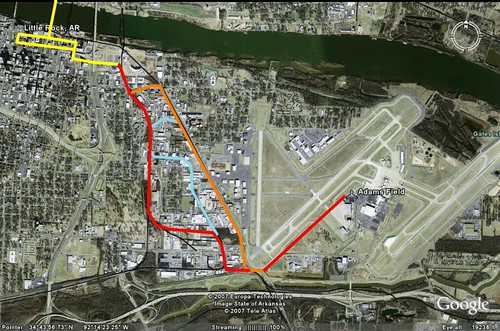
Little Rock has a streetcar system and is thinking of expanding to the airport. THV has the article. I was struck again by how cheap Little Rock can get it done. Their last expansion was only 7 million a mile and the article makes it seem that they could keep the cost that low again. I've created a map that shows the extension area below and it seems like they would use former railroad ROW. This would make the costs of the line more like railroad costs which is much cheaper.

Little-Rock-Airport-Expansi

North Little Rock Mayor Patrick Hays says that a planned extension to Heifer International's headquarters would leave only three or four miles to cover to reach the airport. Hays says extending the line to the airport would allow visitors to take the streetcar directly to downtown hotels. Central Arkansas officials are looking into the feasibility of the proposal and a consultant is helping explore the idea. Running the line to the airport would cost an estimated 20 million dollars. Federal grants would cover 80 percent of the cost.


And finally, a series of History Lessons about Sacramento's Streetcar system over at the Sacramento History Blog.

Part 1: Sacramento Streetcar Suburbs
Part 2: Central Street Railway
Part 3: PG&E and It's Predecessors
Part 4: East Sacramento and Elmhurst

Friday, September 7, 2007

Gimme-Gimmeism & Employment Sprawl

As I was reading accounts of the new Microsoft Bus service which is an obvious nod to the famous Google buses which grace one of the streets by my house every day, I was struck by a comment made to the Seattle Post Intelliger about the transit system:

This is something that the county bus system should be doing and they're not," said Stephen Gerritson, executive director for Commuter Challenge, a Seattle non-profit. "To some extent, Metro is dropping the ball here."
Really? Well I guess the question is what is a good corporate citizen? Obviously Microsoft chose to locate their campus in a sprawling area instead of in the city which has the most commuting options. To me it doesn't seem to be a problem of the county bus system but rather of businesses that decide to locate in unsustainable locals. I have this same problem with Dell in Austin or Chevron in the Bay Area. They located out into nowheresville for cheap land but what they really did is transfer transportation costs onto their employees, specifically employees who wanted a different lifestyle than the auto-oriented trash that we see today. Does anyone wonder why young professionals flock to certain cities like San Francisco, New York, or Seattle? I'll give you a hint, its not to live in Redmond Washington or San Ramon California so they can be closer to their work campus.

This same idea can be applied for people who live in sprawl. Cheaper house? Well pay more for transportation. A study by the Center for Housing Policy showed that for every dollar saved on moving further out, a 70 cent transportation increase was had. We don't seem to let those folks off the hook for their choices so why should we let Microsoft off the hook for theirs? While hard to do now because of their entrenchment in Redmond, what would really help is a move closer to the transportation spines of the region or the creation of a new dense city like center with light rail access to Seattle. People shouldn't blame the County bus for not wanting or being able to incur $2.4 million in operating costs to serve one company, specifically a company who chose an inaccessible area.

Thursday, September 6, 2007

The Limited Vision Line

Some folks in LA want the 720 Rapid bus line in LA to be dedicated to democrat Henry Waxman. In fact, the City Beat Sniper wants to call the 720 the Henry Waxman Limited Vision Line. The congressman representing places such as Hollywood and Malibu, banned tunneling using federal funding after a methane explosion in 1985 during construction of the first subway segments. Looking back, it was particularly short sighted to take off the table the best way to reduce congestion on the busiest corridor in Los Angeles. And as LAist points out, it would also have allowed LA to focus on other bottle necks now, instead of 20 years later. While I applaud Waxman for the repeal of the digging ban, the short sightedness from the past will come back to haunt riders on the 720 and the rest of the city. I imagine he's figured it out, but its a lesson for other elected officials and cities (yeah you Charlotte) who might be looking back 20 years from now wondering 'what if?'

Tuesday, September 4, 2007

The Numbers of Density

Want to calculate what density means? Try this tool created to show what the impact of living in sprawl really is compared to a more dense arrangement. It's a really interesting tool.