Ok I promise tomorrow we'll get back to transit talk that is real, but before that happens, I have to share some of yesterdays pranks in the transit blogosphere:
MTA Proposes to Stop Night Subway Service - Second Ave Sagas
Coordinated Planning - Intermodality
Humor Review - Xing Columbus
Grumpy Ryan - The Bellows
Toyota to build non hybrid Prius - Portland Transport
Any I missed?

Wednesday, April 2, 2008

Tuesday, April 1, 2008
Mary Peters to Transfer Highway Funding to Transit
In an unprecedented move yesterday, Secretary of Transportation Mary Peters went before the House Transportation and Infrastructure Committee and asked that all FY 2009 money be put towards transit expansion. "I'm not sure what we were thinking all these years." she stated before a shocked committee. "The auto is obsolete and transit is the way we must grow our transportation networks."
From the Oval Office President Bush said he approved of the move, hoping that states would appreciate the bold new approach his administration would take. "This funding would expand transit by 100 miles in every city in the United States, that means more jobs for our steel workers and more transportation options for everyone, allowing them to pocket 10% of their income a year instead of spending it on their car." Oh...and April Fools.
From the Oval Office President Bush said he approved of the move, hoping that states would appreciate the bold new approach his administration would take. "This funding would expand transit by 100 miles in every city in the United States, that means more jobs for our steel workers and more transportation options for everyone, allowing them to pocket 10% of their income a year instead of spending it on their car." Oh...and April Fools.
Sunday, March 30, 2008
Automobile Anachronists
Every time I read someone stating in a letter to the editor or on a message board that rail transit is a 19th century technology it makes me sick. We all know the first electric streetcar was run in 1888 in Richmond Virginia by Frank J Sprague. However this was behind the fuel injected automobile by 3 years. Karl Benz (Of Mercedes Benz fame) invented that in 1885.
While autos and street railways were around before these two inventions, these are the predecessors to the vehicles on both sides that we now know. So next time you hear this, please be sure to let that person know that the automobile is a 19th century technology as well. In fact, electric cars are 19th century technology yet no one has a problem trying to develop them now. In fact, the electric vehicle was the first to 65 mph just before 1900. In New York there were electric taxis before the turn of the century. Imagine that.
While autos and street railways were around before these two inventions, these are the predecessors to the vehicles on both sides that we now know. So next time you hear this, please be sure to let that person know that the automobile is a 19th century technology as well. In fact, electric cars are 19th century technology yet no one has a problem trying to develop them now. In fact, the electric vehicle was the first to 65 mph just before 1900. In New York there were electric taxis before the turn of the century. Imagine that.
The market for automobiles in the US was principally divided between electric and steam. In 1899 1575 electric vehicles, 1681 steam cars and 936 gasoline cars were sold. In February of that year the Electric Vehicle Company ordered 200 vehicles and the next month announced that it would introduce electric taxi-cabs on a massive scale. The industrial and technological network under-pinning the electric vehicle industry also seemed to be strong. The producers of electric vehicles had easy access to commercially obtainable components, since they used the same motors, controllers, switches, and batteries as the the streetcars, albeit in smaller size.
Friday, March 28, 2008
Streetcar Funding Source
Columbus has come up with a rather innovative funding initiative for their streetcar line. They are going to put a surcharge on event tickets. So whenever you go to a hockey game you'll pay a few extra dollars on your ticket. But it won't be for naught. If you have a ticket, you get a free ride on the transit line. Sounds like a great plan.
Here is the line map courtesy of Xing Columbus, the local transport blog.Coleman plans to send a proposal to the city council before the end of the year in which the city would add a 4 percent surcharge on tickets to most concerts and sporting events within six blocks of the streetcar route.
Another 4 percent surcharge would affect people parking in lots and garages along the line from Downtown to Ohio State University, and parking-meter rates in area would rise an average of 75 cents per hour.
“I'm so convinced this is the right thing,” Coleman told an audience of streetcar supporters last night at City Hall, referring both to the idea he first raised in 2006 and the new plan to pay for it.
Thursday, March 27, 2008
Fast Pass Art
I've collected a good amount of transit passes over the past few years and noticed that Muni had perhaps the most colorful. Well someone else noticed, actually a lot of people noticed and John Kuzich is creating art with them. Very cool. Check it out.
H/T Rescue Muni
H/T Rescue Muni
Obama on Congestion Pricing
Obama just keeps getting better and better.REPORTER: Later, in an exclusive interview with WNYC, Senator Obama said he supports congestion pricing.
OBAMA: I think Mayor Bloomberg's proposal for congestion pricing is a thoughtful and innovative approach to the problem.
REPORTER: Obama said congestion pricing should not replace federal funding of mass transit.
H/T Streetsblog
The Language of Transit
Who else thinks the word subsidy needs to be ejected from the lexicon of transit advocates and opponents? Dan at Permanent Campaigns writes a piece for MassTransitMag on Language which should start a larger discussion on framing the issues we care about.
We transit advocates have a problem: bad language. Listen to what we ask for:
Operating assistance
Formula funding
Guaranteed appropriations
Boring!
Right now we seem like we’re still on the welfare train, asking for government handouts without any compelling, exciting opportunities for the nation to embrace.
Wednesday, March 26, 2008
Our Low Gas Taxes
Stephen Rees has a post up from the Economist showing gas taxes around the world. On this list we're the lowest! Yay....or something...not. We don't pay the full price for the externalities of using oil. Not only that, we've developed in a way that forces our dependence on it.
Last week I filled up my tank and saw it was about $50. Not a big hit considering the next time I go back to the pump will be about a month and a half from now. Last year I figured out that I spent 4% of my income on transportation. The average American spends 17.5%. So imagine if every person had an option to reduce their transportation costs by 10% or more. For a family that makes $35,000 per year, thats $3,500 that could go to a new home, to education, to local businesses, or to better food. Otherwise that 10% goes to an oil company, which I must say paid my dads salary which kept a roof over my head and well fed, but also makes a lot of fat cats at the top rich, and can send money to folks that don't like us.
If we paid the true cost of gas and everyone could have access to transit like Fred, Adron, or Ben we'd be a lot better off as a country and investing more in our respective communities.
Last week I filled up my tank and saw it was about $50. Not a big hit considering the next time I go back to the pump will be about a month and a half from now. Last year I figured out that I spent 4% of my income on transportation. The average American spends 17.5%. So imagine if every person had an option to reduce their transportation costs by 10% or more. For a family that makes $35,000 per year, thats $3,500 that could go to a new home, to education, to local businesses, or to better food. Otherwise that 10% goes to an oil company, which I must say paid my dads salary which kept a roof over my head and well fed, but also makes a lot of fat cats at the top rich, and can send money to folks that don't like us.
If we paid the true cost of gas and everyone could have access to transit like Fred, Adron, or Ben we'd be a lot better off as a country and investing more in our respective communities.
Tuesday, March 25, 2008
Sprawl and Regeneration in Budapest
Sprawl is not limited to the United States. In fact my favorite transit city is under attack from all flanks. Budapest is feeling the horrors of eurosprawl and like everywhere else, it comes with a cost.
The main culprit? American style suburbs. Never would have guessed."We've exchanged [Victorian-era] London-type smog for Los Angles-type smog," laments Janos Zlinszky of the Regional Environmental Center for Central and Eastern Europe. "The nature of our environmental problems is shifting."
Across east-central Europe, a region once blighted by Communist-era pollution, economic development is bringing on a new set of environmental problems and, in some cases, bringing back old ones.
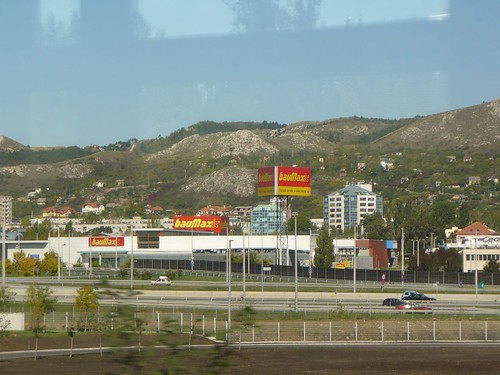
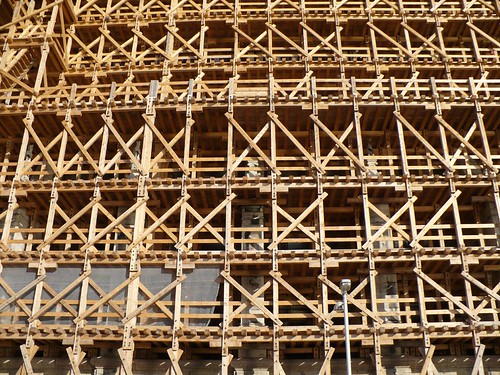
Budapest's worsening air pollution is due in large part to the advent of American-style suburban housing developments and shopping centers, according to Andras Lukacs, president of the Clean Air Action Group. "Several hundred thousand people have moved out of central Budapest and gone to these new so-called residential parks in what used to be green areas," he says. "Each day they come back to their jobs here, but because public transportation isn't so good out there, they take their cars."But public transit is awesome in the city. They are building two new subway lines in addition to the three they have already. During communism, the transit share was 80% but that system came with a heavy price including an underinvestment in all infrastructure. Many buildings are falling apart and have to have some really hefty scaffolding. Here is a photo I took of the big box sprawl. It was noticeable on the train so I took a shot. The photo below the sprawl is some building scaffolding that keeps building pieces from falling while they are repairing it.
Monday, March 24, 2008
AC on Density #2
I mentioned AC's post on Density earlier. In his most recent post, he calculates the weighted densities for 34 regions. I'm wondering how San Jose had such a high density. Perhaps for the same reason that Los Angeles' density is relatively high, due to natural boundaries hemming in exurban growth. Atlanta on the other hand is flat as a pancake and is the worst sprawl offender.
Subscribe to:
Posts (Atom)