Tuesday, April 29, 2008

Road Networks Grow Like Leaves

Very cool article posted by Christian Peralta at Planetizen. The article discusses how road networks grow organically like leaves with major arterials connected to smaller collector routes.

The researchers developed a simple mathematical model that can recreate the characteristic leaf-like patterns that develop, growing a road network from scratch as it would in reality.

The main influence on the simulated network as it grows is the need to efficiently connect new areas to the existing road network – a process they call "local optimisation". They say the road patterns in cities evolve thanks to similar local efforts, as people try to connect houses, businesses and other infrastructures to existing roads.


This is important for transit. The reason being that roads have evolved over hundreds of years often one street at a time. But we always get hammered when one transit line doesn't cure all of the region's ills. The reason being that we're providing core arterial service and depend on the smaller connections to be made by foot, bike, and car. In cities such as New York where the transit system starts to mimic the road network do we see how transit can help everyone with affordability, mobility, and energy independence. I wish folks would realize you have to start small, and grow to a network.

Transit Etiquette

In my daily catch of articles I came across a really cool new blog on transit etiquette. Today, TriMetiquette discussed feat on the seats. Grrr. Check em out.

Monday, April 28, 2008

Streetcar Scalability and Capacity

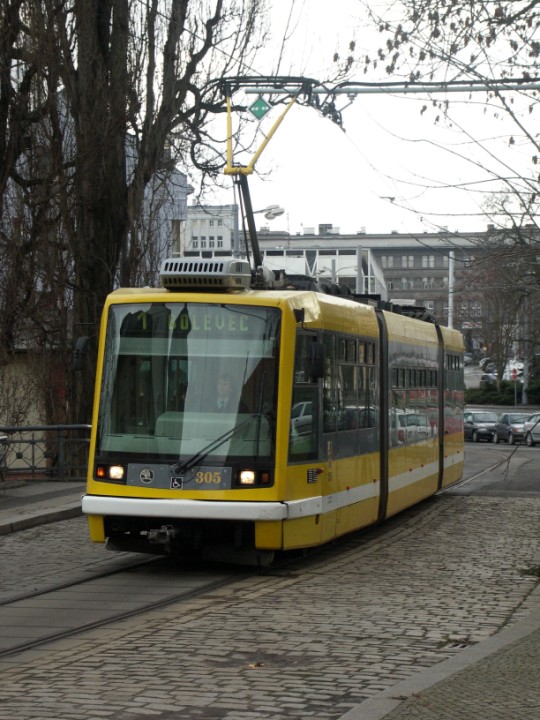
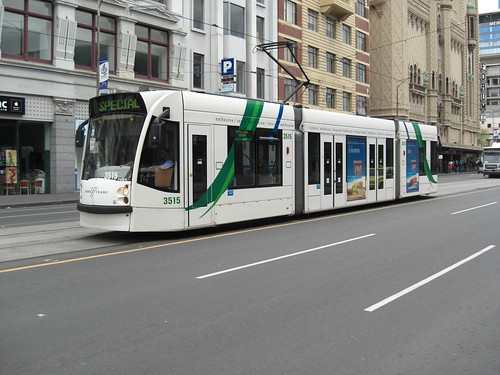
Over at M1ek's I posted a few photos of some Combino trams from different places around the world to show how you can scale the vehicles to fit within any environment. Depending on the capacity needs, there might only use for one streetcar. However, if there are higher passenger volumes, then there are two ways to accommodate this. Either by coupling cars or modular design. Coupling cars is possible, below is a photo of the Skoda T3 in Plzen Czech Republic, the same vehicle as the Portland Streetcar, with couplers.


Photos Courtesy of NYCSubway.org

The next option is the modular tram. Basically, you can build to specifications you want. According to the Siemens website, they c trams from 18 to 72 meters (60 feet to 236 feet) almost 4/5ths of a football field.

Sorry for the bad picture but I stole it from Tom Furmaniak's powerpoint on streetcar tech.

Real Examples below:

Combino - 3 Sections

Flickr Photo by: Johnzebedee

Combino Ultra - 5 Sections

Photo Courtesy of Gen Gibson

Combino Supra: 6 Sections

Flickr photo courtesy of Tschaut

This is the same for the other tram companies including Ansaldo Breda, Skoda, Kinky Sharyo, Bombardier, and Alstom's Citadis Tram.

Sunday, April 27, 2008

Transport Genocide and the Revenge Veto

I like competition but not when its at the expense of working people and pits cities in the United States against each other. This isn't a strategy, its a systematic genocide by the road warriors and privatization crowd at DOT. I know that we talk about the transit space race but its supposed to be a healthy competition rather than a death match. But it's what is happening around the country. The federal government, instead of figuring out how to build the transit projects that everyone wants, is pitting cities against each other for funding. Why doesn't this happen for roads? And why, if one entity with selfish interests in mind instead of the interests of the overall consensus in a region, is a project put in jeopardy?

But an official familiar with the federal transit funding process said, "This is a competitive process with projects around the country. The more everyone's singing off the same page, the more it moves it ahead of other projects"

The most recent example of this idiocy is the Central Corridor in the Twin Cities. Basically though, after the DFL party overrode a major transportation veto by Governor Pawlenty, he decided to veto the funding for the Central Corridor. No one has come out and said it, but its revenge. Nothing more and nothing less. He is certainly in the minority on this issue in the state and is being a good little Republican and hoping to get some street cred for opposing transit it seems like it could be in part for a chance at being John McCain's second hand man.

But this also opened up an opportunity for others to kill the project because they don't like the idea that it would slow auto oriented culture. Let's not put our heads in the sand, all of this is a fight against the status quo of all cars all the time. This line is going to give Washington Street incredible people capacity, but again its all about cars.
In 2001, the Board of Regents passed a resolution stating it wanted a tunnel under Washington Avenue. If not that, a route along the northern edge of campus, through Dinkytown. If not that, a ground-level route along Washington — but only if someone could figure out how to fix the resulting traffic nightmares and how to pay for those fixes.
Since the U didn't get its tunnel because of our favorite "Cost Effectiveness Measure" it started throwing a fit over the fact that the line was going to be on Washington Avenue. All along the way though, the University threw up road blocks:

The Met Council briefly looked at the Dinkytown route but discarded it out of concerns it would be too expensive. The tunnel was in. Then, the U decided to build a Gophers football stadium on the tunnel's route, forcing a rerouting of the already pricey tunnel and adding more than $100 million to its price tag. The tunnel was out; Washington Avenue at street level was in.

...

The full weight of the U's position wasn't widely understood April 7, when Gov. Tim Pawlenty vetoed $70 million in state funding for the Central Corridor, citing, among other things, concerns surrounding the route through the university.

Two days later, the U released preliminary findings of its consultant's report on the Dinkytown route. The findings suggested that route would be cheaper and faster than one along Washington Avenue. The preliminary findings do not yet project ridership levels or how that route would measure up to a complex federal funding formula.

The change will not kill ridership on the line, but will lower the cost effectiveness rating. Perhaps to the point where the line does not pass muster with the FTA. How many times does it have to be said that you can't go around a major center of activity. The measures for transit are bad, this all could have been avoided with the initial tunnel that the University wanted and everyone was willing to invest in. Instead, the line is in limbo all due to the fact that the process can't measure a line for its real benefits and the government does not see the importance of new rapid transit lines enough to fund more. Lets hope this changes soon.
Saturday, April 26, 2008

Why I Love Taking BART to My Gramma's House


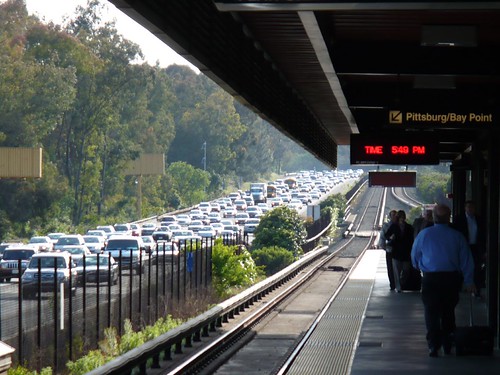
Here is a video I took with my digital camera on the way to my Gramma's last week. I had decided not to drive and call my Dad to pick me up because my folks were in town. Good thing I did!

P1010105

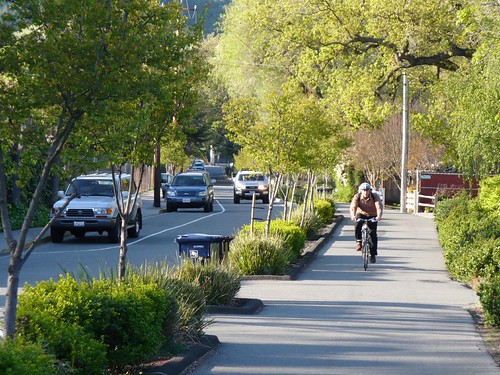
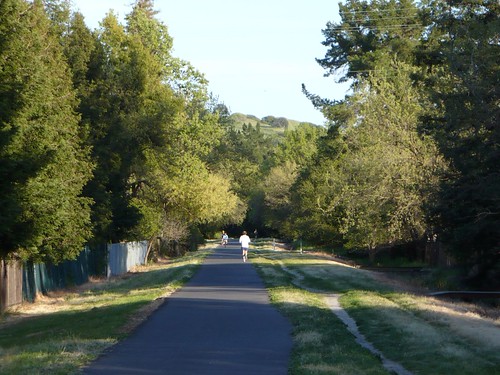
Sometimes however I walk the three miles instead of calling for a ride. And I always go up this street:

P1010101

And down this trail that was once a railroad right of way:

P1010102

Needless to say I actually do go over a river and through the woods to my Gramma's house.

Thursday, April 24, 2008

$8 Dollar a Gallon Gas

In Europe. They've known about how to deal with high gas taxes for a long time. Even so some are feeling the pinch, but most have alternatives. Here is an article from the San Francisco Chronicle discussing the issue:
"We are much better equipped than the U.S. to deal with higher prices and a more volatile market because we are so much less oil intensive than you are," said Noel, who bikes to work.

Europe generally has far better public transportation than the United States, with workers in countries like Britain, Belgium and France packing morning commuter trains and subways. Transportation planning increasingly factors in bike lanes, and more innovative mayors like those in Paris and London are designing schemes to facilitate alternative transport - and to make driving an ever more arduous option.

Wednesday, April 23, 2008

Do Things Like This Hurt or Help?

Ugh...while we've been working hard to get the word out on transit and I wrote in an earlier post that electric rail as we know was actually created after the auto as we know it, we still get folks like Jon Stewart who should be a great help doing stuff like this. I know he's trying to be funny, but does this really help the cause? Perhaps you can tell me if I'm being too persnickety. The section is 47 seconds in.


Hat tip to reader Joe C.

Tuesday, April 22, 2008

Overhead Wires, Pantographs, & Trolleypoles

Warning, rant approaching:

Ben Wear from the Austin American Statesman wrote an article on his blog today on the proposal for an Austin starter line by Roma design. In the article he muffed the overhead wire, not my blog, but the technology details.
Light rail, as opposed to the commuter rail opening late this year or early next year, is generally powered by electricity and has a system or overhead wires that connect to devices on the top of the cars called “catenaries.”
Sigh. The devices on the top of the vehicles can be two things, Pantograph or a Trolley Pole, just like my nom de plume. Interesting history point, the pantograph was actually invented by none other than the east bay Key System, now AC Transit, which had it's 50th tear down anniversary last week. The catenary is actually the support wire for the electric wire. From wikipedia:


To achieve good high speed current collection, it is necessary to keep the contact wire geometry within defined limits throughout the length of the overhead line. It is usually achieved by supporting the contact wire from above by means of a second wire, known variously as the messenger wire (US & Europe) or catenary (UK & Canada). This wire is allowed to follow the natural path of a wire strung between two points, which is known as a catenary curve, thus the use of catenary to describe this wire or sometimes the whole system. This wire is attached to the contact wire at regular intervals by vertical wires known as droppers or drop wires. In this way the contact wire is effectively supported at numerous points.

The messenger wire is supported regularly at structures, either by means of a pulley, link, or clamp. The whole system is then subjected to a mechanical tension. The messenger wire is usually pulled slightly to the left and right by successive supports, so that the contact wire slides from side to side(stagger) on the pantograph as the vehicle moves along (if it did not then it would tend to wear a groove in the pantograph's carbon insert). Such a system, with a single supporting wire, is known as simple equipment.
Sometimes we also call simple equipment a trolley wire which is much more aesthetically pleasing and should be used in downtown settings to minimize the visual pollution. I know this is a bit picky, but if you're going to continuously pick on the local transit agency on details, at least get yours straight.

Rant off.

Rail From the Dead

It's been a long time since the year 2000, but we're starting to see some deja vu and some longer range thinking. Here comes the rail plan revival train.

1. San Antonio. The Express News has an editorial discussing bringing light rail back to the polls.
A proposal, no matter how thoroughly defeated at the polls, is likely to resurface when the timing is right. Is the timing right for light rail in Bexar County? County Judge Nelson Wolff thinks it is.Announcing his goal to promote light rail during a recent event marking the start of ozone season, Wolff said the system would help the area meet tougher environmental standards imposed by the federal government, the Express-News reported. The new standards mean the region, which barely avoided costly sanctions for ground-level ozone pollution last year, may not be so lucky in 2010, when regulators compile their new list of "bad air" cities.In politics, there is no such thing as a dead issue.
2. Norman Oklahoma. They are trying to steal the Supersonics. Not Cool. That might give them an opportunity to build a rail line. Cool. Every story has two sides, this one just might end up in alternative transportation. Though the article says light rail, its highly doubtful thats what they mean when they say they will look at using existing tracks.
Collins, speaking to a Norman Chamber of Commerce legislative breakfast Friday, said he was able to raise the issue of light rail with the owners of the Seattle SuperSonics. He said they seemed interested in promoting rail using existing lines and stations.

Monday, April 21, 2008

Transport Electrification

There is a lot of talk here of passenger rail but little discussion of freight. I can't say that I know about the business that much but I wanted to share a few ideas that I had seen that look promising.
The first is a plan thought up by Bruce McFadden over at Docudharma. His idea is to create a backbone energy corridor along freight lines to transport stranded wind.

It should, I hope, be clear that much of the best resource is in areas that do not have the highest electricity consumption. And at the same time, that is a lot of the terrain that the transcontinental freight rail must traverse to get where its going. And, at the same time, we desperately need to get the main freight rail trunk lines electrified, by hook or by crook. Ergo, I got a grossly oversimplified policy proposal to present.

  • The Federal Government invests in publicly owned infrastructure to electrify the main railroad
  • In return, the owners of the right of way cede use of the right of way above the part that they need to public use, together with access to the ground level right of way for support structures
  • That right of way is used to establish long distance High Voltage DC trunk lines to bring sustainable energy from the places that have it to places the need it
  • In areas where there is a commercial wind resource, the usage rights above those trunk lines are available to be leased out for wind farm operators, with the lease payments rolled back into the funding for the program

Some answers to some challenges to the proposal, after the fold.

Another of interest is a plan to reduce energy consumption in 10 years through transport electrification, mostly by electrifying the freight lines by granting property tax waivers for railroads that electrify. It also includes more rail transit and trolleybuses. Alan Drake discusses that plan over at Light Rail Now! I'm not sure how feasible it is, but its an interesting idea to ponder.