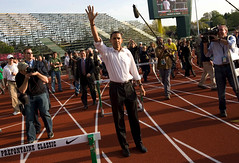
Update: On second thought, probably not a good idea. Translation here.


Oberstar, who chairs the influential House Transportation Committee, supports the Central Corridor project linking St. Paul and Minneapolis. The DFLer said a recently passed bill changes how the Federal Transit Administration evaluates transportation projects that are seeking federal money.Hopefully this means that cities start planning lines based on ridership, rather than saying, what can we build for this small amount of money.
Under the old system, Oberstar said the FTA focused on what's known as the cost-effectiveness index. The CEI is a complicated formula that looks at travel times, ridership and construction costs.
But Oberstar said the index means the agency essentially ignores other factors, such as environmental benefits and the potential for economic development. He pushed for the recent changes, which will require the FTA to also give comparable weight to five other criteria.
With most renewable sources such as wind, solar and hydroelectric, "gross energy" is essentially meaningless in this "Prius vs. Electric Transit" argument, except that efficient extraction of available energy keeps the price of the power obtained down. Taking O'Toole's reasoning to its logical extreme, if wind and solar only captures 10% of the available energy, or a hydroelectric project only captures 25% of the energy available, he'd still report absurdly high BTU's expended. Never mind that in these cases, nature still radiates this energy into Earth's environment--whether humans choose to tap into it or not.
The thing about Toronto, they never got rid of their streetcars. I wonder how much that has to do with their ability to keep transit numbers up. Now they are off on a light rail expansion to fill in some gaps.Atlanta is the poster child for sprawl, and as a result it has hardly any alternatives to cars: 89 percent of workers drive; less than 4 percent take public transit.
Boston is an older city, with an extensive transit system from the days when most people didn’t have cars. Even so, 79 percent of the labor force drives to work, but 11 percent do take public transit.
And then there’s Toronto. It’s still more auto-centered than not — but 22 percent of workers take public transit.
I've been ranting for a while now about the connection between land use patterns and energy consumption, but for a whle it seemed like shouting into the wind, especially as national politicians talked about how some magic pill like ethanol was going to solve all our problems. Lately, though, it seems like the connection between land use, public transit, energy consumption and national security is finally starting to gel in people's minds.I hope you're right.


The Twin City street car to bus conversion was ironically caused by a pro-street car management, a man named Strouse, I think he was. During gasoline rationing he saved up ten million dollars ($ 160 million at today's prices) to buy more PCC cars, re-lay more track, moderninze the rail system.
A shrewd vulture on Wall Street named Green saw all that money in the bank and solicited the stockholder votes to throw out the sfreet car management so Green could disburse all that money to stockholders including himself. His first attempt failed as the stockholder had pride in the company but inflation hit them (and everyone else) so Green prevailed on his second take over attempt. Strouse was fired and the money was paid out to stockholders leaving nothing for renewals.
Wall Street neophytes saw those big dividends and sent the stock price soaring. Green soid his. Buy low and sell high. Local politicians took Green's place, one named Fred Osanna(In the picture above), a political lawyer. He got a promise from General Motors to loan him all the money he needed to rid the city of street cars and they had National City Lines send him their Barney Larrick to manage the job.
Since there would be no more profits, Osanna and Larrick sold all of the copper wires, car baen property and salvage from scrapping cars to their wives or other relatives at a rock bottom price. Their relatives waited a few weeks then sold all the junk on the market for far more than they paid Twin City Rapid Transit for it. Roy Chalk did the same thing in Washington but was careful not to go to jail. Osanna and Larrick both went to jail, for defrauding the other stockholders.
"In the future, these areas will outperform the rest of the region. If the market goes up everywhere, these areas will increase by 10 to 20 per cent or more. If values in the GTA drop, these will drop by 10to 20 per cent less," forecasts Campbell.
Campbell said he doesn't own property in the area, but will be looking this week for multi-residential units as an investment.
Access to transportation is just one of many real estate criteria used to determine value, but it is becoming increasingly important as highways grow more congested and gas prices increase.