Friday, October 24, 2008

Euclid Corridor BRT Opens

The Euclid Corridor BRT opens this weekend in Cleveland making it the third true BRT line to launch in recent years (Orange Line and Eugene EMX). Expectations will be high, err low. Projected 2025 ridership stated in the Plain Dealer is 15,000. That's a far cry from the previous projections of 39,000 cited by the FTA. Given the amount of destinations and jobs on the line I doubt it will take long to get to 15,000.

They basically reconstructed the street and are running the same buses as the Eugene system. It's also another case of a project in the FTA process opening over 10 years after conception. I thought BRT was supposed to be cheaper and quicker to implement? Though if it started today, the project wouldn't even be funded under Ma Peters. It got a Medium Low in Cost-Effectiveness and cost $21 million per mile. I thought the reason for BRT projects was because they are more cost-effective. Basically what this proves is that the FTA doesn't want to spend money on projects that give transit its own ROW. No not painting lanes on the street, but a true separation from other traffic that makes it more effective. Today, its required to get a medium in CE as we've discussed before.
Those projects that do not currently have a rating of "medium" in cost-effectiveness would automatically be precluded from funding recommendation by the FTA, notwithstanding the merits of other criteria applicable to those projects.
This is part of the cutdown in projects that has been going on lately. It's recently dropped from 85 projects in the pipe before the 2005 "medium" enforcement to 2007. Not counting small starts, this year only has 31 projects in the New Starts report.
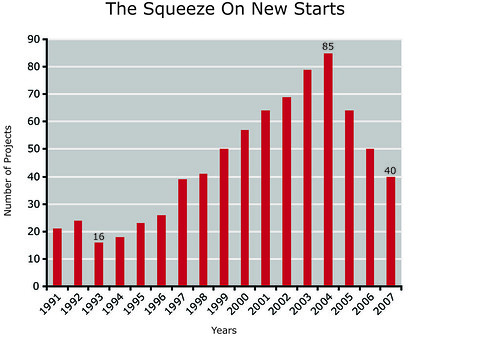
Lest you think that projects are rightly being cut, it should be noted that Denver's Southeast Corridor, Charlotte's South Corridor, the Los Angeles Orange Line, and the Minneapolis Hiawatha Line all had a Medium Low ratings. Those projects have all passed their projections yet would not have been funded under the current process. Anyone else tired of cost-effectiveness being used as a blunt object to bludgeon the alternatives that will truly get people into transit, including rail AND true BRT?

Let's see how this line goes. I still wish it would have been rail and electrified, but it's an improvement in the corridor, one that the FTA would not approve of these days.

Friday Night Linkage

Peter at SF Bike Blog points out the shameful state of bike lanes compared to other green cities.
~~~
To me, when McCain's economist says we should invest in infrastructure "wisely", especially after talking about Dulles, he really means that like Ma Peters, he thinks investing in bikes and transit is silly. He also uses the phrase "performance and accountability in our taxpayer dollars". If we continue to measure performance like they do, the New York Subway and Metro are worthless investments.

H/T Greater Greater Washington via Grist
~~~
Options are available for cutting down the cost of the Fastracks program, especially the sections to Boulder. I'm hoping that the stimulus package includes money for them to finish.
~~~
Senators are standing up to the transit cuts that would happen if AIG and others go back on thier deals with transit agencies.
~~~
Purple Line leaders formed a coalition to be more effective at getting federal funding, or as its known these days, beating your fellow Americans for the scraps.
State legislators from Montgomery and Prince George's counties announced the formation of the Purple Line Legislative Caucus Thursday in order to make a stronger case for federal funding of the proposed light rail or bus line.
~~~
Surprise Surprise!!! The Seattle Times columnist says vote No on Light Rail in Seattle. I hope it passes big time under the big blue wave.

100,000!

We just crashed the 100,000 visit mark on the blog. Thanks to everyone who has come by over the last two years.

Thursday, October 23, 2008

Support for Transit by the Brick Yard

71% of people in Indianapolis would pay to fund transit. Seems like a movement is growing. However, I personally don't like the idea of starting with suburban commuter rail. Given that urbanites will pay for most of the line to the suburbs, its just another example of exporting tax base.

Drinking Your Milkshake

Snotty legislators get theirs. Gotta play the clip.

The Liberal Light Rail Agenda

I really wish they would cut this out. So what if we want a different lifestyle?

Is the TTC Really Dead?

The Trans Texas Corridor is what keeps a lot of ranchers and landowners up at night worrying if their property is going to be cut into pieces by the largest land grab in state history. As of now, it might be dead. What a huge waste of space. It was supposed to be a quarter mile wide for trucks, pipelines, cars, and trains or so they said. I won't count my chickens until the smoke disappears but I hope it doesn't just die, but goes down in a fantastic fireball that takes slick Rick and his hair with it.
"I want to clear this up. I did not vote for the Trans-Texas Corridor and you're welcome to look at the voting records," he said in a broadcast by KXAN in Austin. Then Craddick, a Republican who was debating his Democratic opponent, Bill Dingus, in Midland, stuck a fork in the Trans-Texas Corridor and declared the ambitious plan done, according to KXAN. "Everybody in Austin knows it's dead," he said. "Everybody across the state knows it's dead. It's just something to be talking about."

When in Doubt...

make stuff up. Don't let those silly facts get in the way.

Wednesday, October 22, 2008

The Stakes of Stim

In track when teammates of mine used to get stim it was usually attaching wires to their muscles and turning a knob so that electricity would course through and loosen them up. Similar to the knob turn, folks in Congress are looking to pull the lever on a stimulus package to get things going. This idea isn't new. It was what got us through the great depression and built some of the most sturdy bridges, lodges, and infrastructure ever. These days when we build, it seems so cheap. We're always looking for shortcuts, but we shouldn't be doing that this time. We should be investing in our future, and hopefully it's a green one.
In Portland, city officials are already preparing lists of infrastructure projects they might launch with an infusion of federal money. It would be a nice silver lining for Portland if the economic crunch bought a refurbished bridge over the Willamette, or a streetcar extension.
This would be a big boon for cities that have projects ready to go. As I said in an earlier post, it will be a huge deal for cities like LA and Seattle to pass their transit measures. Salt Lake City, Denver, Portland, and Houston already have a lot of engineering done for their new lines and if infused with stim, they could push that money to other transit projects to extend thier networks furthering the gap between them and those which are falling further behind.

If for instance Seattle drops the ball, it will be harder for them to seek stim money for projects that were rejected on a ballot measure. Though it might be a boon for thier streetcar infrastructure, regional transit might suffer from a crisis in confidence where opponents claim the win and the upper hand in cash direction. With the stakes so high for federal funding opportunity, it's important that these measures pass, else an opportunity that happens once in a century to double up on much needed transit capital spending could be lost.

Tuesday, October 21, 2008

Mapping the Tube

From The Bellows. It's a 25 minute documentary from the BBC. If you have the time, take a look. Steve B, I thought you would enjoy this one.