Tuesday, September 22, 2009

Catenary and Trolleywire

Sorry if I left people hanging with the trolleywire vs. catenary article. Essentially, as Arcady explained in the comments of the last post, catenary suspension uses two or more wires to suspend the contact wire between poles. The term catenary comes from the curve created by the sagging of a wire or chain between two points. In overhead contact systems, the catenary curve is seen in the support wire while the contact wire is connected to it by suspenders.

Some versions can be pretty ugly such as New Jersey Transit's catenary:

Photo Courtesy HeritageTrolley.org

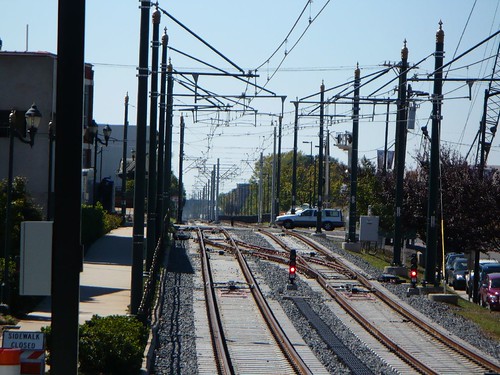
Here's a crossover in Charlotte and a long straight stretch.
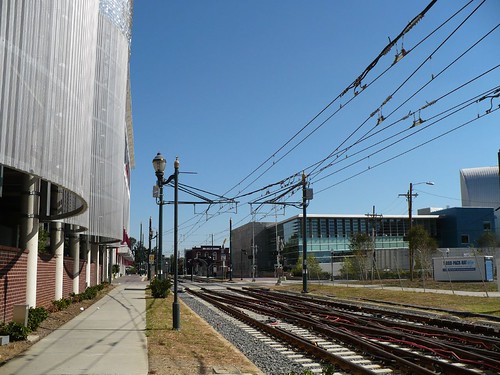
P1000942

P1000965

Unfortunately this is sometimes the ugly that people think about when they think about overhead wires. While it's music to my lungs, many other people don't feel the same way.

The catenary differs from a simple trolley wire suspension in that there are more wires as well as generally more visual obstruction. The catenary is used for higher speed lines because the tension created in the wire is great enough to keep the pantograph from bouncing up against the wire which can cause great damage. Ultimately trolleywire is perfectly good for streetcars in cities and I would generally believe that it's probably the first consideration of designers of modern streetcar systems.

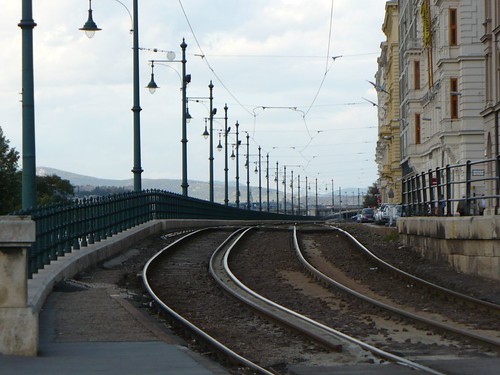
Below is a Combino Supra under trolley wire.
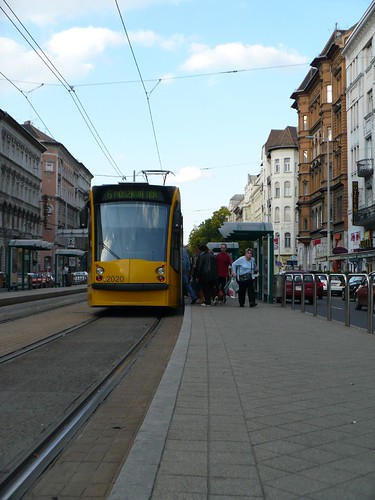
Budapest_CombinoSupra2

More Budapest

Budapest_ROW

Some fun images from 1924's Electric Railway Handbook

Monday, September 21, 2009

Why the Catenary Talk?

After overriding the Mayor's veto, URS is going to look at how to bring the streetcar to the city. One of the issues, how to power them, will be fun to consider. Though the question asked in the article seems wrong:
"Do you want to be one of the last streetcars with a catenary system, or the first with a new system - that's the dilemma," Nadolny said.
What streetcar actually needs catenary? Simple trolley wire will do. Some interurban lines could run up to 90mph on trolleywire. I don't see why we have to always over-engineer these things. If you want to ugly things up, go ahead and build catenary. Perhaps that is the goal since the idea of wireless streetcars is all the rage.

"We Don't Dwell"

Yay FTA Models. You totally rule at figuring out ridership in new light rail cities. You did a bang up job in Minneapolis (24K in 2020, current 26k), really got those Houston numbers right for 2020 (33k in 2020, current 38k), and Charlotte was right on target(9k opening, current 14k). Note: the APTA daily numbers are a bit wonky. I don't know if I completely trust them to the rider but they make the point.

Now we can add Phoenix to the list of FTA model lowballing:
The rail was projected to attract 26,000 riders per day, but the number is closer to 33,000, boosted in large part by weekend riders.
What kills me about all this lowballing, is what the cost effectiveness number was, and what it SHOULD have been. Ultimately that is what decides projects. And it's a little messed up that the FTA keeps getting it wrong, especially when they can kill a project because of a CE below Medium. Oh, and here's the money quote from the opponents:
Starlee Rhoades, the spokeswoman for the Goldwater Institute, a vocal critic of the rail’s expense. “I’ve taken it,” Ms. Rhoades said, slightly sheepishly. “It’s useful.” She and her colleagues still think the rail is oversubsidized, but in terms of predictions of failure, she said, “We don’t dwell.”
...
“We are also proponents of paying your own way, and we think the light rail remains too subsidized.”
That's right, you're in the New York Times saying the light rail is useful and full of people after you said no one would ride it. In fact, your institute is just like every other that goes around and spreads doom and gloom everywhere. And what is the fascination with subsidies? I guess I'll never get that end of the argument.

The Ads Begin

It seems silly that any city should have to vote on passenger rail when they don't have to vote for another city service such as improvements to water and streets. I'm not against voting for sales taxes or bond measures as we do these with city services all the time. What does bother me is having to ask permission for every little detail when the money is already assembled. When you start deferring every little decision to voters, you get California. And look at how well we're doing!

The only other city that has been made to vote on passenger rail even if it didn't include a bond measure or sales tax increase is Austin. Other cities including Denver and Houston decided to build the first line and found that it was a pretty good idea, so voters raised taxes on themselves to expand them. So Issue 9 begins in Cincinnati and here is the first ad in the fight against a ballot measure that would make the public vote on any amendment having to do with passenger rail, including commuter, streetcar, or even high speed rail.

Thursday, September 17, 2009

Non Highway Users Anonymous

They can will it to be a user fee all they want, but it isn't. As an example, during my time in Austin I drove quite a bit around town if I wasn't on the #1, 5, 7 buses. But for the most part I wasn't on the highways. A little Mopac here, a little 183 there, but maybe twice a month during school if that. TxDOT and the MPO get back federal flex funds which they can use for lots of things. But it's not usually paying directly for what you're using that gas on most, those local roads.

Now it does come back to transit etc, but you're not paying directly for what you're using. I do pay a user fee now when I go over the bay bridge to my Gramma's house. And for the most part that $4 charge keeps me taking BART, which is faster anyway to downtown Oakland. But these tea party cries of socialism fall on deaf ears when you know these same people LOVE the socialism of roads. They even love the community good of transit. So much so that when it doesn't work, they get angry that government isn't doing a job they didn't fund it enough to do. Oh the irony.

Wednesday, September 16, 2009

Midweek Notes

Arlington is the largest city in the United States without transit, but will run trains through the city for the Superbowl coming in 2011.
~~~
Vancouver does Granny Flats in high rises.
~~~
Seattle Mayoral candidate McGinn is floating ideas for another light rail election in two years. But by light rail does he mean rapid streetcar or light metro?
~~~
A dustup over trolley buses in Seattle. I'd be interested to see if the bean counters actually did a lifecycle analysis considering how long electric trolleybuses actually last. Anyone who takes away existing hydro powered transit and replaces it with diesel needs a head check. It's unfortunate that it is even being discussed at all.
~~~
The economy isn't being so kind to mixed use projects in Atlanta.

Tuesday, September 15, 2009

Tuesday Night Notes

Tram trains in are starting in England. It would be interesting to see if cities in the United States start looking at tram trains as a model.
~~~
Kemper Freeman really doesn't get the gold mine he could be standing on.
~~~
Apparently the Lehman collapse has slowed Caltrain's electrification. From house testimony:
Losses in our county alone, for example, include: $25 million in San Mateo County Transit Authority funds that will stall planned electrification of the Caltrain Peninsula Commuter Rail Service

Monday, September 14, 2009

Running Scared

The green movement is gaining influence and looking for 10% of the revenue for carbon credits. But this is scary to the highway movement as their influence and scare tactics wear thin.

According to Greg Cohen, president of the American Highway Users Alliance, the changing partisan guard in Washington has made highway groups wary of the focus on transit funds. “People are much more nervous about being on the chopping block,” he said. “It seems like the anti-highway crowd has much more influence than they had in the past.”

Anti highway? How about pro livable communities.

Depending on Obama's FTA

A lot of people are depending on Obama's FTA to change the rules to let them build streetcars and other projects. I'm hoping that he doesn't let them down by continuing to delay the transportation bill. In Charlotte, the city council overrode a veto by Mayor McCrory to spend money on a streetcar study hoping that the FTA would change cost effectiveness rules aimed at speed instead of placemaking and short extended walking connections.
But the council's Democratic majority said it was important to get the project started. They hope the federal government will change its rules to pay for streetcar construction, and they argued by spending the money now the city would be first in line.

Get Off My Grass Track

John McCain hates transit. We would be living in an extended Bush nightmare if he were President today. It shows because it seems as if he knows absolutely nothing about how the Federal Transit Administration does competitive grants. I would somewhat understand the pork argument if he was targeting projects randomly inserted such as a bridge to nowhere, but many of the target projects actually have full funding grant agreements with the FTA after going through the highly competitive New Starts program. Much of this money seems to be for the annual allotment the FTA pays out for projects that sign their FFGA.

I would also say that many highway projects that are being built today wouldn't make it through this process so to call them pork shows the lack of understanding. The Mayor of Stamford who has a BRT project in final design even goes as far as to say McCain doesn't get it.
The SUT project will also be a model of livability and sustainability, optimizing the use of the SITC and its 225 commuter trains and hundred of buses a day, supporting the development of LEED-certified and green buildings for 12,000 new residents and highly-paid workers, and reducing vehicle miles traveled by 18,900,000 per year.
True colors coming through every day. 18 million VMT is a lot less foreign oil.