Saturday, June 27, 2009

Saturday Sacramento Links

It was nice to see everyone at the NJudah shindig last night. I'm in Sacramento for a family reunion this weekend so posting might be light.

Looks like Phoenix is pausing its first extension due to funding issues.
~~~
I think people like Barbara Boxer still don't get the climate, transport, land use connection. I am glad that folks are talking gas tax, but there has to be a better way.
~~~
LA is building an Orange Line extension that connects the Chatsworth Metrolink station to the Warner Center, which is kind of like LA's Tyson's Corner. I think this is a great connection that obviously should be updated as soon as possible. With the Warner Center thinking about densifying, the connection to commuter rail is key.
~~~
I like this quote from Rep. John Mica:
"if you're on the Transportation Committee long enough, even if you're a fiscal conservative, which I consider myself to be, you quickly see the benefits of transportation investment. Simply, I became a mass transit fan because it's so much more cost effective than building a highway. Also, it's good for energy, it's good for the environment – and that's why I like it."
~~~
Some interesting information on traction motors in Europe. Kind of continues on our electrification theme of late.

Thursday, June 25, 2009

Horseshoes & Hand Grenades

"Officials laud transit center, buses as ‘close’ to light rail"

Why don't you try and sell it a little harder...

The bus lines are designed to imitate light rail systems used in other cities. Many parts of the route have dedicated bus-only lanes and the buses will stop at raised platform stations, where passengers will buy tickets before boarding. “We’ve had a lot of discussion in this valley about light rail. This is the closest thing we can bring for the cost of a bus,” Snow said. “It is really a train-on-tires concept. It’s designed around the light rail concept. It looks like it’s a train.”

Total references to superior transit to the bus they are building in the article: 9 I'm not going to say whether this corridor should or shouldn't have had light rail over BRT. But it seems to me that people might be disappointed when they don't get the train you're promising.

Let's See if Coburn is Still a.....

Seems as if Steny Hoyer is going to take up the mantle of getting WMATA some money. It's really sad that it continually has to be death that wakes people up .
On Wednesday, House Majority Leader Steny Hoyer said he plans to seek $3 billion for Metro transit capital improvements, some of which would likely be spent to replace some those old Series 1000 cars, purchased between 1974 and 1978.
But they've tried to help Metro before. Hopefully people like Coburn will stop being jerks. Anyone remember this gem?
Legislation that would mandate collision-avoidance systems for trains is being blocked by Republican Sen. Tom Coburn of Oklahoma, who objects to a provision that would provide a major funding boost for Amtrak that was bundled together with the safety measures this week.
...
Mr. Coburn also opposes a provision that would steer $1.5 billion to the Washington Metropolitan Area Transit Authority, saying passengers and local authorities should fund mass-transit operations in the nation's capital.

Wednesday, June 24, 2009

Bikes Over Cars

Bikes are overtaking cars as the most used transport mode in Amsterdam. Perhaps if streets in San Francisco were amenable to bikes we'd get a similar share.

Direct Result

A direct result of poor ridership estimation or purposeful underestimation for new lines is not enough capacity to supply service to the people that use the system. Minneapolis has decided to shut down parts of the Hiawatha line this weekend to lengthen the platforms for three car trains. This is going to happen on the South Corridor in Charlotte as well in time. It's unfortunate but this is something we're going to see in San Francisco on the Central Subway as well. Whoever thought cutting platform length to save money now instead of saving money later was a good idea was very very short sighted. These types of cost cutting decisions on the front end really need to stop.

Monday, June 22, 2009

Possible TOD Opportunity

Ah the fun begins. As we dig deeper into the bill, I'm sure we'll find tons of goodies like this:
‘‘(2) the development of corridors to support
25 new fixed guideway capital projects under sub-
1 sections (d) and (e), including protecting rights-of
2way through acquisition, construction of dedicated
3 bus and high occupancy vehicle lanes and park and
4 ride lots, and other nonvehicular capital improve
5 ments that the Secretary may determine would re
6 sult in increased public transportation usage in the
7 corridor.
Transit agencies have never really been able to buy up property for land banks other than parking spaces before. Perhaps this leaves an opening for TOD help from transit agencies? I'm also glad that it seems as if there is no language allowing new starts funding to pay for HOT lanes. That seemed to be a fetish of the last administration.

Categorical Exclusion

One of the provisions in the newly released transportation bill is a categorical exclusion on environmental impact statements for streetcar projects that operate in existing right of ways. Here is the language:
18 SEC. 3027. STREETCAR CATEGORICAL EXCLUSION.
19 Not later than one year after the date of enactment
20 of this Act, the Secretary shall complete a rulemaking
21 process regarding light rail streetcars that are—
22 (1) located within an existing right-of-way with
23 in the classes of action identified in regulation by
24 the Secretary; and
1 (2) that are categorically excluded from require2
ments for environmental assessments or environ3
mental impact statements pursuant to regulations
4 promulgated by the Council on Environmental Qual5
ity under part 1500 of title 40, Code of Federal
6 Regulations (as in effect on October 1, 2003).
I hate the look and unreadability of legal documents such as this, but I guess it has to be this way. I wonder when we'll start seeing a modified definition of streetcar in existing ROW. Does this mean we'll see more rapid streetcars?

H/T E-Lo

Electroexecution of the Milwaukee Road

Every once in a while I'll stop reading articles and pick up a book. Sometimes its a book I started but put down for reasons unremembered. Recently I opened up Internal Combustion again. I highly suggest the read, especially the chapters on the Milwaukee Road. It's fascinating to see how efficient and cost effective the Road was before you factored in the corruption and construction mischief.
An ICC investigation concluded that the total cost, more than quadruple the orginal estimate, could not be justified by any adequate engineering or traffic surveys that were made. On the contrary, everything indicates that the project was the result of rivalry between powerful groups. Competitor railroads immediately began snatching up land to sell to the Milwaukee at severely inflated levels or started calculated bidding wars to drive up the prices.
It's sad really that more lines hadn't been electrified and that the true sustainable value of this route was not emulated in places inside of the United States. Ultimately it was in Europe, and they enjoy the success they built after our lead with the MR.

But here are a few key passages on pg 188 that stood out in the book to me on how the Milwaukee died after its tough beginning.
JP Kiley was a Milwaukee vice president determined to eliminate all electric lines. The reasons, Kiley presumed, would be cost, technological obsolescence and lesser capability. This was the assumption.

Laurence Wylie was an electrical engineer devoted to clean, electric trains. Wylie was appointed by Kiley in 1948 to oversee to oversee the dismantling of all electric. Having worked with electric rail since 1919, Wylie balked. On his own volition, Wylie ordered comparative studies of electric trains versus diesel. His finding contradicted Kiley's theories. The old electric could outpull the new diesels and run cheaper, dollar for dollar. In fact, on one typical run to the West Coast, three diesels were shown to annually cost more than $104,000 extra. In mountainous terrain, diesels fared even worse. Newer electrics constructed by GE in the 1950's for the Soviet Union showed still better results. These powerful new GE electrics, nicknamed little Joes for Joeseph Stalin, were almost twice as economical and powerful as the GM diesels, especially on long runs.

For example, six Electro Motive Division F diesels were needed to haul 3,300 tons, and five electro motive division GP9s were required for about the same chore. But that same tonnage was easily pulled by just four old GE freight electrics. The electrics also beat the gas burning locomotives on flatter terrain. Kiley dismissed Wylie's findings and instead relied on his own engineering tests. in large measure provided by the Electro Motive Division. Whylie, who had worked his way up from a Montana trainmaster to a district superintendent, could not understand why the engineering reports did not jibe. In his campaign to replace electrics with GM diesels, Kiley was constantly butressed by GM's glowing engineering reports. Finally, Wylie realized the newest diesels were being compared not with the newest high speed electrics, but thirty year old electrics. Moreover, other data from General Motors Electro Motive Division was constantly being skewed in favor of Diesel.

Who was heading up GM's Electro Motive Divison efforts in the late 1940's? It was Dana Kettering, the son of Charles Kettering, and the same inventive genius who'd helped Gray and Davis Electrical Engineers develop the starter battery array that mysteriously undercut Thomas Edison's attempt to create an electric vehicle with Henry Ford. In that instance, the testing had also been challenged as disingenuous.
It's amazing what you can do when you don't have to carry around your own powerplant. It's also amazing how comparing apples and oranges continues to allow people to make decisions.
Sunday, June 21, 2009

Sunday Night Photo Dump: Salt Lake & SF Aerials

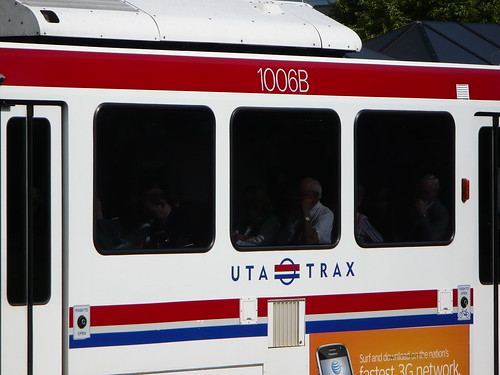
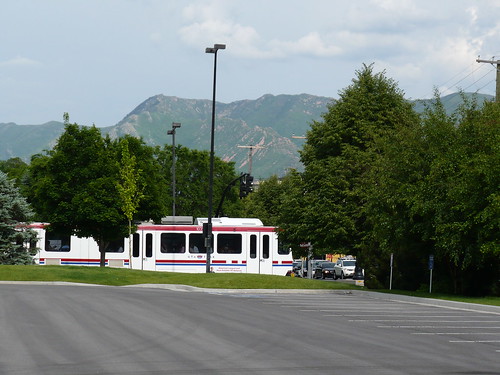
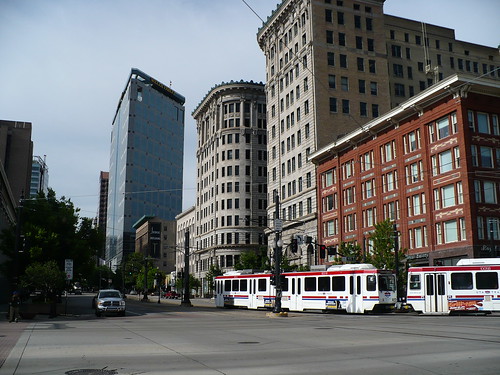
I forgot to post these after my Salt Lake Trip but there are a few good shots from the one station I got to hang around at that weekend. Unfortunately I didn't get to take a ride but I did get an all too familiar video of someone running after the train.


Also I'm not sure but these look like the trains that VTA sold to Salt Lake City.


Some more photos:

Thinker

Salt Lake City Trax

Great Mountains

Salt Lake City Trax

Downtown

Salt Lake City Trax

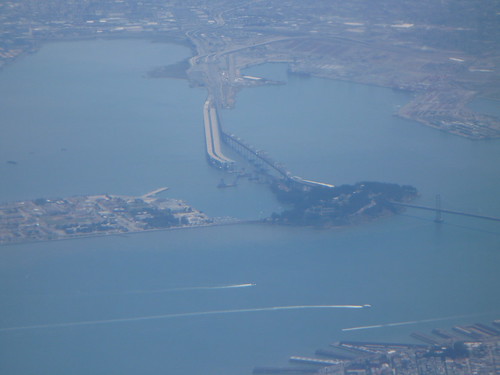
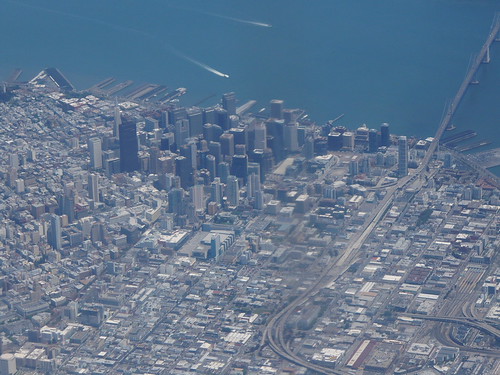
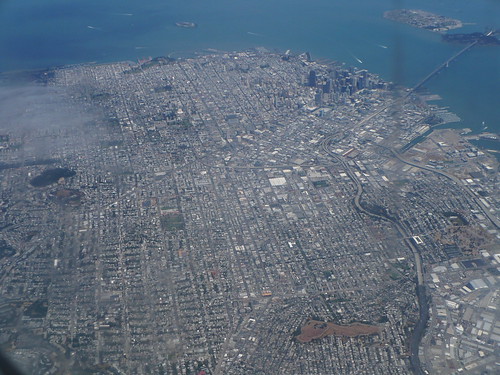
I also got a few San Francisco shots on the way home...I wish I could have opened the window.

New Bridge Span

More Aerials

Downtown

More Aerials

Third Street

More Aerials

Eastern Neighborhoods

More Aerials

Splitting the TOD Narrative

I wish there were more stories like this one that start to deconstruct the two narratives for TOD in this economy. The one where real TOD is holding its value better versus the construction of new TOD. I don't think you can compare the keeping of existing home values that are in true TOD versus the issues with constructing it.
As Jeffrey Otteau, a residential analyst, put it in a recent interview, “Nothing has been able to escape the economic and financial collapse we’ve seen over the last year — transit-oriented development included.”
It would be nice to see more of the following statistics in different cities.
“Nine of the top 10 housing markets in the state have rail stations,” Mr. Otteau pointed out in a recent report, adding that “the new tunnel just increases the appeal of downtown living.”
What I would like to see come out of this is more planning so that in the next boom cycle more development is transit oriented. We really need to start thinking about value and allowing people to save money instead of pushing them to spend it in certain sectors such as transportation. That is the whole premise of the green dividend which is one way we need to start thinking about sustainability, that of the pocketbook.