
Back in Port Arthur, track had kept Charles focused. It had given him something to do during football offseason, when cousins found trouble .Now I often defend athletics because I was an athlete who benefited from competing for a division one school. But there were times when I had to fight my guidance councilor to take harder classes. At times she would try to give me easy classes because of catering to the lowest common denominator in the program. People who just needed classes to stay eligible to play.
Charles says he was told that if he wanted to maintain his place as the Longhorns' starting running back, he'd have to abandon track and make football a year-round commitment.There were many guys who liked to run who were told they couldn't. I don't doubt that studying more tape helps. But Football isn't the center of the universe. If they are enrolled in school, let them take the classes they want. And if they want to play another sport that helps their football playing in the offseason why not let them?
“Downs-Thomson paradox, also referred to as the Pigou-Knight-Downs paradox, states that the equilibrium speed of car traffic on the road network is determined by the average door-to-door speed of equivalent journeys by (rail-based or otherwise segregated) public transport. It follows that increasing road capacity can actually make overall congestion on the road worse."Sounds like some sort of variation of induced demand.
Council Member Sheryl Cole sits with Leffingwell on the Transit Working Group; she had heard Allen say there he believed pressure to meet a November 2004 rail referendum deadline had shortchanged the design and engineering work on the Red Line. In Allen's assessment, inadequate early planning, design, and engineering work, combined with a failure to engage sufficient outside expertise, had led to an unrealistic budget and schedule.I wrote about the quick switch from LRT to Commuter Rail in my Master's report. Capital Metro had only been working on the Red Line plan for a few months before they made the decision to put it before voters in the summer. They had been talking about LRT up until January of 2004. Contacts at UT had mentioned that Capital Metro had stopped talking to them cold turkey to pursue this other plan. From my Masters report (Thesis)
According to John Rishling, Vice President for Campus Planning at the University of Texas, light rail planning continued until January of 2004 when talks with John Almond, the lead engineer for the rail project, all of the sudden stopped. Rishling stated that the Pickle Research Center in North Austin between the red line and the Union Pacific line is being planned as a residential campus for students of the University of Texas and transit was needed to connect it to the main campus. Maps in Rishling’s office suggest light rail be built down San Jacinto Street but even by August he had not heard anything from the transit agency except for what he read in the news...In March of 2004 Capital Metro announced their proposed system.From Doug Allen's account it seems as if they didn't have enough time to think this plan through before the election. More than likely they devised the plan for the Red Line in two months based on years of putting the alternatives against each other. In other words it smells of bad push politics from people like Mike Krusee, which we knew all along was spinning away from light rail and pushing for rail towards his district, not in Capital Metro's service area.
In October's meeting, Allen said the cost of the Red Line commuter rail system "probably could and should have" been $300 million (to build it out properly, with double tracking) to serve the transit ridership potential in that corridor – still a good price for a 32-mile system.I don't think this should be hard for everyone to understand. 38,000 riders for LRT in 2000 versus 2,000 riders for Commuter rail in 2004. It's not rocket science. The politics was messy and Capital Metro allowed themselves to get pushed into it. This didn't start with the current contractor, this started back before 2000 with Krusee who was head of the House Transportation Committee. Again from my Masters Report:
Representative Krusee proposed a starter red line replacing the 1998 consultant’s green line light rail in 2000. Consultants in 1998 believed that the green line was a better route for ridership production however it was turned down by the voters in 2000. It seemed that commuter rail was on Senator Krusee’s mind even before the 2000 election. In a 2000 Austin American Statesman article, he was quoted, “I wish they would be more open-minded to alternatives to light rail”.His fixation on that freight line led to a poorly planned line and here we are seeing the results in 2009. Thanks Mike, glad you had your revelations after you lost your power to do anything about it.


But most Denton County cities, including Lake Dallas, rejected membership and the sales tax requirement. When DCTA offered those cities a second chance at membership in 2006, only Shady Shores and Corinth talked seriously about buying in.~~~
McCrory is credited with pushing through a transportation plan that, with the help of a $200 million federal grant for light rail, revitalized blighted Charlotte neighborhoods. On Friday, he visited with about 200 advocates of returning electric trolleys to the Fort Worth streets.
Now that light rail is on the ground in Charlotte, he said, "our bus ridership is not just people who have to have it but people who want to ride it. Bus ridership is all races and classes. The bus system is unbelievable now."
What happened in Charlotte was not only the construction of light rail and the planning for a rapid transit network, but most of the half cent sales tax went into improving bus service. This is what the referendum focused on back in 2007. If passed, it would have severely hampered the bus system as well as the LRT expansion. But as a reward for the investment, Charlotte has had substantial gains in ridership directly related to the upgraded network and improved service.
SEC. 173. Hereafter, for interstate multi-modal projects which are in Interstate highway corridors, the Secretary shall base the rating under section 5309(d) of title 49, United States Code, of the non-New Starts share of the public transportation element of the project on the percentage of non-New Starts funds in the unified finance plan for the multi-modal project: Provided, That the Secretary shall base the accounting of local matching funds on the total amount of all local funds incorporated in the unified finance plan for the multi-modal project for the purposes of funding under chapter 53 of title 49, United States Code and title 23, United States Code: Provided further, That the Secretary shall evaluate the justification for the project under section 5309(d) of title 49, United States Code, including cost effectiveness, on the public transportation costs and public transportation benefits.But the reason why the amendment had to be created is because federal funding has lots of strings and these matches are quite tricky. And while many cities would like to skip the new starts process initially by building the first line themselves, the NEPA rules are not structured to allow this. Several different cities have tried successfully and unsuccessfully to do something similar with their match process however the key sticking point is always the NEPA process and following the environmental rules.
Imagine if a transit agency acted like (and had the political and financial resources to do so) ODOT or WDOT. There would be "bus levels of service", ranging from A to F or so, allocated as follows:Similarly, Jarrett made a comment about how if all your favorite restaurants were empty, you'd likely not have a restaurant to eat at anymore. The ensuing comments are likely to be of interest.Level A: Everyone can sit where they want.
Level B: Passengers have to occasionally say "excuse me" as they walk past other (seated) passengers while boarding or disembarking.
Level C: Someone has to sit next to a stranger, without an intervening empty seat.
Level D: Passengers have to look real hard to find the few empty seats that are remaining; the aisle may occasionally be blocked.
Level E: The bus is SRO.
Level F: The bus is crushloaded.Any level of service below C would be considered an unacceptable level of service, and would cause planners to add additional buses to the route. But since this is the DOT thinking, they would be adding buses ALL THROUGHOUT THE DAY, not just during the AM and PM rush.
It says a lot, I think, that transit agencies are frequently encouraged to increase usage of existing services (i.e. add congestion), but DOTs are permitted to try and build their way out of it.
"Clustering bars near public transit, they agree, could reel in visitors, reduce drunken driving and send a signal that Utah's capital doesn't shut down after dark. "
"I don't think it's done any great favors to transit down here," said Salt Lake City resident Stephen Pace, who led the anti-rail group Utahns for Responsible Public Spending. He said UTA should have focused instead on buses that have the same right-of-way preference over cars as trains, but are more flexible and require a less massive investment.This is the ugly side of the mode wars where people who fight it don't think ANY money should be spent on transit, even if they say in public we should. It's not a nod to smart planning ideas but rather what is cheaper. It shows because these attacks come amongst vigorous transit expansion in all modes. It's also interesting that opponents are starting to attack the conservative credibility of UTA's leaders. A lot of the anti-tax folks are coming out to argue against any spending via taxes.
Pace rails against the "so-called" elected officials who champion fiscally conservative values but are "just as deep in the federal trough as anybody else" to fund TRAX extensions into their communities.It makes me wonder, what is fiscally conservative anyway in terms of development and infrastructure expansion? Is it doing nothing?
How ironic that Republicans, one of whom I first supported over 20 years ago, and one who pledged never to impose new taxes when he came seeking my assistance in running his first campaign several years ago, would be the leading proponents of a new tax that could siphon as much as $300 million per year from the residents of Hillsborough County.What's even better is that the author of the Tampa article also believes that people have a choice whether to spend money on gasoline or not, even when they construction of the communities they live in are based on the automobile alone.
Sharpe writes that the proposed tax increase of $85 per person is "... less than the three-week price rise in the cost of gasoline." Perhaps. But the option of paying for gas is ours and not an imposed burden by our government.Funny that imposed burden.
Another approach is to finance new projects several notches smaller in cost and boldness — and in contribution to economic growth. Denver and Salt Lake City, for example, are extending light rail and bus lines into the outlying suburbs, at a cost of less than $5 billion apiece.The Federal Government is a limited partner in these investments. For example while the Feds pay 90% of freeway expansion, more recent experience for these transit projects shows there is only a 50% match, and in more recent new starts reports that has been sliding down. Denver for example is asking for less than 40%.
Huntersville Mayor Jill Swain said the N.C. Department of Transportation, "from the top down, recognizes that north Mecklenburg's roads are overwhelmed, and Barry Moose's comment shows we need to move the traffic through our area faster."More sprawl subsidy on the way!
The trends concept is basically a recipe for continued sprawl: It leaves regional development patterns up to current policies and market trends. It assumes that all $2.4 billion worth of projects in the current investment pipeline get built.Market trends? Since when was sprawl market based? I always assumed it was fueled by a big fat subsidy to home owners through unequal housing subsidies and road subsidies. I must be wrong since the frame is that it's actually the market pushing that direction. The biggest challenge for advocates as shown by this paragraph is reframing the debate. We need to jump on it and own it. We should be the fiscally responsible ones, the ones who care about whether locals get to keep their hard earned money. It's also because shifting demographic and market trends are swinging away from what they used to be.
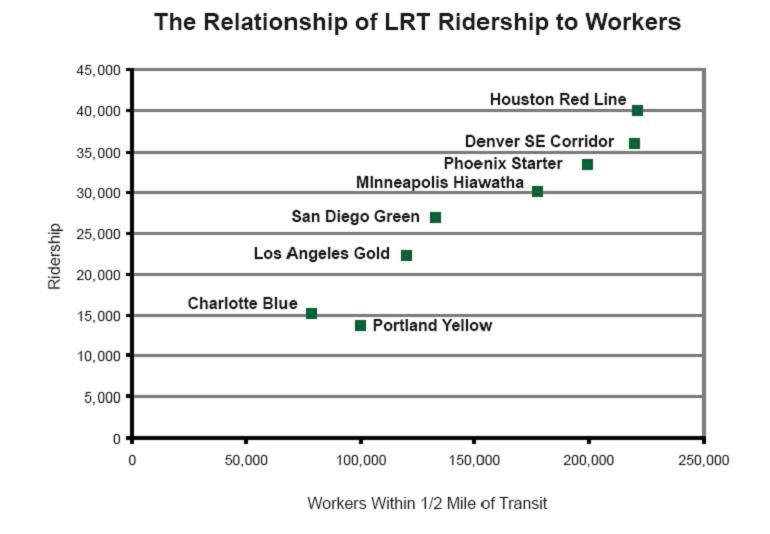 So with all this evidence why would anyone ever think about running a line outside of an employment district instead of right through it to capture more riders? The goal should be to boost and improve accessibility for workers, who make up 60% of transit ridership, not make it harder for them to use transit.
However, many of the proposed solutions encroach upon our freedom of mobility and our right to live where we want. Smart growth land-use strategies are simply ways to encourage living in high-density areas offering mass transit, which counters the preferred lifestyles of most Americans. Instead of changing the transportation systems to modify our behavior, we should improve our transportation systems to match people’s behaviors and preferences.Personal freedom is a defining characteristic of the American way of life...This gem is from the head of the highway users alliance:
If so, I assume you would reject policies that would limit the choice of new homes that can be zoned and built, force people to pay to park in front of their home, add high tolls to their car trips, require paid parking at suburban shopping centers, divert their taxes, and involve the federal government in local land use planning, right? Afterall, these unfortunate souls do not need to be punished for living how they were forced to live, right?I just fell of the couch laughing. Man those users sure do pay for the system! We can let people live however they want as long as its with cars! This is amazing yet not surprising. This is what we are fighting against.
We are in total agreement in fact -- Americans should be free to live where the want to live, work where they want to work, and shop where they want to shop. And as they choose freely without armtwisting from the federal government, we should provide the transportation system that is finanically, politically, and environmentally sustainable to support that free choice. We could start our plan with the one mode of transportation that could theoretically support itself with a reasonably set gas tax paid by its users.
“What we’re saying to them is we’re one of the few cities coming in with our own money,” Villaraigosa said in an interview yesterday. “You figure it out.”Perhaps he has those other cities in mind. Cities are living up to their end of the deal and more. With the feds giving out money, many have struggled to criticize, feeling like they might get the spigot cut off. Well right now there isn't a spigot at all, so its probably time to start railing on the folks in Washington to get moving already. Apparently Peter DeFazio has already started. Get rid of the clowns that are advising Obama or at least shut Summers up and get some infrastructure spending going. LA is putting up their end, Denver is putting up their end. Metro Regions keep getting the shaft, give them a hand and create some jobs already!
Kopper, who filed one of the lawsuits, said despite the court ruling, he believes the city hasn't adequately reviewed potential consequences of the added traffic. "The public and decision makers really do not know how much impact this project is going to have on the traffic before voting for it," he said.But why should it? This project is going to put 12,000 housing units and 25,000 people right at the terminal of the eventual CAHSR line and on the doorstep of downtown. If anything, this project is going to slash VMT and environmental impacts that would have resulted in those 12,000 units being situated elsewhere in the region. In theory its the perfect example of the trip not taken. I'm worried about the foot traffic.

"The biggest misconception about transit is it's the reason development happens," said Russ, a planner in an American company, Glatting Jackson, who has designed rail lines in Charlotte, Pittsburgh and Orlando and stations in Denver.Much development we've seen with recent light rail lines has been from the ability to expand the sphere of a market like downtown, but not change it. The line also has the power to shape an existing market. This is what the Portland Streetcar did when it pushed most of the development in downtown for the last decade along its corridor. I also believe that the streetcar allowed the market in Portland to feed on itself creating a synergy that wasn't possible without it or regulations that shaped growth around it.
But even if a formal state plan doesn't emerge, Vision California could affect state policy. The impetus to reduce carbon emissions is one example: State agencies eventually could draw on the studies to require local governments to allow additional high-density development near bus and train stops. "Once we build the base cases, we have a tool where we can spin the dials," Calthorpe said. "Let's just get the information together. That's a giant step forward in itself."
Over the past 50 years, Krusee argued, the federal government was using tax money that came by and large from cities to subsidize roads to areas without access otherwise. "City dwellers have subsidized the land purchases and the development costs out in the suburbs," said Krusee. What's more, the gas tax, which city dwellers pay when driving on city roads, but which goes to freeways largely outside of urban cores, is "a huge transfer of wealth from the cities to the suburbs to build these rings."This admission is important, and it points the way towards sustainability for the whole urban economic system. Once we realize that we can't keep expanding roads(or sewer, electrical systems which have similar costs to the roads in terms of return according to Scott Bernstein) further and further out, and that the goals of the interstate system have been co-opted by suburban development forces for fiscally and environmentally unsustainable practices, the more of an effect we'll have on changing every citizens fortunes, not just those who build sprawl.
Hagan rode to her new Charlotte office – a symbolic short hop – on the Lynx light rail line, a reminder that earlier this year, she secured $24 million for the Charlotte Area Transit System~~~
Instead of demanding the construction of a second BART tube for $10 billion, perhaps we should be asking why everybody and their grandmother absolutely, positively has to work in downtown San Francisco to begin with.I'm pretty sure San Francisco's CBD only has a certain small share of the region's overall jobs, perhaps 10-15% at most. I'm guessing here but for the most part this is the case in most of the country. But the reality is that since the jobs are clustered so tightly, they demand usage of alternative transport. They also are places of agglomeration and its not an issue of the execs getting a corner office but where face to face meetings and deals happen at lunch. (This is a whole other topic but I don't believe E-working is every going to replace working in an office with other people) There is a reason why the first BART system was built, because leaders of the area wanted to be the Banking Center of the West Coast and needed that critical mass of density and prestige to achieve it.
"The biggest problem presented in the report is the fact that cities are being planned especially for cars and for adults,"~~~
I used to make a big grocery shopping trip just about every Saturday, driving several miles to a store and throwing half a dozen shopping bags into the trunk. Now I can walk to a supermarket three blocks away~~~
There is a terrible chicken-and-egg problem to transportation planning, in which planners express regret that there is so little transit demand and so much traffic before building new roads. They have to accommodate the demand they've got! But you can't have transit demand if you don't have transit, and if you don't recognize that, then you're doomed to keep building roads forever. No one in the mind of the planners has yet invented a substitute for the automobile.~~~
He said one great problem facing cities was historic under-investment in public transport, which meant services were under heavy strain or, on city fringes, non-existent. Better planning was needed to ensure communities were not separated from jobs and services. "Isolated communities breed social exclusion and entrenched disadvantage," Mr **** said. 'Increasing density in cities is part of the solution to urban growth, alongside greenfield development." He said the development had to happen with regard to climate change, with carbon emissions reduced through better design and greater consideration of water use.Why Australia's Prime Minister Kevin Rudd. The willingness to punish for past and possible future transgressions was not unnoticed either.
Kevin Rudd wants to seize greater control of urban planning by denying infrastructure funding to states and councils that won't agree to improve public transport and ban haphazard housing development.If only didn't spend more money on cars than transit here in the United States and had rules with teeth. But in the current system everyone has to get theirs whether they deserve it or not.
The Obama administration may funnel more federal aid directly to cities and bypass states, Valerie Jarrett, a senior adviser to the president, said during a Chicago appearance with her former boss, Mayor Richard M. Daley.I'll believe it when I see it happen.
 Jim Davis, Garfield via Photobucket
The project, known as the Abu Dhabi Light Rail Transit/Tram study involves 340 kilometers of tram lines and is one of several major transportation projects that make up the Surface Transport Master Plan. The department expects the LRT to start operating in 2014.What I'm wondering about with these tram plans in middle eastern cities is are they connected to urban development plans that focus on walkability? It seems that a common complaint about the system in Dubai is that buildings aren't really in sync with how the transit operates. But that is likely a building design issue with urbanism in the area around the line. I say this mostly because it looks like there is a good grid pattern in the city.

The area is being dubbed “the Innovation Corridor,” says James Lockwood, a spokesman in Mayor Chris Coleman’s office. “Since all the utilities have to get in there to move lines because of the installation of light rail, they saw this as a great opportunity to figure out what to do to create smart grid technology to improve energy efficiency for businesses and homes,” he says.I just hope they aren't asking for free cable...
In Union City, the State raid threatens to delay the 100-acre BART Station District redevelopment project. The project, a collaboration between the Union City Redevelopment Agency, other local transit agencies and the state and federal governments, includes remodeling the BART station to create a two-sided station with additional parking; nearby new housing; new offices; and retail space. This transit-oriented development has been in the works for 10 years.Here's a solution. Fix prop 13! Fix the budget process and hold a constitutional convention. Cut out the shell games because everyone is tired of you not bringing enough lunch money and bumming off of them.

